Gemini 4 Neon vs Claude Opus 5.5: Which Is Best for SMEs and Businesses?

Tram Ta
November 25, 2026
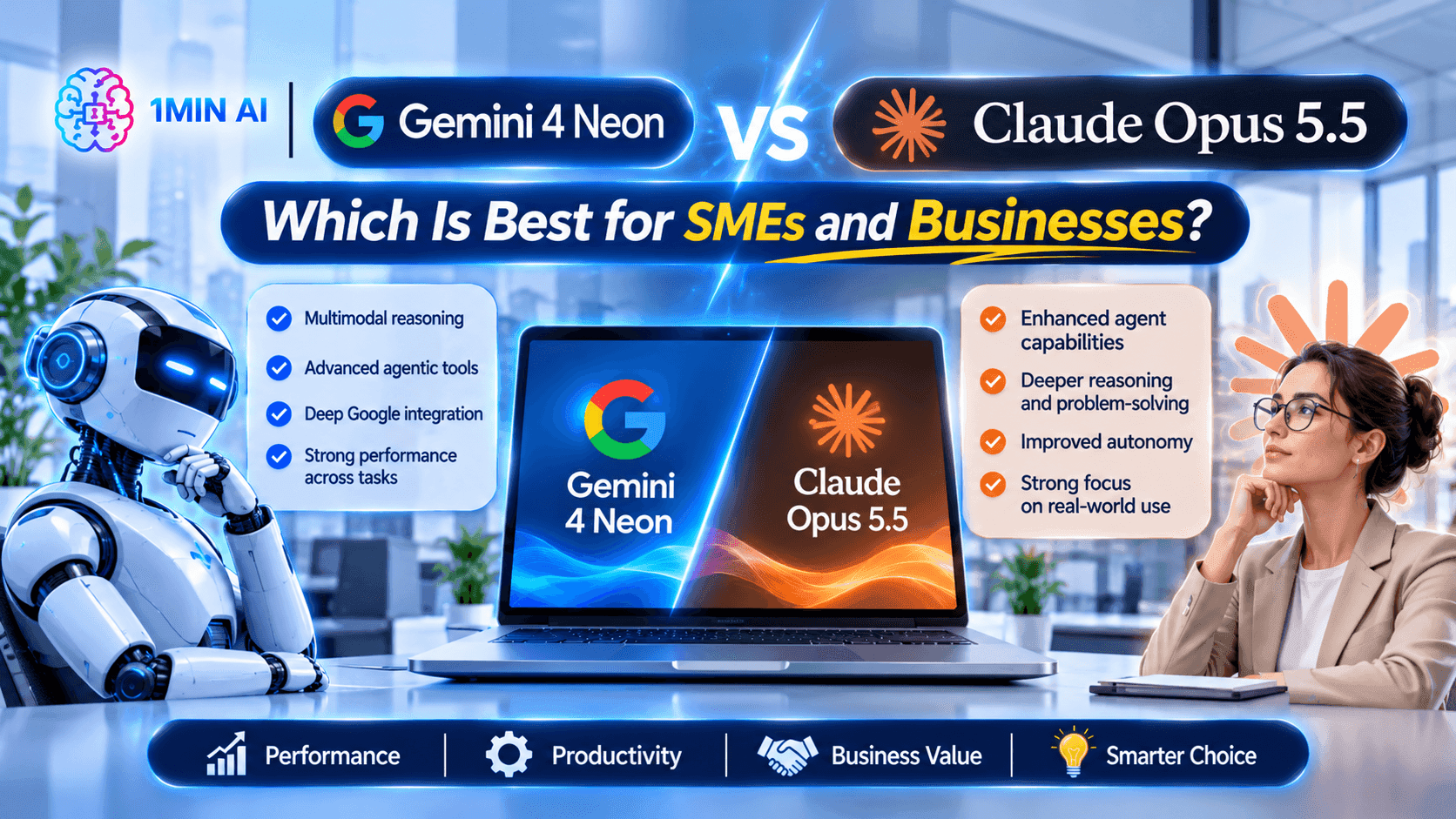
Compare Gemini 4 Neon vs Claude Opus 5.5 for SMEs. Explore benchmarks, pricing, coding, research, and business use cases, then test both on 1minAI.
Two models attracting attention are Google's Gemini 4 Neon and Anthropic's Claude Opus 5.5. Both offer advanced reasoning, large context windows, and capabilities for demanding professional workflows. However, they approach performance, speed, and cost differently.
Gemini 4 Neon is positioned as a balanced model for complex coding, analysis, and enterprise workflows, while Claude Opus 5.5 focuses on long-running agentic coding and knowledge work.
So, which one should an SME choose?
The answer depends on your workload, budget, and business priorities. In this guide, we'll compare Gemini 4 Neon vs Claude Opus 5.5, examine their practical strengths, and explain how you can test both models through 1minAI before deciding which fits your business.
What Is Gemini 4 Neon?
Gemini 4 Neon is Google's Gemini 4 model designed to balance advanced intelligence, speed, and operating efficiency.
Released on November 18, 2026, Neon is positioned between Google's lighter Gemini models and its more demanding frontier options. It targets complex coding, analytical reasoning, and production-grade business workflows.
For SMEs, this positioning is important. Not every task requires the most expensive or computationally intensive AI model. Many businesses need a model that can handle demanding work while remaining practical for regular use.
Key Features of Gemini 4 Neon
1. Advanced reasoning
Gemini 4 Neon can help businesses work through complex questions, compare options, analyze information, and develop structured recommendations.
Potential applications include:
- Evaluating new business opportunities.
- Reviewing financial and operational information.
- Planning marketing campaigns.
- Analyzing customer feedback.
- Investigating technical problems.
2. Long-context understanding
Gemini 4 Neon supports a context window of up to 1 million tokens.
This is useful when a business needs to work with extensive documents, reports, technical files, or multiple sources of information within one task.
For example, an SME owner could provide a collection of product specifications, customer feedback, and market research materials to prepare a structured product strategy.
3. Multimodal input
Gemini 4 Neon supports text, image, speech, and video inputs.
This creates opportunities for businesses that work with more than written documents. Teams can use multimodal AI to examine visual materials, understand recorded information, and extract insights from different content formats.
4. Adjustable thinking levels
Gemini 4 Neon provides different thinking levels, including low, medium, high, and extra-high.
This allows users to adjust the reasoning effort depending on the task. A simple request may not need the same depth of reasoning as a complex financial analysis or software investigation.
Gemini 4 Neon Specifications
| Specification | Gemini 4 Neon |
|---|---|
| Developer | Google DeepMind |
| Release date | November 18, 2026 |
| Context window | 1 million tokens |
| Thinking levels | Low, medium, high, extra-high |
| Input modalities | Text, image, speech, video |
| Output modality | Text |
| API input price | $3 per million tokens |
| API output price | $15 per million tokens |
| Main focus | Coding, reasoning, research, and business workflows |
For SMEs looking for a capable model that can handle a range of professional tasks, Gemini 4 Neon is an interesting option.
You can also explore Gemini 4 Neon on 1minAI to learn more about its features and try it with available credits.
What Is Claude Opus 5.5?
Claude Opus 5.5 is Anthropic's advanced AI model, released on September 22, 2026.
It is designed for long-running agentic coding, complex knowledge work, software engineering, and tasks that require detailed reasoning.
For SMEs, Claude Opus 5.5 can be useful when work involves understanding extensive information, improving technical projects, preparing professional documents, or reviewing complicated business decisions.
Key Features of Claude Opus 5.5
1. Complex coding and software engineering
Claude Opus 5.5 is designed to handle demanding software development tasks.
Developers can use it to:
- Review large codebases.
- Identify and fix software inefficiencies.
- Refactor existing applications.
- Investigate technical errors.
- Support multi-step development projects.
This can be especially useful for small businesses with limited engineering resources.
2. Long-running knowledge work
Claude Opus 5.5 supports a context window of up to 1 million tokens.
This allows it to work with extensive documents, research materials, and technical information in a single context.
For example, a business consultant could use it to review a large collection of reports and prepare an executive summary with recommendations.
3. Professional communication
Anthropic emphasizes clearer communication and more natural writing in Opus 5.5.
This is valuable for businesses that regularly prepare proposals, reports, internal documentation, customer communications, and other professional materials.
4. Adaptive thinking
Claude Opus 5.5 uses adaptive thinking, allowing it to allocate reasoning effort to more demanding tasks.
Instead of treating every request as equally complex, it can spend more effort where deeper analysis is useful.
Claude Opus 5.5 Specifications
| Specification | Claude Opus 5.5 |
|---|---|
| Developer | Anthropic |
| Release date | September 22, 2026 |
| Context window | 1 million tokens |
| Maximum output | 128K tokens |
| Thinking | Adaptive thinking |
| Input modalities | Text and image |
| Output modality | Text |
| API input price | $4 per million tokens |
| API output price | $20 per million tokens |
| Main focus | Agentic coding and knowledge work |
For businesses that prioritize complex coding, detailed analysis, and polished professional communication, Claude Opus 5.5 deserves consideration.
You can try Claude Opus 5.5 on 1minAI and evaluate its performance on your own business tasks.
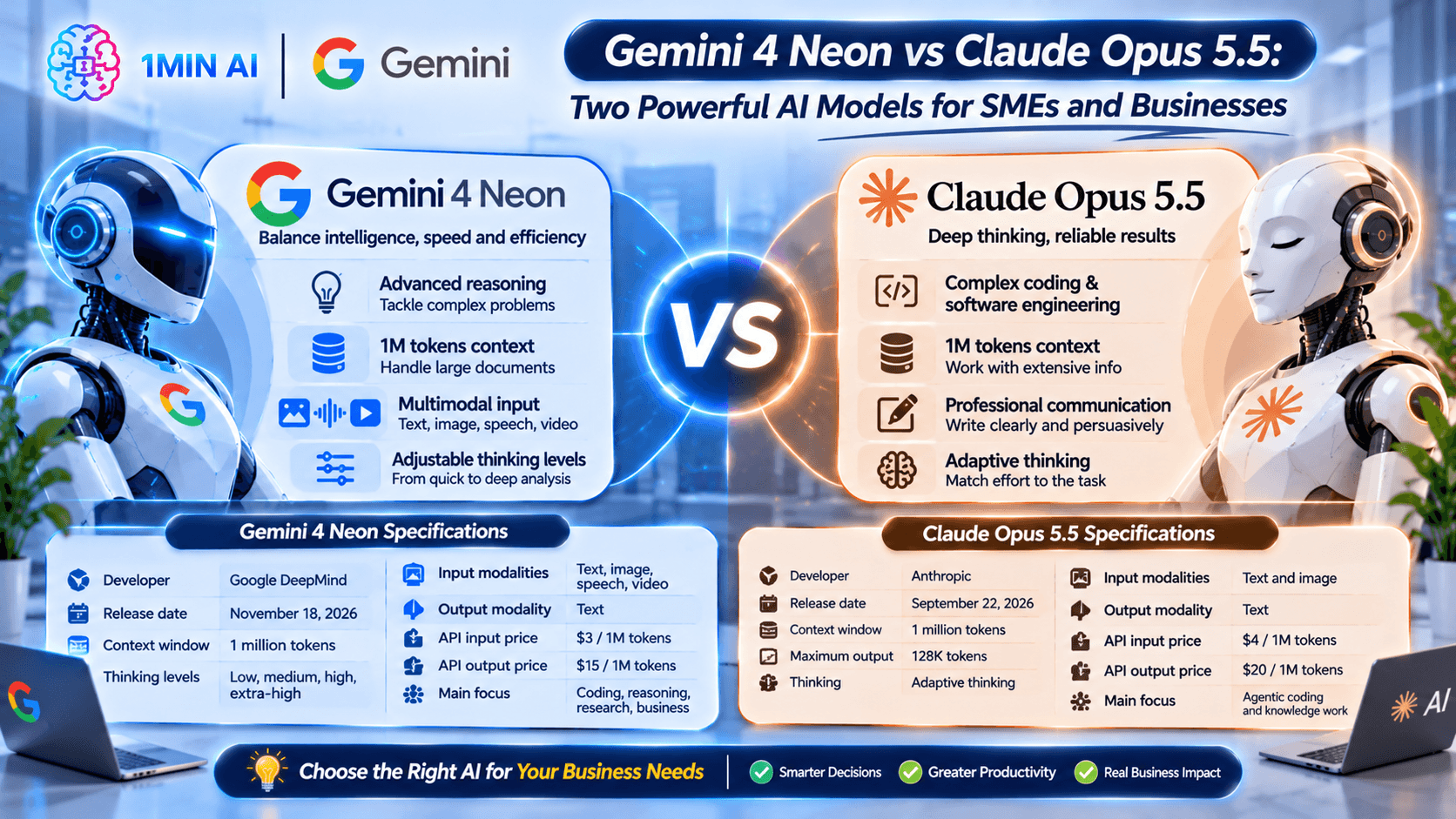
Gemini 4 Neon vs Claude Opus 5.5: Key Differences
Both models are designed for advanced professional workloads, but their differences can influence which one makes more sense for a small business.
Here is a practical comparison.
| Comparison | Gemini 4 Neon | Claude Opus 5.5 |
|---|---|---|
| Developer | Google DeepMind | Anthropic |
| Release date | November 18, 2026 | September 22, 2026 |
| Context window | 1M tokens | 1M tokens |
| Maximum output | 64K standard synchronous output | 128K tokens |
| Input types | Text, images, speech, video | Text, images |
| Reasoning | Adjustable thinking levels | Adaptive thinking |
| API input price | $3 / 1M tokens | $4 / 1M tokens |
| API output price | $15 / 1M tokens | $20 / 1M tokens |
| Key strengths | Multimodal analysis, long context, efficiency | Agentic coding, knowledge work, polished communication |
| Business fit | Broad business and technical workflows | Complex development and detailed knowledge work |
Intelligence and Benchmark Performance
Benchmarks can help businesses understand model capabilities, but they should not be treated as a complete prediction of real-world performance.
According to the Artificial Analysis comparison, Gemini 4 Neon reaches an Intelligence Index score of 62 at extra-high reasoning, while Claude Opus 5.5 reaches 59 at its maximum setting.
Gemini also performs strongly in several tested areas, including finance and accounting, strategy and operations, and terminal-bench tasks at selected reasoning levels.
However, Claude Opus 5.5 maintains advantages in some coding and critical problem-solving evaluations, including FrontierCode-AA 2.0 and CritPt v2 at the compared settings.
The practical takeaway is that Gemini 4 Neon has a slight lead on this particular overall index, but the difference does not mean it will outperform Opus 5.5 on every business task.
Speed and Response Time
Speed matters when employees use AI repeatedly throughout the workday.
Artificial Analysis reports that Claude Opus 5.5 has a faster first-answer-token time at comparable low and high reasoning settings in its comparison.
For example, at the low setting, its reported time to first token is approximately 5.28 seconds, compared with 19.29 seconds for Gemini 4 Neon.
However, first-token latency is not the same as completing a task. Complex workflows can require additional reasoning and longer generation time.
Businesses should evaluate both how quickly a model starts responding and how long it takes to produce a usable final result.
Pricing and Cost Efficiency
For SMEs, the cost of AI usage can become important as teams scale their workflows.
Based on the listed API rates:
| Cost | Gemini 4 Neon | Claude Opus 5.5 |
|---|---|---|
| Input per 1M tokens | $3 | $4 |
| Output per 1M tokens | $15 | $20 |
| Cached input per 1M tokens | $0.15 | $0.20 |
Gemini 4 Neon is approximately 25% cheaper per input and output token at these listed rates.
Artificial Analysis also reports a lower cost per task for Gemini 4 Neon at the low reasoning setting: $0.75 compared with $0.98 for Claude Opus 5.5 in its Intelligence Index task workload.
However, API token prices and total business costs are not the same thing. Actual spending depends on prompt length, output length, reasoning effort, caching, retries, and the number of tasks.
A cheaper model is not automatically more economical if it requires more corrections or produces results that need substantial human editing.
Context Window and Multimodal Capabilities
Both models offer a 1-million-token context window, making them suitable for extensive documents and large information sets.
The main difference is their input modalities.
Gemini 4 Neon supports text, images, speech, and video, while Claude Opus 5.5 supports text and image inputs.
This gives Gemini an advantage when businesses need to work with different types of media.
For example:
- A marketing team can analyze video materials.
- A product team can examine visual references.
- A training team can process recorded information.
- A research team can combine written and visual sources.
Claude Opus 5.5 remains a strong choice for businesses whose workflows are primarily based on text, documents, images, and software development.
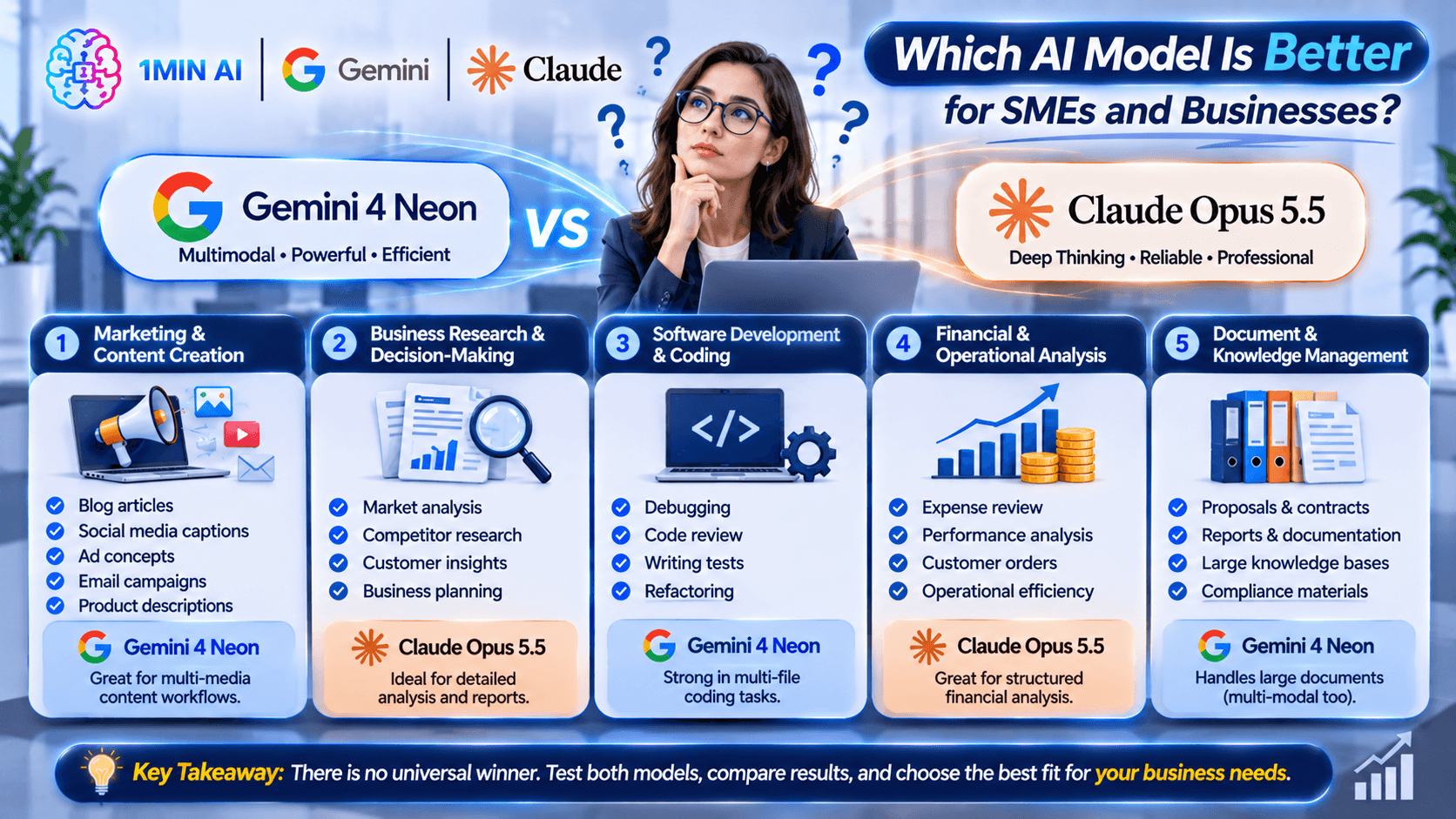
Which AI Model Is Better for SMEs and Businesses?
There is no universal winner. The better choice depends on what your business needs AI to accomplish.
Let's look at five common SME use cases.
1. Marketing and Content Creation
Marketing teams need to create content consistently without sacrificing quality.
Common tasks include:
- Writing blog articles.
- Creating social media captions.
- Developing advertising concepts.
- Preparing email campaigns.
- Researching customer pain points.
- Improving product descriptions.
Gemini 4 Neon is a strong option when content workflows involve different media formats, such as images, videos, and speech.
Claude Opus 5.5 is worth testing when the priority is structured writing, detailed explanations, and polished professional communication.
Recommendation: Test both models with the same content brief. Compare the accuracy, tone, structure, and amount of editing required before choosing a regular workflow.
2. Business Research and Decision-Making
SME owners frequently need to make decisions with limited time and resources.
For example, they may need to evaluate a new market, compare competitors, assess customer feedback, or prepare a business expansion plan.
Gemini 4 Neon can help organize large information sets and analyze multimodal materials.
Claude Opus 5.5 can help structure detailed reports, explain complex information, and develop well-organized recommendations.
Recommendation: Use both models when the decision is important. Ask one to prepare an analysis and the other to challenge its assumptions. Verify important claims using reliable business data.
3. Software Development and Coding
Small businesses that develop their own products need efficient development workflows.
AI models can support developers with:
- Debugging.
- Code review.
- Writing unit tests.
- Refactoring.
- Technical documentation.
- Software architecture discussions.
Gemini 4 Neon performs strongly on several multi-file coding and automation benchmarks.
Claude Opus 5.5 has a strong position in agentic coding and certain terminal-focused tasks.
Recommendation: Test both models on the same real bug or development task. Compare whether the proposed solution works, whether it introduces new problems, and how much manual correction is needed.
4. Financial and Operational Analysis
Financial and operational decisions require careful interpretation of information.
For example, a small business may need to review expenses, summarize monthly performance, analyze customer orders, or identify operational inefficiencies.
Gemini 4 Neon has strong reported results in finance and accounting evaluations.
Claude Opus 5.5 can also help organize financial reports and explain complex business information.
Recommendation: Consider Gemini 4 Neon for cost-conscious analysis workflows, but verify calculations and financial conclusions independently. Neither model replaces a qualified accountant or financial adviser.
5. Document and Knowledge Management
Many SMEs work with proposals, contracts, reports, product documents, and internal procedures.
Both models offer a 1-million-token context window, making them useful for large-document tasks.
Gemini 4 Neon offers an additional advantage when the material includes speech or video.
Claude Opus 5.5 is a strong option for detailed text-based analysis and professional document work.
Recommendation: Choose based on the actual file formats and output requirements. For important contracts or compliance documents, always arrange appropriate human review.
Gemini 4 Neon vs Claude Opus 5.5: Which Should Your Business Choose?
Here is a quick decision guide for SMEs.
| Business priority | Suggested model | Why |
|---|---|---|
| Lower API token costs | Gemini 4 Neon | Lower listed input and output rates |
| Multimodal analysis | Gemini 4 Neon | Supports text, images, speech, and video |
| Large document analysis | Both | Both support a 1M-token context window |
| Multi-file coding workflows | Gemini 4 Neon | Strong results on selected coding benchmarks |
| Terminal-heavy development | Claude Opus 5.5 | Slight lead on selected terminal and coding evaluations |
| Professional writing | Test both | Writing quality depends on tone and task |
| Financial and business analysis | Gemini 4 Neon | Strong reported finance and accounting benchmark results |
| Complex knowledge work | Both | Different strengths across reasoning and professional tasks |
Choose Gemini 4 Neon If:
- Your business needs multimodal input.
- You frequently analyze long documents and mixed media.
- You want lower API token rates.
- You work with coding, research, and business analysis.
- You need a flexible model for different types of professional tasks.
Choose Claude Opus 5.5 If:
- Your team handles complex software development.
- You need help with terminal-focused coding workflows.
- You regularly prepare detailed professional documents.
- You value structured communication and long-running knowledge work.
- Your actual tasks produce better results with Claude.
Should SMEs Use Both?
For some businesses, the best approach is not choosing only one model.
You can use Gemini 4 Neon for one type of task and Claude Opus 5.5 for another. You can also compare their answers before making important decisions.
This is particularly useful for SMEs that want to avoid building their entire AI workflow around one provider.
Why Choose One? Use Gemini 4 Neon and Claude Opus 5.5 Together on 1minAI
https://youtube.com/shorts/xF0LsMxWWOE?si=tG7d9iQdj0VOKVys
For SMEs and business teams, choosing between Gemini 4 Neon and Claude Opus 5.5 doesn't have to be an either-or decision. Each model brings different strengths, and using both can give you a more balanced perspective before making important business decisions.
With 1minAI Multi AI Chat, you can access different AI models in one workspace, compare their responses, and decide which suggestions best fit your needs.
Here are three practical ways to use both models together:
1. Compare business strategies
Ask Gemini 4 Neon and Claude Opus 5.5 to develop a growth strategy for your business. Compare their target audience analysis, marketing recommendations, budget priorities, and proposed next steps.
You can use one model's suggestions to identify gaps in the other's response, then combine the strongest ideas into a more complete plan.
2. Use both for research and decision-making
Give both models the same research task, such as analyzing a competitor, evaluating a new market, or reviewing a business proposal. Compare how they organize information, explain risks, and support their recommendations.
Always verify important facts, figures, and sources before using the results in a business decision.
3. Combine creative thinking with detailed review
Use one model to generate initial ideas, such as a product launch campaign or a new service concept. Then ask the other to critique the proposal, identify weaknesses, and suggest improvements.
You can also reverse the process. The goal is to use different AI perspectives to improve the quality of your final work.
Start Using Both Models on 1minAI
Instead of spending time deciding which model is universally better, test Gemini 4 Neon and Claude Opus 5.5 on the tasks your business actually handles.
Visit Gemini 4 Neon on 1minAI and Claude Opus 5.5 on 1minAI, or explore Multi AI Chat to compare different models in one place.
The best approach for SMEs isn't necessarily picking one AI model. It's knowing how to use multiple models together to research better, work faster, and make more informed decisions.
You can start with:
- Gemini 4 Neon: Explore Google's model for advanced reasoning, coding, and multimodal workflows.
- Claude Opus 5.5: Try Anthropic's model for complex coding and knowledge work.
- Multi AI Chat: Access available AI models and compare their responses.
- Mix AI Models: Explore ways to combine different AI models in your workflow.
For SMEs, the goal is not simply to use the most powerful model available. It is to find a model that delivers useful results at a reasonable cost for the work your business actually performs.
Frequently Asked Questions
1. Is Gemini 4 Neon better than Claude Opus 5.5?
Gemini 4 Neon has a slight lead on the Artificial Analysis Intelligence Index at the compared highest reasoning settings and offers lower listed API token prices. However, Claude Opus 5.5 performs better on some coding and terminal evaluations. The better model depends on your specific workload.
2. Which model is cheaper, Gemini 4 Neon or Claude Opus 5.5?
Gemini 4 Neon has lower listed API rates: $3 per million input tokens and $15 per million output tokens. Claude Opus 5.5 costs $4 per million input tokens and $20 per million output tokens. Actual spending depends on usage, reasoning effort, and workflow design.
3. Which AI model is better for small businesses?
Gemini 4 Neon is an attractive option for SMEs that prioritize multimodal analysis and lower token costs. Claude Opus 5.5 is worth considering for complex coding, terminal-focused tasks, and knowledge work. Businesses should test both against their own tasks.
4. Can Gemini 4 Neon and Claude Opus 5.5 analyze long documents?
Yes. Both models offer a context window of up to 1 million tokens. This can support extensive document analysis, although actual limits depend on the model interface, input format, and available output capacity.
5. Can I use Gemini 4 Neon for marketing?
Yes. Gemini 4 Neon can help with marketing research, campaign planning, customer feedback analysis, content ideas, and multimodal content review. You should still review generated content before publishing it.
Conclusion
Gemini 4 Neon vs Claude Opus 5.5 is an important comparison for SMEs looking to adopt advanced AI without overlooking operating costs and practical performance.
Gemini 4 Neon stands out for its multimodal capabilities, competitive token pricing, and strong results across several reasoning and business-related benchmarks. Claude Opus 5.5 remains a compelling choice for complex coding, terminal-focused work, and detailed knowledge tasks.
For many SMEs, the smartest approach is to test both rather than make a decision based only on benchmark rankings.
With 1minAI, you can explore Gemini 4 Neon and Claude Opus 5.5 in one workspace, compare their answers, and discover which model works best for your business.
Start testing both AI models on 1minAI and build a more efficient AI workflow for your business.
For more AI capabilities, visit 1minAI Features and try the 1minAI Agent.
- #Information
- #Commerce
Alternatives
Discover the best alternatives to 1minAI and compare features, pricing, and use cases.

1min.AI vs OpenRouter
1min.AI vs. OpenRouter: Compare the ready-to-use AI creation product against the technical API tool. Find out if you need a zero-code creative studio or a coding infrastructure hub.
 Ngoc Hong
1min.AI vs Planable
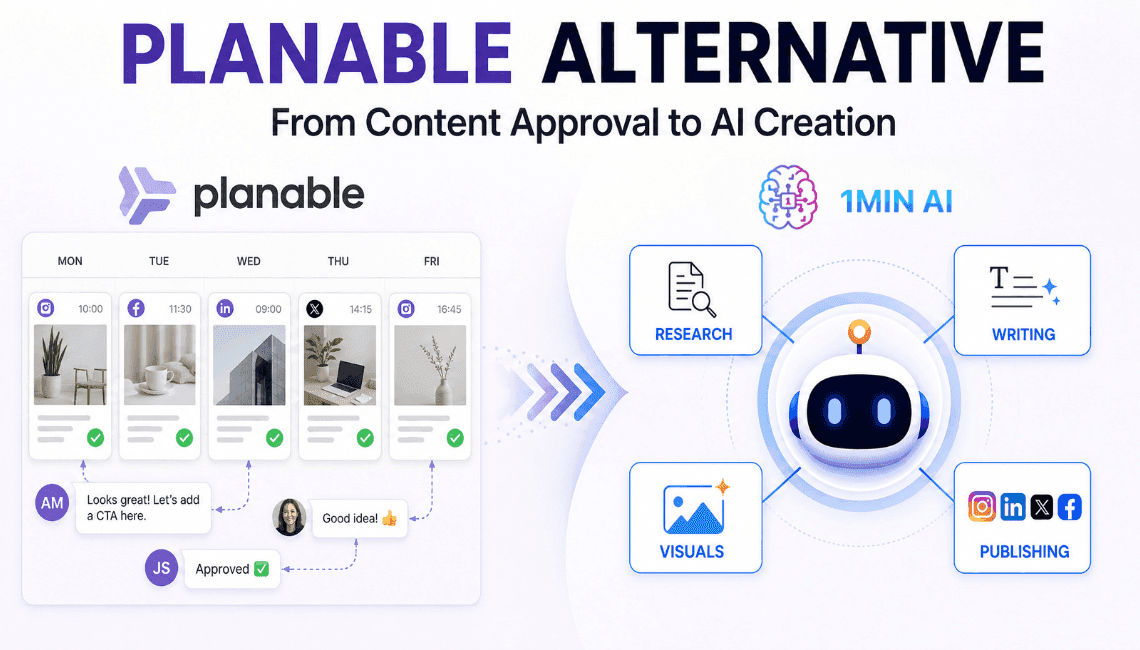
Looking for a Planable alternative? See how 1min.AI Social Content Agents research, write, design and publish posts across your social channels from one credit pool.
 Trang Tran
1min.AI vs. Metricool: Which Platform Does More for Your Marketing Workflow?
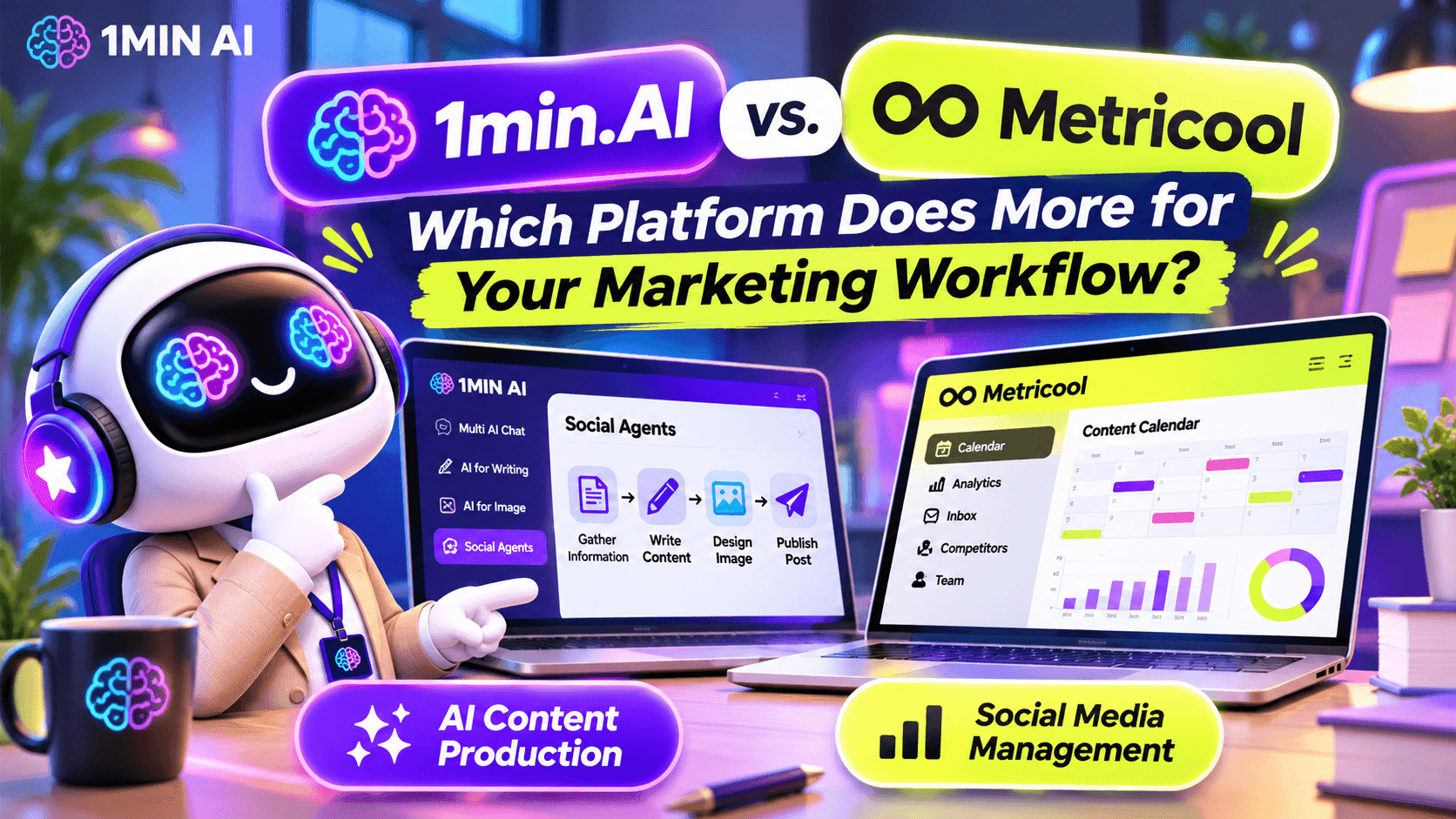
Compare 1min.AI vs. Metricool across content creation, visual production, scheduling, analytics, MCP, and pricing to find the right platform for your marketing workflow.
AI Tools
Discover the best AI tools to boost productivity, creativity, and everyday work.
Top 4 Affordable AI Tools for Startup Founders
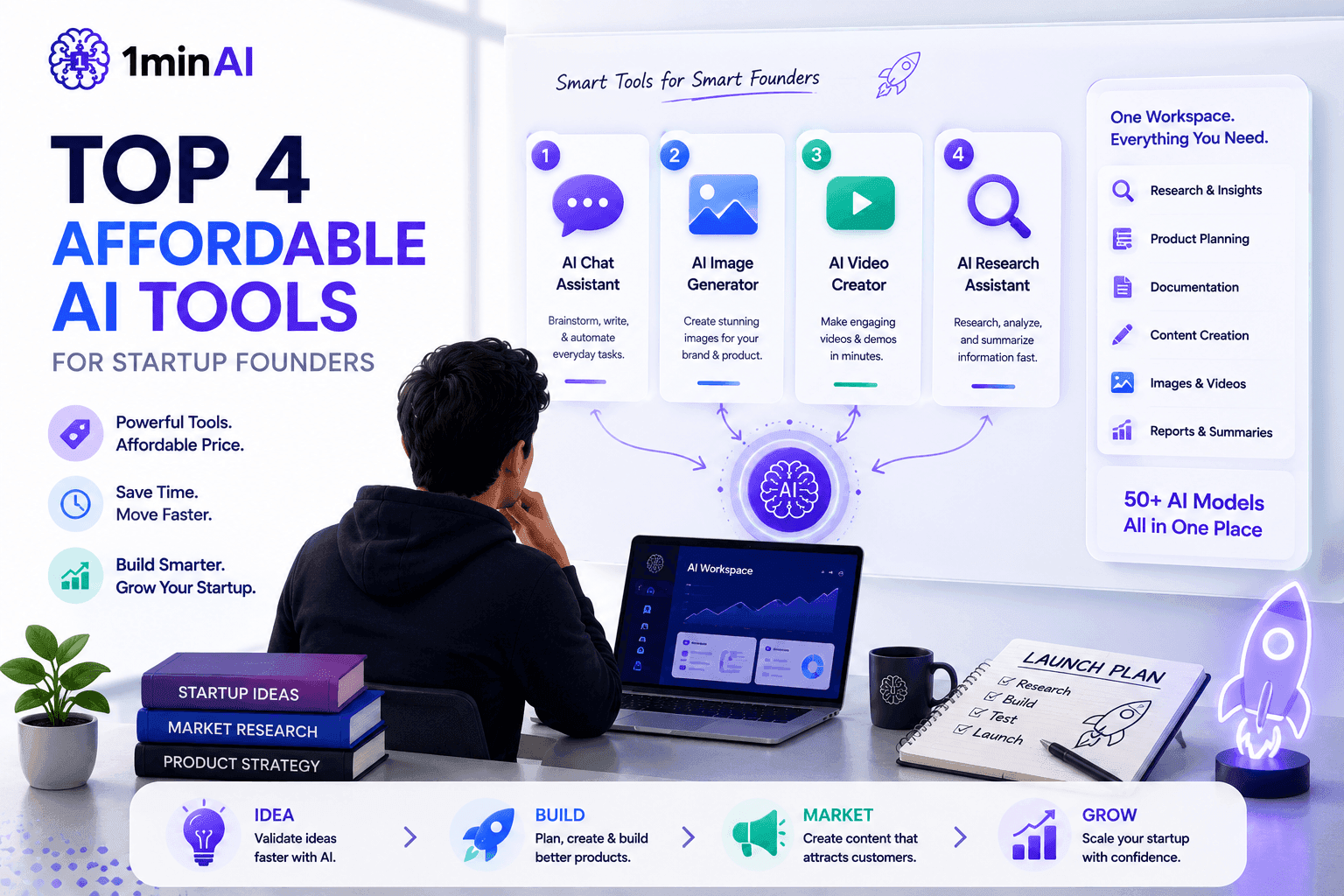
Discover the top 4 affordable AI tools for startup founders to validate ideas, build products, create content, and launch faster without overspending.
 Tram Ta
Turn “Make It Better” Into Better Content With AI
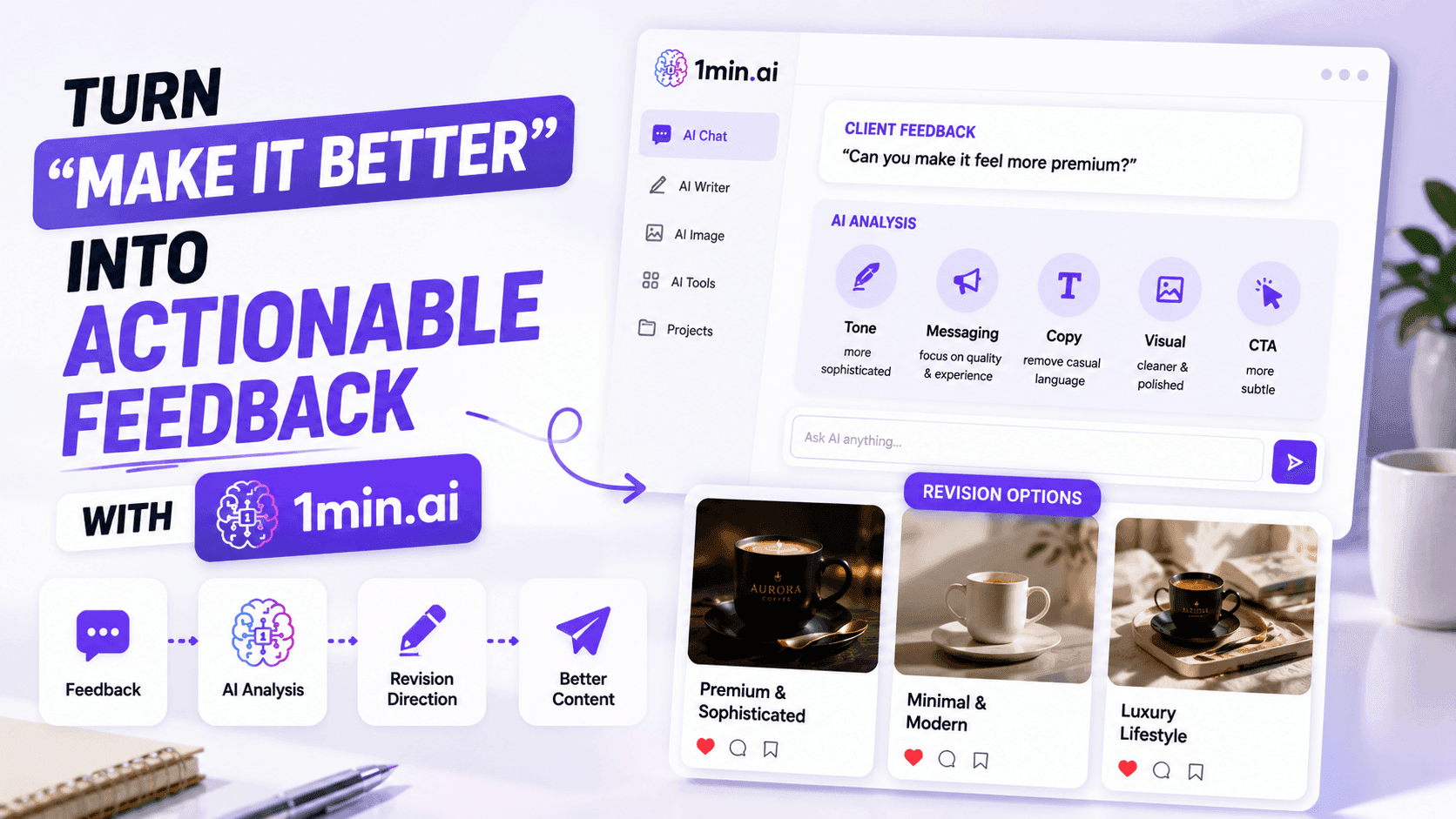
Use AI to turn vague client feedback into clear revisions, reduce unnecessary edits, and deliver better content faster.
 Lien Anh Vu
Free AI X Comment
Create funny, witty, or insightful comments for Twitter with our AI-powered Twitter Comment Generator. Boost your engagement and stand out in the crowd!
Trang TranAI Features
Comprehensive AI features that streamline workflows, improve efficiency, and empower teams to achieve more.
1minAI: Free AI Grammar Checker
Check grammar for free with 1minAI’s AI grammar checker. Find grammar, spelling, and writing mistakes, improve clarity, and polish your content in seconds.
Tram Ta
Build a Portfolio Website Faster with 1min.AI
Learn how freelance creatives can use 1min.AI to plan, write, design, and generate a professional portfolio website faster, even without strong coding skills.
Lien Anh VuFree AI X Comment
Create funny, witty, or insightful comments for Twitter with our AI-powered Twitter Comment Generator. Boost your engagement and stand out in the crowd!
Trang TranAI Use Cases
A curated collection of AI use cases for business, productivity, and industry-specific applications.
Best Time to Post on Instagram: A Practical Guide for Better Engagement
Discover the best time to post on Instagram, including the best days and times for different audiences, plus tips to find the ideal posting schedule for your account.
Tram TaTurn “Make It Better” Into Better Content With AI
Use AI to turn vague client feedback into clear revisions, reduce unnecessary edits, and deliver better content faster.
Lien Anh VuBuild a Portfolio Website Faster with 1min.AI
Learn how freelance creatives can use 1min.AI to plan, write, design, and generate a professional portfolio website faster, even without strong coding skills.
Lien Anh VuAI Tutorials
Learn how to use AI with practical, step-by-step tutorials.
Black Friday AI Tool Deals in 2026
Discover what Black Friday AI tool deals 2026 has to offer. Find out how to secure the 1min.AI lifetime deal via AppSumo, Dealify, Stack Social, and verify on Trustpilot, Slashdot, and Software Advice.
 Hang Nguyen
Viral Reels in Minutes: How to Use 1minAI’s Text-to-Speech for Satirical Voiceovers
Learn how satirical page admins use 1minAI’s Text-to-Speech feature to generate instant news anchor and dramatic voiceovers for TikToks, Shorts, and Instagram Reels.
Turn “Make It Better” Into Better Content With AI
Use AI to turn vague client feedback into clear revisions, reduce unnecessary edits, and deliver better content faster.
Lien Anh VuAI Guides
Learn AI faster with practical guides, real-world examples, and actionable best practices.

Safely Buy AI Tools Online: 2026 Black Friday Guide
Discover how to find and secure the best Black Friday AI deals online. Learn expert strategies to avoid scams, combat subscription fatigue, and verify software.
Hang Nguyen
How to start an AI business without building from scratch
Learn how to start an AI business, validate your idea, and launch faster without building costly AI infrastructure from scratch.
Ngoc Hong
ChatGPT Prompt Tone and Accuracy: How to Get Better Answers on 1minAI
Does prompt tone affect ChatGPT accuracy? Explore the latest studies, learn effective prompting techniques, and compare AI responses on 1minAI.
Tram TaAI Solutions
Browse the best AI solutions for automation, coding, research, productivity, customer support, marketing, and business workflows.
Safely Buy AI Tools Online: 2026 Black Friday Guide
Discover how to find and secure the best Black Friday AI deals online. Learn expert strategies to avoid scams, combat subscription fatigue, and verify software.
Hang Nguyen
Free AI Tattoo Generator: Custom Designs
Turn any idea into a custom tattoo design with 1min.AI's free AI tattoo generator. Describe your idea, pick a style, and download in seconds.
Trang TranTurn “Make It Better” Into Better Content With AI
Use AI to turn vague client feedback into clear revisions, reduce unnecessary edits, and deliver better content faster.
Lien Anh VuAI Models
Explore the world's leading AI models in one place.
Free AI Chat With Claude Fable 5.2 On 1min.AI
Free AI chat with Claude Fable 5.2 on 1min.AI. Compare Fable 5.2 vs Opus 5.5, see Fable 5.2 benchmarks, and start chatting in minutes.
Trang Tran
GPT-6.2 Sol: Specs, Pricing & Free Access
Explore GPT-6.2 Sol specs, pricing, and how it compares with GPT-6.1 Sol and Claude Opus 5.5, then try it free in 1min.AI Multi AI Chat.
Trang Tran
GPT 6.2 Astra: Pricing, Benchmarks & Free Access
GPT 6.2 Astra release date, pricing, Reddit feedback and Opus 5.5 comparison. See what it does best and chat with it on 1min.AI for free.
Trang TranAI Comparisons
Compare AI tools, models, and platforms to find the best fit for your needs.
Gemini 4 Neon vs Hydrogen: Specs, Price & Picks
Gemini 4 Neon vs Hydrogen, Carbon and Argon: compare price, benchmarks and use cases to pick the right model, then test them side by side on 1min.AI.
Trang Tran
Kling AI Vs Veo 3: Which Model Wins?
Kling AI vs Veo 3: compare motion, native audio, pricing & free tiers to see which AI video generator wins for your project - try both on 1min.AI.
Trang Tran
DeepSeek V4 Pro vs Flash Comparison
Compare DeepSeek V4 Pro vs DeepSeek V4 Flash metrics. Optimize your agentic apps and improve AI fact checking on 1min.ai today.
Ngoc HongAI Integrations
Seamlessly integrate AI with the tools you already use to automate work and boost productivity.

POV: You Have 10+ Posts to Make Every Day
Learn how to build an AI content workflow that helps content creators produce 10+ social media posts a day faster with AI brainstorming, image generation, and content creation.
Lien Anh Vu
Stop Switching Between AI Apps: How AI Integration Transforms Employer Branding
Discover how AI integration helps HR teams streamline employer branding by combining AI writing, documents, images, video, and multiple AI models into one workspace.
Tram Ta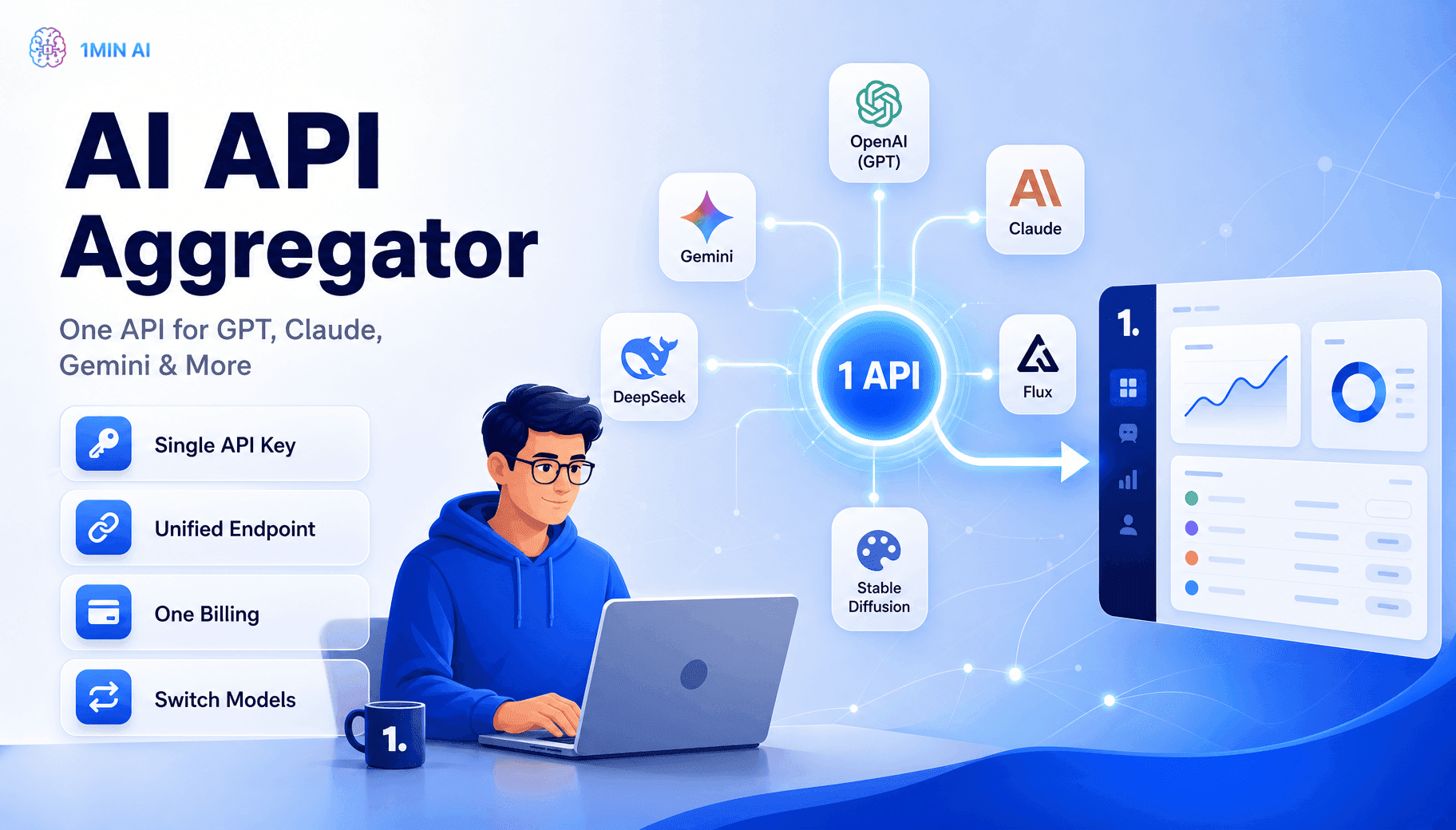
AI API Aggregator Explained For Developers
An AI API aggregator gives developers one unified API to call multiple AI models, cutting integration time and vendor lock in.
Trang TranAI for Industries
Find the best AI tools and workflows for healthcare, finance, education, legal, manufacturing, retail, real estate, and more
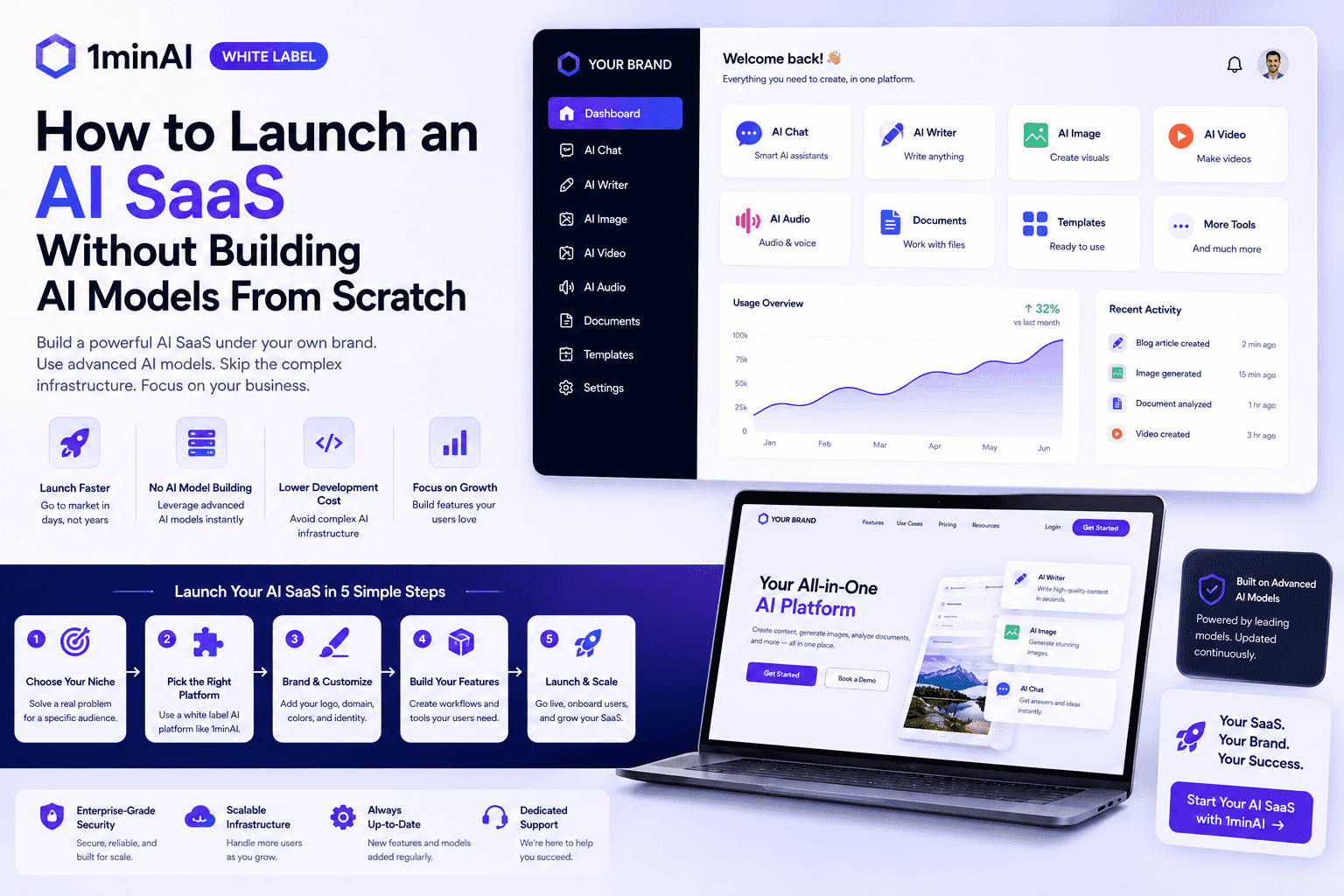
How to Launch an AI SaaS Without Building AI Models From Scratch
Learn how to launch an AI SaaS without building AI models from scratch. Explore white-label AI, product strategy, branding, pricing, and how 1minAI can help.
Tram Ta
ChatGPT Trending Photo Prompts to Copy and Paste
Explore chatgpt trending photo prompt ideas you can copy and paste. Create viral AI portraits, collages, and aesthetic photos with ease.
Trang TranTry Image To Video AI With Prompt Online Free
Try image to video AI with prompt online free, no login and no watermark. Upload a photo, type the motion you want, and get a short video in minutes.
Trang TranAI Agents
Discover and run AI agents to automate tasks across your work and daily life.
1minAI: Free AI Grammar Checker
Check grammar for free with 1minAI’s AI grammar checker. Find grammar, spelling, and writing mistakes, improve clarity, and polish your content in seconds.
Tram Ta
AI Agents for Facebook
Use an AI Agent for Facebook to create content, generate images, schedule posts, and publish from your documents and conversations.
Ngoc Hong
AI Agent vs AI Assistant: Which One Actually Saves Designers More Time?
Learn the difference between AI Agent vs AI Assistant and discover which solution helps designers automate repetitive work, reduce revisions, and save more time.
Lien Anh VuAI Workflows
Explore ready-to-use AI workflows for productivity, marketing, sales, support, and more.
POV: You Have 10+ Posts to Make Every Day
Learn how to build an AI content workflow that helps content creators produce 10+ social media posts a day faster with AI brainstorming, image generation, and content creation.
Lien Anh VuChatGPT Prompt Tone and Accuracy: How to Get Better Answers on 1minAI
Does prompt tone affect ChatGPT accuracy? Explore the latest studies, learn effective prompting techniques, and compare AI responses on 1minAI.
Tram Ta
How to Resell AI Software: A Practical Guide to Building an AI Revenue Stream
Learn how to resell AI software and build a recurring AI revenue stream. Discover how white label AI platforms help agencies and entrepreneurs launch branded AI services.
Tram TaNewsletter
Weekly AI Innovations with 1minAI

🔮 Weekly AI Innovations #147: 1min.ai Drops Major Shift: AI Circle, Kimi & Wan 3.0
Explore AI Circle (formerly AI Social), Kimi K3.1 Pro’s 2M context, and Alibaba Wan 3.0 & 3.0 Prime cinematic video on 1min.ai.
Hang Nguyen
🔮 Weekly AI Innovations #146: Mistral 3.5, Qwen Image & Cohere A+ are ready on 1min.ai
Deploy Mistral Large 3, Qwen Image 3.0, and Cohere Command A+ on 1min.ai. Boost RAG accuracy and cut visual generation latency in one unified AI workspace.
Hang Nguyen
🔮 Weekly AI Innovations #145: X Content Agent & GPT 6.1 Terra on 1min.ai
Scale viral reach with the X Content Agent on 1min.ai. Discover an end-to-end 4-stage pipeline with zero token burn, plus the launch of GPT 6.1 Terra.
Hang Nguyen