
How to start an AI business without building from scratch

Ngoc Hong
September 6, 2026
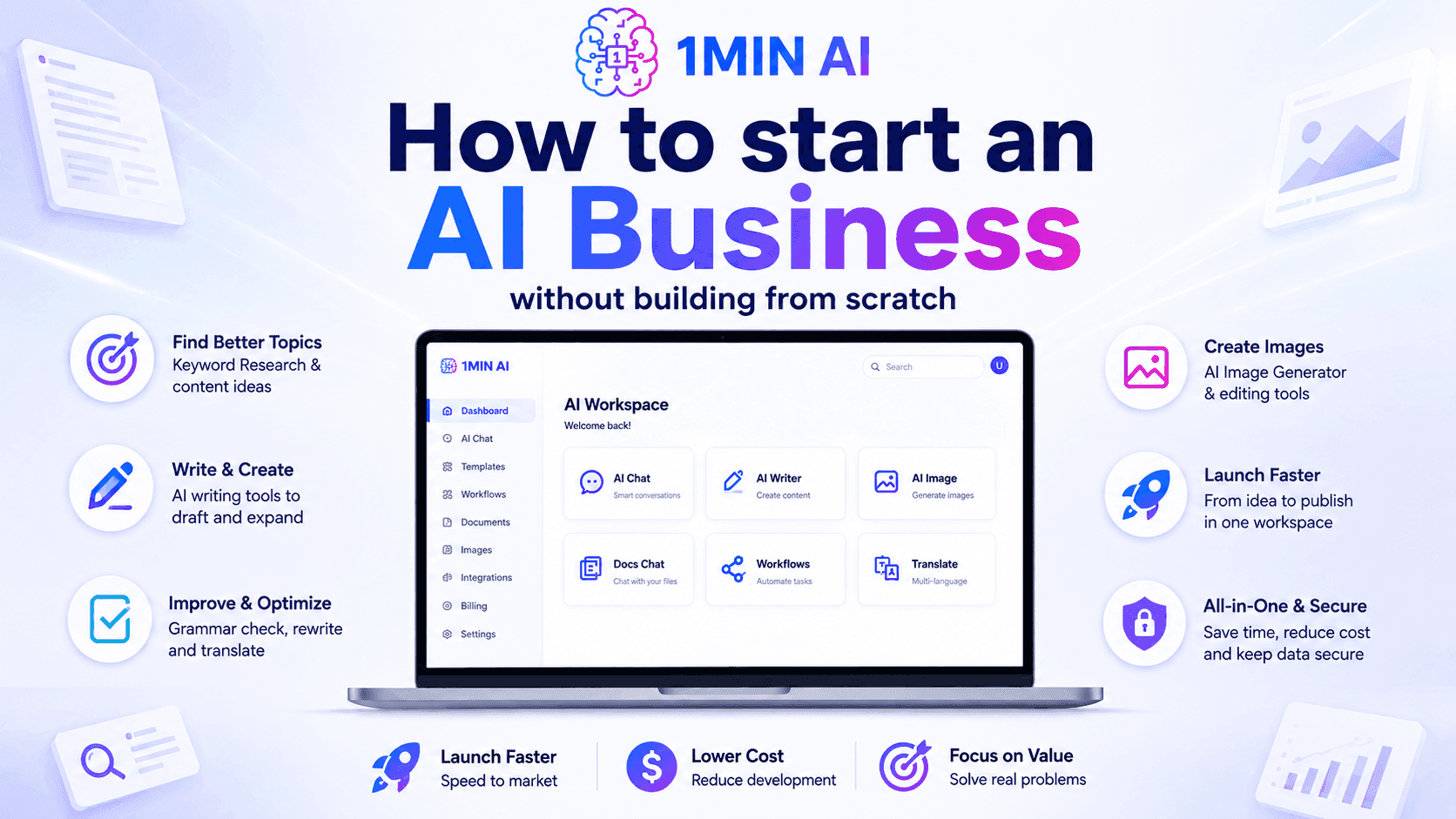
Learn how to start an AI business, validate your idea, and launch faster without building costly AI infrastructure from scratch.
Learning how to start an AI business is not only about choosing an AI model. Startup founders also need to validate demand, control development costs, and launch quickly. This guide explains how to turn an AI business idea into a practical MVP, compare different development approaches, and decide when an AI platform or white-label solution makes more sense than building everything from scratch.
Why starting an AI business is harder than it looks
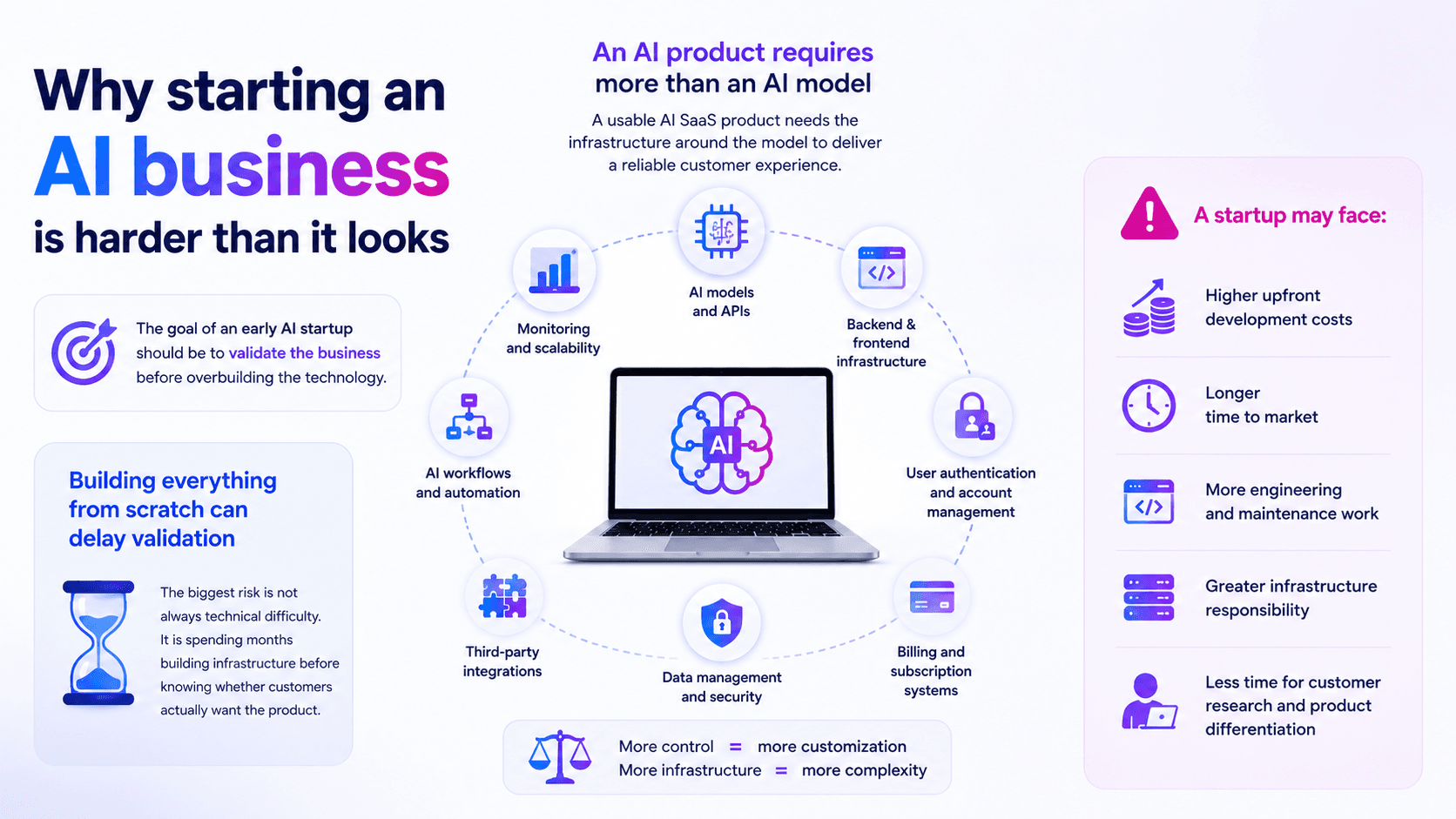
Launching an AI startup involves more than connecting an application to an AI API. Founders must also consider infrastructure, product workflows, user management, billing, integrations, security, and ongoing maintenance. For an early-stage team, building every layer internally can consume valuable engineering resources before the business idea has been properly validated.
An AI product requires more than an AI model
The AI model is only one part of the product. A usable AI SaaS product needs the infrastructure around that model to deliver a reliable customer experience.
Key components often include:
- AI models and APIs
- Backend and frontend infrastructure
- AI workflows and automation
- User authentication and account management
- Billing and subscription systems
- Third-party integrations
- Data management and security
- Monitoring and scalability
For startup founders, this creates an important trade-off. More control can provide greater customization, but additional infrastructure also increases development time and operational complexity.
Building everything from scratch can delay validation
The biggest risk is not always technical difficulty. It is spending months building infrastructure before knowing whether customers actually want the product.
A startup may face:
- Higher upfront development costs
- Longer time to market
- More engineering and maintenance work
- Greater infrastructure responsibility
- Less time for customer research and product differentiation
The goal of an early AI startup should be to validate the business before overbuilding the technology.
How to start an AI business: a practical roadmap
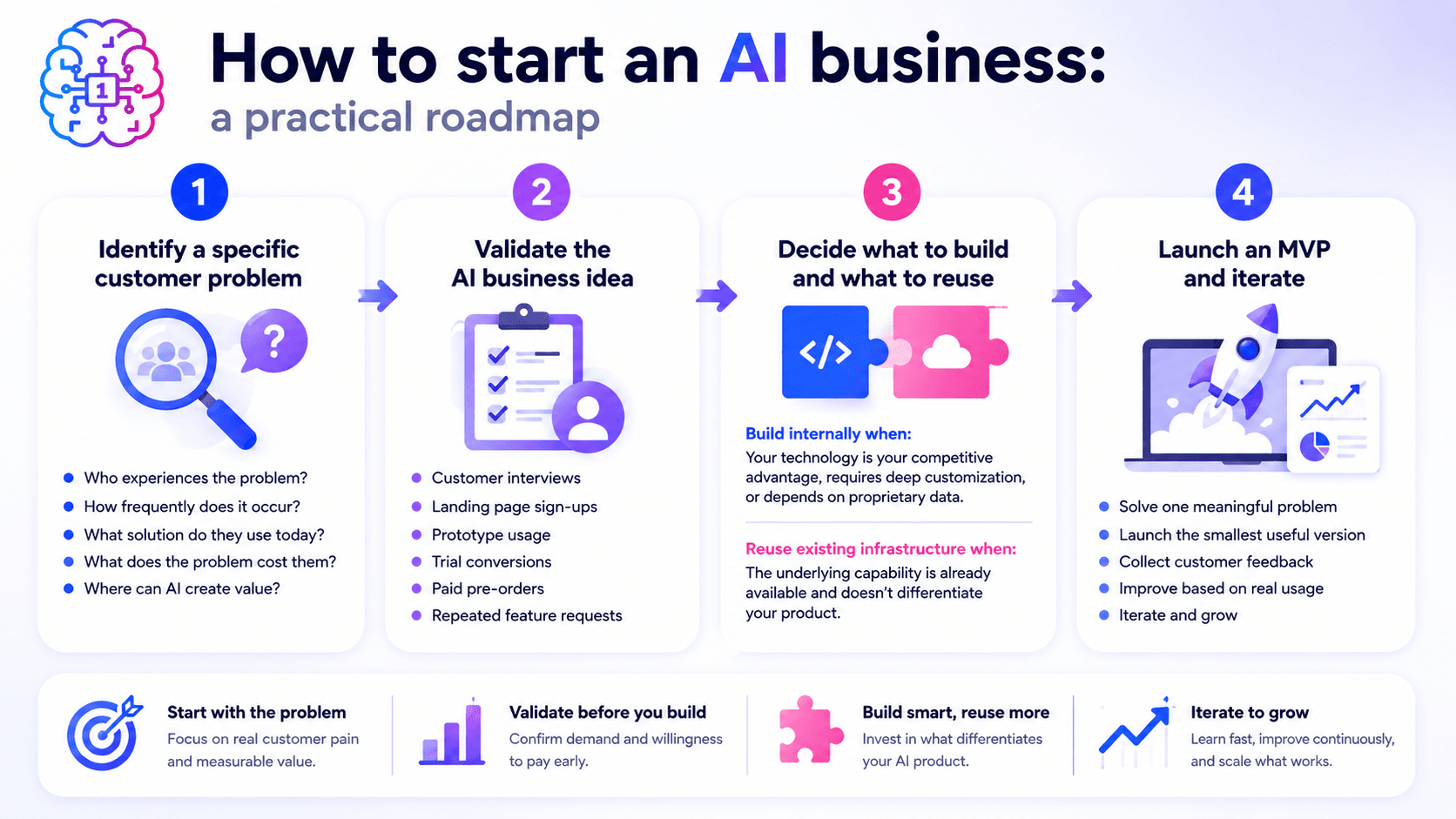
The most efficient approach is to start with the customer problem, validate demand, and only then decide how much technology needs to be built internally. This keeps the MVP focused while reducing unnecessary development work.
Identify a specific customer problem
A strong AI business starts with a clear problem rather than a generic AI capability. Instead of asking, "What can AI do?", founders should ask, "Which repetitive or expensive problem can AI solve better?"
Define:
- Who experiences the problem?
- How frequently does it occur?
- What solution do they use today?
- What does the problem cost them?
- Where can AI create measurable value?
A specific problem also makes positioning easier. For example, an AI tool for real estate teams has a clearer target market than a general-purpose AI assistant.
Validate the AI business idea
Validation should happen before significant infrastructure investment. Talk to potential customers, analyze competitors, build a lightweight prototype, and measure whether users are willing to adopt or pay for the solution.
Useful validation signals include:
- Customer interviews
- Landing page sign-ups
- Prototype usage
- Trial conversions
- Paid pre-orders
- Repeated requests for the same feature
This process helps founders distinguish between an interesting AI concept and a viable AI business.
Decide what to build and what to reuse
Once the idea is validated, separate your product's unique value from the infrastructure that supports it.
Build internally when: Your technology is the primary competitive advantage, requires deep customization, or depends on proprietary data and workflows.
Reuse existing infrastructure when: The underlying capability is already available and does not differentiate your product.
This distinction allows small SaaS teams to focus engineering resources on the features customers actually care about.
Launch an MVP and iterate
An MVP should solve one meaningful problem rather than replicate an entire AI platform. Launch the smallest useful version, collect customer feedback, and improve the product based on real usage.
The faster you reach this feedback loop, the faster you can determine whether your AI business deserves further investment.
Choose the right way to build your AI product
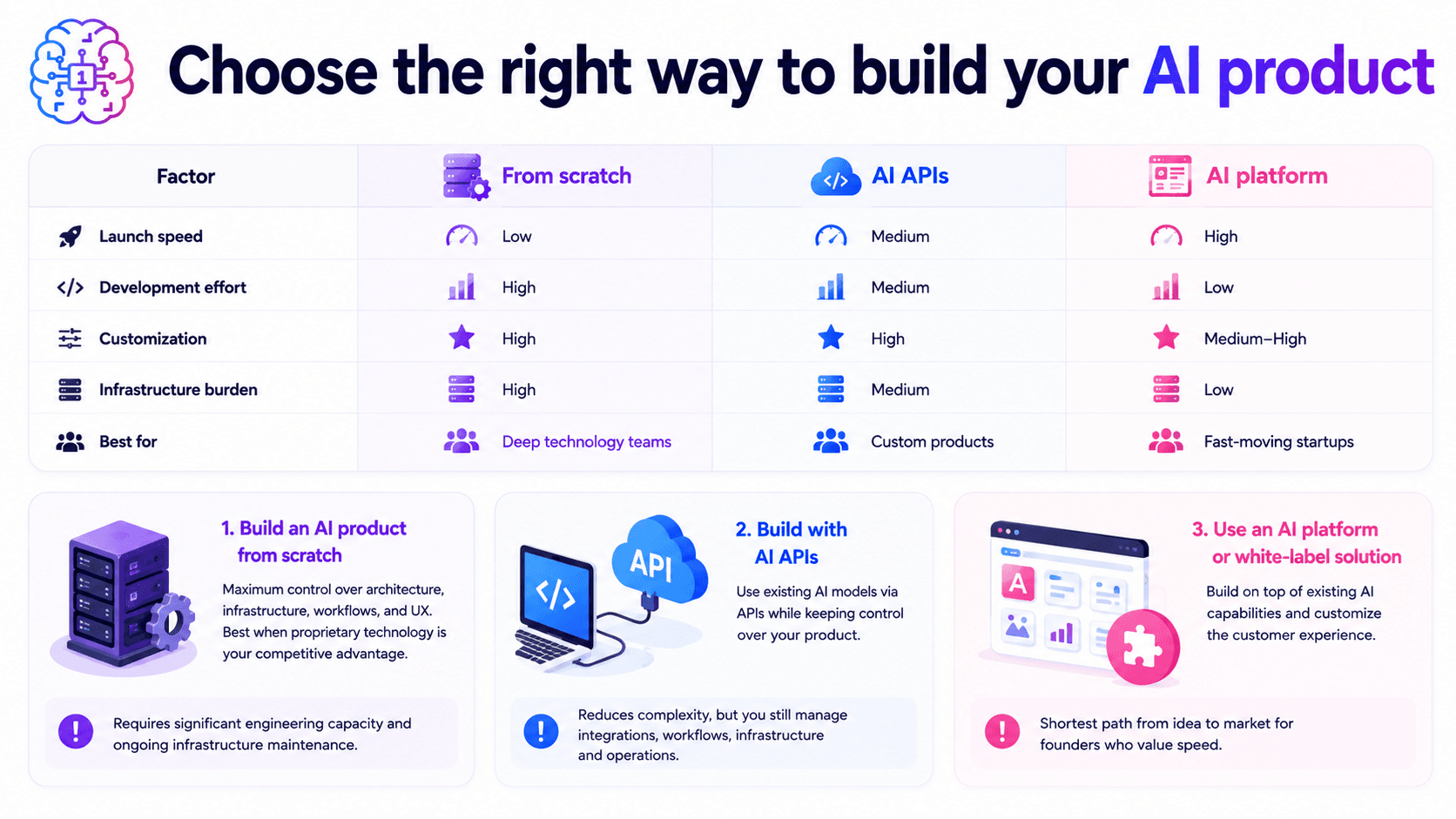
There are three common approaches to AI product development: building infrastructure from scratch, connecting directly to AI APIs, or using an AI platform. The right choice depends on your team's technical resources, launch timeline, and need for customization.
| Factor | From scratch | AI APIs | AI platform |
|---|---|---|---|
| Launch speed | Low | Medium | High |
| Development effort | High | Medium | Low |
| Customization | High | High | Medium–High |
| Infrastructure burden | High | Medium | Low |
| Best for | Deep technology teams | Custom products | Fast-moving startups |
Build an AI product from scratch
Building from scratch gives founders maximum control over architecture, infrastructure, workflows, and user experience. It can make sense when proprietary technology is central to the company's competitive advantage.
However, this approach requires significant engineering capacity. Startups must also maintain the infrastructure as models, APIs, security requirements, and customer demand change.
Build with AI APIs
AI APIs reduce the complexity of developing machine learning infrastructure. Teams can connect their application to existing models while retaining control over the product experience.
This approach works well when founders have engineering resources but do not need to build their own AI models. The remaining challenge is still managing integrations, workflows, infrastructure, and product operations.
Use an AI platform or white-label solution
An AI platform can reduce the infrastructure burden further. Instead of developing every AI layer internally, startups can build their product around existing AI capabilities and customize the customer-facing experience.
For founders focused on speed, this can shorten the path from validated idea to market-ready product.
What to look for in an AI platform
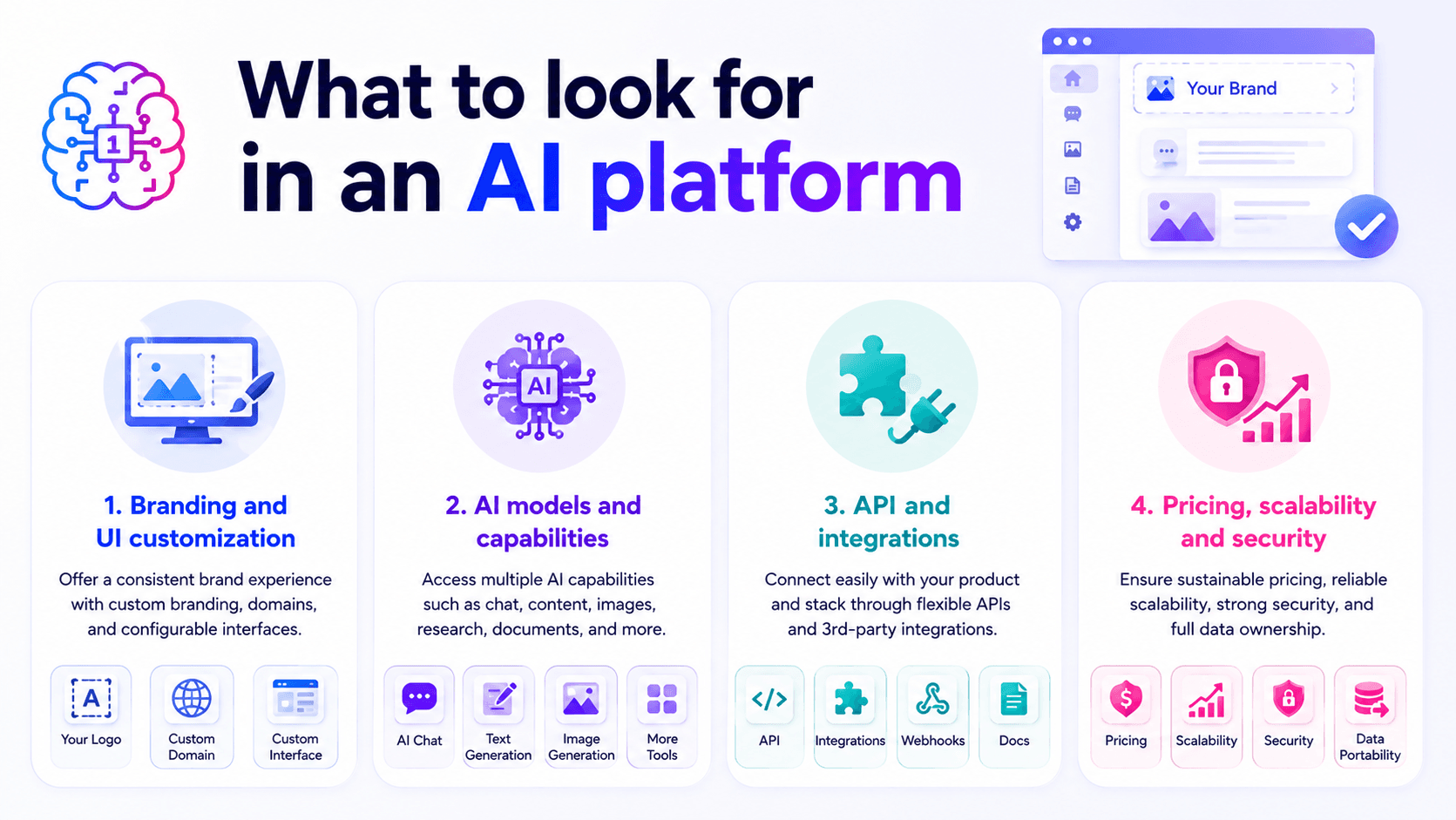
Choosing an AI platform is a product decision, not only a technical decision. Founders should evaluate whether the platform supports their brand, workflows, integrations, scalability, and long-term business model.
Branding and UI customization
A white-label platform should allow the startup to create a consistent customer experience. Look for options such as custom branding, custom domains, and configurable interfaces.
The platform should feel like part of your product rather than an unrelated third-party tool.
AI models and capabilities
Different AI businesses require different capabilities. Depending on the product, you may need AI chat, content generation, image generation, research, document processing, or other workflows.
Access to multiple AI capabilities can also reduce the need to integrate separate providers for every feature.
API and third-party integrations
APIs allow startups to connect AI capabilities with their existing products and workflows. Check available integrations, API flexibility, documentation, and compatibility with your technology stack.
This becomes especially important when the AI platform is part of a larger SaaS product.
Pricing, scalability, and security
Pricing should remain sustainable as usage grows. Founders should also evaluate usage limits, infrastructure responsibility, data handling, security practices, and data portability before committing.
A lower initial cost is not necessarily better if the platform creates expensive limitations later.
Launch your AI product with 1minAI
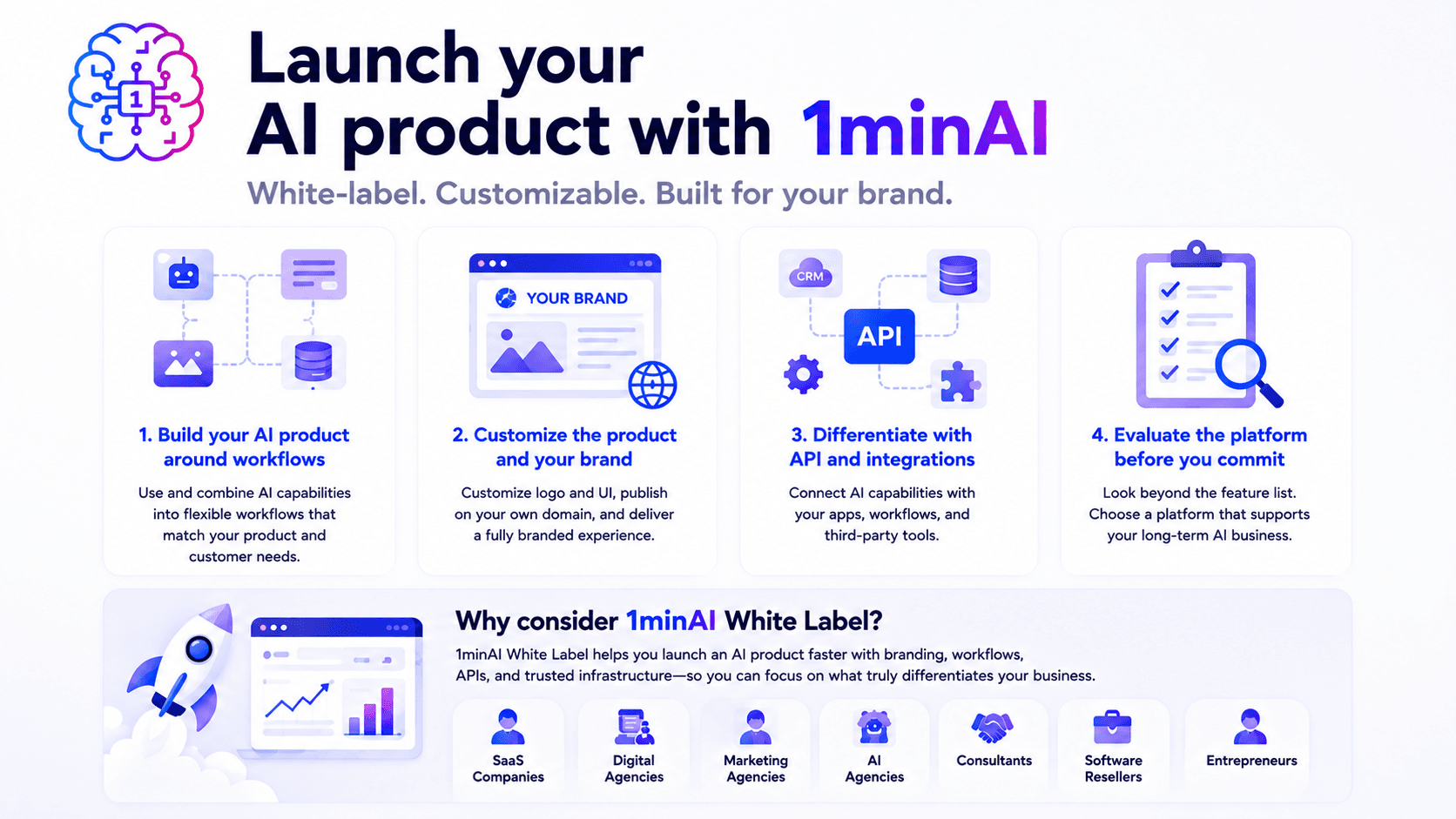
For startups and entrepreneurs, choosing a white-label AI platform is about more than getting access to AI tools. The platform should give you enough control to build a branded product, connect your existing systems, and grow without taking on the full infrastructure burden.
Build your AI product around workflows
1minAI lets businesses build with workflows instead of starting every AI process from scratch. This can help founders turn existing AI capabilities into practical experiences that match their product and customer needs.
You can also combine AI capabilities into workflows that support specific business use cases. This gives your team more flexibility than relying on a fixed collection of standalone AI tools.
Customize the product and your brand
Brand control is essential when launching an AI product under your own business. 1minAI supports logo and UI customization, helping businesses create an experience that aligns with their existing brand.
You can also publish your AI product to your own domain. This allows customers to access the service through your branded website rather than being directed to a third-party platform.
Differentiate with API and integrations
An AI product needs to work with the systems your customers already use. API capabilities can help businesses connect AI functionality with their existing applications, workflows, and third-party tools.
This is especially useful for SaaS companies, agencies, and entrepreneurs that want to add AI capabilities without rebuilding the underlying AI infrastructure themselves.
Evaluate the platform before you commit
Before choosing a white-label AI platform, founders should look beyond the feature list. Consider questions such as:
| What to evaluate | Why it matters |
|---|---|
| Branding and UI customization | Ensures the product fits your brand |
| Custom domain | Creates a branded customer experience |
| API and integrations | Connects AI capabilities with existing products |
| Feature flexibility | Determines how much you can adapt the product |
| Pricing and hidden fees | Helps forecast your actual operating costs |
| Data protection | Reduces security and compliance concerns |
| Data portability | Makes it easier to switch providers if needed |
| Customer support | Provides help during onboarding and ongoing use |
| Documentation and training | Reduces the learning curve for your team |
| Pricing control | Lets you determine how to package your product |
| Billing options | Helps define how payments are handled |
| Multi-language and multi-currency support | Makes expansion into new markets easier |
For founders, these questions can reveal whether a platform is suitable for building a long-term AI business or simply provides access to a collection of AI tools.
Why consider 1minAI White Label?
1minAI White Label is designed for businesses that want to launch an AI product without building the entire AI infrastructure themselves. It combines AI capabilities with options for branding, UI customization, custom domains, workflows, and API integration.
This makes the platform relevant to SaaS companies, digital agencies, marketing agencies, AI agencies, consultants, software resellers, and entrepreneurs looking to create an AI product under their own brand.
Instead of investing engineering resources into rebuilding common AI infrastructure, your team can focus on the parts that differentiate your business: your target market, workflows, customer experience, and pricing model.
Ready to build your own branded AI product?
Contact the 1minAI White Label team at collaborate@1min.ai to discuss your requirements and explore how the platform can support your AI product.
Ready to launch your AI product without building every AI layer from scratch?
Contact: collaborate@1min.ai
Alternatives
Discover the best alternatives to 1minAI and compare features, pricing, and use cases.

1min.AI vs OpenRouter
1min.AI vs. OpenRouter: Compare the ready-to-use AI creation product against the technical API tool. Find out if you need a zero-code creative studio or a coding infrastructure hub.
 Ngoc Hong
1min.AI vs Lovart
Compare 1min.AI vs Lovart across features, pricing, credits, brand tools, and use cases to find the right AI platform for your workflow.
Ngoc Hong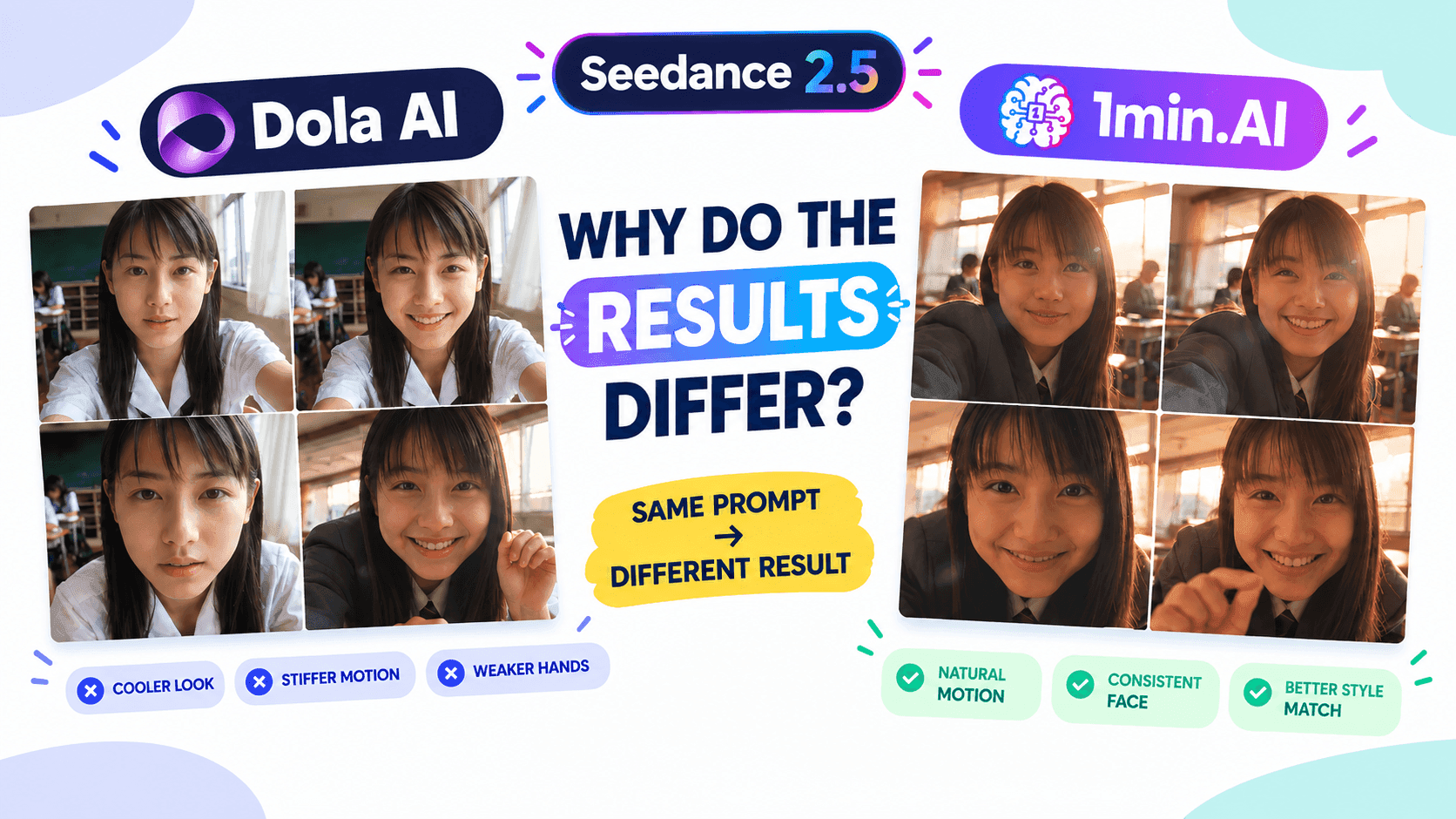
1min. AI vs Dola AI
Looking for a Dola AI alternative? Compare 1min.AI vs Dola AI on video generation, free plans, pricing and privacy to pick the right AI app.
Ngoc HongAI Tools
Discover the best AI tools to boost productivity, creativity, and everyday work.
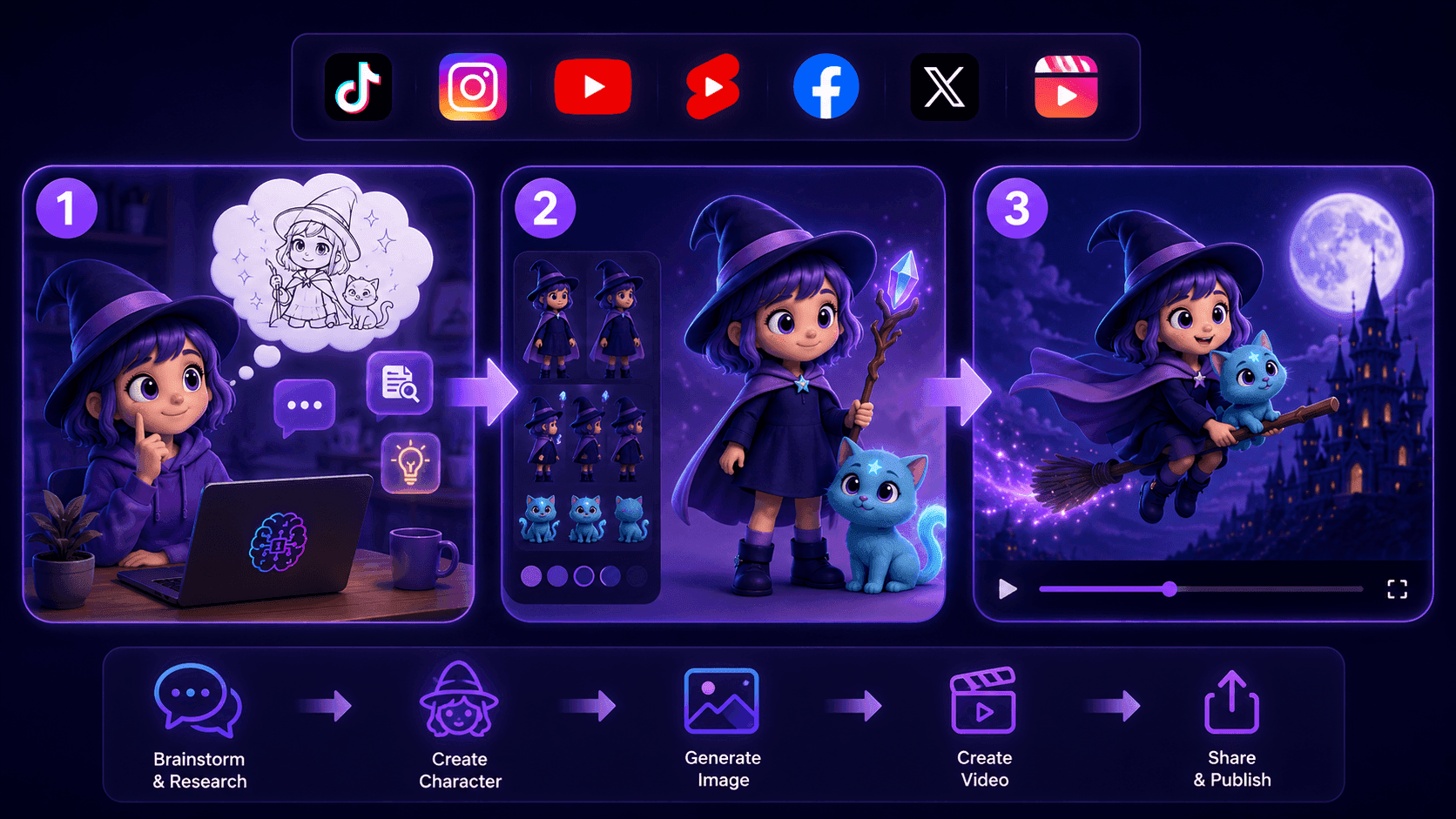
Create Consistent Cartoon Content in Just a Few Steps
Create engaging cartoon videos for TikTok and Reels with 1min.AI. Research ideas, create characters, and turn images into animated videos in 3 simple steps.
 Lien Anh Vu
One Product, 10 UGC Creatives: How AI Makes Content Testing Easier
Create more authentic UGC with an AI UGC video generator, test more creative angles and scale affiliate content without filming every version.
Lien Anh Vu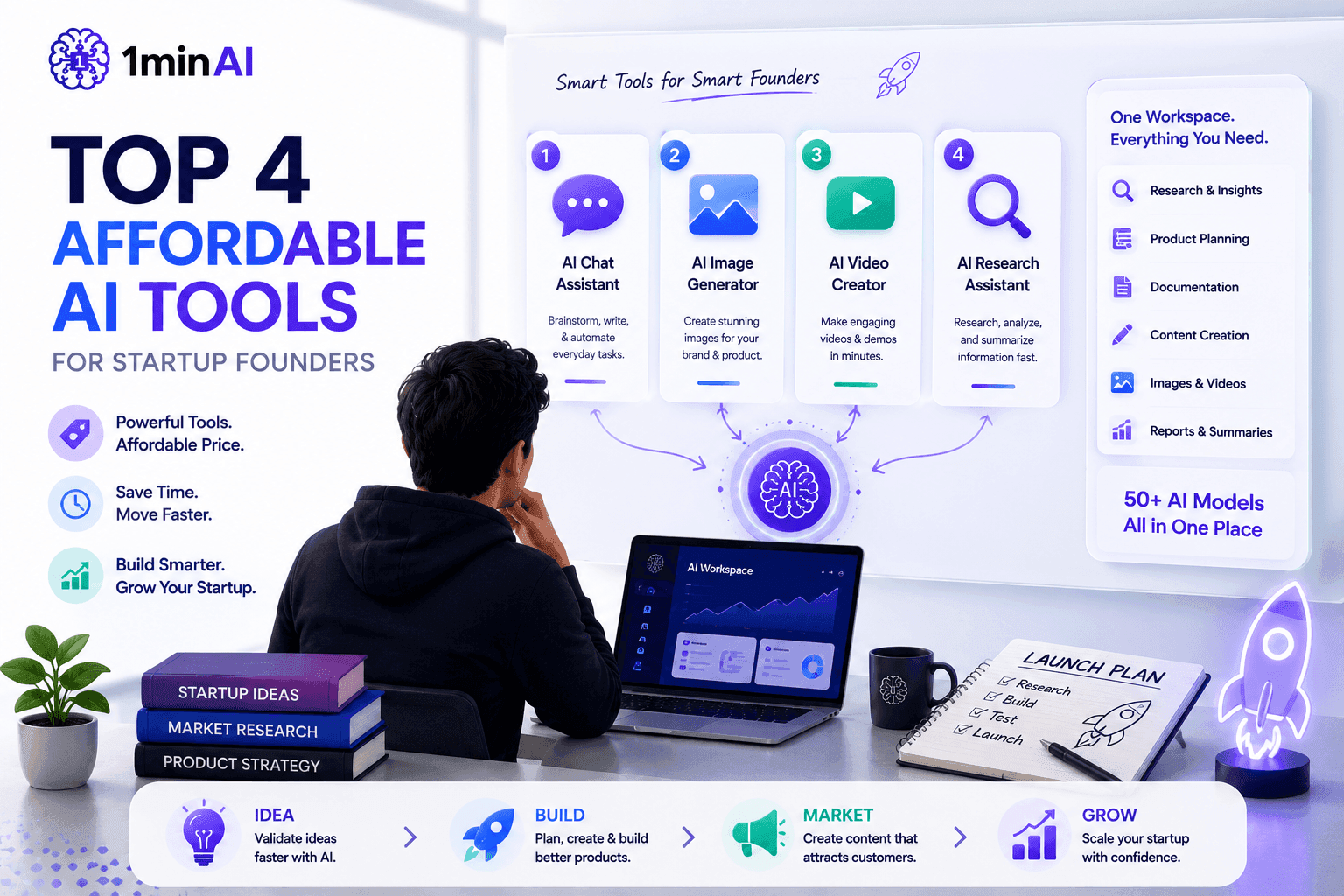
Top 4 Affordable AI Tools for Startup Founders
Discover the top 4 affordable AI tools for startup founders to validate ideas, build products, create content, and launch faster without overspending.
 Tram Ta
AI Features
Comprehensive AI features that streamline workflows, improve efficiency, and empower teams to achieve more.
Create Consistent Cartoon Content in Just a Few Steps
Create engaging cartoon videos for TikTok and Reels with 1min.AI. Research ideas, create characters, and turn images into animated videos in 3 simple steps.
Lien Anh VuOne Product, 10 UGC Creatives: How AI Makes Content Testing Easier
Create more authentic UGC with an AI UGC video generator, test more creative angles and scale affiliate content without filming every version.
Lien Anh Vu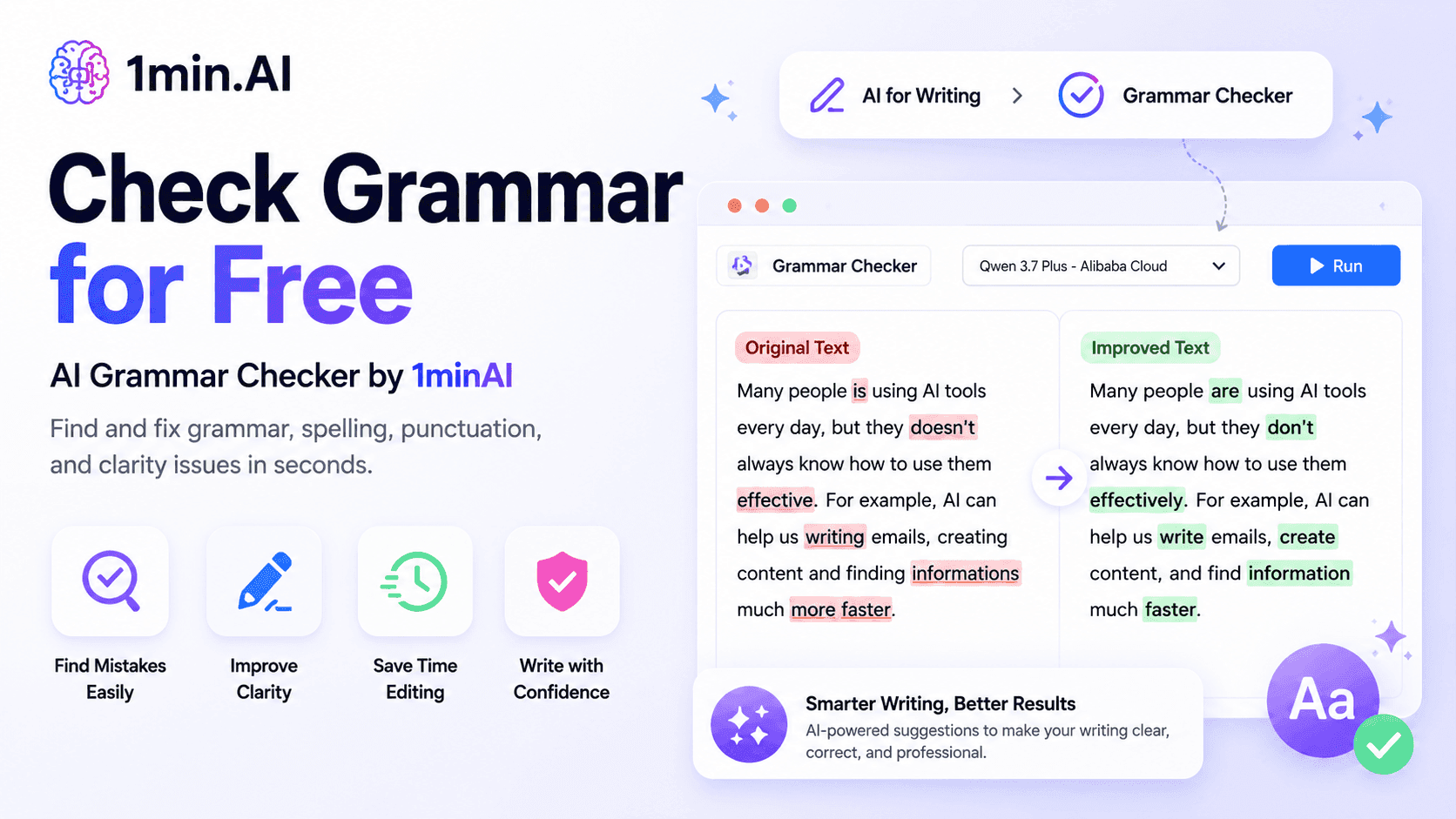
1minAI: Free AI Grammar Checker
Check grammar for free with 1minAI’s AI grammar checker. Find grammar, spelling, and writing mistakes, improve clarity, and polish your content in seconds.
Tram TaAI Use Cases
A curated collection of AI use cases for business, productivity, and industry-specific applications.
Create Consistent Cartoon Content in Just a Few Steps
Create engaging cartoon videos for TikTok and Reels with 1min.AI. Research ideas, create characters, and turn images into animated videos in 3 simple steps.
Lien Anh VuOne Product, 10 UGC Creatives: How AI Makes Content Testing Easier
Create more authentic UGC with an AI UGC video generator, test more creative angles and scale affiliate content without filming every version.
Lien Anh Vu
Best Time to Post on Instagram: A Practical Guide for Better Engagement
Discover the best time to post on Instagram, including the best days and times for different audiences, plus tips to find the ideal posting schedule for your account.
Tram TaAI Tutorials
Learn how to use AI with practical, step-by-step tutorials.

Black Friday AI Tool Deals in 2026
Discover what Black Friday AI tool deals 2026 has to offer. Find out how to secure the 1min.AI lifetime deal via AppSumo, Dealify, Stack Social, and verify on Trustpilot, Slashdot, and Software Advice.
 Hang Nguyen
Create Consistent Cartoon Content in Just a Few Steps
Create engaging cartoon videos for TikTok and Reels with 1min.AI. Research ideas, create characters, and turn images into animated videos in 3 simple steps.
Lien Anh Vu
[Seedance 2.5 New] Better AI Product Videos, Less Rework in 1min.AI
Use Seedance 2.5 image to video on 1min.AI to create more consistent AI product videos, reduce failed generations, save credits, and improve UGC workflows.
Lien Anh VuAI Guides
Learn AI faster with practical guides, real-world examples, and actionable best practices.

Safely Buy AI Tools Online: 2026 Black Friday Guide
Discover how to find and secure the best Black Friday AI deals online. Learn expert strategies to avoid scams, combat subscription fatigue, and verify software.
Hang NguyenCreate Consistent Cartoon Content in Just a Few Steps
Create engaging cartoon videos for TikTok and Reels with 1min.AI. Research ideas, create characters, and turn images into animated videos in 3 simple steps.
Lien Anh Vu[Seedance 2.5 New] Better AI Product Videos, Less Rework in 1min.AI
Use Seedance 2.5 image to video on 1min.AI to create more consistent AI product videos, reduce failed generations, save credits, and improve UGC workflows.
Lien Anh VuAI Solutions
Browse the best AI solutions for automation, coding, research, productivity, customer support, marketing, and business workflows.
Safely Buy AI Tools Online: 2026 Black Friday Guide
Discover how to find and secure the best Black Friday AI deals online. Learn expert strategies to avoid scams, combat subscription fatigue, and verify software.
Hang NguyenCreate Consistent Cartoon Content in Just a Few Steps
Create engaging cartoon videos for TikTok and Reels with 1min.AI. Research ideas, create characters, and turn images into animated videos in 3 simple steps.
Lien Anh VuOne Product, 10 UGC Creatives: How AI Makes Content Testing Easier
Create more authentic UGC with an AI UGC video generator, test more creative angles and scale affiliate content without filming every version.
Lien Anh VuAI Models
Explore the world's leading AI models in one place.
Create Consistent Cartoon Content in Just a Few Steps
Create engaging cartoon videos for TikTok and Reels with 1min.AI. Research ideas, create characters, and turn images into animated videos in 3 simple steps.
Lien Anh VuOne Product, 10 UGC Creatives: How AI Makes Content Testing Easier
Create more authentic UGC with an AI UGC video generator, test more creative angles and scale affiliate content without filming every version.
Lien Anh Vu[Seedance 2.5 New] Better AI Product Videos, Less Rework in 1min.AI
Use Seedance 2.5 image to video on 1min.AI to create more consistent AI product videos, reduce failed generations, save credits, and improve UGC workflows.
Lien Anh VuAI Comparisons
Compare AI tools, models, and platforms to find the best fit for your needs.
Kling AI Vs Veo 3: Which Model Wins?
Kling AI vs Veo 3: compare motion, native audio, pricing & free tiers to see which AI video generator wins for your project - try both on 1min.AI.
 Trang Tran
[Seedance 2.5 New] Better AI Product Videos, Less Rework in 1min.AI
Use Seedance 2.5 image to video on 1min.AI to create more consistent AI product videos, reduce failed generations, save credits, and improve UGC workflows.
Lien Anh Vu
DeepSeek V4 Pro vs Flash Comparison
Compare DeepSeek V4 Pro vs DeepSeek V4 Flash metrics. Optimize your agentic apps and improve AI fact checking on 1min.ai today.
Ngoc HongAI Integrations
Seamlessly integrate AI with the tools you already use to automate work and boost productivity.
POV: You Have 10+ Posts to Make Every Day
Learn how to build an AI content workflow that helps content creators produce 10+ social media posts a day faster with AI brainstorming, image generation, and content creation.
Lien Anh Vu
How to Use an AI Fashion Video Generator for Fashion Week 2026
Turn Fashion Week 2026 ideas into stunning fashion videos with AI. Learn how to brainstorm, create visuals, and transform images into videos with one simple workflow.
Lien Anh Vu
Stop Switching Between AI Apps: How AI Integration Transforms Employer Branding
Discover how AI integration helps HR teams streamline employer branding by combining AI writing, documents, images, video, and multiple AI models into one workspace.
Tram TaAI for Industries
Find the best AI tools and workflows for healthcare, finance, education, legal, manufacturing, retail, real estate, and more
7 Low-Cost AI Business Ideas for Your Startup
Explore 7 low-cost AI business ideas you can start with a small budget, from content and video services to AI consulting, reselling, and automation.
Tram Ta
How to Start a One-Person AI Business: 7 Models You Can Run Solo
Learn how to start a one-person AI business with 7 practical models, from AI consulting and content services to automation and software reselling.
Tram Ta
Free AI Image Generator For Ecommerce
Turn phone photos into studio, white-background, and lifestyle product images. Try the best AI image generator for ecommerce online free with 1min.AI.
Trang TranAI Agents
Discover and run AI agents to automate tasks across your work and daily life.
1minAI: Free AI Grammar Checker
Check grammar for free with 1minAI’s AI grammar checker. Find grammar, spelling, and writing mistakes, improve clarity, and polish your content in seconds.
Tram Ta
AI Agents for Facebook
Use an AI Agent for Facebook to create content, generate images, schedule posts, and publish from your documents and conversations.
Ngoc Hong
AI Agent vs AI Assistant: Which One Actually Saves Designers More Time?
Learn the difference between AI Agent vs AI Assistant and discover which solution helps designers automate repetitive work, reduce revisions, and save more time.
Lien Anh VuAI Workflows
Explore ready-to-use AI workflows for productivity, marketing, sales, support, and more.
Create Consistent Cartoon Content in Just a Few Steps
Create engaging cartoon videos for TikTok and Reels with 1min.AI. Research ideas, create characters, and turn images into animated videos in 3 simple steps.
Lien Anh VuOne Product, 10 UGC Creatives: How AI Makes Content Testing Easier
Create more authentic UGC with an AI UGC video generator, test more creative angles and scale affiliate content without filming every version.
Lien Anh VuPOV: You Have 10+ Posts to Make Every Day
Learn how to build an AI content workflow that helps content creators produce 10+ social media posts a day faster with AI brainstorming, image generation, and content creation.
Lien Anh VuNewsletter
Weekly AI Innovations with 1minAI

🔮 Weekly AI Innovations #140: Deepseek 4.1 Flash & Gemini Upgrades
Explore Deepseek 4.1 Flash and new Gemini models on 1min.ai. Plus, check our update on your Billing - Usage page for better clarity.
Hang Nguyen
🔮 Weekly AI Innovations #136: Grok 4.6 and Smart Data Retention
Discover the latest 1min.ai updates! Upgrade to Grok 4.6 for blazing-fast AI, and check our new Data Retention policies to secure your files today.
Hang Nguyen
🔮 Weekly AI Innovations #139: Dawn of the next-gen AI
Discover the immense power of GPT-6 Astra and Claude Fable 5.1. Unlock next-generation AI models on 1min.ai to solve complex tasks effortlessly.
Hang Nguyen