
1minAI Data Privacy Compliance: A Guide for Businesses

Tram Ta
November 25, 2026
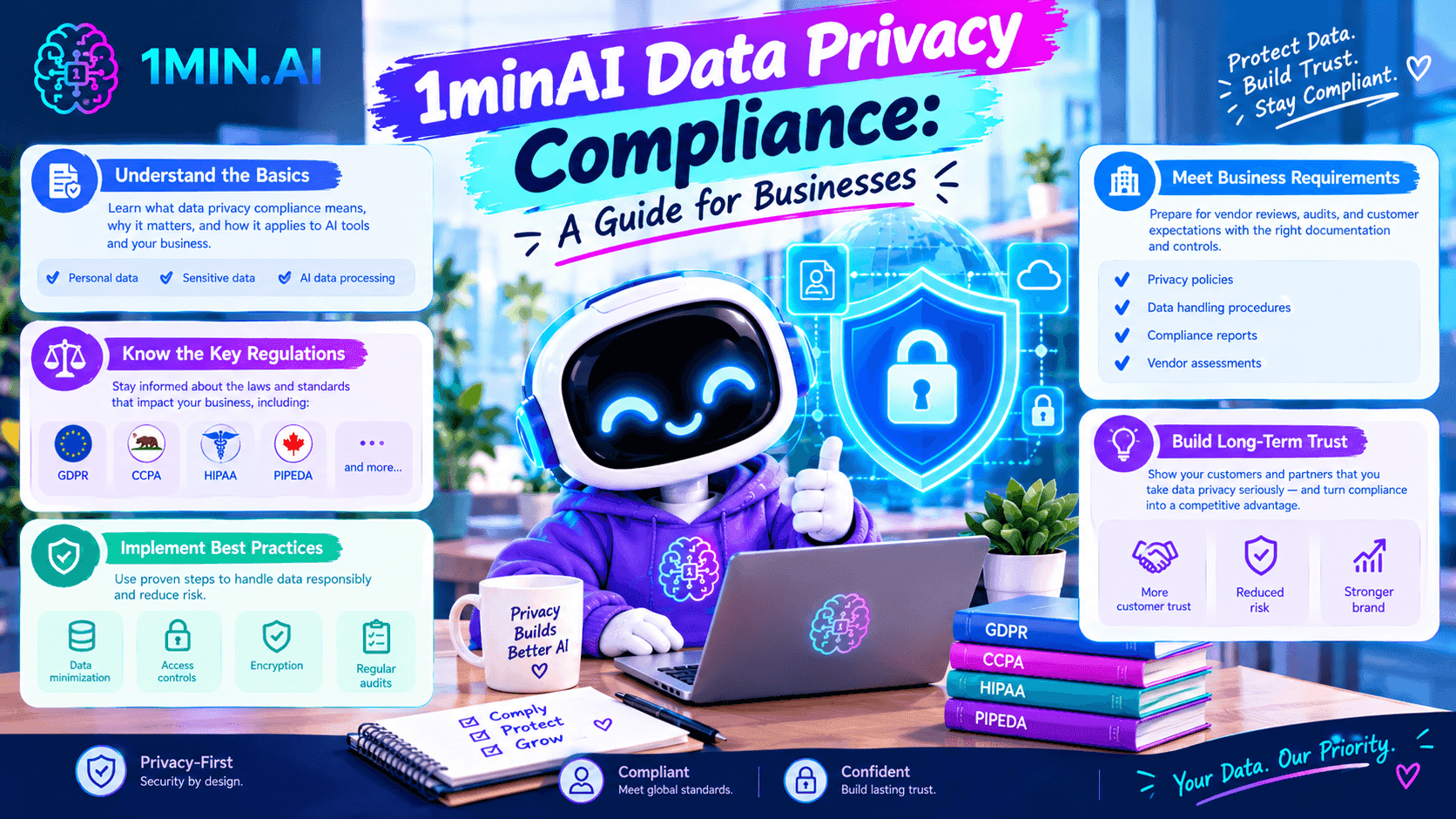
Explore data privacy compliance for AI tools, including GDPR principles, data handling, security controls, and how to evaluate 1minAI for business use.
Businesses are adopting AI to create content, analyze documents, automate repetitive tasks, and improve productivity. But as AI becomes part of everyday workflows, companies must also consider how personal and confidential information is collected, processed, stored, and shared.
This makes data privacy compliance an important consideration when choosing an AI platform. Organizations need to understand their legal obligations, review how software providers handle information, and establish rules for employees using AI at work.
For businesses considering 1minAI, the evaluation should cover both its published security practices and the privacy terms that apply to specific workflows.
In this guide, we'll explain the fundamentals of data privacy compliance, common risks when using AI, practical steps businesses can take, and how to review 1minAI's published security and privacy information.
What Is Data Privacy Compliance?
Data privacy compliance means following the laws, regulations, contractual requirements, and internal policies that govern how personal information is handled.
The exact requirements depend on factors such as where an organization operates, whose data it processes, the type of information involved, and the services it provides.
For example, a business serving customers in the European Economic Area may need to consider the General Data Protection Regulation (GDPR). A company handling protected health information in the United States may have obligations under HIPAA when the relevant legal conditions apply.
Data privacy compliance is not simply about preventing data breaches. It can also involve:
- Collecting only the personal information necessary for a defined purpose.
- Explaining how information will be used.
- Establishing an appropriate legal basis for processing where required.
- Limiting access to authorized people and services.
- Retaining information only as permitted and necessary.
- Respecting applicable rights to access, correct, or delete personal data.
- Managing third-party providers and international data transfers.
When AI tools enter a business workflow, these responsibilities do not automatically disappear. Organizations still need to understand what information they submit and whether their use of the platform meets applicable requirements.
Why Is Data Privacy Compliance Important When Using AI?
AI tools can process prompts, uploaded documents, images, audio, customer research, and information from connected applications. Depending on the workflow, that information may include personal details or confidential business data.
Without clear policies, employees might unintentionally submit information that should not be shared with an unapproved service.
Consider these examples:
| Business use case | Potential privacy concern |
|---|---|
| Drafting marketing emails | Including customer names, email addresses, or purchase histories in prompts |
| Summarizing customer feedback | Uploading identifiable comments without checking permissions |
| Analyzing business documents | Exposing personal or confidential information in reports |
| Generating customer support replies | Submitting account details or sensitive support conversations |
| Using AI agents with connected apps | Granting access to more data or actions than the task requires |
The solution is not necessarily to avoid AI altogether. Instead, businesses should assess the data involved, select suitable tools, and establish appropriate controls.
A clear approach to data privacy compliance can help reduce unnecessary exposure, support customer trust, and make AI adoption easier to manage.
How 1minAI Supports Data Privacy Compliance
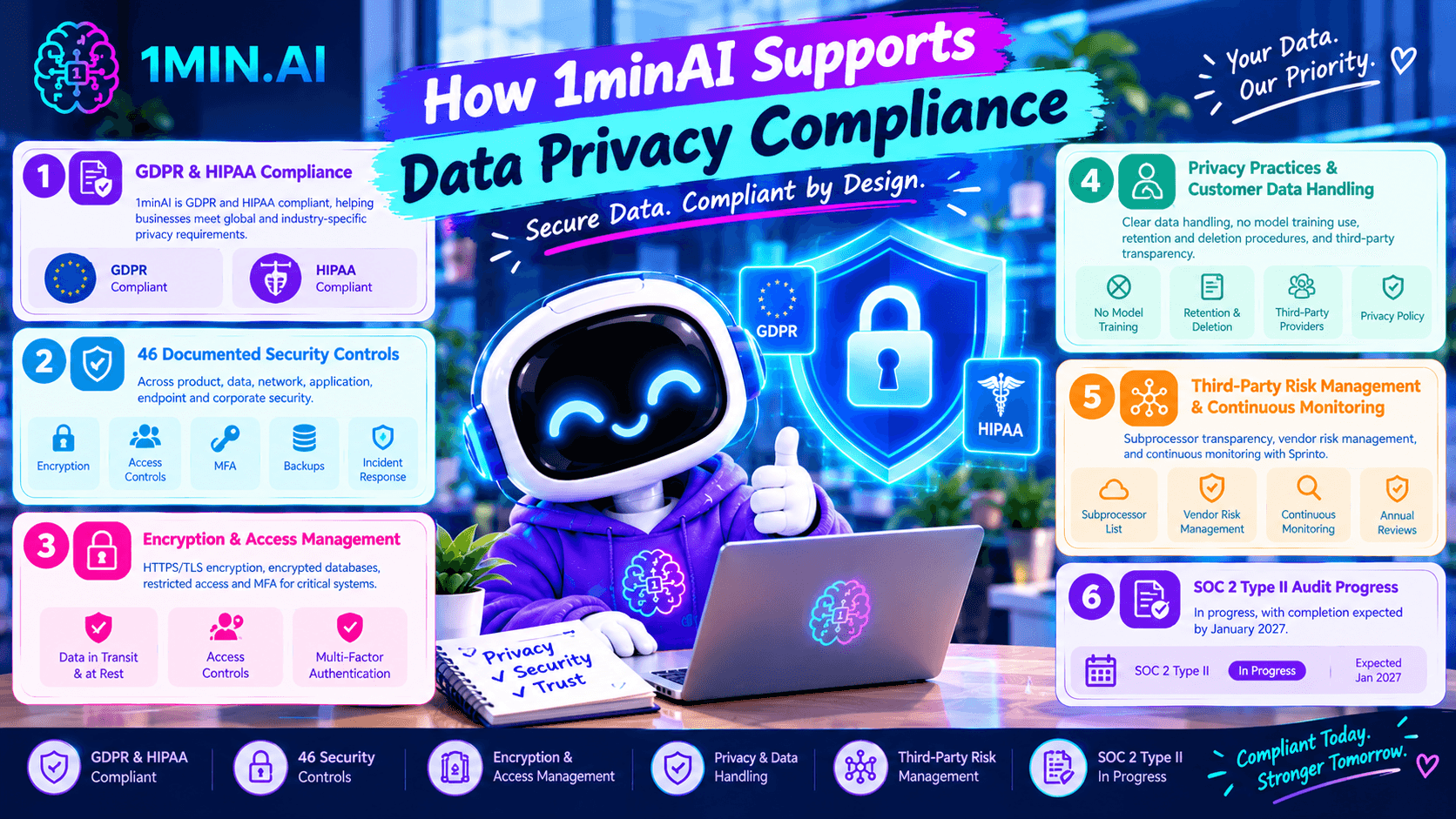
1minAI publishes information about its privacy practices, security controls, and compliance status through its AI Data Privacy page and Trust Center. These resources provide concrete evidence that businesses can use when assessing the platform for their workflows.
Here are six areas to consider when evaluating 1minAI's approach to data privacy compliance.
1. GDPR and HIPAA Compliance Information
Privacy and data protection requirements vary by jurisdiction and industry. Two important frameworks businesses may encounter are the General Data Protection Regulation (GDPR) and the Health Insurance Portability and Accountability Act (HIPAA).
According to its published Trust Center information, 1minAI lists both GDPR and HIPAA as compliant.
- GDPR: Relevant to organizations that process personal data within the regulation's scope. It establishes requirements concerning lawful processing, transparency, data minimization, individual rights, and accountability.
- HIPAA: Establishes protections for certain health information handled by covered entities and business associates in the United States, subject to the law's scope and requirements.
These compliance statements give businesses a starting point for their vendor assessment. However, compliance depends on the specific processing activity, contractual arrangements, and applicable legal requirements. For example, HIPAA obligations do not apply to every organization or every health-related workflow.
Before using 1minAI for regulated information, review the available documentation and confirm that the relevant service and intended use meet your organization's obligations.
2. 46 Documented Security Controls
1minAI's public security information lists 46 security controls across areas including product security, data security, network security, application security, endpoint protection, and corporate security.
These controls provide more detail than a general statement that a platform takes security seriously. They give businesses specific areas to examine during vendor reviews.
Examples of documented measures include:
- Encryption for data in transit and at rest.
- Restricted access to critical systems.
- Multi-factor authentication for staff accessing critical systems.
- Regular backups and backup-integrity testing.
- Documented security incident-response procedures.
- Security and privacy training for employees.
Together, these measures address several important aspects of protecting information against unauthorized access, loss, or disclosure.
For a business evaluating 1minAI, the next step is to review the relevant controls in the Trust Center and determine whether their scope matches the organization's data protection requirements.
3. Encryption and Access Management
Encryption and access controls are foundational components of data security.
1minAI's published security information describes HTTPS/TLS encryption for data in transit and encryption at rest for production databases storing customer data. It also describes approval requirements for access to critical systems and multi-factor authentication for staff with such access.
These measures serve different purposes:
- Encryption helps protect information while it is transmitted or stored.
- Access controls limit access to authorized personnel and systems.
- Multi-factor authentication (MFA) adds an additional verification step when staff access critical systems.
For organizations using AI to work with internal documents, client briefs, or business content, these controls are relevant evidence to consider when assessing a provider.
Security also depends on how customers use the platform. Businesses should establish appropriate account practices, limit unnecessary sharing, and ensure that employees follow internal data-handling policies.
4. Privacy Practices and Customer Data Handling
Data privacy compliance is not only about protecting information from unauthorized access. It also concerns how information is collected, processed, retained, and deleted.
1minAI's Privacy Policy describes its handling of personal data and other information submitted to the service. Its public documentation also states that customer data is not used to train AI models.
When reviewing these statements, businesses should distinguish between model training and other forms of data processing. Information may still be processed by the service or relevant third-party providers to deliver requested features, and some information may be stored according to the applicable terms and plan.
For a complete assessment, review:
- What personal information and uploaded content the service collects.
- How prompts, files, and generated outputs are handled.
- The applicable retention periods and deletion procedures.
- Which third-party providers may process information.
- Any exceptions or additional terms relevant to the intended workflow.
This helps organizations assess privacy requirements based on documented practices rather than assuming that a single privacy statement answers every question.
5. Third-Party Risk Management and Continuous Monitoring
AI platforms may depend on external providers for cloud infrastructure, AI processing, security monitoring, and other operational services. Reviewing these relationships is an important part of data privacy compliance because information may pass through multiple systems during a workflow.
1minAI's Trust Center provides subprocessor information and describes its security monitoring and vendor risk management practices. Its published security materials also identify Sprinto as a tool used for continuous compliance monitoring and describe annual management reviews of risk and vendor assessments.
These practices can help businesses investigate how a provider monitors its security program and evaluates external service providers.
Before adoption, review the current subprocessor list and confirm whether the relevant providers, data transfers, and contractual safeguards meet your organization's requirements.
6. SOC 2 Type II Audit Progress
Independent examinations can provide additional evidence for business customers assessing a software provider's controls.
According to 1minAI's published security information, its SOC 2 Type II audit is in progress, with completion expected by January 2027. This is a stated target, not confirmation that a completed report has been issued.
SOC 2 Type II evaluates relevant controls and their operating effectiveness over a defined period. It can support a vendor security assessment, but it is not a universal certification of compliance with every privacy law.
If your company requires a completed SOC 2 Type II report, check the 1minAI Trust Center for the latest status and available documentation.
In the meantime, businesses can assess the security controls and privacy information that 1minAI already publishes. The important point is to distinguish documented current controls from an audit that has not yet been completed.
Frequently Asked Questions
What is data privacy compliance?
Data privacy compliance means meeting the legal, contractual, and organizational requirements that govern how personal information is collected, used, stored, shared, and deleted.
Is data privacy compliance the same as data security?
No. Data security focuses on protecting information against unauthorized access, loss, or misuse. Data privacy focuses on how information is collected and processed, including whether that processing is lawful and appropriate. Security is an important part of privacy, but it is not the whole picture.
Is 1minAI suitable for businesses with privacy requirements?
Businesses should assess 1minAI against their specific requirements by reviewing its published privacy information, security controls, third-party providers, and applicable terms. Suitability depends on the data involved and the organization's legal, contractual, and technical obligations.
Does 1minAI use customer data to train AI models?
1minAI's published materials state that customer data is not used to train AI models. Review the current privacy documentation for the scope of that statement and other aspects of data processing, including retention and third-party services.
Does SOC 2 Type II guarantee data privacy compliance?
No. SOC 2 Type II examines controls within a defined scope and period. It does not automatically demonstrate compliance with every privacy law. Organizations should review the report alongside applicable legal obligations, privacy terms, and their own risk requirements.
Where can I learn more about 1minAI's data privacy practices?
Start with the 1minAI AI Data Privacy page and the 1minAI Trust Center. You can also read Is 1minAI Secure? A Guide to Data Security and Privacy and Is 1minAI Safe for Business?.
Conclusion
Data privacy compliance is an ongoing responsibility, not a one-time software selection decision. Businesses need to understand their legal obligations, minimize the information they share, evaluate vendors, and establish clear rules for using AI.
1minAI publishes information about its privacy approach and security controls to help users evaluate the platform. Before adopting it for sensitive workflows, review the available documentation, confirm the current compliance status, and check that the relevant practices meet your organization's requirements.
For further information, explore 1minAI AI Data Privacy.
Discover more AI features: https://1min.ai/features
Try 1minAI agent now: https://app.1min.ai/ai-agent-demo
- #Information
- #Commerce
- #SOC 2
Alternatives
Discover the best alternatives to 1minAI and compare features, pricing, and use cases.

1min.AI vs OpenRouter
1min.AI vs. OpenRouter: Compare the ready-to-use AI creation product against the technical API tool. Find out if you need a zero-code creative studio or a coding infrastructure hub.
 Ngoc Hong
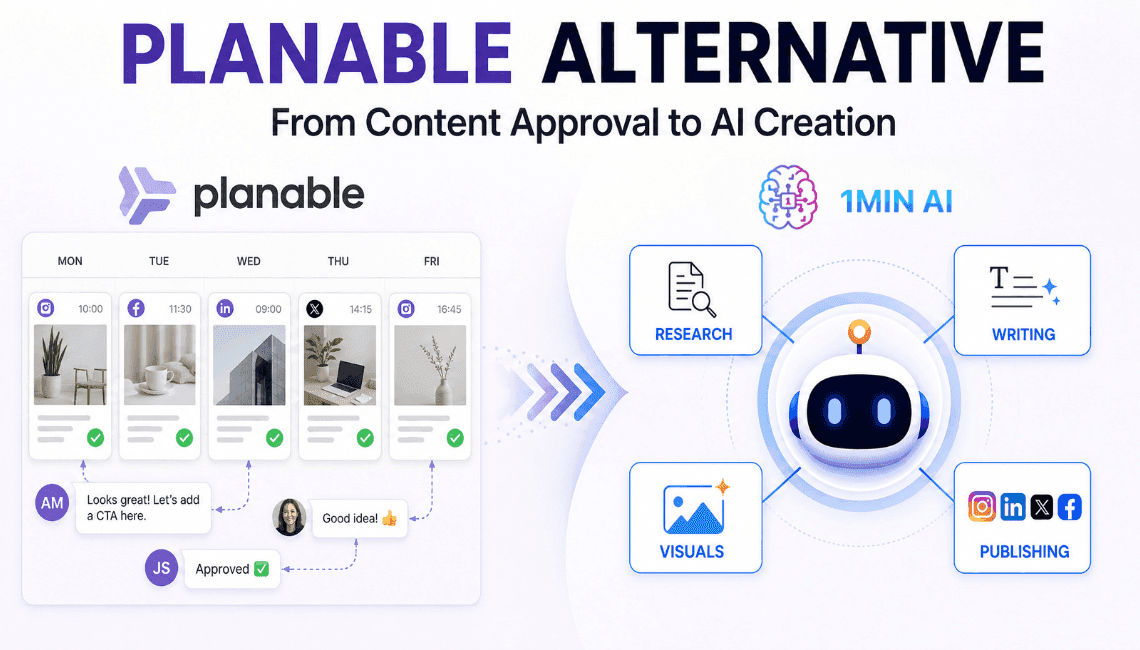
1min.AI vs Planable
Looking for a Planable alternative? See how 1min.AI Social Content Agents research, write, design and publish posts across your social channels from one credit pool.
 Trang Tran
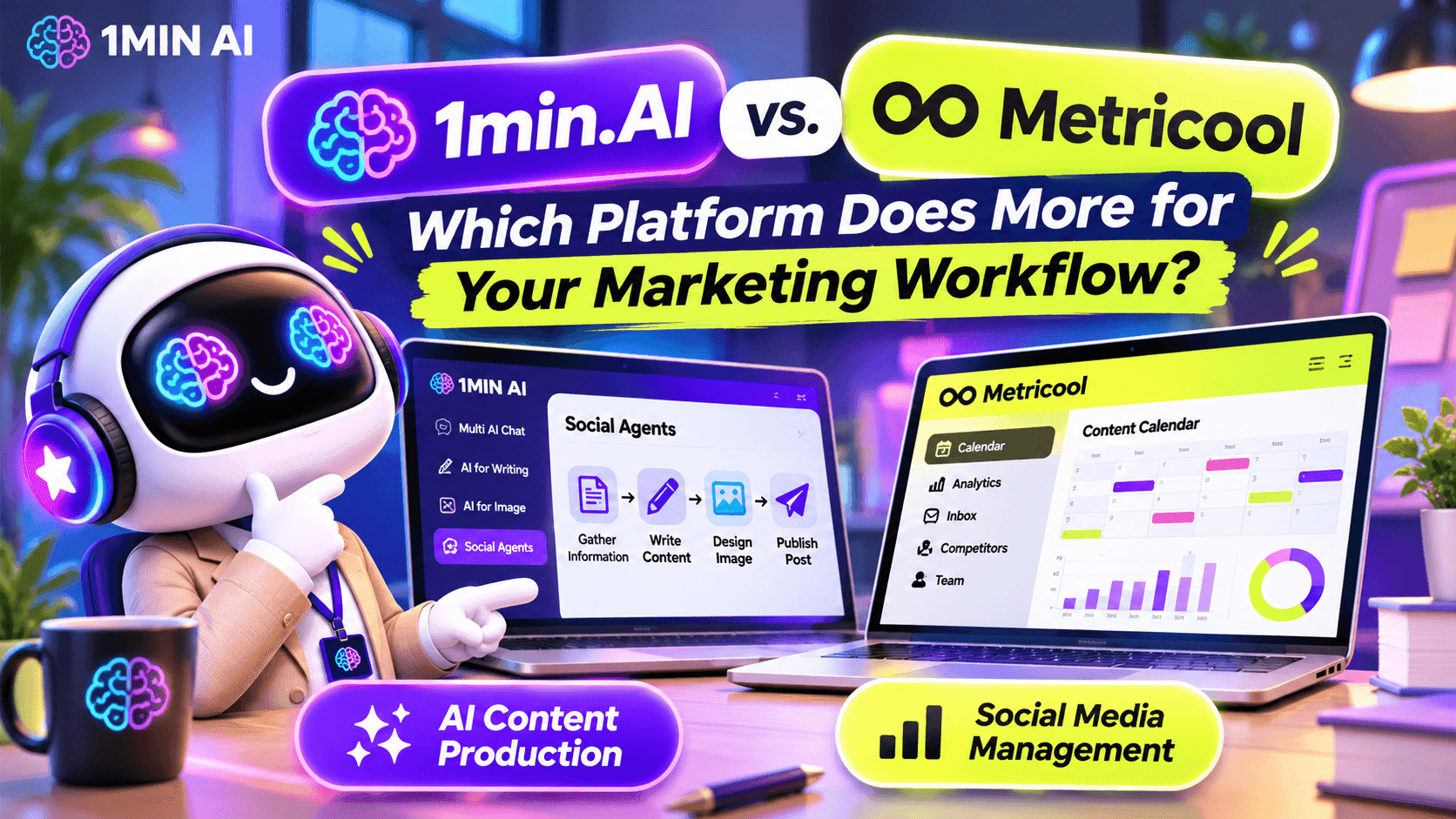
1min.AI vs. Metricool: Which Platform Does More for Your Marketing Workflow?
Compare 1min.AI vs. Metricool across content creation, visual production, scheduling, analytics, MCP, and pricing to find the right platform for your marketing workflow.
AI Tools
Discover the best AI tools to boost productivity, creativity, and everyday work.
Top 4 Affordable AI Tools for Startup Founders
Discover the top 4 affordable AI tools for startup founders to validate ideas, build products, create content, and launch faster without overspending.
 Tram Ta
Turn “Make It Better” Into Better Content With AI
Use AI to turn vague client feedback into clear revisions, reduce unnecessary edits, and deliver better content faster.
 Lien Anh Vu
Free AI X Comment
Create funny, witty, or insightful comments for Twitter with our AI-powered Twitter Comment Generator. Boost your engagement and stand out in the crowd!
Trang TranAI Features
Comprehensive AI features that streamline workflows, improve efficiency, and empower teams to achieve more.
1minAI: Free AI Grammar Checker
Check grammar for free with 1minAI’s AI grammar checker. Find grammar, spelling, and writing mistakes, improve clarity, and polish your content in seconds.
Tram Ta
Build a Portfolio Website Faster with 1min.AI
Learn how freelance creatives can use 1min.AI to plan, write, design, and generate a professional portfolio website faster, even without strong coding skills.
Lien Anh VuFree AI X Comment
Create funny, witty, or insightful comments for Twitter with our AI-powered Twitter Comment Generator. Boost your engagement and stand out in the crowd!
Trang TranAI Use Cases
A curated collection of AI use cases for business, productivity, and industry-specific applications.
Best Time to Post on Instagram: A Practical Guide for Better Engagement
Discover the best time to post on Instagram, including the best days and times for different audiences, plus tips to find the ideal posting schedule for your account.
Tram TaTurn “Make It Better” Into Better Content With AI
Use AI to turn vague client feedback into clear revisions, reduce unnecessary edits, and deliver better content faster.
Lien Anh VuBuild a Portfolio Website Faster with 1min.AI
Learn how freelance creatives can use 1min.AI to plan, write, design, and generate a professional portfolio website faster, even without strong coding skills.
Lien Anh VuAI Tutorials
Learn how to use AI with practical, step-by-step tutorials.
Black Friday AI Tool Deals in 2026
Discover what Black Friday AI tool deals 2026 has to offer. Find out how to secure the 1min.AI lifetime deal via AppSumo, Dealify, Stack Social, and verify on Trustpilot, Slashdot, and Software Advice.
 Hang Nguyen
Viral Reels in Minutes: How to Use 1minAI’s Text-to-Speech for Satirical Voiceovers
Learn how satirical page admins use 1minAI’s Text-to-Speech feature to generate instant news anchor and dramatic voiceovers for TikToks, Shorts, and Instagram Reels.
Turn “Make It Better” Into Better Content With AI
Use AI to turn vague client feedback into clear revisions, reduce unnecessary edits, and deliver better content faster.
Lien Anh VuAI Guides
Learn AI faster with practical guides, real-world examples, and actionable best practices.

Safely Buy AI Tools Online: 2026 Black Friday Guide
Discover how to find and secure the best Black Friday AI deals online. Learn expert strategies to avoid scams, combat subscription fatigue, and verify software.
Hang Nguyen
How to start an AI business without building from scratch
Learn how to start an AI business, validate your idea, and launch faster without building costly AI infrastructure from scratch.
Ngoc Hong
ChatGPT Prompt Tone and Accuracy: How to Get Better Answers on 1minAI
Does prompt tone affect ChatGPT accuracy? Explore the latest studies, learn effective prompting techniques, and compare AI responses on 1minAI.
Tram TaAI Solutions
Browse the best AI solutions for automation, coding, research, productivity, customer support, marketing, and business workflows.
Safely Buy AI Tools Online: 2026 Black Friday Guide
Discover how to find and secure the best Black Friday AI deals online. Learn expert strategies to avoid scams, combat subscription fatigue, and verify software.
Hang Nguyen
Free AI Tattoo Generator: Custom Designs
Turn any idea into a custom tattoo design with 1min.AI's free AI tattoo generator. Describe your idea, pick a style, and download in seconds.
Trang TranTurn “Make It Better” Into Better Content With AI
Use AI to turn vague client feedback into clear revisions, reduce unnecessary edits, and deliver better content faster.
Lien Anh VuAI Models
Explore the world's leading AI models in one place.
Free AI Chat With Claude Fable 5.2 On 1min.AI
Free AI chat with Claude Fable 5.2 on 1min.AI. Compare Fable 5.2 vs Opus 5.5, see Fable 5.2 benchmarks, and start chatting in minutes.
Trang Tran
GPT-6.2 Sol: Specs, Pricing & Free Access
Explore GPT-6.2 Sol specs, pricing, and how it compares with GPT-6.1 Sol and Claude Opus 5.5, then try it free in 1min.AI Multi AI Chat.
Trang Tran
GPT 6.2 Astra: Pricing, Benchmarks & Free Access
GPT 6.2 Astra release date, pricing, Reddit feedback and Opus 5.5 comparison. See what it does best and chat with it on 1min.AI for free.
Trang TranAI Comparisons
Compare AI tools, models, and platforms to find the best fit for your needs.
Gemini 4 Neon vs Hydrogen: Specs, Price & Picks
Gemini 4 Neon vs Hydrogen, Carbon and Argon: compare price, benchmarks and use cases to pick the right model, then test them side by side on 1min.AI.
Trang Tran
Kling AI Vs Veo 3: Which Model Wins?
Kling AI vs Veo 3: compare motion, native audio, pricing & free tiers to see which AI video generator wins for your project - try both on 1min.AI.
Trang Tran
DeepSeek V4 Pro vs Flash Comparison
Compare DeepSeek V4 Pro vs DeepSeek V4 Flash metrics. Optimize your agentic apps and improve AI fact checking on 1min.ai today.
Ngoc HongAI Integrations
Seamlessly integrate AI with the tools you already use to automate work and boost productivity.
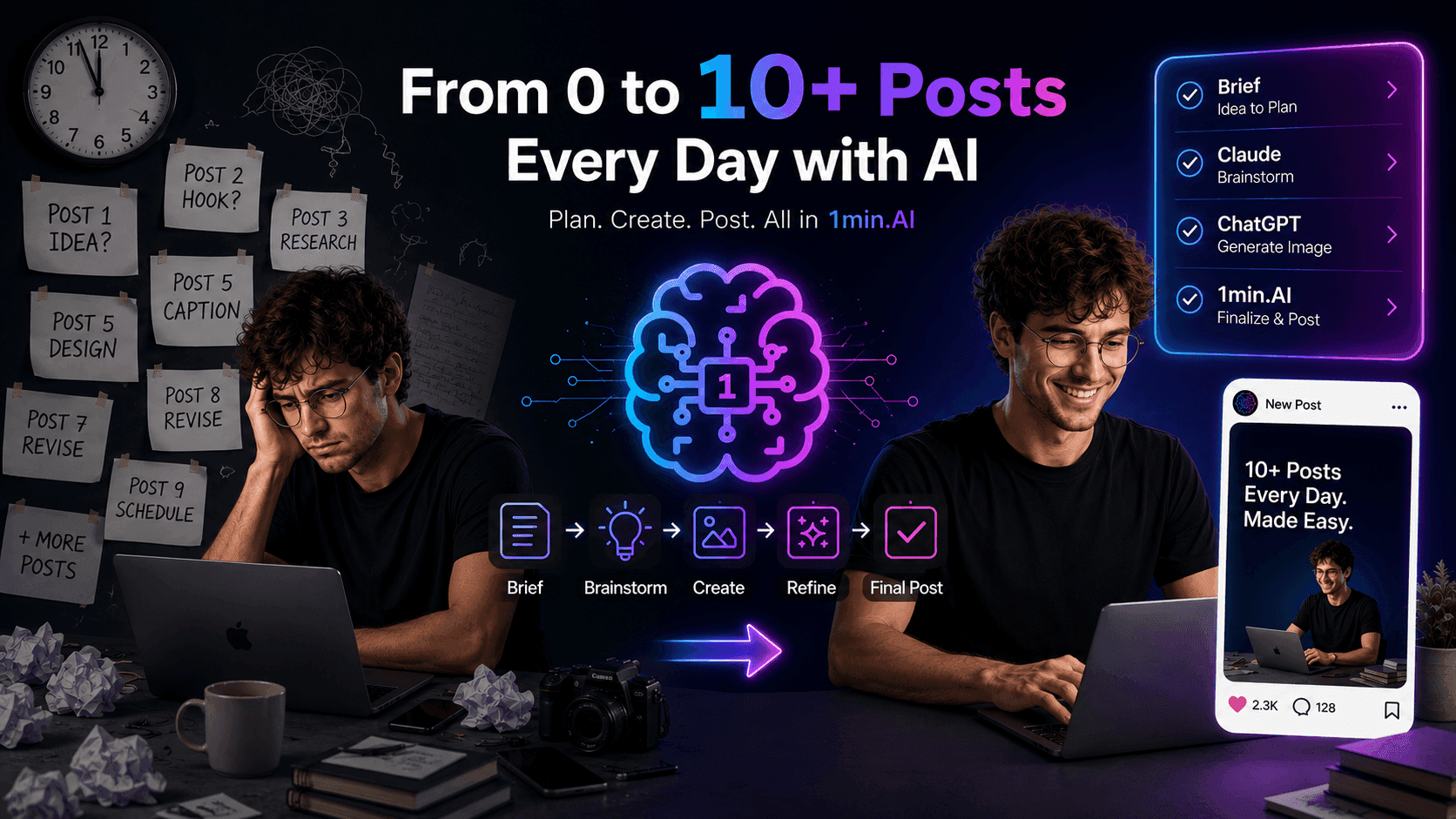
POV: You Have 10+ Posts to Make Every Day
Learn how to build an AI content workflow that helps content creators produce 10+ social media posts a day faster with AI brainstorming, image generation, and content creation.
Lien Anh Vu
Stop Switching Between AI Apps: How AI Integration Transforms Employer Branding
Discover how AI integration helps HR teams streamline employer branding by combining AI writing, documents, images, video, and multiple AI models into one workspace.
Tram Ta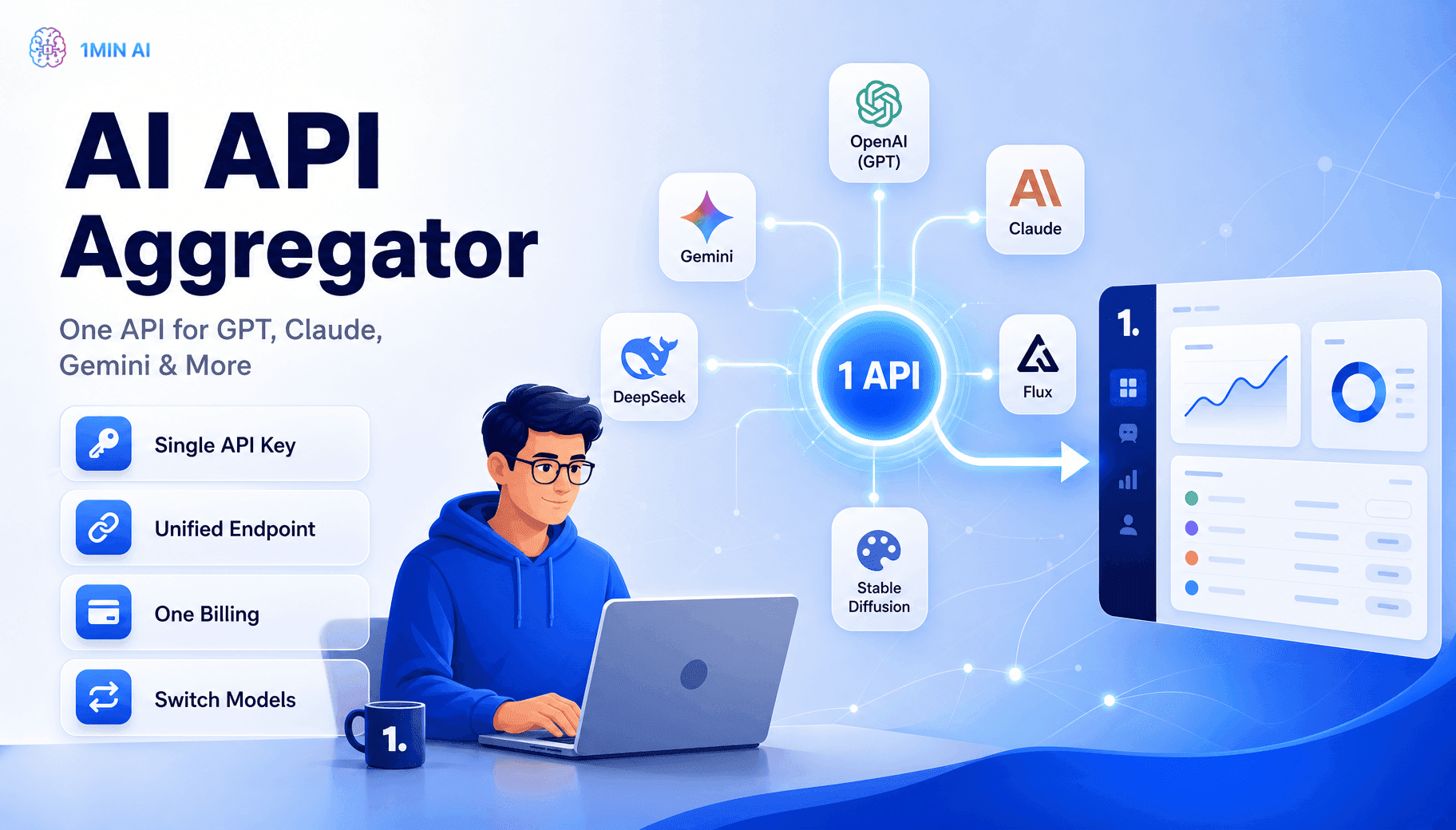
AI API Aggregator Explained For Developers
An AI API aggregator gives developers one unified API to call multiple AI models, cutting integration time and vendor lock in.
Trang TranAI for Industries
Find the best AI tools and workflows for healthcare, finance, education, legal, manufacturing, retail, real estate, and more
How to Launch an AI SaaS Without Building AI Models From Scratch
Learn how to launch an AI SaaS without building AI models from scratch. Explore white-label AI, product strategy, branding, pricing, and how 1minAI can help.
Tram Ta
ChatGPT Trending Photo Prompts to Copy and Paste
Explore chatgpt trending photo prompt ideas you can copy and paste. Create viral AI portraits, collages, and aesthetic photos with ease.
Trang TranTry Image To Video AI With Prompt Online Free
Try image to video AI with prompt online free, no login and no watermark. Upload a photo, type the motion you want, and get a short video in minutes.
Trang TranAI Agents
Discover and run AI agents to automate tasks across your work and daily life.
1minAI: Free AI Grammar Checker
Check grammar for free with 1minAI’s AI grammar checker. Find grammar, spelling, and writing mistakes, improve clarity, and polish your content in seconds.
Tram Ta
AI Agents for Facebook
Use an AI Agent for Facebook to create content, generate images, schedule posts, and publish from your documents and conversations.
Ngoc Hong
AI Agent vs AI Assistant: Which One Actually Saves Designers More Time?
Learn the difference between AI Agent vs AI Assistant and discover which solution helps designers automate repetitive work, reduce revisions, and save more time.
Lien Anh VuAI Workflows
Explore ready-to-use AI workflows for productivity, marketing, sales, support, and more.
POV: You Have 10+ Posts to Make Every Day
Learn how to build an AI content workflow that helps content creators produce 10+ social media posts a day faster with AI brainstorming, image generation, and content creation.
Lien Anh VuChatGPT Prompt Tone and Accuracy: How to Get Better Answers on 1minAI
Does prompt tone affect ChatGPT accuracy? Explore the latest studies, learn effective prompting techniques, and compare AI responses on 1minAI.
Tram Ta
How to Resell AI Software: A Practical Guide to Building an AI Revenue Stream
Learn how to resell AI software and build a recurring AI revenue stream. Discover how white label AI platforms help agencies and entrepreneurs launch branded AI services.
Tram TaNewsletter
Weekly AI Innovations with 1minAI

🔮 Weekly AI Innovations #147: 1min.ai Drops Major Shift: AI Circle, Kimi & Wan 3.0
Explore AI Circle (formerly AI Social), Kimi K3.1 Pro’s 2M context, and Alibaba Wan 3.0 & 3.0 Prime cinematic video on 1min.ai.
Hang Nguyen
🔮 Weekly AI Innovations #146: Mistral 3.5, Qwen Image & Cohere A+ are ready on 1min.ai
Deploy Mistral Large 3, Qwen Image 3.0, and Cohere Command A+ on 1min.ai. Boost RAG accuracy and cut visual generation latency in one unified AI workspace.
Hang Nguyen
🔮 Weekly AI Innovations #145: X Content Agent & GPT 6.1 Terra on 1min.ai
Scale viral reach with the X Content Agent on 1min.ai. Discover an end-to-end 4-stage pipeline with zero token burn, plus the launch of GPT 6.1 Terra.
Hang Nguyen