
Gemini Neon vs Carbon: Which Is Best for Daily Tasks?

Tram Ta
November 25, 2026
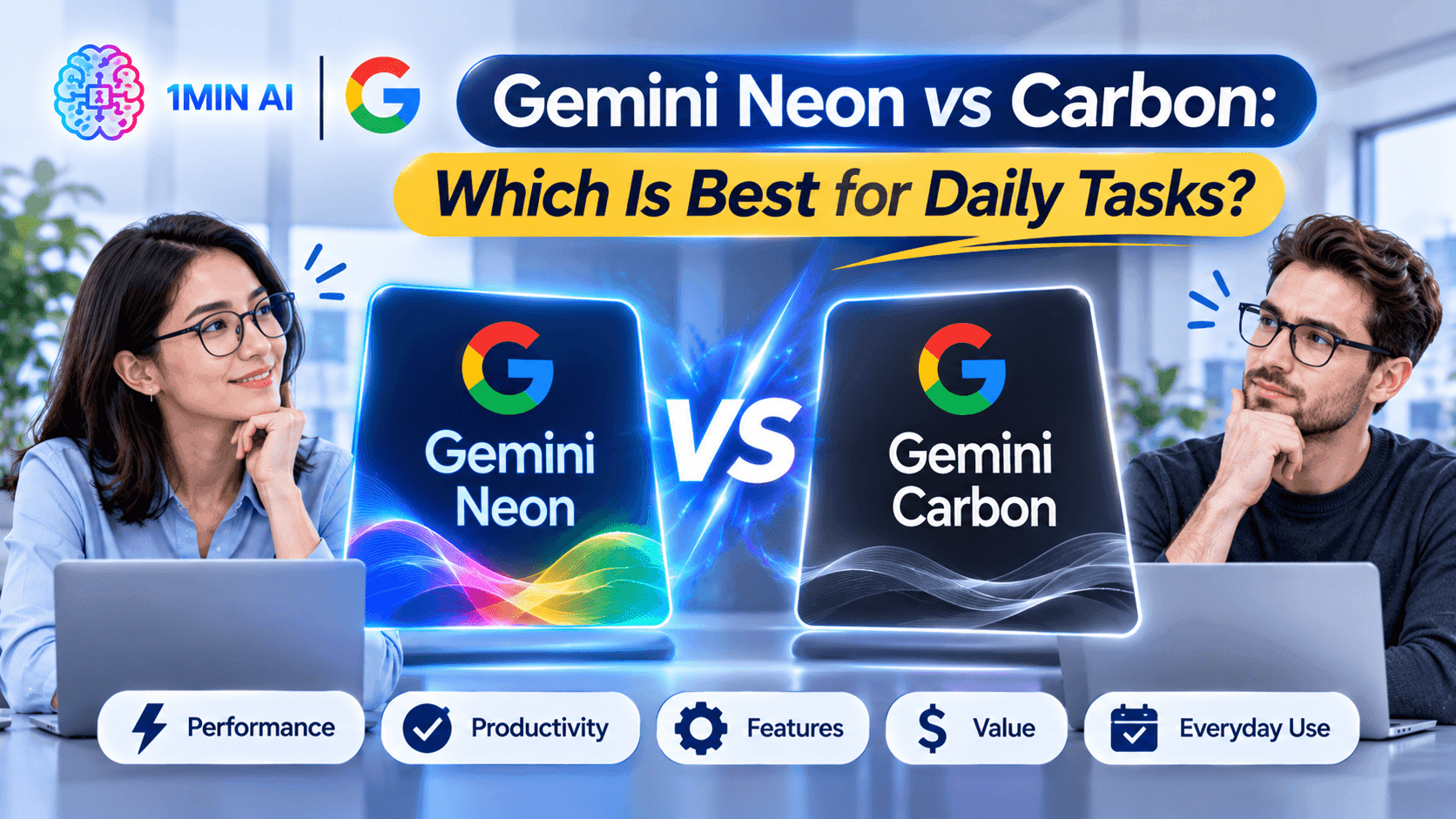
Compare Gemini 4 Neon vs Carbon for daily tasks, coding, research, and deep reasoning. Discover how to use Gemini Neon with other AI models on 1minAI.
Google's Gemini 4 family includes models designed for different levels of speed, reasoning, and task complexity. Two notable options are Gemini 4 Neon and Gemini 4 Carbon.
Both are capable of handling demanding AI tasks, but they have different priorities.
So, which one should you use for daily work?
You can also compare AI models in one workspace with 1minAI Multi AI Chat. While Gemini 4 Neon is available on 1minAI, Carbon is not currently listed as an integrated model, so you can use Neon alongside other available models to compare different approaches.
What Is Gemini 4 Neon?
Gemini 4 Neon is Google's model for users who need a balance between intelligence, speed, and efficiency.
It is adapted from Gemini 4 Carbon but optimized for frequent, demanding workflows. Instead of spending as much time exploring every possible direction, Neon aims to deliver strong reasoning and useful results with faster turnaround.
This makes it suitable for many everyday professional tasks, including:
- Writing and content creation: Draft articles, organize ideas, rewrite content, and develop marketing materials.
- Coding and debugging: Review code, identify errors, explain functions, and help implement features.
- Business analysis: Summarize reports, organize information, and evaluate business ideas.
- Research: Review documents, extract key information, and compare different sources.
- Multimodal tasks: Work with supported text, image, audio, and video inputs.
Why Use Gemini 4 Neon for Daily Work?
The biggest advantage of Neon is its balance. Many everyday tasks require more than a simple answer but don't need an extended reasoning process.
For example, imagine you're preparing a marketing campaign. You may need to:
- Research your target audience.
- Generate campaign ideas.
- Write social media captions.
- Review the messaging.
- Create variations for different channels.
Neon can help with each stage without requiring you to switch between multiple specialized tools for every small task.
It is also useful for developers who frequently ask AI to explain code, review functions, suggest fixes, and iterate on implementation ideas.
In short: Gemini 4 Neon is a practical choice when you want capable AI assistance throughout your working day.
What Is Gemini 4 Carbon?
Gemini 4 Carbon is designed for tasks that push the limits of AI reasoning.
Google positions Carbon for complex, multi-step work across engineering, cybersecurity, scientific reasoning, and demanding knowledge tasks. It can spend more thinking tokens exploring hypotheses, evaluating possible solutions, and running extended verification loops.
Rather than optimizing primarily for frequent interactions, Carbon is intended for problems where getting the reasoning right matters more than getting an immediate response.
Its strengths include:
- Complex software engineering: Investigate difficult bugs, understand large codebases, and evaluate architectural decisions.
- Scientific research: Explore complicated questions, compare hypotheses, and work through technical material.
- Long-horizon workflows: Handle tasks that involve multiple stages and require consistent reasoning.
- Deep verification: Examine assumptions, test possible explanations, and look for weaknesses in proposed solutions.
- Advanced data analysis: Work through complicated datasets and analytical problems.
When Does Gemini 4 Carbon Make More Sense?
Consider a software team investigating a problem that appears across several interconnected services.
A basic debugging task might involve identifying a syntax error or correcting a small function. Neon is a reasonable choice for that kind of work.
However, a deeper investigation might require understanding the entire architecture, tracing dependencies, examining multiple possible causes, and evaluating whether a proposed fix introduces new problems.
That's the type of demanding workflow Carbon is designed to address.
Carbon can also be useful when researching a complicated scientific question or reviewing a large technical project where the reasoning process itself is important.
In short: Carbon is aimed at difficult problems that benefit from deeper exploration, rather than every routine interaction.
Gemini 4 Neon vs Carbon: Speed, Reasoning, and Pricing
Let's look beyond their intended roles and examine some measurable differences.
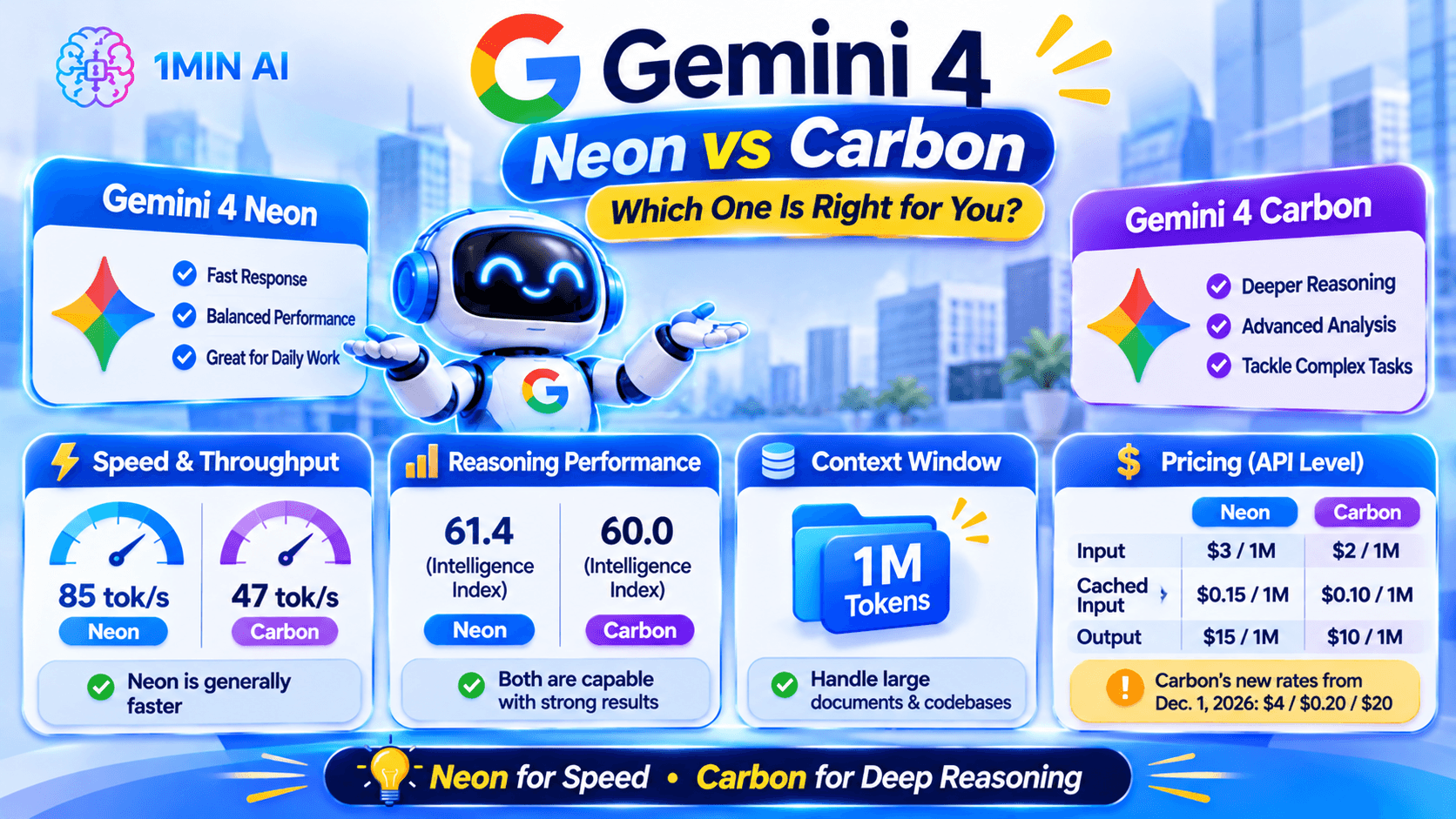
Speed and Throughput
Gemini 4 Neon is generally faster in current provider comparisons.
For example, OpenRouter's published comparison reports median throughput of approximately 85 tokens per second for Neon and 47 tokens per second for Carbon. Its reported median latency is also lower for Neon.
These figures provide a useful indication of their relative response speed, but they are not guaranteed performance for every prompt. Results can change depending on the provider, model settings, server load, and task complexity.
For frequent tasks such as drafting, summarizing, and iterative coding, faster responses can make a noticeable difference to your workflow.
Carbon's slower pace can be acceptable when the task requires more extensive reasoning and verification.
Reasoning and Benchmark Performance
Both models are capable, and neither should be treated as universally better.
In the OpenRouter comparison using Artificial Analysis results, Neon records an Intelligence Index score of 61.4 at its reported best configuration, while Carbon records 60.0.
However, the comparison uses different thinking configurations for the two models. It should not be interpreted as a perfectly controlled test of every possible setting.
Google's own Carbon model card also reports strong results across several demanding benchmarks, including long-context reasoning, engineering, scientific reasoning, and agentic workflows.
The practical takeaway is that benchmark rankings are useful reference points, but your own tasks matter more. A model that performs well on a general benchmark may not necessarily produce the best answer for your particular business or technical problem.
Context Window
Both models support a context window of approximately one million tokens.
This is useful when working with large amounts of information, such as:
- Long reports and technical documents.
- Large codebases.
- Research materials.
- Multiple files that need to be analyzed together.
- Extensive project instructions and background information.
However, a large context window does not automatically mean every answer will be accurate. You should still verify important details and ask the model to identify uncertainty.
API Pricing
Based on the currently published OpenRouter comparison, the introductory API rates are:
| API pricing | Gemini 4 Neon | Gemini 4 Carbon |
|---|---|---|
| Input | $3 / 1M tokens | $2 / 1M tokens |
| Cached input | $0.15 / 1M tokens | $0.10 / 1M tokens |
| Output | $15 / 1M tokens | $10 / 1M tokens |
Carbon's introductory pricing is scheduled to end on November 30, 2026. From December 1, the listed standard rates are scheduled to increase to $4 per million input tokens, $0.20 per million cached input tokens, and $20 per million output tokens.
These are API-level prices, not subscription fees or 1minAI credit rates. Developers should confirm the latest prices with their API provider before estimating production costs.
Which Model Is Better for Different Daily Tasks?
You don't need the most powerful model for every task. The smarter approach is to match the model to the amount of reasoning required.
| Daily task | Suggested model | Why |
|---|---|---|
| Writing emails and short content | Gemini 4 Neon | Fast, capable assistance for frequent writing |
| Summarizing documents | Gemini 4 Neon | Efficient document analysis |
| Brainstorming marketing ideas | Gemini 4 Neon | Quick idea generation and iteration |
| Routine coding and debugging | Gemini 4 Neon | Suitable for frequent development tasks |
| Reviewing a large software architecture | Gemini 4 Carbon | Designed for complex engineering problems |
| Investigating difficult technical issues | Gemini 4 Carbon | Better suited to extended reasoning and verification |
| Exploring scientific research | Gemini 4 Carbon | Designed for demanding research and reasoning |
| Analyzing a complicated multi-stage problem | Gemini 4 Carbon | More suitable when thorough exploration matters |
These are practical starting points, not strict limitations. Neon can handle complex work, and Carbon can perform simpler tasks. The difference is which model is likely to be the more appropriate starting point.
How to Use Gemini 4 Neon With Other AI Models on 1minAI
Comparing models is more useful than relying on a single benchmark or review.
For example, you might ask one model to develop a business strategy and another to critique it. One may produce a more practical plan, while another may identify risks or opportunities that were overlooked.
This is where 1minAI Multi AI Chat can help.
1minAI brings multiple AI models into one workspace, allowing you to switch between available models and compare their responses without managing separate chat interfaces.
Gemini 4 Neon is available on 1minAI. Gemini 4 Carbon is not currently integrated, but you can compare Neon with other available models, such as Gemini 4 Argon and Claude Opus 5.5, for a second perspective.
Step 1: Open 1minAI Multi AI Chat
Visit 1minAI and open AI Chat. Choose Gemini 4 Neon from the available model list.
You can start with a free account and use available credits to try supported models. Check your account's current credit balance and usage before running larger tasks.
Step 2: Give Gemini 4 Neon a Real Daily Task
Start with a task you already need to complete.
For example, ask Neon to create a weekly marketing plan, review a report, or help debug a piece of code.
Try this prompt:
Prompt:
"Act as a business productivity assistant. Help me organize the following tasks into a practical weekly plan. Prioritize tasks based on urgency, business impact, and estimated effort. Identify dependencies and suggest which tasks can be completed together.
My tasks:
[Insert your tasks here]
Present the result as a weekly schedule with clear priorities and actionable next steps."
Review the response and adjust the instructions until the plan fits your actual workload.
Step 3: Compare the Result With Another Available Model
Now switch to another model available in 1minAI, such as Gemini 4 Argon or Claude Opus 5.5.
Give it the same prompt and compare:
- Which response is easier to follow?
- Which model identifies more practical priorities?
- Which one makes fewer unsupported assumptions?
- Which plan better matches your available time and resources?
You can also ask the second model to critique the first model's output.
Comparison prompt:
"Review this weekly productivity plan. Identify missing tasks, unrealistic deadlines, potential dependencies, and opportunities to improve the schedule. Explain your reasoning and provide a revised version if necessary."
This approach helps you benefit from multiple AI perspectives rather than accepting the first response automatically.
Step 4: Use the Best Ideas to Complete Your Work
Once you have compared the responses, combine the most useful suggestions.
For example, use one model's schedule, another model's prioritization advice, and your own knowledge of the business to create a final plan.
You can apply the same approach to content creation, research, coding, and business analysis.
Step 5: Move to a Deeper-Reasoning Workflow When Needed
If your task becomes more demanding than a normal daily request, consider whether a stronger reasoning model or a specialized tool is appropriate.
For example, a routine code review may be manageable with Neon. A complex architectural investigation may warrant a model designed for deeper reasoning, such as Carbon through a supported provider.
You can explore other model options and AI tools through 1minAI's AI model comparison and multi-model workspace.
A note about Carbon: Until Gemini 4 Carbon is added to 1minAI, you cannot select Neon and Carbon together inside its model list. You can still use Neon with other models available on 1minAI and evaluate Carbon separately through a provider that supports it.
Why Using Multiple AI Models on 1minAI Can Improve Your Workflow
The biggest advantage of using multiple AI models is having more than one perspective on the same problem.
Even capable models can interpret instructions differently, overlook details, or make assumptions. Comparing responses helps you identify those differences before relying on an answer.
With 1minAI, you can use this approach across several types of work:
- Content creation: Generate ideas with one model and ask another to improve the structure or critique the draft.
- Business planning: Compare strategic recommendations and identify assumptions that need further research.
- Research: Ask different models to summarize and analyze the same material, then verify important findings.
- Software development: Use one model to propose an implementation and another to review its logic and potential edge cases.
- Everyday productivity: Compare schedules, task priorities, and approaches to managing your workload.
You don't need to use multiple models for every small request. For simple tasks, one suitable model is often enough. Model comparison becomes more valuable when the output affects an important decision or when you want to explore different solutions.
Conclusion: Use the Right AI Model for the Right Task
In the Gemini 4 Neon vs Carbon comparison, the main difference is their intended role.
Gemini 4 Neon is a strong choice for frequent work that requires a balance of reasoning, speed, and efficiency. It can help with everyday writing, coding, research, and business tasks.
Gemini 4 Carbon is designed for more demanding problems, including complex engineering, scientific research, and long-horizon workflows that benefit from deeper reasoning and verification.
But you don't have to build your entire workflow around a single model.
With 1minAI Multi AI Chat, you can use Gemini 4 Neon alongside other available AI models, compare their responses, and choose the strongest ideas for your work. Although Carbon is not currently integrated into 1minAI, you can still explore its capabilities through supported providers and compare its results with your 1minAI workflow.
The goal isn't to use the most powerful model for everything. It's to combine the right AI capabilities to get better results from your daily work.
For more AI capabilities, visit 1minAI Features and try the 1minAI Agent.
- #Information
- #Commerce
Alternatives
Discover the best alternatives to 1minAI and compare features, pricing, and use cases.

1min.AI vs OpenRouter
1min.AI vs. OpenRouter: Compare the ready-to-use AI creation product against the technical API tool. Find out if you need a zero-code creative studio or a coding infrastructure hub.
 Ngoc Hong
1min.AI vs Planable
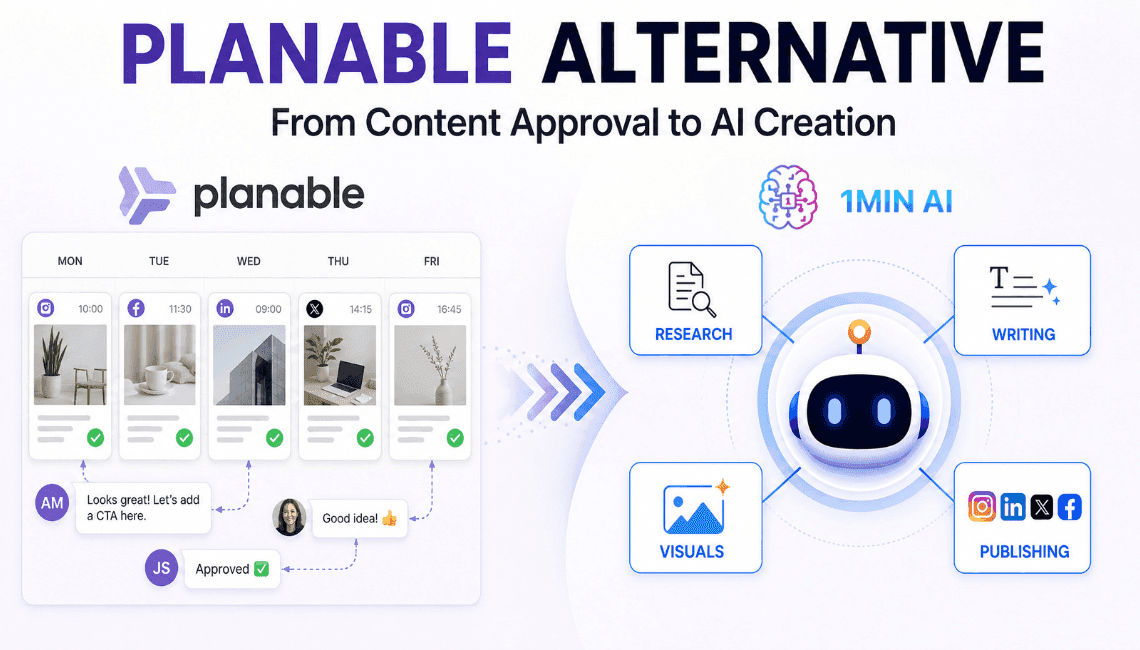
Looking for a Planable alternative? See how 1min.AI Social Content Agents research, write, design and publish posts across your social channels from one credit pool.
 Trang Tran
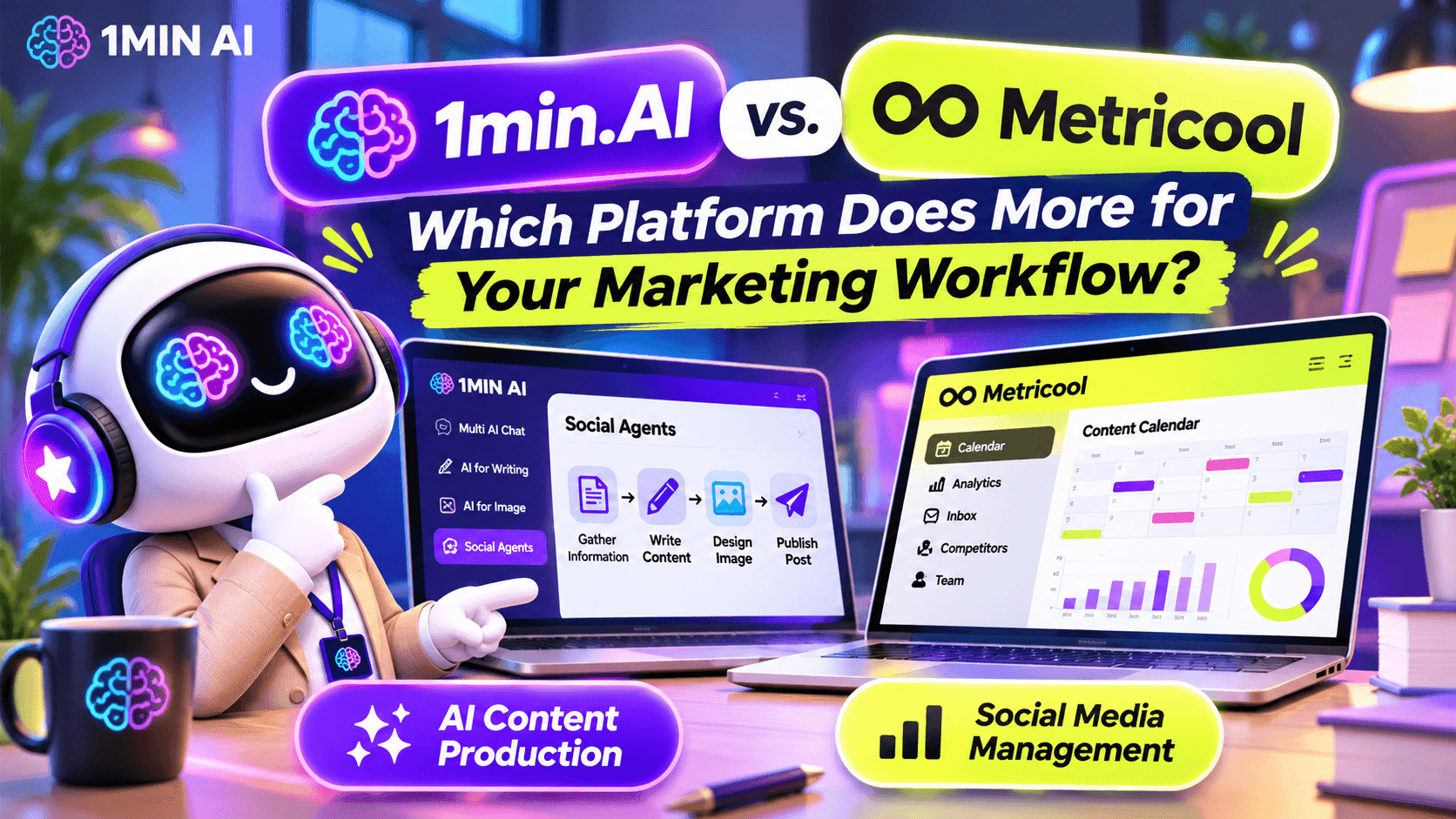
1min.AI vs. Metricool: Which Platform Does More for Your Marketing Workflow?
Compare 1min.AI vs. Metricool across content creation, visual production, scheduling, analytics, MCP, and pricing to find the right platform for your marketing workflow.
AI Tools
Discover the best AI tools to boost productivity, creativity, and everyday work.
Top 4 Affordable AI Tools for Startup Founders
Discover the top 4 affordable AI tools for startup founders to validate ideas, build products, create content, and launch faster without overspending.
 Tram Ta
Turn “Make It Better” Into Better Content With AI
Use AI to turn vague client feedback into clear revisions, reduce unnecessary edits, and deliver better content faster.
 Lien Anh Vu
Free AI X Comment
Create funny, witty, or insightful comments for Twitter with our AI-powered Twitter Comment Generator. Boost your engagement and stand out in the crowd!
Trang TranAI Features
Comprehensive AI features that streamline workflows, improve efficiency, and empower teams to achieve more.
1minAI: Free AI Grammar Checker
Check grammar for free with 1minAI’s AI grammar checker. Find grammar, spelling, and writing mistakes, improve clarity, and polish your content in seconds.
Tram Ta
Build a Portfolio Website Faster with 1min.AI
Learn how freelance creatives can use 1min.AI to plan, write, design, and generate a professional portfolio website faster, even without strong coding skills.
Lien Anh VuFree AI X Comment
Create funny, witty, or insightful comments for Twitter with our AI-powered Twitter Comment Generator. Boost your engagement and stand out in the crowd!
Trang TranAI Use Cases
A curated collection of AI use cases for business, productivity, and industry-specific applications.
Best Time to Post on Instagram: A Practical Guide for Better Engagement
Discover the best time to post on Instagram, including the best days and times for different audiences, plus tips to find the ideal posting schedule for your account.
Tram TaTurn “Make It Better” Into Better Content With AI
Use AI to turn vague client feedback into clear revisions, reduce unnecessary edits, and deliver better content faster.
Lien Anh VuBuild a Portfolio Website Faster with 1min.AI
Learn how freelance creatives can use 1min.AI to plan, write, design, and generate a professional portfolio website faster, even without strong coding skills.
Lien Anh VuAI Tutorials
Learn how to use AI with practical, step-by-step tutorials.

Black Friday AI Tool Deals in 2026
Discover what Black Friday AI tool deals 2026 has to offer. Find out how to secure the 1min.AI lifetime deal via AppSumo, Dealify, Stack Social, and verify on Trustpilot, Slashdot, and Software Advice.
 Hang Nguyen
Viral Reels in Minutes: How to Use 1minAI’s Text-to-Speech for Satirical Voiceovers
Learn how satirical page admins use 1minAI’s Text-to-Speech feature to generate instant news anchor and dramatic voiceovers for TikToks, Shorts, and Instagram Reels.
Turn “Make It Better” Into Better Content With AI
Use AI to turn vague client feedback into clear revisions, reduce unnecessary edits, and deliver better content faster.
Lien Anh VuAI Guides
Learn AI faster with practical guides, real-world examples, and actionable best practices.

Safely Buy AI Tools Online: 2026 Black Friday Guide
Discover how to find and secure the best Black Friday AI deals online. Learn expert strategies to avoid scams, combat subscription fatigue, and verify software.
Hang Nguyen
How to start an AI business without building from scratch
Learn how to start an AI business, validate your idea, and launch faster without building costly AI infrastructure from scratch.
Ngoc Hong
ChatGPT Prompt Tone and Accuracy: How to Get Better Answers on 1minAI
Does prompt tone affect ChatGPT accuracy? Explore the latest studies, learn effective prompting techniques, and compare AI responses on 1minAI.
Tram TaAI Solutions
Browse the best AI solutions for automation, coding, research, productivity, customer support, marketing, and business workflows.
Safely Buy AI Tools Online: 2026 Black Friday Guide
Discover how to find and secure the best Black Friday AI deals online. Learn expert strategies to avoid scams, combat subscription fatigue, and verify software.
Hang Nguyen
Free AI Tattoo Generator: Custom Designs
Turn any idea into a custom tattoo design with 1min.AI's free AI tattoo generator. Describe your idea, pick a style, and download in seconds.
Trang TranTurn “Make It Better” Into Better Content With AI
Use AI to turn vague client feedback into clear revisions, reduce unnecessary edits, and deliver better content faster.
Lien Anh VuAI Models
Explore the world's leading AI models in one place.
Free AI Chat With Claude Fable 5.2 On 1min.AI
Free AI chat with Claude Fable 5.2 on 1min.AI. Compare Fable 5.2 vs Opus 5.5, see Fable 5.2 benchmarks, and start chatting in minutes.
Trang Tran
GPT-6.2 Sol: Specs, Pricing & Free Access
Explore GPT-6.2 Sol specs, pricing, and how it compares with GPT-6.1 Sol and Claude Opus 5.5, then try it free in 1min.AI Multi AI Chat.
Trang Tran
GPT 6.2 Astra: Pricing, Benchmarks & Free Access
GPT 6.2 Astra release date, pricing, Reddit feedback and Opus 5.5 comparison. See what it does best and chat with it on 1min.AI for free.
Trang TranAI Comparisons
Compare AI tools, models, and platforms to find the best fit for your needs.
Gemini 4 Neon vs Hydrogen: Specs, Price & Picks
Gemini 4 Neon vs Hydrogen, Carbon and Argon: compare price, benchmarks and use cases to pick the right model, then test them side by side on 1min.AI.
Trang Tran
Kling AI Vs Veo 3: Which Model Wins?
Kling AI vs Veo 3: compare motion, native audio, pricing & free tiers to see which AI video generator wins for your project - try both on 1min.AI.
Trang Tran
DeepSeek V4 Pro vs Flash Comparison
Compare DeepSeek V4 Pro vs DeepSeek V4 Flash metrics. Optimize your agentic apps and improve AI fact checking on 1min.ai today.
Ngoc HongAI Integrations
Seamlessly integrate AI with the tools you already use to automate work and boost productivity.
POV: You Have 10+ Posts to Make Every Day
Learn how to build an AI content workflow that helps content creators produce 10+ social media posts a day faster with AI brainstorming, image generation, and content creation.
Lien Anh Vu
Stop Switching Between AI Apps: How AI Integration Transforms Employer Branding
Discover how AI integration helps HR teams streamline employer branding by combining AI writing, documents, images, video, and multiple AI models into one workspace.
Tram Ta
AI API Aggregator Explained For Developers
An AI API aggregator gives developers one unified API to call multiple AI models, cutting integration time and vendor lock in.
Trang TranAI for Industries
Find the best AI tools and workflows for healthcare, finance, education, legal, manufacturing, retail, real estate, and more
How to Launch an AI SaaS Without Building AI Models From Scratch
Learn how to launch an AI SaaS without building AI models from scratch. Explore white-label AI, product strategy, branding, pricing, and how 1minAI can help.
Tram Ta
ChatGPT Trending Photo Prompts to Copy and Paste
Explore chatgpt trending photo prompt ideas you can copy and paste. Create viral AI portraits, collages, and aesthetic photos with ease.
Trang TranTry Image To Video AI With Prompt Online Free
Try image to video AI with prompt online free, no login and no watermark. Upload a photo, type the motion you want, and get a short video in minutes.
Trang TranAI Agents
Discover and run AI agents to automate tasks across your work and daily life.
1minAI: Free AI Grammar Checker
Check grammar for free with 1minAI’s AI grammar checker. Find grammar, spelling, and writing mistakes, improve clarity, and polish your content in seconds.
Tram Ta
AI Agents for Facebook
Use an AI Agent for Facebook to create content, generate images, schedule posts, and publish from your documents and conversations.
Ngoc Hong
AI Agent vs AI Assistant: Which One Actually Saves Designers More Time?
Learn the difference between AI Agent vs AI Assistant and discover which solution helps designers automate repetitive work, reduce revisions, and save more time.
Lien Anh VuAI Workflows
Explore ready-to-use AI workflows for productivity, marketing, sales, support, and more.
POV: You Have 10+ Posts to Make Every Day
Learn how to build an AI content workflow that helps content creators produce 10+ social media posts a day faster with AI brainstorming, image generation, and content creation.
Lien Anh VuChatGPT Prompt Tone and Accuracy: How to Get Better Answers on 1minAI
Does prompt tone affect ChatGPT accuracy? Explore the latest studies, learn effective prompting techniques, and compare AI responses on 1minAI.
Tram Ta
How to Resell AI Software: A Practical Guide to Building an AI Revenue Stream
Learn how to resell AI software and build a recurring AI revenue stream. Discover how white label AI platforms help agencies and entrepreneurs launch branded AI services.
Tram TaNewsletter
Weekly AI Innovations with 1minAI

🔮 Weekly AI Innovations #147: 1min.ai Drops Major Shift: AI Circle, Kimi & Wan 3.0
Explore AI Circle (formerly AI Social), Kimi K3.1 Pro’s 2M context, and Alibaba Wan 3.0 & 3.0 Prime cinematic video on 1min.ai.
Hang Nguyen
🔮 Weekly AI Innovations #146: Mistral 3.5, Qwen Image & Cohere A+ are ready on 1min.ai
Deploy Mistral Large 3, Qwen Image 3.0, and Cohere Command A+ on 1min.ai. Boost RAG accuracy and cut visual generation latency in one unified AI workspace.
Hang Nguyen
🔮 Weekly AI Innovations #145: X Content Agent & GPT 6.1 Terra on 1min.ai
Scale viral reach with the X Content Agent on 1min.ai. Discover an end-to-end 4-stage pipeline with zero token burn, plus the launch of GPT 6.1 Terra.
Hang Nguyen