Gemma 4 12B: A Detailed Review for Developers and AI Builders
Ngoc Hong
July 6, 2026
Discover Gemma 4 12B, a multimodal AI model that runs smoothly on a 16GB laptop. The ultimate solution for AI fact checking and agentic workflow processing. Try it now on 1min.ai.
Are you struggling with multimodal AI models being too heavy and consuming excessive hardware resources? Running AI locally on your personal laptop is now a reality with Gemma 4 12B. This article will analyze the power of this model and how it thoroughly solves the hardware problem for developers.
The Resource Problem When Running Multimodal AI Models
Integrating multiple image and audio data streams makes AI systems bulky. This creates a massive technical barrier for independent developers.
Traditional multimodal models always demand massive hardware configurations to operate. They typically rely on separate encoders to translate images and audio. Afterward, these raw data representations are passed to the large language model for further processing.
This fragmented structure directly increases the latency of the entire processing system. Simultaneously, it consumes a massive amount of RAM during continuous operation. As a result, developers face significant difficulties when attempting to deploy AI locally on their computers. Out-of-Memory warnings have become a constant nightmare for every software developer.
Unified Architecture: The Breakthrough Solution of Gemma 4 12B
Google DeepMind has completely redesigned how AI receives and processes multimodal information. Gemma 4 12B brings a unified architecture, completely eliminating memory bottlenecks.
Unlike the older generation, this model does not use any multimodal encoders. Image and audio data are pushed directly into the core LLM backbone. This is also the first mid-sized model equipped with native audio input processing capabilities.
The image processing workflow has been maximally simplified to accelerate analysis speed. The vision encoder was replaced by an ultra-lightweight and highly flexible embedding module. This module uses only a simple matrix multiplication combined with positional embedding and normalization. This allows the LLM backbone to automatically take over the entire complex visual processing workflow.
For audio, the processing workflow has been optimized even more radically. The audio encoder has been entirely removed from the architecture of this new system. The raw audio signal is projected straight into the dimensional space of text tokens. Thanks to this, the Google AI Edge Eloquent app can transcribe and translate voice completely offline.
Real-World Performance and Local Operation Capabilities
The model's reasoning power is clearly proven through rigorous standard benchmarks. It demonstrates impressive work performance within an incredibly compact system design.
This new model acts as the perfect bridge between the edge-friendly E4B version and the 26B MoE edition. Despite being extremely compact, its reasoning power approaches that of the high-end 26B version. Most notably, the total memory requirement is less than half of the larger version.
It is small enough to run smoothly on standard laptops with just 16GB of VRAM or unified memory. This opens up incredibly powerful capabilities for processing agentic workflows right on personal devices. Additionally, the system is equipped with Multi-Token Prediction (MTP) drafters to significantly reduce latency.
Performance Benchmark Chart: Below is a chart comparing the real-world performance of the model against other versions:
Compatibility and Supporting Ecosystem
A good AI model needs to easily integrate into the community's current workflows. Google has prepared an incredibly comprehensive open-source ecosystem.
-
Open License: The system is released under the Apache 2.0 license, ensuring openness and easy accessibility.
-
Popularity: To date, the Gemma 4 model family has officially surpassed 150 million downloads.
-
Distribution Platforms: You can download the weights directly from popular platforms like Hugging Face and Kaggle.
The supporting ecosystem provides a wealth of powerful tools for developers worldwide. You can use LM Studio, Ollama, MLX, SGLang, vLLM, or efficiently fine-tune with Unsloth. Google has also released an official Skills Repository to support advanced workflows.
Why Should You Use Gemma 4 12B on the 1min.ai Ecosystem?
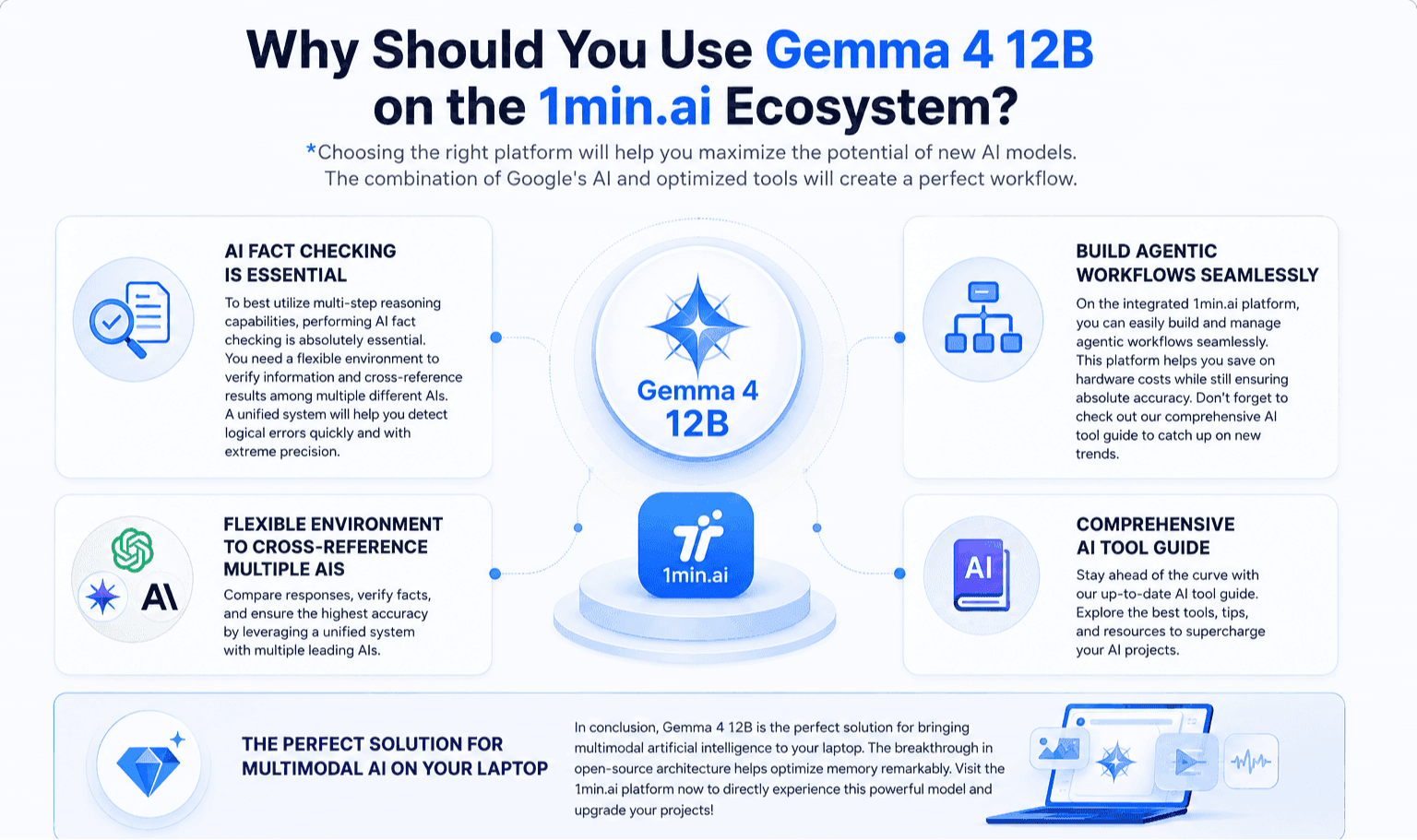
Choosing the right platform will help you maximize the potential of new AI models. The combination of Google's AI and optimized tools will create a perfect workflow.
To best utilize multi-step reasoning capabilities, performing AI fact checking is absolutely essential. You need a flexible environment to verify information and cross-reference results among multiple different AIs. A unified system will help you detect logical errors quickly and with extreme precision.
On the integrated 1min.ai platform, you can easily build and manage agentic workflows seamlessly. This platform helps you save on hardware costs while still ensuring absolute accuracy. Don't forget to check out our comprehensive AI tool guide to catch up on new trends.
In conclusion, Gemma 4 12B is the perfect solution for bringing multimodal artificial intelligence to your laptop. The breakthrough in open-source architecture helps optimize memory remarkably. Visit the 1min.ai platform now to directly experience this powerful model and upgrade your projects!