SOC 2 Type II Explained: AI Software Security Guide

Tram Ta
October 28, 2026
Learn what SOC 2 Type II means, how it differs from Type I, what auditors examine, and how to evaluate an AI software vendor's security.
When businesses choose AI software, they need more than useful features and competitive pricing. They also need confidence that a vendor has appropriate controls to protect information, manage risks, and operate its services reliably.
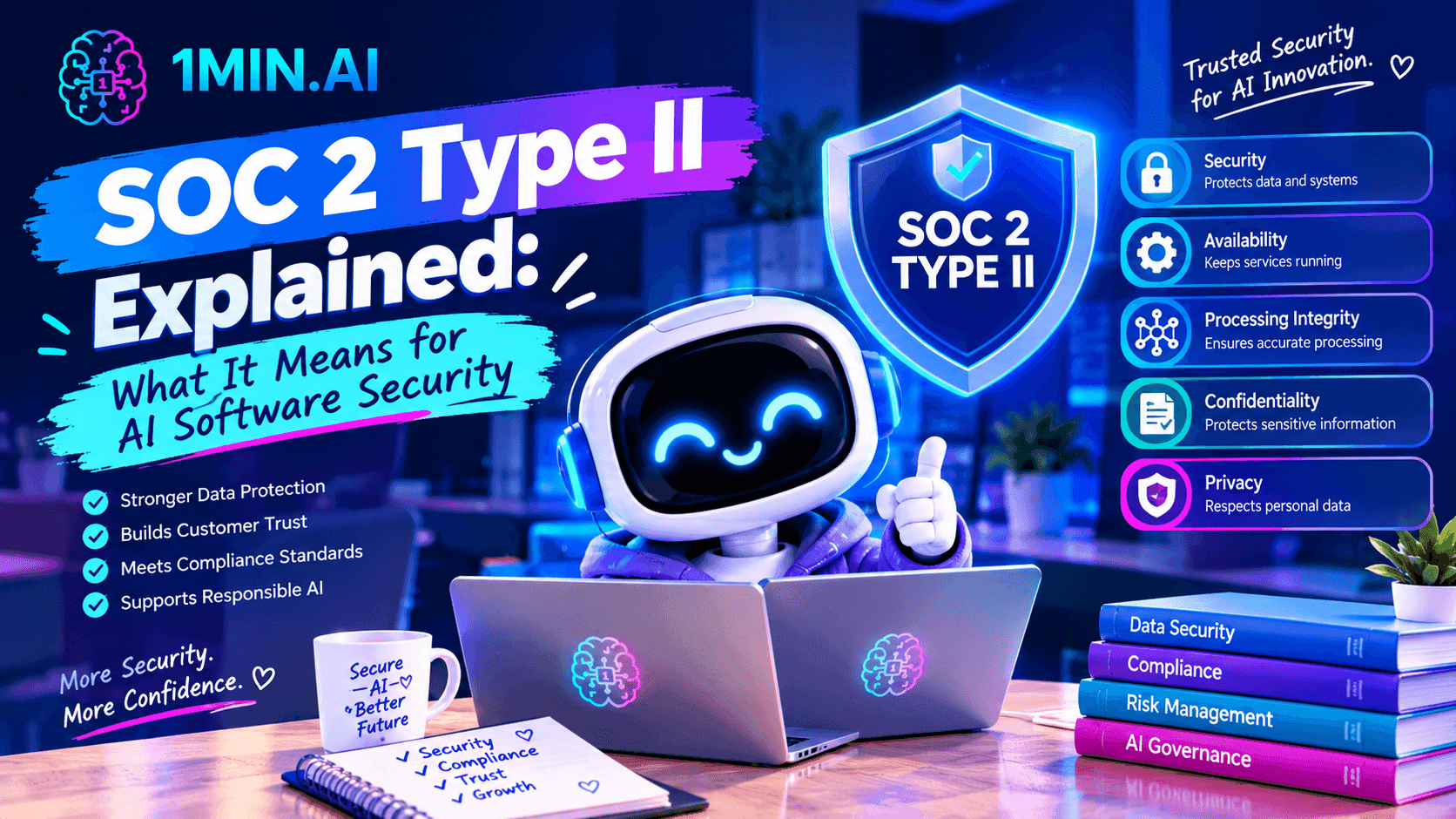
This is where SOC 2 Type II becomes relevant. It is an independent examination that evaluates a service organization's controls and whether those controls operate effectively over a specified period.
For companies adopting AI chat platforms, document-processing tools, and AI agents, understanding SOC 2 can make vendor security reviews more informed and efficient.
In this guide, you'll learn what SOC 2 Type II means, how it differs from Type I, what its Trust Services Criteria cover, and how to use a SOC 2 report when evaluating AI software. We'll also explain how to check 1minAI's current compliance status.
What Is SOC 2 Type II?
SOC 2 stands for System and Organization Controls 2. It is an examination framework developed by the American Institute of Certified Public Accountants (AICPA) for evaluating controls relevant to the security and operation of service organizations.
A SOC 2 examination focuses on controls related to one or more of five Trust Services Criteria:
- Security
- Availability
- Processing integrity
- Confidentiality
- Privacy
Security is included in every SOC 2 examination. The other criteria are included according to the scope of the engagement and the services being evaluated.
SOC 2 is especially relevant to software-as-a-service (SaaS) providers, cloud platforms, data-processing services, and AI vendors because customers may depend on these companies to handle information and support important business operations.
What makes SOC 2 Type II different?
A SOC 2 Type II examination evaluates both the suitability of the design of relevant controls and their operating effectiveness over a defined examination period.
This means the examination considers more than whether a company has written security policies. It also examines evidence showing whether applicable controls operated as intended during the period.
For example, an examination may consider access reviews, security monitoring, change management, or incident-response records, depending on the controls within scope.
You can learn more from the AICPA's SOC 2 resources.
SOC 2 Type I vs. Type II: What's the Difference?
The main difference is the period covered by the examination and the evidence used to evaluate controls.
| Comparison | SOC 2 Type I | SOC 2 Type II |
|---|---|---|
| Main focus | Control design and implementation at a specific date | Control design and operating effectiveness over a defined period |
| Time coverage | Point in time | Period of time |
| Evidence | Evidence supporting the design and implementation of controls | Design evidence plus evidence of control operation throughout the examination period |
| What it helps customers assess | Whether relevant controls are suitably designed at the reporting date | Whether relevant controls are suitably designed and operated effectively during the period |
| Common use | An initial view of a vendor's control environment | A more extensive view of how controls operated over time |
A Type II report generally requires more evidence because the auditor evaluates control operation over a period rather than at one point in time.
However, neither report type automatically proves that a vendor is risk-free. Buyers should review the scope, examination period, results, and any relevant exceptions before deciding whether a vendor meets their requirements.
It is also important to use the correct terminology: SOC 2 is an examination and reporting framework, not a product certification that guarantees complete security.
What Does SOC 2 Type II Evaluate?
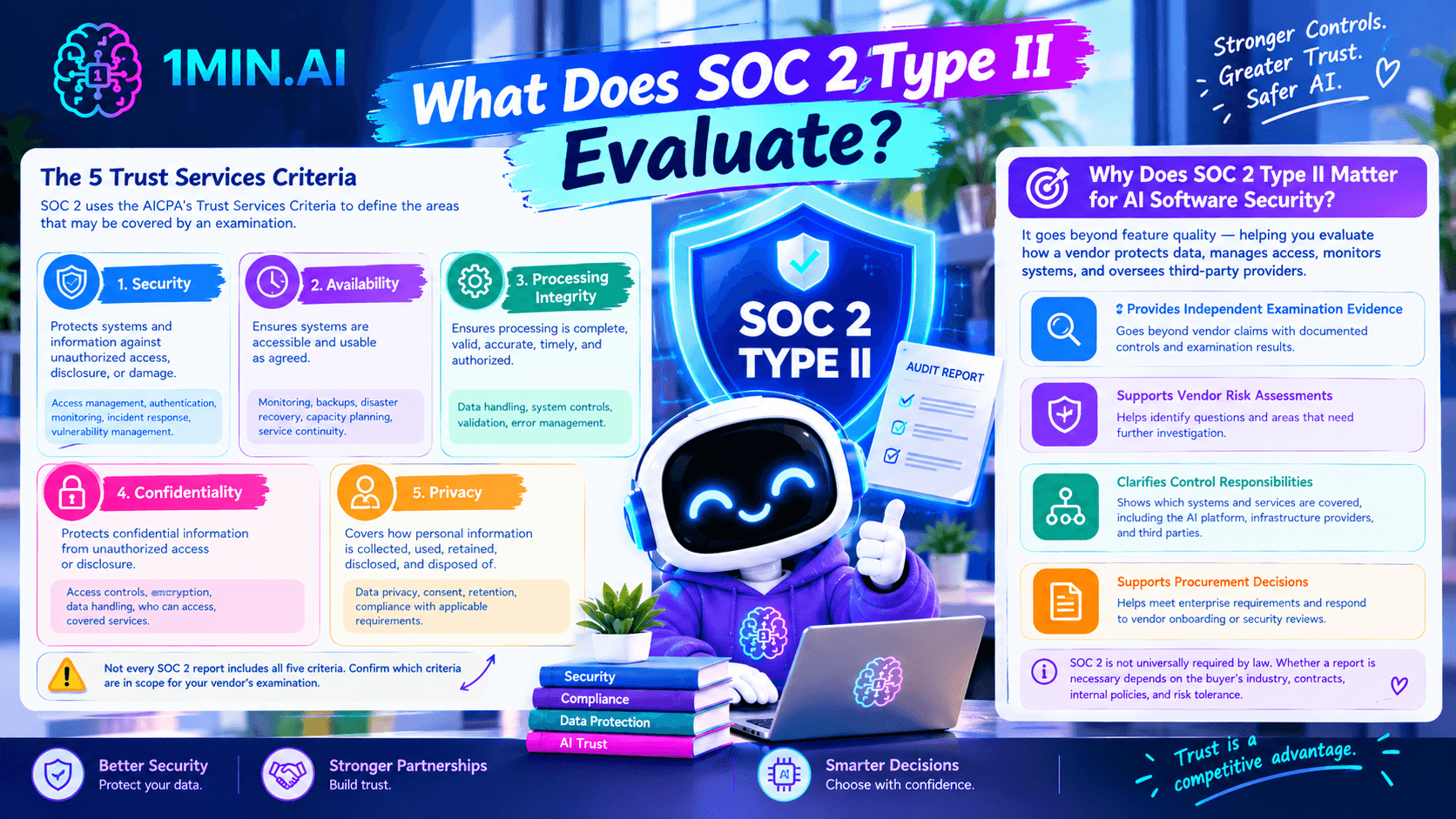
SOC 2 uses the AICPA's Trust Services Criteria to define the areas that may be covered by an examination. Understanding these criteria helps businesses connect a report to their actual security needs.
1. Security
Security concerns protecting systems and information against unauthorized access, disclosure, or damage.
Depending on the scope, relevant controls may include access management, authentication, security monitoring, incident response, and vulnerability management.
For AI vendors, security is particularly important because a platform may process prompts, uploaded documents, generated content, and other customer information.
2. Availability
Availability concerns whether systems are accessible and usable as agreed.
Relevant controls may address system monitoring, backups, disaster recovery, capacity planning, and service continuity.
For businesses relying on AI for daily operations, availability can affect whether employees can complete tasks when needed. A SOC 2 report does not necessarily guarantee uninterrupted service, so customers should also review the vendor's service commitments.
3. Processing Integrity
Processing integrity concerns whether system processing is complete, valid, accurate, timely, and authorized, according to the relevant commitments.
For AI software, this criterion should not be confused with a guarantee that AI-generated answers are factually correct. SOC 2 does not automatically establish that a model will never produce inaccurate or misleading output.
Instead, buyers should understand the specific processing activities and controls included in the examination.
4. Confidentiality
Confidentiality concerns protecting information designated as confidential from unauthorized access or disclosure.
This matters when companies use AI tools to process internal reports, business plans, client documents, or proprietary materials.
When reviewing a vendor, look for clarity about how confidential information is handled, who can access it, and which services are covered by the report.
5. Privacy
Privacy concerns how personal information is collected, used, retained, disclosed, and disposed of in accordance with applicable commitments and requirements.
This is especially important when AI workflows involve personal data, customer records, or other identifiable information.
A SOC 2 report may include privacy criteria, but privacy is not automatically in scope for every SOC 2 examination. Confirm which criteria are included rather than assuming every report covers all five.
Why Does SOC 2 Type II Matter for AI Software Security?
AI software introduces questions that go beyond feature quality. Businesses need to understand how a vendor protects data, manages access, monitors systems, and oversees third-party providers.
SOC 2 Type II can support that evaluation in several ways.
It provides independent examination evidence
A vendor's own security statements are useful, but an independent examination provides additional evidence about controls within the report's scope.
This helps security teams move beyond general claims and assess documented controls and examination results.
It supports vendor risk assessments
Businesses often review software providers before allowing employees to use them for company work. A SOC 2 report can provide information for that process and help identify questions that need further investigation.
It helps clarify control responsibilities
AI workflows may involve the AI platform, infrastructure providers, and external model providers. A report can help clarify which systems and services are covered, although it does not replace a review of relevant subprocessors and contractual terms.
It can support procurement decisions
Some enterprise customers request SOC 2 documentation as part of their vendor onboarding or security review. Having suitable documentation available can help a provider respond to these requests.
However, SOC 2 is not universally required by law. Whether a report is necessary depends on the buyer's industry, contractual obligations, internal policies, and risk tolerance.
How to Evaluate an AI Vendor's SOC 2 Type II Report
Finding a SOC 2 claim on a website is only the first step. Before relying on a report, check whether it actually addresses the risks relevant to your organization.
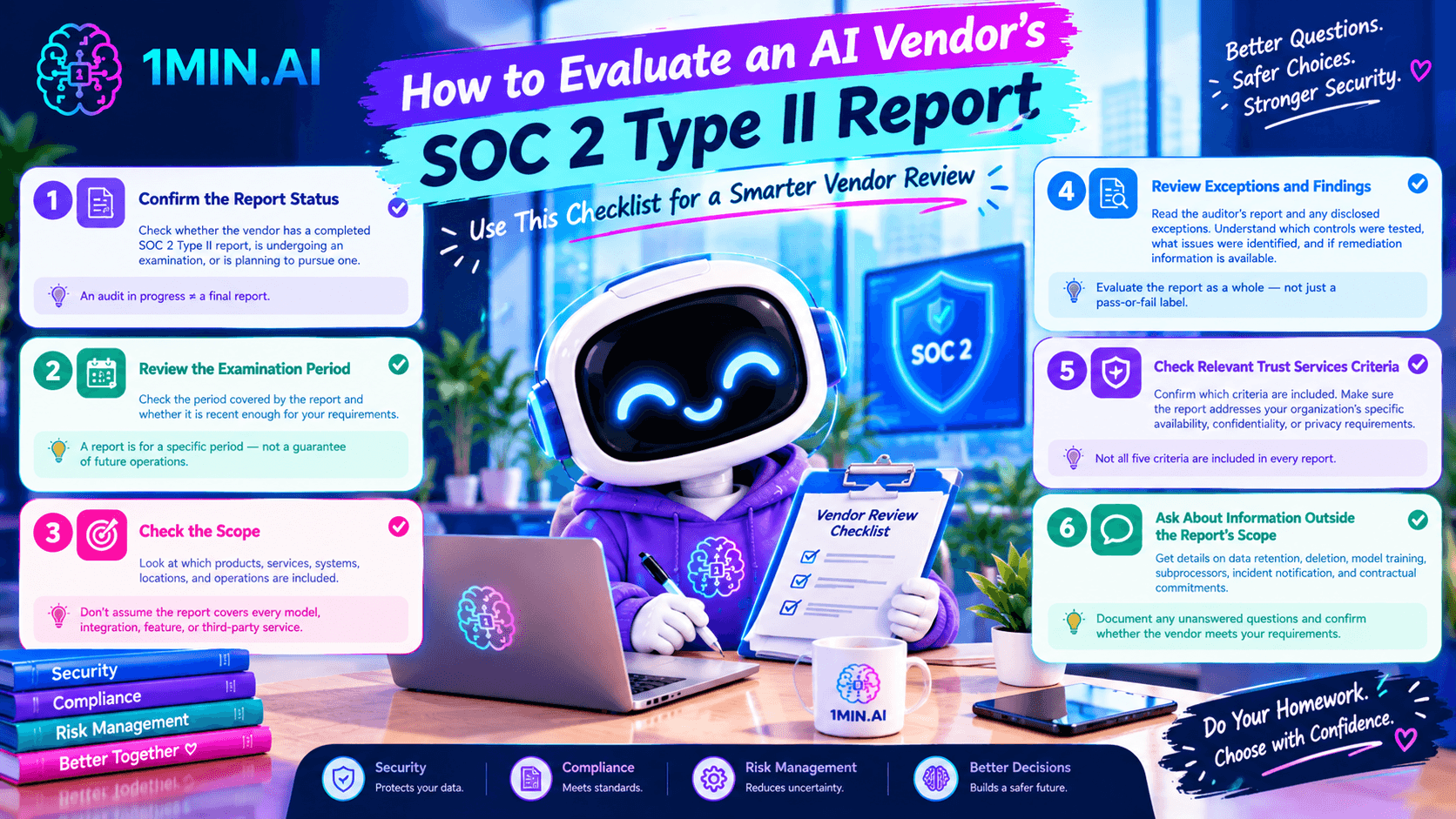
Use this checklist during your vendor review.
1. Confirm the report status
Determine whether the vendor has a completed SOC 2 Type II report, is undergoing an examination, or is planning to pursue one.
These statuses are not interchangeable. An audit in progress does not mean a final report has been issued.
2. Review the examination period
Check the period covered by the report and whether it is recent enough for your organization's requirements.
A report describes controls and evidence for a particular scope and period. It should not be treated as a guarantee about all future operations.
3. Check the scope
Look at which products, services, systems, locations, and operations are included.
This is especially important for AI platforms with multiple features. Do not assume a report covers every model, integration, product feature, or third-party service offered by the vendor.
4. Review exceptions and findings
Read the auditor's report and any disclosed exceptions in context. Understand which controls were tested, what issues were identified, and whether additional explanations or remediation information are available.
A report should be evaluated as a whole rather than reduced to a simple pass-or-fail label.
5. Check relevant Trust Services Criteria
Confirm which criteria are included. If your organization has specific availability, confidentiality, or privacy requirements, make sure the report addresses the relevant areas.
6. Ask about information outside the report's scope
A SOC 2 report does not answer every question about an AI vendor. You may also need details about data retention, deletion, model training, subprocessors, incident notification, and contractual commitments.
Document any unanswered questions and confirm whether the vendor's practices meet your requirements.
What Is 1minAI's SOC 2 Type II Status?
1minAI provides a public Trust Center where businesses can review published security and compliance information.
According to its currently published information, 1minAI's SOC 2 Type II audit is in progress, with completion expected by January 2027. This is a stated target, not confirmation that a completed report has been issued.
For businesses evaluating 1minAI, the appropriate next step is to check the Trust Center for the latest status and available supporting documentation.
In addition to SOC 2, review the platform's documented security controls and privacy information. Consider how these practices relate to your intended use, particularly if your workflow involves confidential documents, client information, or personal data.
1minAI brings multiple AI capabilities together, including AI chat, writing, image generation, video, audio, document tools, and AI agents. Before adopting any of these features for business use, confirm that the applicable data-handling terms and security arrangements fit your organization's requirements.
If your procurement policy requires a completed SOC 2 Type II report, ask 1minAI whether suitable documentation is currently available. Do not treat an audit in progress as a completed examination.
For a broader overview of 1minAI's security practices, read Is 1minAI Secure? A Guide to Data Security and Privacy.
Frequently Asked Questions
Is SOC 2 Type II a certification?
No. SOC 2 Type II is an independent examination and report on controls within a defined scope and period. It is more accurate to refer to a completed SOC 2 Type II report than to describe SOC 2 as a product certification.
How long does a SOC 2 Type II audit take?
The timeline varies depending on an organization's readiness, control environment, and examination scope. Type II includes a defined period during which controls operate and evidence is collected, so the process generally takes longer than a point-in-time Type I examination.
Is SOC 2 Type II mandatory for AI companies?
Not universally. Some enterprise customers and industries require SOC 2 documentation as part of procurement or contractual arrangements, but requirements vary. Companies should evaluate applicable regulations, customer expectations, and internal risk policies.
Does SOC 2 Type II guarantee that AI software is secure?
No. It provides independent examination evidence about controls within the report's scope. Buyers should also evaluate the product's data-handling practices, third-party relationships, AI-specific risks, and suitability for their intended use.
Does 1minAI have a completed SOC 2 Type II report?
According to its published information, 1minAI's audit is in progress, with completion expected by January 2027. Visit the 1minAI Trust Center for the latest status and available documentation.
Conclusion
SOC 2 Type II is an important consideration when evaluating AI software, particularly for businesses that need evidence of a vendor's security controls.
The key is to understand what the examination covers, how Type II differs from Type I, and whether the report addresses the risks that matter to your organization. A completed report can support a vendor assessment, but it should be considered alongside privacy terms, data-handling practices, and contractual requirements.
For 1minAI, start with the Trust Center to review its current security information and SOC 2 Type II status. Confirm that the available documentation meets your requirements before adopting the platform for sensitive workflows.
For further information, explore the 1minAI Trust Center.
Discover more AI features: https://1min.ai/features
Try 1minAI agent now: https://app.1min.ai/ai-agent-demo
- #Information
Alternatives
Discover the best alternatives to 1minAI and compare features, pricing, and use cases.

1min.AI vs OpenRouter
1min.AI vs. OpenRouter: Compare the ready-to-use AI creation product against the technical API tool. Find out if you need a zero-code creative studio or a coding infrastructure hub.
 Ngoc Hong

1min.AI vs Lovart
Looking for a Lovart alternative? Compare creative workflows, pricing considerations, and practical prompts to see whether 1min.AI fits your team.
Ngoc Hong
1min.AI vs Jarvis AI
Compare 1min.AI vs Jarvis AI to discover which AI platform is better for writing, research, automation, and content creation. Find the best AI assistant for your workflow.
Ngoc HongAI Tools
Discover the best AI tools to boost productivity, creativity, and everyday work.
Create Consistent Cartoon Content in Just a Few Steps
Create engaging cartoon videos for TikTok and Reels with 1min.AI. Research ideas, create characters, and turn images into animated videos in 3 simple steps.
 Lien Anh Vu
One Product, 10 UGC Creatives: How AI Makes Content Testing Easier
Create more authentic UGC with an AI UGC video generator, test more creative angles and scale affiliate content without filming every version.
Lien Anh Vu
Top 4 Affordable AI Tools for Startup Founders
Discover the top 4 affordable AI tools for startup founders to validate ideas, build products, create content, and launch faster without overspending.
 Tram Ta
AI Features
Comprehensive AI features that streamline workflows, improve efficiency, and empower teams to achieve more.
Create Consistent Cartoon Content in Just a Few Steps
Create engaging cartoon videos for TikTok and Reels with 1min.AI. Research ideas, create characters, and turn images into animated videos in 3 simple steps.
Lien Anh VuOne Product, 10 UGC Creatives: How AI Makes Content Testing Easier
Create more authentic UGC with an AI UGC video generator, test more creative angles and scale affiliate content without filming every version.
Lien Anh Vu
1minAI: Free AI Grammar Checker
Check grammar for free with 1minAI’s AI grammar checker. Find grammar, spelling, and writing mistakes, improve clarity, and polish your content in seconds.
Tram TaAI Use Cases
A curated collection of AI use cases for business, productivity, and industry-specific applications.
Create Consistent Cartoon Content in Just a Few Steps
Create engaging cartoon videos for TikTok and Reels with 1min.AI. Research ideas, create characters, and turn images into animated videos in 3 simple steps.
Lien Anh VuOne Product, 10 UGC Creatives: How AI Makes Content Testing Easier
Create more authentic UGC with an AI UGC video generator, test more creative angles and scale affiliate content without filming every version.
Lien Anh Vu
Best Time to Post on Instagram: A Practical Guide for Better Engagement
Discover the best time to post on Instagram, including the best days and times for different audiences, plus tips to find the ideal posting schedule for your account.
Tram TaAI Tutorials
Learn how to use AI with practical, step-by-step tutorials.
Black Friday AI Tool Deals in 2026
Discover what Black Friday AI tool deals 2026 has to offer. Find out how to secure the 1min.AI lifetime deal via AppSumo, Dealify, Stack Social, and verify on Trustpilot, Slashdot, and Software Advice.
 Hang Nguyen
Create Consistent Cartoon Content in Just a Few Steps
Create engaging cartoon videos for TikTok and Reels with 1min.AI. Research ideas, create characters, and turn images into animated videos in 3 simple steps.
Lien Anh Vu
[Seedance 2.5 New] Better AI Product Videos, Less Rework in 1min.AI
Use Seedance 2.5 image to video on 1min.AI to create more consistent AI product videos, reduce failed generations, save credits, and improve UGC workflows.
Lien Anh VuAI Guides
Learn AI faster with practical guides, real-world examples, and actionable best practices.
Safely Buy AI Tools Online: 2026 Black Friday Guide
Discover how to find and secure the best Black Friday AI deals online. Learn expert strategies to avoid scams, combat subscription fatigue, and verify software.
Hang NguyenCreate Consistent Cartoon Content in Just a Few Steps
Create engaging cartoon videos for TikTok and Reels with 1min.AI. Research ideas, create characters, and turn images into animated videos in 3 simple steps.
Lien Anh Vu[Seedance 2.5 New] Better AI Product Videos, Less Rework in 1min.AI
Use Seedance 2.5 image to video on 1min.AI to create more consistent AI product videos, reduce failed generations, save credits, and improve UGC workflows.
Lien Anh VuAI Solutions
Browse the best AI solutions for automation, coding, research, productivity, customer support, marketing, and business workflows.
Safely Buy AI Tools Online: 2026 Black Friday Guide
Discover how to find and secure the best Black Friday AI deals online. Learn expert strategies to avoid scams, combat subscription fatigue, and verify software.
Hang NguyenCreate Consistent Cartoon Content in Just a Few Steps
Create engaging cartoon videos for TikTok and Reels with 1min.AI. Research ideas, create characters, and turn images into animated videos in 3 simple steps.
Lien Anh VuOne Product, 10 UGC Creatives: How AI Makes Content Testing Easier
Create more authentic UGC with an AI UGC video generator, test more creative angles and scale affiliate content without filming every version.
Lien Anh VuAI Models
Explore the world's leading AI models in one place.
Create Consistent Cartoon Content in Just a Few Steps
Create engaging cartoon videos for TikTok and Reels with 1min.AI. Research ideas, create characters, and turn images into animated videos in 3 simple steps.
Lien Anh VuOne Product, 10 UGC Creatives: How AI Makes Content Testing Easier
Create more authentic UGC with an AI UGC video generator, test more creative angles and scale affiliate content without filming every version.
Lien Anh Vu[Seedance 2.5 New] Better AI Product Videos, Less Rework in 1min.AI
Use Seedance 2.5 image to video on 1min.AI to create more consistent AI product videos, reduce failed generations, save credits, and improve UGC workflows.
Lien Anh VuAI Comparisons
Compare AI tools, models, and platforms to find the best fit for your needs.
Kling AI Vs Veo 3: Which Model Wins?
Kling AI vs Veo 3: compare motion, native audio, pricing & free tiers to see which AI video generator wins for your project - try both on 1min.AI.
 Trang Tran
[Seedance 2.5 New] Better AI Product Videos, Less Rework in 1min.AI
Use Seedance 2.5 image to video on 1min.AI to create more consistent AI product videos, reduce failed generations, save credits, and improve UGC workflows.
Lien Anh Vu
DeepSeek V4 Pro vs Flash Comparison
Compare DeepSeek V4 Pro vs DeepSeek V4 Flash metrics. Optimize your agentic apps and improve AI fact checking on 1min.ai today.
Ngoc HongAI Integrations
Seamlessly integrate AI with the tools you already use to automate work and boost productivity.
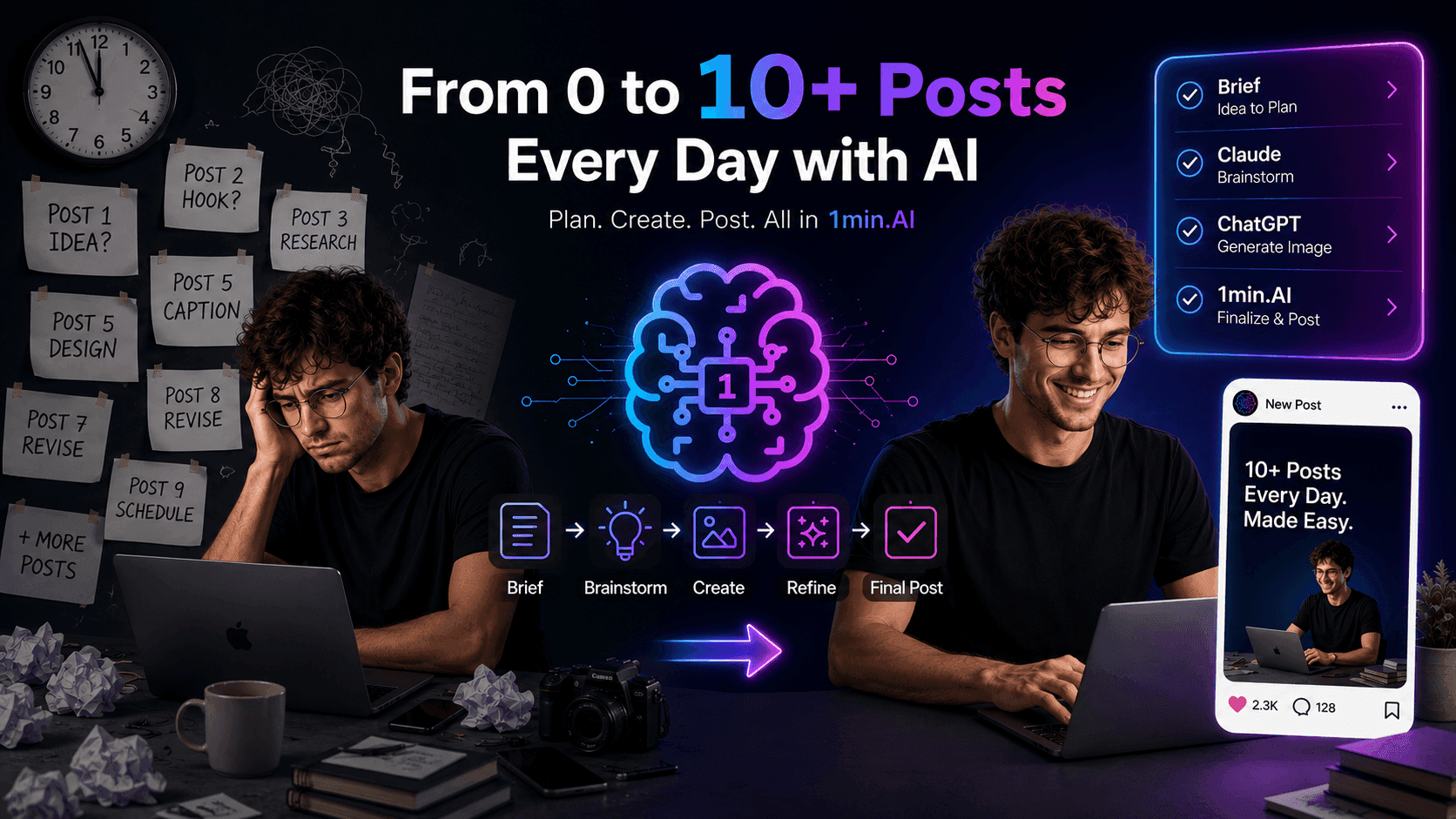
POV: You Have 10+ Posts to Make Every Day
Learn how to build an AI content workflow that helps content creators produce 10+ social media posts a day faster with AI brainstorming, image generation, and content creation.
Lien Anh Vu
How to Use an AI Fashion Video Generator for Fashion Week 2026
Turn Fashion Week 2026 ideas into stunning fashion videos with AI. Learn how to brainstorm, create visuals, and transform images into videos with one simple workflow.
Lien Anh Vu
Stop Switching Between AI Apps: How AI Integration Transforms Employer Branding
Discover how AI integration helps HR teams streamline employer branding by combining AI writing, documents, images, video, and multiple AI models into one workspace.
Tram TaAI for Industries
Find the best AI tools and workflows for healthcare, finance, education, legal, manufacturing, retail, real estate, and more
Free AI Product Description Generator
Write product descriptions that sell in minutes. Use this free AI product description generator to turn details or a photo into on-brand copy. Try 1min.AI.
Trang Tran
Best Business Productivity Tools for Startups to Maximize Profits | 1minAI
Discover the best business productivity tools for startups to save time, streamline workflows, reduce repetitive tasks, and support profitable growth with AI.
Tram Ta
Best AI Tool for Content Marketing |1minAI
Looking for the best AI tool for content marketing? See how 1minAI helps marketers research, write, repurpose, create visuals, and scale content from one AI workspace.
Tram TaAI Agents
Discover and run AI agents to automate tasks across your work and daily life.
1minAI: Free AI Grammar Checker
Check grammar for free with 1minAI’s AI grammar checker. Find grammar, spelling, and writing mistakes, improve clarity, and polish your content in seconds.
Tram Ta
AI Agents for Facebook
Use an AI Agent for Facebook to create content, generate images, schedule posts, and publish from your documents and conversations.
Ngoc Hong
AI Agent vs AI Assistant: Which One Actually Saves Designers More Time?
Learn the difference between AI Agent vs AI Assistant and discover which solution helps designers automate repetitive work, reduce revisions, and save more time.
Lien Anh VuAI Workflows
Explore ready-to-use AI workflows for productivity, marketing, sales, support, and more.
Create Consistent Cartoon Content in Just a Few Steps
Create engaging cartoon videos for TikTok and Reels with 1min.AI. Research ideas, create characters, and turn images into animated videos in 3 simple steps.
Lien Anh VuOne Product, 10 UGC Creatives: How AI Makes Content Testing Easier
Create more authentic UGC with an AI UGC video generator, test more creative angles and scale affiliate content without filming every version.
Lien Anh VuPOV: You Have 10+ Posts to Make Every Day
Learn how to build an AI content workflow that helps content creators produce 10+ social media posts a day faster with AI brainstorming, image generation, and content creation.
Lien Anh VuNewsletter
Weekly AI Innovations with 1minAI
🔮 Weekly AI Innovations #143: Update Update GPT-6, GPT-6.1 & Ideogram 4.0 & Ideogram 4.0
Access GPT-6 Sol, Luna, GPT-6.1 Sol, and Ideogram 4.0 on 1min.ai. Boost typography accuracy to 98.4% and cut reasoning latency by 45% in one platform.
Hang Nguyen
🔮 Weekly AI Innovations #142: Grok 4.7, Opus 5.5 & Sonnet 5.5 on 1min.ai
Access Grok 4.7, Claude Opus 5.5, and Sonnet 5.5 on 1min.ai. Cut subscription costs by up to 70% and process millions tokens in a single unified workspace.
Hang Nguyen
🔮 Weekly AI Innovations #141: Seedance 2.5 & Stable Audio 3: Next-Gen AI
Explore Seedance 2.0, 2.5, and StabilityAI's Stable Audio 3 on 1min.ai. Generate studio-grade audio and synchronized motion with next-gen generative AI.
Hang Nguyen