
Best Business Productivity Tools for Startups to Maximize Profits | 1minAI

Tram Ta
October 13, 2026
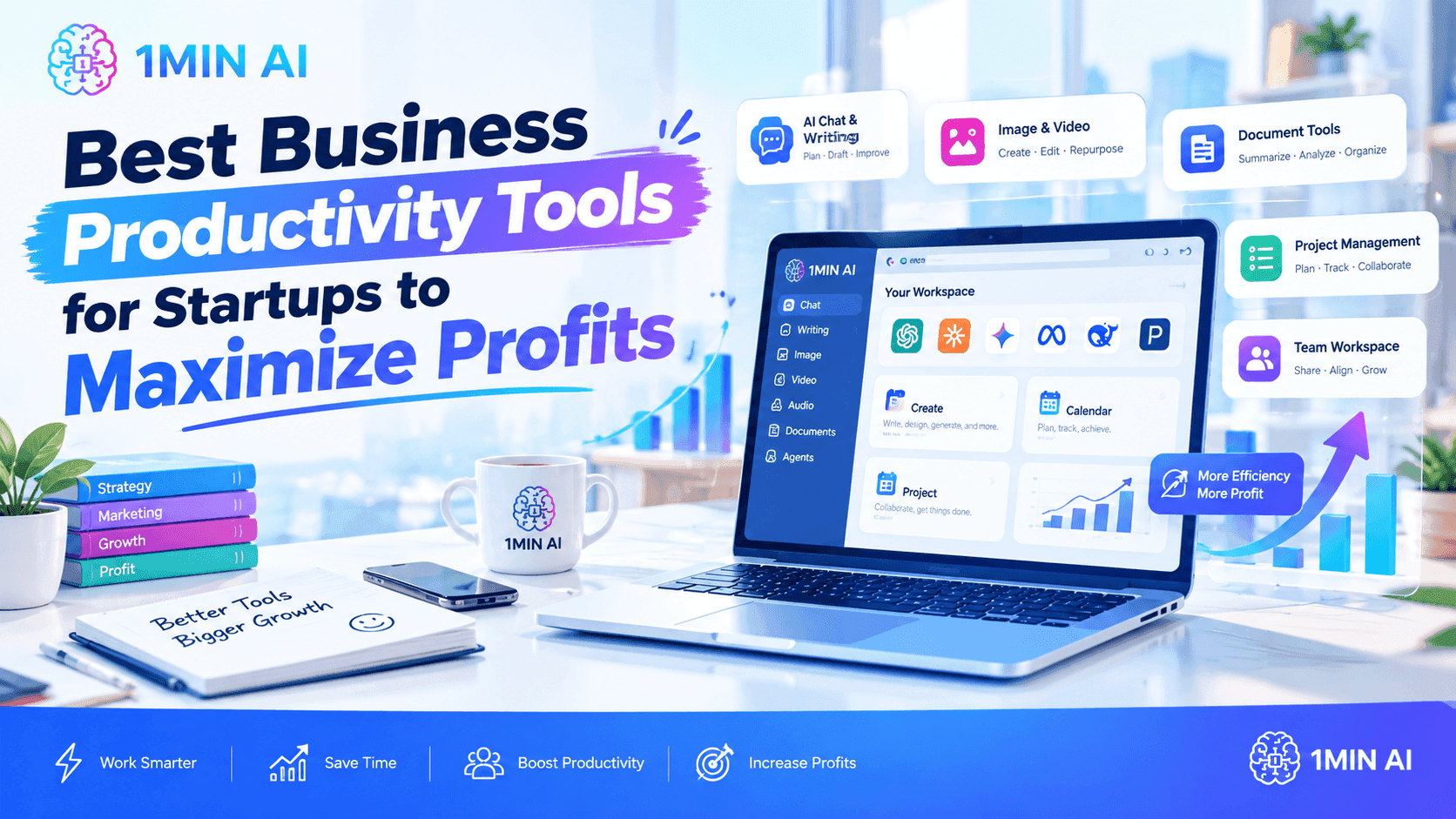
Discover the best business productivity tools for startups to save time, streamline workflows, reduce repetitive tasks, and support profitable growth with AI.
Business productivity tools help teams organize work, communicate, manage information, and complete tasks more efficiently. For startups, the right tools can reduce repetitive work, improve collaboration, and help a small team handle more responsibilities without immediately increasing headcount.
These tools can include project management software, communication platforms, document editors, customer relationship management (CRM) systems, automation software, and AI-powered workspaces.
AI is becoming an important part of this toolkit. Instead of manually drafting every email, researching every topic, or creating each marketing asset from scratch, founders can use AI to accelerate parts of these workflows while keeping people responsible for decisions and quality. The goal isn't to collect as many tools as possible. It's to build a lean system that saves time, controls costs, and supports business growth.
https://youtu.be/YIxKpxFD0F4?si=-JFRII_5LUo8t_xn
Why Startups Need Business Productivity Tools
Startups often operate with limited budgets and small teams. Founders may handle marketing, sales, customer support, product development, and operations at the same time.
Without an organized workflow, routine tasks can consume time that should go toward customers, product improvements, and revenue-generating activities.
The right productivity tools can help startups:
- Reduce repetitive work: Speed up drafting, research, reporting, and content preparation.
- Control operating costs: Evaluate whether several overlapping subscriptions can be consolidated.
- Improve team coordination: Keep project information, responsibilities, and deadlines organized.
- Produce more with existing resources: Give small teams practical support across multiple business functions.
- Make better-informed decisions: Summarize documents, analyze information, and compare possible approaches.
- Scale more deliberately: Standardize repeatable workflows before adding more people or software.
These benefits aren't automatic. A tool creates value when it solves a real bottleneck and the time or cost saved exceeds the cost of using it.
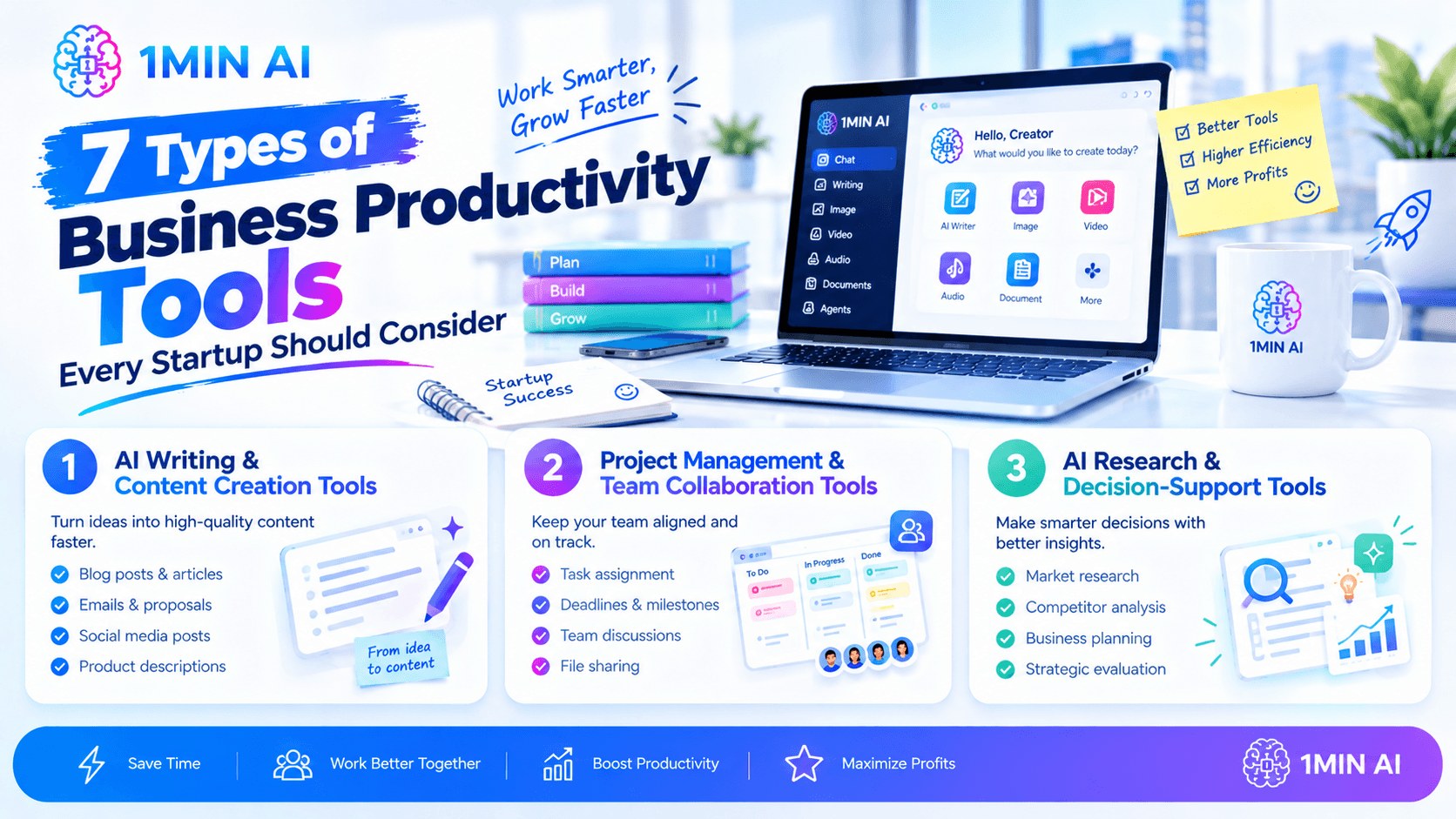
7 Types of Business Productivity Tools Every Startup Should Consider
Rather than adopting every new application, start by identifying the tasks that slow your business down. These seven categories cover common startup needs.
1. AI Writing and Content Creation Tools
Startups need a steady flow of communication: website copy, product descriptions, emails, proposals, social media posts, blog articles, and sales materials.
AI writing tools can help create first drafts, generate ideas, rewrite unclear sentences, and adapt content for different audiences. Founders can spend less time starting from a blank page and more time reviewing the message.
Practical startup workflow:
- Define the target audience and business objective.
- Ask AI to draft the content in a suitable format.
- Review the draft for accuracy, tone, and brand consistency.
- Adapt the final version for the intended channel.
For example, a SaaS startup could turn one product announcement into a launch email, a LinkedIn post, a short website update, and a customer FAQ.
1minAI's Free AI Content Generator is a useful starting point for exploring AI-assisted writing. You can also learn how creators use AI in this guide to AI tools for content creators.
2. Project Management and Team Collaboration Tools
When a startup grows beyond a few people, informal conversations and scattered task lists can make it difficult to track progress.
Project management tools help teams assign responsibilities, set deadlines, monitor milestones, and keep project information in one place. Collaboration platforms support discussions and document sharing.
For a small team, a simple workflow may be enough:
- Create a project for each major initiative.
- Break the project into tasks with clear owners.
- Set deadlines and define what completion means.
- Review blocked tasks during a weekly meeting.
- Document decisions so team members can find them later.
AI can complement these tools by helping summarize meeting notes, draft project updates, and turn rough ideas into task lists. However, teams should still use a reliable system as the source of truth for task ownership and status.
3. AI Research and Decision-Support Tools
Startup founders frequently need to investigate competitors, understand customers, evaluate new markets, and prepare business plans.
Research tools can help organize information, summarize long documents, generate hypotheses, and compare strategic options. AI can also help founders identify questions they may have overlooked.
For example, before launching a new feature, ask AI to help structure an evaluation around:
- The customer problem being solved
- Target customer segments
- Existing alternatives
- Potential differentiators
- Implementation costs and risks
- Metrics that would indicate success
Treat AI-generated findings as a starting point, not proof of market demand. Verify important claims using reliable sources, customer interviews, and real business data.
For more practical examples, explore 4 AI tools for startup founders.
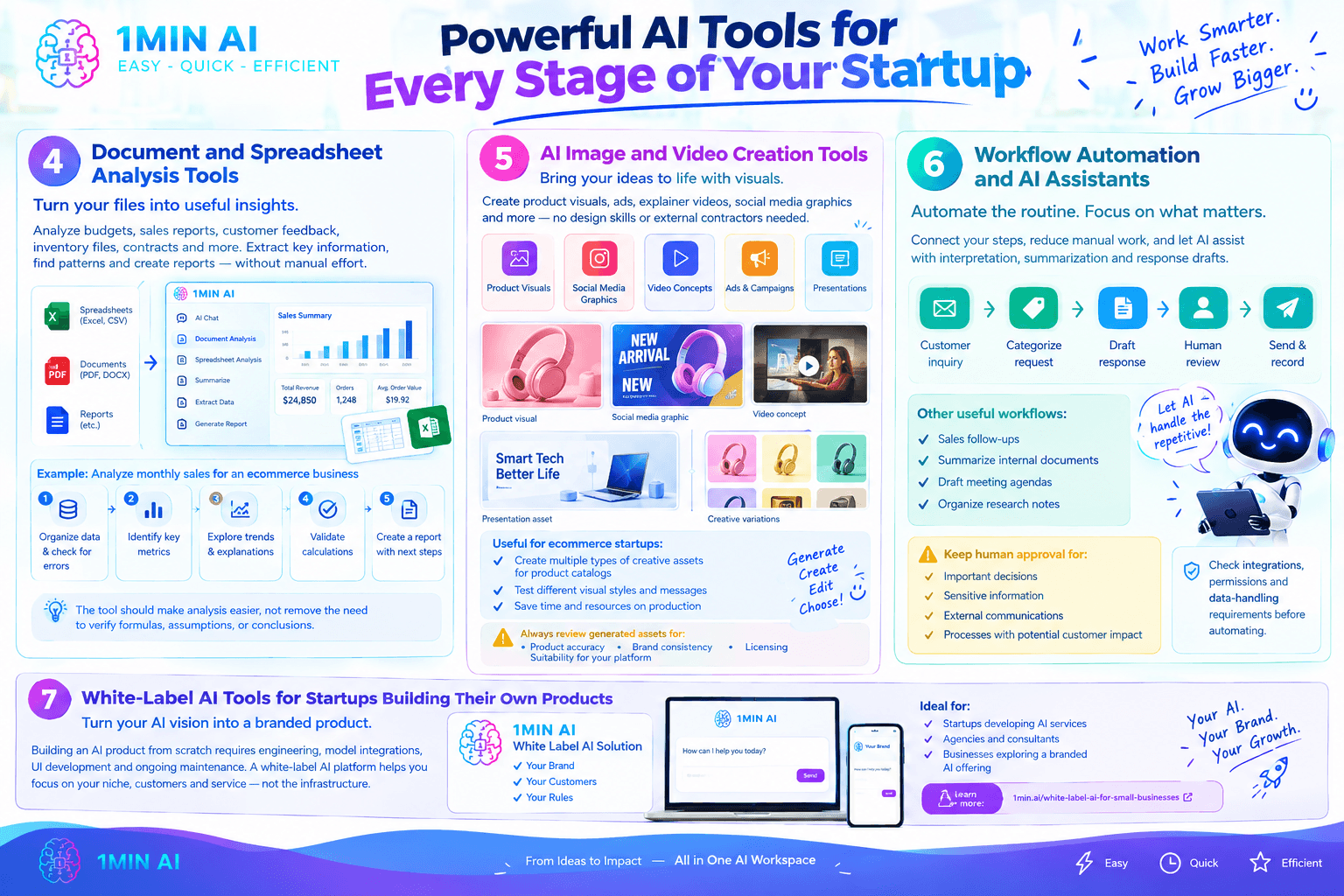
4. Document and Spreadsheet Analysis Tools
Startups generate information across budgets, sales reports, customer feedback, inventory files, contracts, and operational documents. Reviewing every file manually can slow decision-making.
Document and spreadsheet tools help teams extract key information, summarize lengthy material, identify patterns, and prepare reports.
Consider a small ecommerce business that wants to understand its monthly sales. A practical workflow is to:
- Organize the sales data and check for missing or inconsistent values.
- Identify important metrics, such as revenue, order volume, and average order value.
- Use analysis tools to explore trends and possible explanations.
- Validate calculations against the original spreadsheet.
- Turn the findings into a short report with recommended next steps.
The tool should make analysis easier, not remove the need to verify formulas, assumptions, or conclusions.
5. AI Image and Video Creation Tools
Marketing often requires more than written content. Startups also need product visuals, advertisements, explainer videos, social media graphics, and presentation assets.
Traditional production can require design skills, external contractors, or substantial time. AI image and video tools offer another way to create initial concepts and supporting assets.
Possible uses include:
- Creating visual concepts for a product launch
- Generating social media graphics
- Producing short video concepts for advertisements
- Preparing alternative creative directions for testing
- Developing visuals for presentations and landing pages
For ecommerce startups, these tools can be especially useful when a product catalog needs multiple types of creative assets.
Explore free AI tools for ecommerce for examples of how AI can support product content and online selling.
Generated assets should still be reviewed for product accuracy, brand consistency, licensing considerations, and suitability for the intended platform.
6. Workflow Automation and AI Assistants
Many startup tasks follow predictable patterns: collecting information, drafting a response, updating a record, preparing a report, or routing a request to the right person.
Automation tools help connect these steps so that routine work requires less manual intervention. AI assistants can support tasks that involve interpreting instructions, summarizing information, or drafting responses.
Start with a repetitive workflow that has clear inputs and outputs. For example:
Customer inquiry → categorize the request → draft a response → human review → send and record the result
Other possible workflows include preparing sales follow-ups, summarizing internal documents, drafting meeting agendas, and organizing research notes.
Keep human approval for consequential decisions, sensitive information, and external communications where an incorrect response could damage customer trust. Before automating a process, also check the available integrations, permissions, and data-handling requirements.
7. White-Label AI Tools for Startups Building Their Own Products
Some startups don't just want to use productivity tools internally. They want to offer AI-powered services to customers.
Building an AI product from scratch can require engineering resources, model integrations, user-interface development, and ongoing maintenance. A white-label AI platform may help reduce the amount of infrastructure a startup needs to develop itself.
With a suitable platform, a business can focus more on its niche, customer experience, workflows, and service offering rather than recreating every underlying capability.
1minAI offers a white-label solution for businesses exploring branded AI products. Learn more through 1minAI White Label AI for Small Businesses.
This category is most relevant to startups developing AI services, agencies, consultants, and businesses exploring a branded AI offering. It isn't necessary for every startup seeking ordinary internal productivity improvements.
How 1minAI Can Support Startup Productivity
Using too many disconnected AI applications can create its own overhead. Team members may need to switch between platforms, repeat instructions, and manage several separate workflows.
1minAI brings multiple AI capabilities into one workspace, helping users explore different tasks without relying on a separate dedicated application for every use case.
Depending on the task, a startup might use AI to:
- Draft business content: Prepare emails, articles, product copy, and marketing materials.
- Explore ideas and compare responses: Use AI chat to brainstorm, evaluate options, and refine a draft.
- Work with visual content: Create images and explore video-generation workflows.
- Process information: Summarize material and organize research into more useful formats.
- Support repeatable tasks: Explore AI agents and workflows where the available functionality fits the business need.
The main benefit is workflow flexibility. A founder might research a product idea, draft a landing page, generate campaign concepts, and prepare social content within a broader AI workspace.
However, 1minAI should be evaluated against the actual requirements of your business. It does not automatically replace every project management system, accounting platform, CRM, or specialized automation application. Confirm the features, integrations, usage limits, and plan details you need before consolidating existing tools.
How to Choose the Best Business Productivity Tools for Your Startup
A good productivity stack starts with business priorities, not a list of popular applications.
Step 1: Identify Your Biggest Bottleneck
List the tasks that consume the most time or frequently cause delays. Examples include preparing marketing content, responding to leads, reviewing reports, or coordinating projects.
Choose one or two problems to solve first.
Step 2: Estimate the Cost of the Current Workflow
Calculate how much time your team spends on the task each week. Consider subscription fees, contractor costs, rework, and the consequences of delays.
This establishes a baseline for evaluating whether a new tool provides value.
Step 3: Test Tools Against Real Tasks
Use a representative task rather than relying only on a product demonstration. Test the tool with your own workflow, then evaluate output quality, ease of use, reliability, and any required manual corrections.
For AI tools, check factual accuracy and whether the result meets your brand or operational requirements.
Step 4: Compare Total Cost, Not Just the Starting Price
A free tool may have usage limits, while a paid tool may save enough time to justify its cost. Compare the full monthly expense, including subscriptions, integrations, training, and maintenance.
Avoid paying for overlapping tools unless they provide distinct value.
Step 5: Measure the Results
Track a small set of meaningful metrics, such as:
- Time needed to complete a task
- Cost per deliverable
- Number of revisions required
- Response time to customers
- Team adoption and usage
- Errors or rework after implementation
For revenue-related workflows, track the relevant business outcome as well. Faster content production, for example, does not automatically guarantee more sales.
Step 6: Standardize What Works
Once a tool proves useful, document the workflow, assign ownership, and explain when human review is required. Then expand to another bottleneck.
This gradual approach reduces unnecessary spending and makes it easier to identify which tools actually contribute to productivity.
Frequently Asked Questions
What are the best business productivity tools for startups?
The best tools depend on the team's needs. Common categories include project management, collaboration, AI writing, research, document and spreadsheet analysis, workflow automation, and creative production. Start with the tools that address your biggest bottlenecks.
Can AI productivity tools reduce startup costs?
They can help reduce some manual work and may allow businesses to consolidate overlapping applications. However, savings depend on subscription costs, usage limits, output quality, and the amount of review still required.
Is 1minAI suitable for small businesses?
1minAI can be useful for small businesses that want to explore multiple AI capabilities in one workspace. Relevant tasks may include writing, research, visual content creation, and other AI-assisted workflows. Check current features and plans against your specific needs.
What is a white-label AI tool?
A white-label AI tool allows a business to offer an AI-powered product under its own brand, depending on the platform's customization and licensing options. It may suit startups and agencies that want to develop a branded AI service without building every underlying capability from scratch.
How many productivity tools should a startup use?
There is no ideal number for every business. Start with a small, practical stack that covers essential workflows. Add a tool when it solves a clear problem or provides measurable value, rather than adopting software simply because it is popular.
Final Thoughts
The best business productivity tools help startups spend less time on repetitive work and more time building products, serving customers, and improving their business. The right combination may include project management, collaboration, research, content creation, data analysis, and automation tools.
For startups that want to incorporate AI across multiple workflows, 1minAI offers a workspace for exploring AI chat, writing, image and video creation, and other capabilities. Start with one concrete task, measure the result, and expand only when the tool delivers practical value.
For further information, explore 1minAI White Label AI for Small Businesses.
Discover more AI features: https://1min.ai/features
Try 1minAI agent now: https://app.1min.ai/ai-agent-demo
Alternatives
Discover the best alternatives to 1minAI and compare features, pricing, and use cases.

1min.AI vs OpenRouter
1min.AI vs. OpenRouter: Compare the ready-to-use AI creation product against the technical API tool. Find out if you need a zero-code creative studio or a coding infrastructure hub.
 Ngoc Hong
1min.AI vs Jarvis AI
Compare 1min.AI vs Jarvis AI to discover which AI platform is better for writing, research, automation, and content creation. Find the best AI assistant for your workflow.
Ngoc Hong
1min.AI vs Taskade
Compare 1min.AI vs Taskade for AI content creation, automation, agents, and creative workflows to find the right workspace.
Ngoc HongAI Tools
Discover the best AI tools to boost productivity, creativity, and everyday work.
Create Consistent Cartoon Content in Just a Few Steps
Create engaging cartoon videos for TikTok and Reels with 1min.AI. Research ideas, create characters, and turn images into animated videos in 3 simple steps.
 Lien Anh Vu
One Product, 10 UGC Creatives: How AI Makes Content Testing Easier
Create more authentic UGC with an AI UGC video generator, test more creative angles and scale affiliate content without filming every version.
Lien Anh Vu
Top 4 Affordable AI Tools for Startup Founders
Discover the top 4 affordable AI tools for startup founders to validate ideas, build products, create content, and launch faster without overspending.
 Tram Ta
AI Features
Comprehensive AI features that streamline workflows, improve efficiency, and empower teams to achieve more.
Create Consistent Cartoon Content in Just a Few Steps
Create engaging cartoon videos for TikTok and Reels with 1min.AI. Research ideas, create characters, and turn images into animated videos in 3 simple steps.
Lien Anh VuOne Product, 10 UGC Creatives: How AI Makes Content Testing Easier
Create more authentic UGC with an AI UGC video generator, test more creative angles and scale affiliate content without filming every version.
Lien Anh Vu
1minAI: Free AI Grammar Checker
Check grammar for free with 1minAI’s AI grammar checker. Find grammar, spelling, and writing mistakes, improve clarity, and polish your content in seconds.
Tram TaAI Use Cases
A curated collection of AI use cases for business, productivity, and industry-specific applications.
Create Consistent Cartoon Content in Just a Few Steps
Create engaging cartoon videos for TikTok and Reels with 1min.AI. Research ideas, create characters, and turn images into animated videos in 3 simple steps.
Lien Anh VuOne Product, 10 UGC Creatives: How AI Makes Content Testing Easier
Create more authentic UGC with an AI UGC video generator, test more creative angles and scale affiliate content without filming every version.
Lien Anh Vu
Best Time to Post on Instagram: A Practical Guide for Better Engagement
Discover the best time to post on Instagram, including the best days and times for different audiences, plus tips to find the ideal posting schedule for your account.
Tram TaAI Tutorials
Learn how to use AI with practical, step-by-step tutorials.

Black Friday AI Tool Deals in 2026
Discover what Black Friday AI tool deals 2026 has to offer. Find out how to secure the 1min.AI lifetime deal via AppSumo, Dealify, Stack Social, and verify on Trustpilot, Slashdot, and Software Advice.
 Hang Nguyen
Create Consistent Cartoon Content in Just a Few Steps
Create engaging cartoon videos for TikTok and Reels with 1min.AI. Research ideas, create characters, and turn images into animated videos in 3 simple steps.
Lien Anh Vu
[Seedance 2.5 New] Better AI Product Videos, Less Rework in 1min.AI
Use Seedance 2.5 image to video on 1min.AI to create more consistent AI product videos, reduce failed generations, save credits, and improve UGC workflows.
Lien Anh VuAI Guides
Learn AI faster with practical guides, real-world examples, and actionable best practices.

Safely Buy AI Tools Online: 2026 Black Friday Guide
Discover how to find and secure the best Black Friday AI deals online. Learn expert strategies to avoid scams, combat subscription fatigue, and verify software.
Hang NguyenCreate Consistent Cartoon Content in Just a Few Steps
Create engaging cartoon videos for TikTok and Reels with 1min.AI. Research ideas, create characters, and turn images into animated videos in 3 simple steps.
Lien Anh Vu[Seedance 2.5 New] Better AI Product Videos, Less Rework in 1min.AI
Use Seedance 2.5 image to video on 1min.AI to create more consistent AI product videos, reduce failed generations, save credits, and improve UGC workflows.
Lien Anh VuAI Solutions
Browse the best AI solutions for automation, coding, research, productivity, customer support, marketing, and business workflows.
Safely Buy AI Tools Online: 2026 Black Friday Guide
Discover how to find and secure the best Black Friday AI deals online. Learn expert strategies to avoid scams, combat subscription fatigue, and verify software.
Hang NguyenCreate Consistent Cartoon Content in Just a Few Steps
Create engaging cartoon videos for TikTok and Reels with 1min.AI. Research ideas, create characters, and turn images into animated videos in 3 simple steps.
Lien Anh VuOne Product, 10 UGC Creatives: How AI Makes Content Testing Easier
Create more authentic UGC with an AI UGC video generator, test more creative angles and scale affiliate content without filming every version.
Lien Anh VuAI Models
Explore the world's leading AI models in one place.
Create Consistent Cartoon Content in Just a Few Steps
Create engaging cartoon videos for TikTok and Reels with 1min.AI. Research ideas, create characters, and turn images into animated videos in 3 simple steps.
Lien Anh VuOne Product, 10 UGC Creatives: How AI Makes Content Testing Easier
Create more authentic UGC with an AI UGC video generator, test more creative angles and scale affiliate content without filming every version.
Lien Anh Vu[Seedance 2.5 New] Better AI Product Videos, Less Rework in 1min.AI
Use Seedance 2.5 image to video on 1min.AI to create more consistent AI product videos, reduce failed generations, save credits, and improve UGC workflows.
Lien Anh VuAI Comparisons
Compare AI tools, models, and platforms to find the best fit for your needs.

Kling AI Vs Veo 3: Which Model Wins?
Kling AI vs Veo 3: compare motion, native audio, pricing & free tiers to see which AI video generator wins for your project - try both on 1min.AI.
 Trang Tran
[Seedance 2.5 New] Better AI Product Videos, Less Rework in 1min.AI
Use Seedance 2.5 image to video on 1min.AI to create more consistent AI product videos, reduce failed generations, save credits, and improve UGC workflows.
Lien Anh Vu
DeepSeek V4 Pro vs Flash Comparison
Compare DeepSeek V4 Pro vs DeepSeek V4 Flash metrics. Optimize your agentic apps and improve AI fact checking on 1min.ai today.
Ngoc HongAI Integrations
Seamlessly integrate AI with the tools you already use to automate work and boost productivity.
POV: You Have 10+ Posts to Make Every Day
Learn how to build an AI content workflow that helps content creators produce 10+ social media posts a day faster with AI brainstorming, image generation, and content creation.
Lien Anh Vu
How to Use an AI Fashion Video Generator for Fashion Week 2026
Turn Fashion Week 2026 ideas into stunning fashion videos with AI. Learn how to brainstorm, create visuals, and transform images into videos with one simple workflow.
Lien Anh Vu
Stop Switching Between AI Apps: How AI Integration Transforms Employer Branding
Discover how AI integration helps HR teams streamline employer branding by combining AI writing, documents, images, video, and multiple AI models into one workspace.
Tram TaAI for Industries
Find the best AI tools and workflows for healthcare, finance, education, legal, manufacturing, retail, real estate, and more
Best Business Productivity Tools for Startups to Maximize Profits | 1minAI
Discover the best business productivity tools for startups to save time, streamline workflows, reduce repetitive tasks, and support profitable growth with AI.
Tram Ta
Best AI Tool for Content Marketing |1minAI
Looking for the best AI tool for content marketing? See how 1minAI helps marketers research, write, repurpose, create visuals, and scale content from one AI workspace.
Tram Ta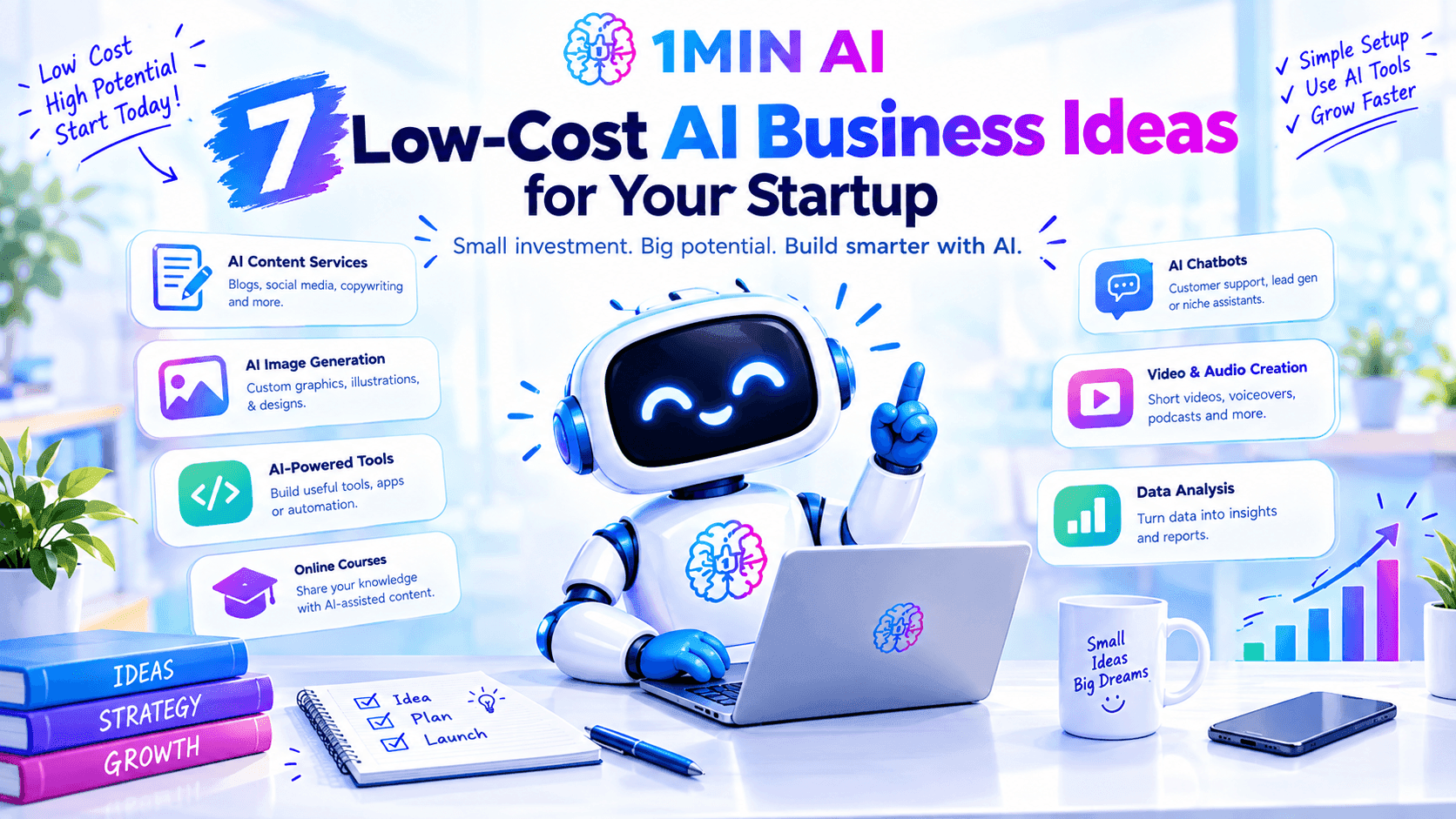
7 Low-Cost AI Business Ideas for Your Startup
Explore 7 low-cost AI business ideas you can start with a small budget, from content and video services to AI consulting, reselling, and automation.
Tram TaAI Agents
Discover and run AI agents to automate tasks across your work and daily life.
1minAI: Free AI Grammar Checker
Check grammar for free with 1minAI’s AI grammar checker. Find grammar, spelling, and writing mistakes, improve clarity, and polish your content in seconds.
Tram Ta
AI Agents for Facebook
Use an AI Agent for Facebook to create content, generate images, schedule posts, and publish from your documents and conversations.
Ngoc Hong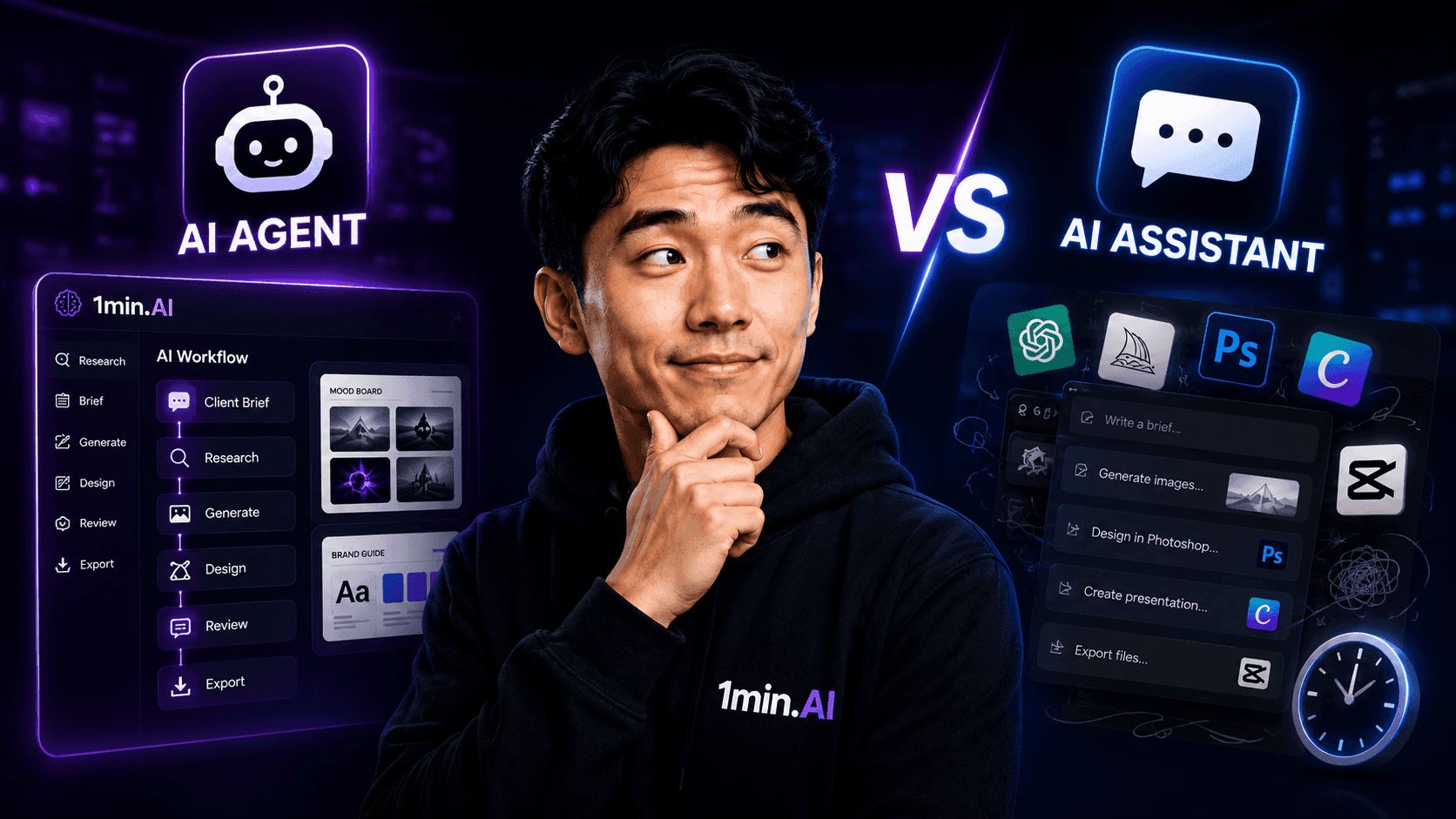
AI Agent vs AI Assistant: Which One Actually Saves Designers More Time?
Learn the difference between AI Agent vs AI Assistant and discover which solution helps designers automate repetitive work, reduce revisions, and save more time.
Lien Anh VuAI Workflows
Explore ready-to-use AI workflows for productivity, marketing, sales, support, and more.
Create Consistent Cartoon Content in Just a Few Steps
Create engaging cartoon videos for TikTok and Reels with 1min.AI. Research ideas, create characters, and turn images into animated videos in 3 simple steps.
Lien Anh VuOne Product, 10 UGC Creatives: How AI Makes Content Testing Easier
Create more authentic UGC with an AI UGC video generator, test more creative angles and scale affiliate content without filming every version.
Lien Anh VuPOV: You Have 10+ Posts to Make Every Day
Learn how to build an AI content workflow that helps content creators produce 10+ social media posts a day faster with AI brainstorming, image generation, and content creation.
Lien Anh VuNewsletter
Weekly AI Innovations with 1minAI

🔮 Weekly AI Innovations #141: Seedance 2.5 & Stable Audio 3: Next-Gen AI
Explore Seedance 2.0, 2.5, and StabilityAI's Stable Audio 3 on 1min.ai. Generate studio-grade audio and synchronized motion with next-gen generative AI.
Hang Nguyen
🔮 Weekly AI Innovations #140: Deepseek 4.1 Flash & Gemini Upgrades
Explore Deepseek 4.1 Flash and new Gemini models on 1min.ai. Plus, check our update on your Billing - Usage page for better clarity.
Hang Nguyen
🔮 Weekly AI Innovations #139: Dawn of the next-gen AI
Discover the immense power of GPT-6 Astra and Claude Fable 5.1. Unlock next-generation AI models on 1min.ai to solve complex tasks effortlessly.
Hang Nguyen