
Topical Authority: 7 Steps to Build It for SEO

Ngoc Hong
October 4, 2026
Learn what topical authority means, how to build a topical map, and create connected content that strengthens your SEO strategy.
Topical Authority: 7 Steps to Build It for SEO
Having dozens of articles does not automatically make a website authoritative. Topical authority comes from covering a subject comprehensively, connecting related content, and consistently demonstrating useful expertise.
This guide explains what topical authority means, how a topical authority map works, and seven practical steps to build one. You will also learn how AI can speed up research and content production without replacing SEO strategy or human judgment.
What Is Topical Authority?
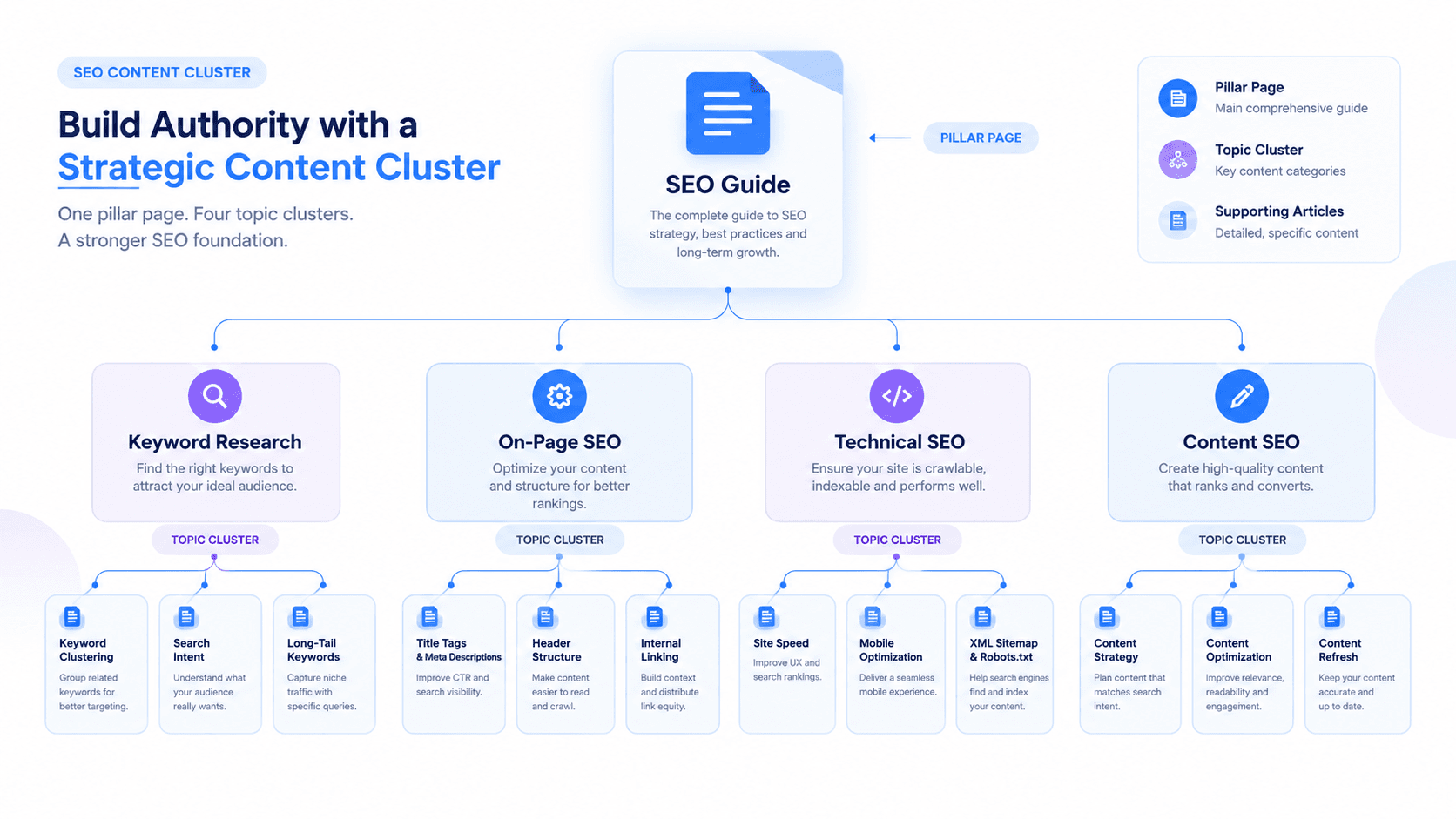
Topical authority is the perceived expertise and credibility of a website on a specific subject. Instead of publishing unrelated articles, an authoritative website builds a connected body of content that answers different questions around one core topic.
For example, a website about SEO should not publish only articles targeting broad keywords such as “SEO.” It can cover keyword research, search intent, technical SEO, internal linking, content optimization, and other related subtopics.
Topical authority in SEO
In SEO, topical authority is about depth, breadth, relevance, and connections between content. Search engines can use these signals to better understand what a website covers and how individual pages relate to one another.
However, topical authority should not be treated as a single metric or guaranteed ranking factor. The practical goal is simpler: build a website that provides comprehensive, trustworthy coverage of a topic for real users.
Topical authority vs. domain authority
These concepts are related but different.
| Topical Authority | Domain Authority |
|---|---|
| Focuses on expertise around a subject | Estimates the strength of an entire domain |
| Built through relevant content and topical coverage | Commonly associated with backlinks and overall site strength |
| Can be strong in one topic and weaker in another | Usually represents the broader domain |
| Relies heavily on content relevance and relationships | Often calculated using third-party SEO tools |
The key takeaway: a website does not need to cover everything to build topical authority. It needs to become genuinely useful within a defined subject area.
What Is a Topical Authority Map?
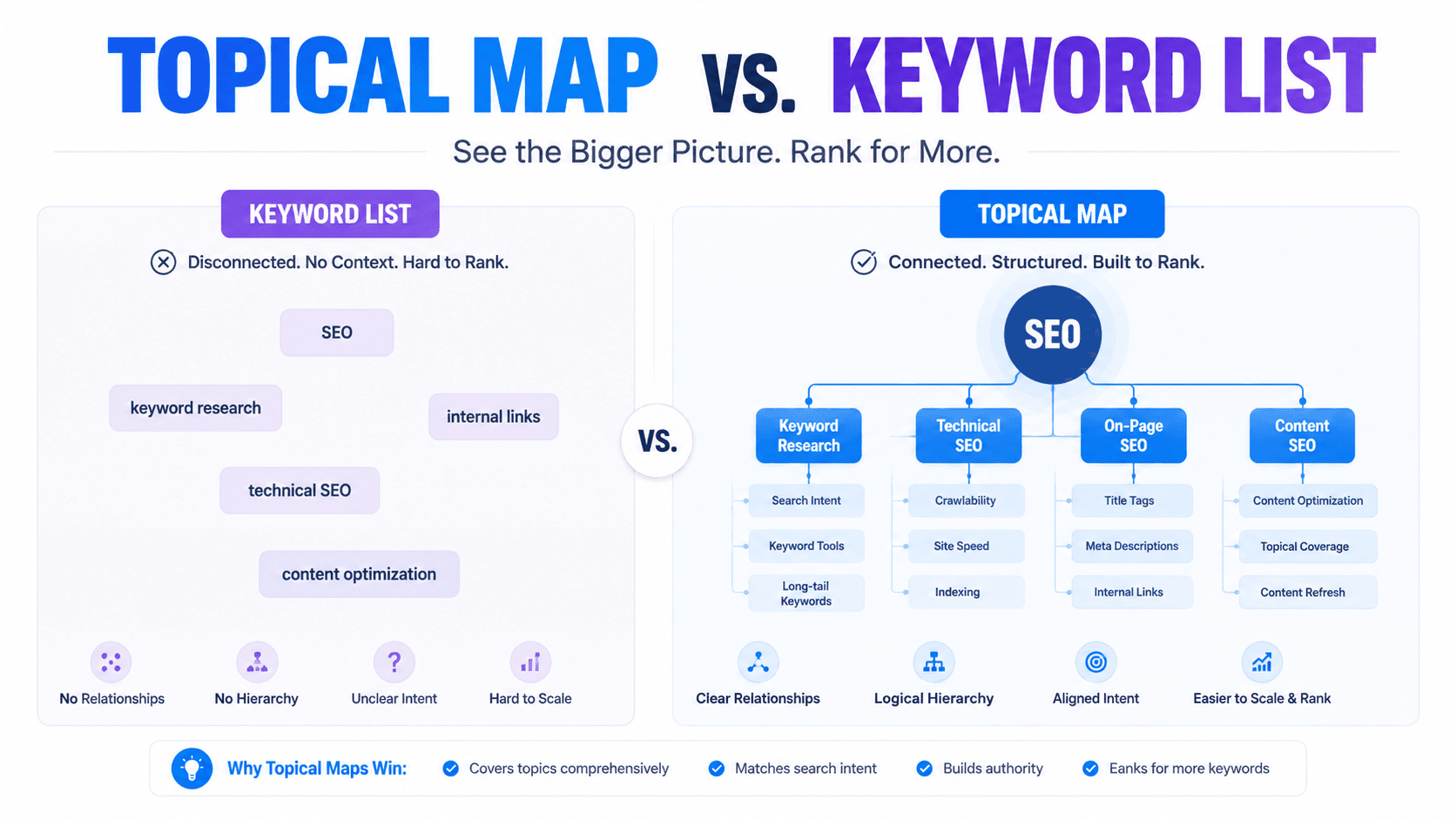
A topical authority map turns a broad subject into an organized content system. It shows the main topic, its important subtopics, supporting articles, and the relationships between them.
This is more useful than a simple keyword list because keywords tell you what people search for, while a topical map helps determine how those searches should be covered together.
Start with a pillar topic
The pillar topic is the broad subject you want your website to become known for.
For example:
SEO
→ Keyword Research → On-Page SEO → Technical SEO → Content SEO → Link Building → SEO Analytics
Each major subtopic can then be expanded into more specific questions and supporting content.
Build clusters around search intent
A strong content cluster should cover different stages of the user's information journey.
For example, under Keyword Research, you might create:
- What is keyword research?
- How to do keyword research
- Keyword clustering explained
- Search intent vs. keyword difficulty
- How to find long-tail keywords
- Best keyword research tools
- How to build a keyword map
This structure gives users multiple paths through the topic while helping your site build meaningful relationships between pages.
Connect related pages with internal links
Internal linking turns separate articles into a connected content system.
A common structure looks like:
Pillar page → Cluster article → Supporting article
Use descriptive anchor text and link between pages when the relationship is genuinely useful. Avoid adding links simply to increase the number of internal links on a page.
How to Build Topical Authority: 7 Steps
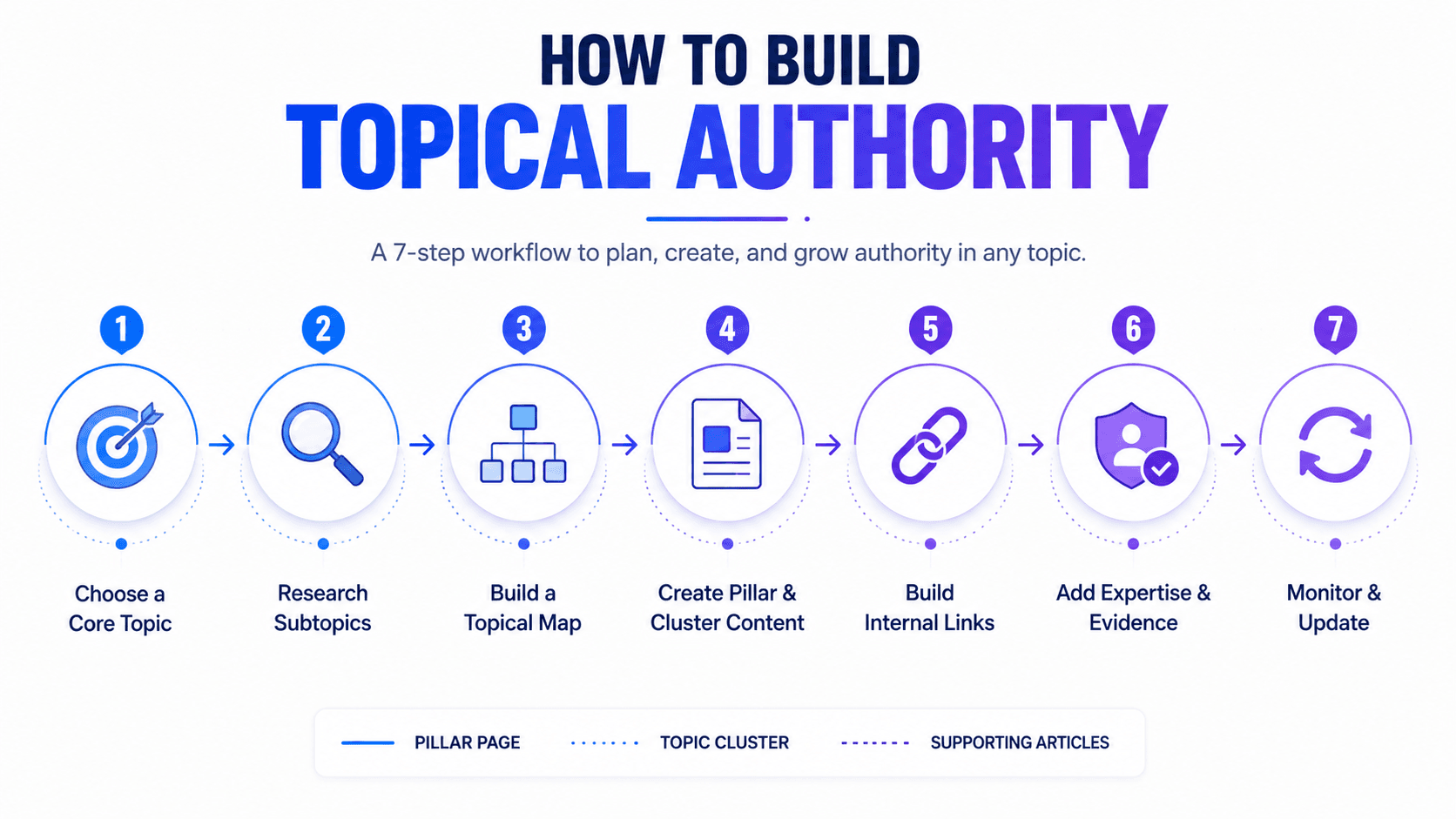
Building topical authority is an ongoing process rather than a one-time SEO task. Use the following workflow to turn research into a structured content system.
1. Choose a focused core topic
Start with a subject that matches your audience, expertise, and business goals. A topic that is too broad can produce hundreds of disconnected content ideas.
Define the topic narrowly enough to establish clear boundaries, but broadly enough to support multiple related subtopics.
2. Research subtopics and search intent
Go beyond the primary keyword. Research related queries, questions, long-tail keywords, competitor content, and gaps in existing search results.
Then classify each topic by intent:
- Informational
- Commercial
- Transactional
- Navigational
This prevents your content plan from becoming a collection of articles targeting similar searches.
3. Build your topical authority map
Organize your research into a hierarchy.
| Level | Example |
|---|---|
| Core topic | SEO |
| Main cluster | Keyword Research |
| Subtopic | Keyword Clustering |
| Supporting question | How to cluster keywords |
| Related content | Best keyword clustering tools |
The goal is not to create as many pages as possible. The goal is to identify the important coverage your audience actually needs.
4. Create pillar and cluster content
Build your most important pages first, then expand into supporting content.
Your pillar page should provide a broad overview. Cluster articles should answer specific questions in greater depth.
Avoid creating multiple pages that satisfy the same search intent. This can create unnecessary duplication and make your content architecture harder to manage.
5. Build a strong internal linking structure
Connect your content based on topical relationships.
For example:
SEO Guide ↓ Keyword Research Guide ↓ Keyword Clustering Guide ↓ Long-Tail Keyword Research Guide
Review your existing articles regularly and add relevant links as new content is published.
6. Add original expertise and evidence
Content depth alone is not enough. Add information that readers cannot get from simply combining existing articles.
Consider including:
- First-hand experience
- Original examples
- Expert insights
- Data and research
- Screenshots or demonstrations
- Relevant sources
- Practical workflows
This is especially important when using AI to produce content. AI can accelerate research and drafting, but human review should remain responsible for accuracy, context, and original value.
7. Monitor, update, and strengthen your content
Topical authority is not finished when an article is published.
Track which pages perform well, identify content gaps, update outdated information, improve internal links, and consolidate overlapping pages when necessary.
A simple maintenance cycle is:
Research → Map → Create → Connect → Verify → Publish → Update
This keeps your content system aligned with changes in search behavior and your audience's needs.
How AI Can Help Build Topical Authority
AI can make the execution process faster, but it should support your SEO strategy rather than replace it.
With a multi-model AI workspace such as 1min.AI, SEO and content teams can use different models to support research, compare answers, generate content ideas, draft articles, and cross-check information.
A practical workflow looks like:
Research → Compare → Map → Draft → Verify → Publish → Update
For example, you can use AI to identify related subtopics, turn research into a preliminary content structure, generate supporting article ideas, and compare outputs from multiple models.
The important distinction is automation of execution, not automation of expertise. Your team should still decide which topics matter, validate claims, assess search intent, and add original insights before publishing.
AI Agent Survey: Get Up to 3M Credits
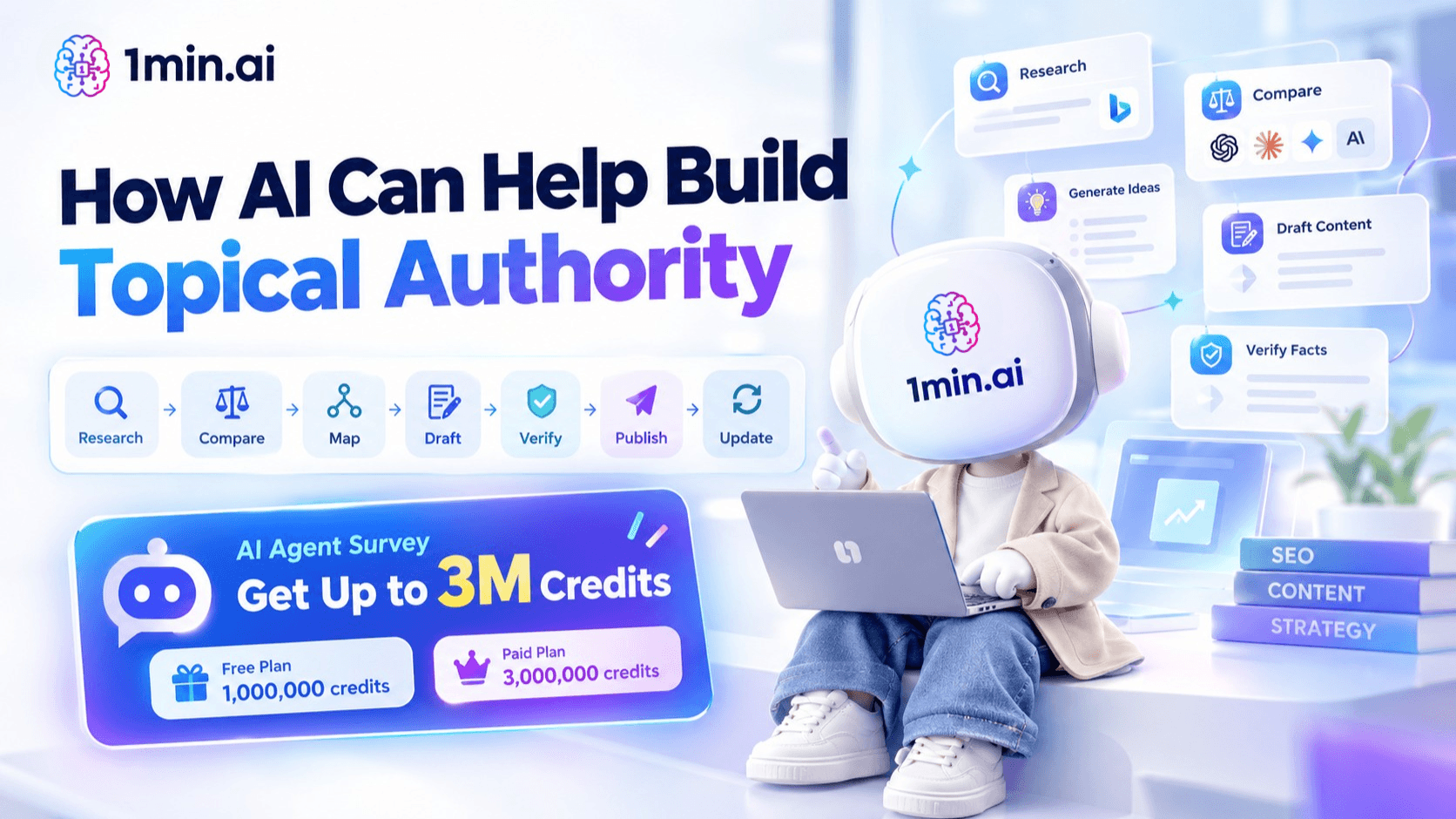
Help shape the next 1minAI Agent by completing our early access survey. Your feedback helps us understand what users need from AI agents—and you’ll receive credits as a thank-you.
- Free plan: Get 1,000,000 credits
- Paid plan: Get 3,000,000 credits
- One survey submission per user
- One credit reward per team
- All submitters receive an exclusive discount code by email
👉 Complete the AI Agent Survey and get rewarded for helping us build the next 1minAI Agent.
Final Takeaway
Topical authority is built through connected, useful, and trustworthy coverage of a subject—not by simply publishing more articles. Start with a focused topic, map its important subtopics, create pillar and cluster content, and connect everything with meaningful internal links.
Use AI to accelerate research, organization, drafting, and verification, while keeping strategy and final judgment human-led. With a consistent process, your website can gradually build a stronger and more useful topical content system.
Alternatives
Discover the best alternatives to 1minAI and compare features, pricing, and use cases.

1min.AI vs OpenRouter
1min.AI vs. OpenRouter: Compare the ready-to-use AI creation product against the technical API tool. Find out if you need a zero-code creative studio or a coding infrastructure hub.
 Ngoc Hong
1min.AI vs Lovart
Compare 1min.AI vs Lovart across features, pricing, credits, brand tools, and use cases to find the right AI platform for your workflow.
Ngoc Hong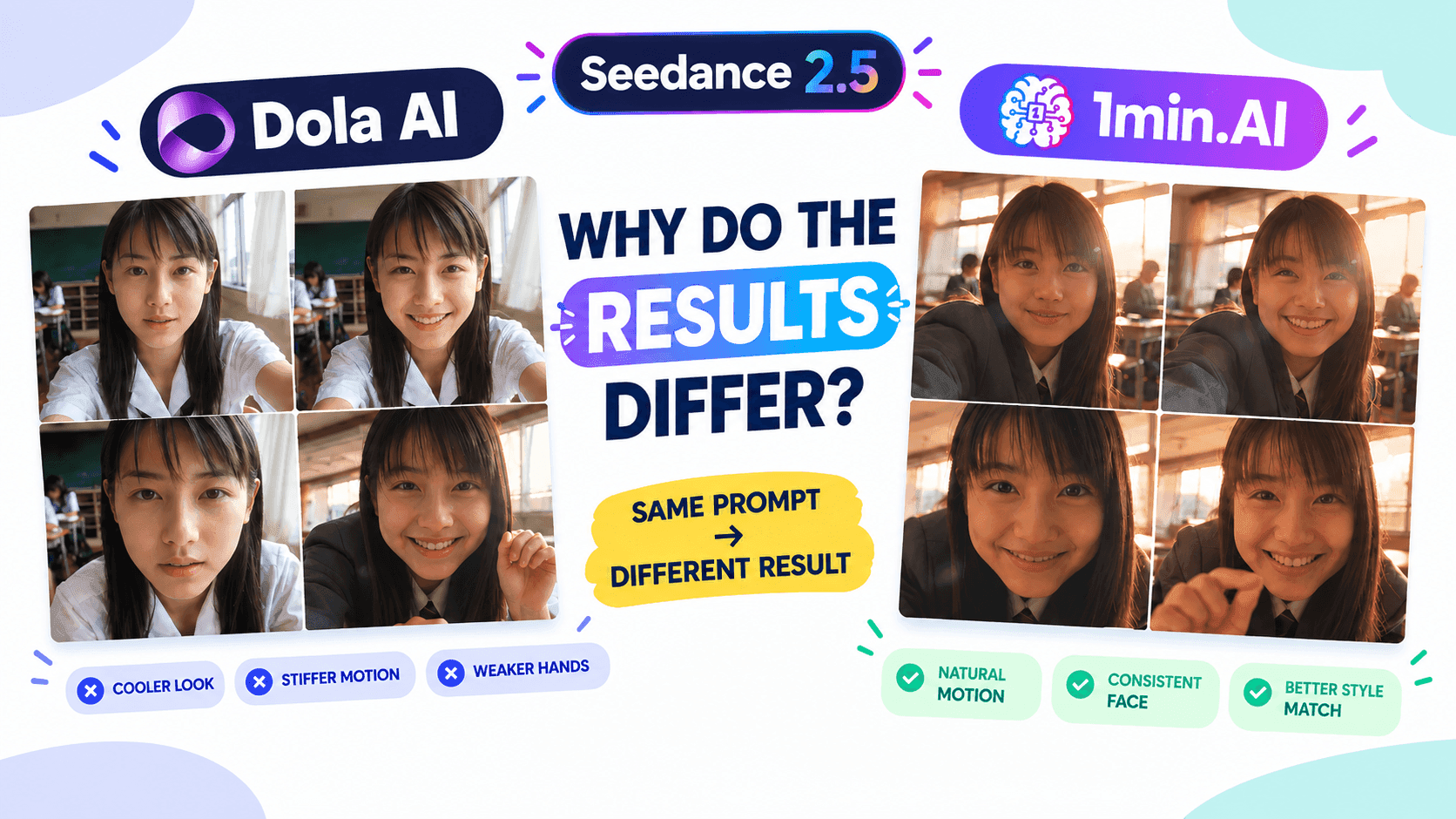
1min. AI vs Dola AI
Looking for a Dola AI alternative? Compare 1min.AI vs Dola AI on video generation, free plans, pricing and privacy to pick the right AI app.
Ngoc HongAI Tools
Discover the best AI tools to boost productivity, creativity, and everyday work.
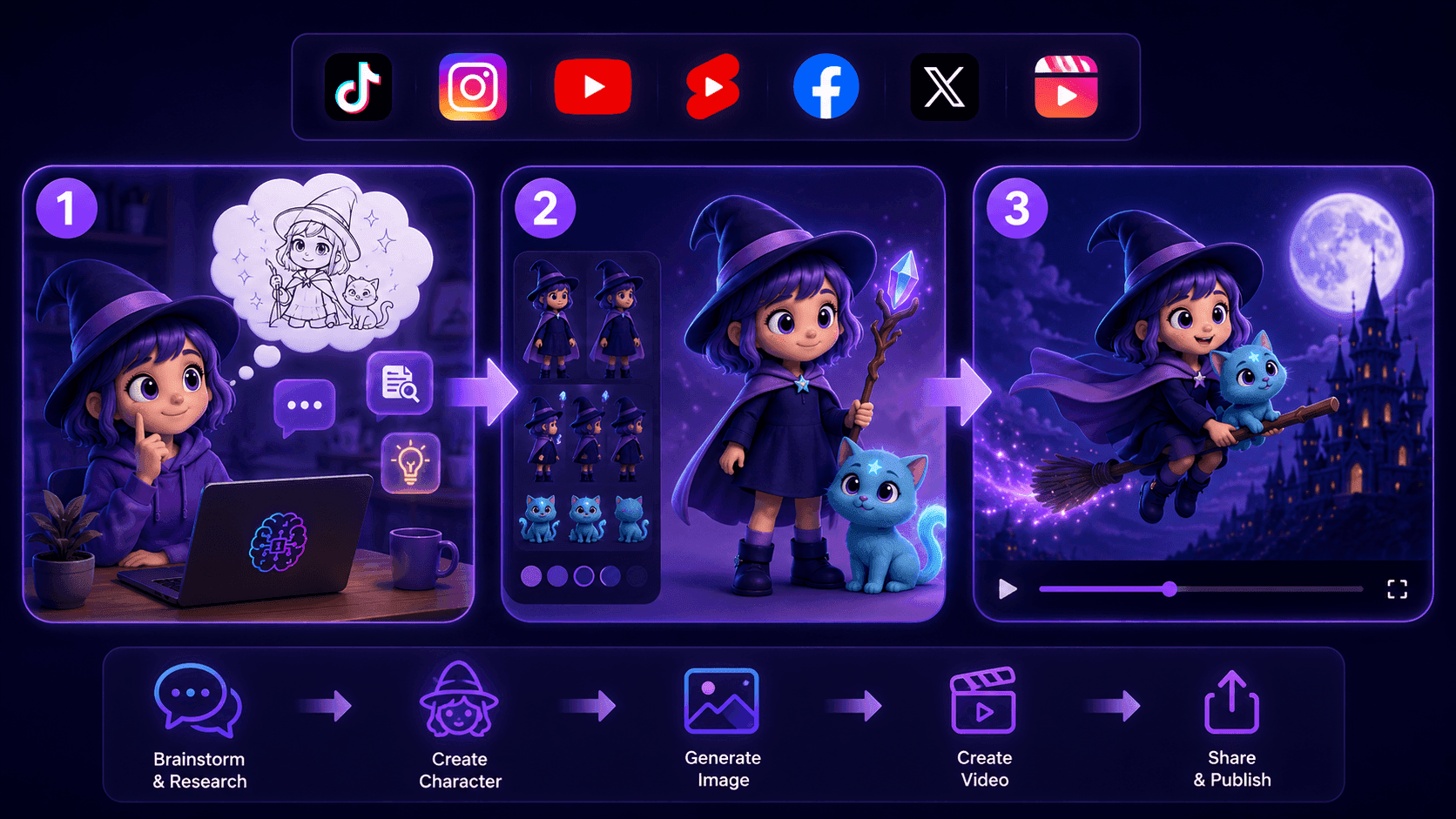
Create Consistent Cartoon Content in Just a Few Steps
Create engaging cartoon videos for TikTok and Reels with 1min.AI. Research ideas, create characters, and turn images into animated videos in 3 simple steps.
 Lien Anh Vu
One Product, 10 UGC Creatives: How AI Makes Content Testing Easier
Create more authentic UGC with an AI UGC video generator, test more creative angles and scale affiliate content without filming every version.
Lien Anh Vu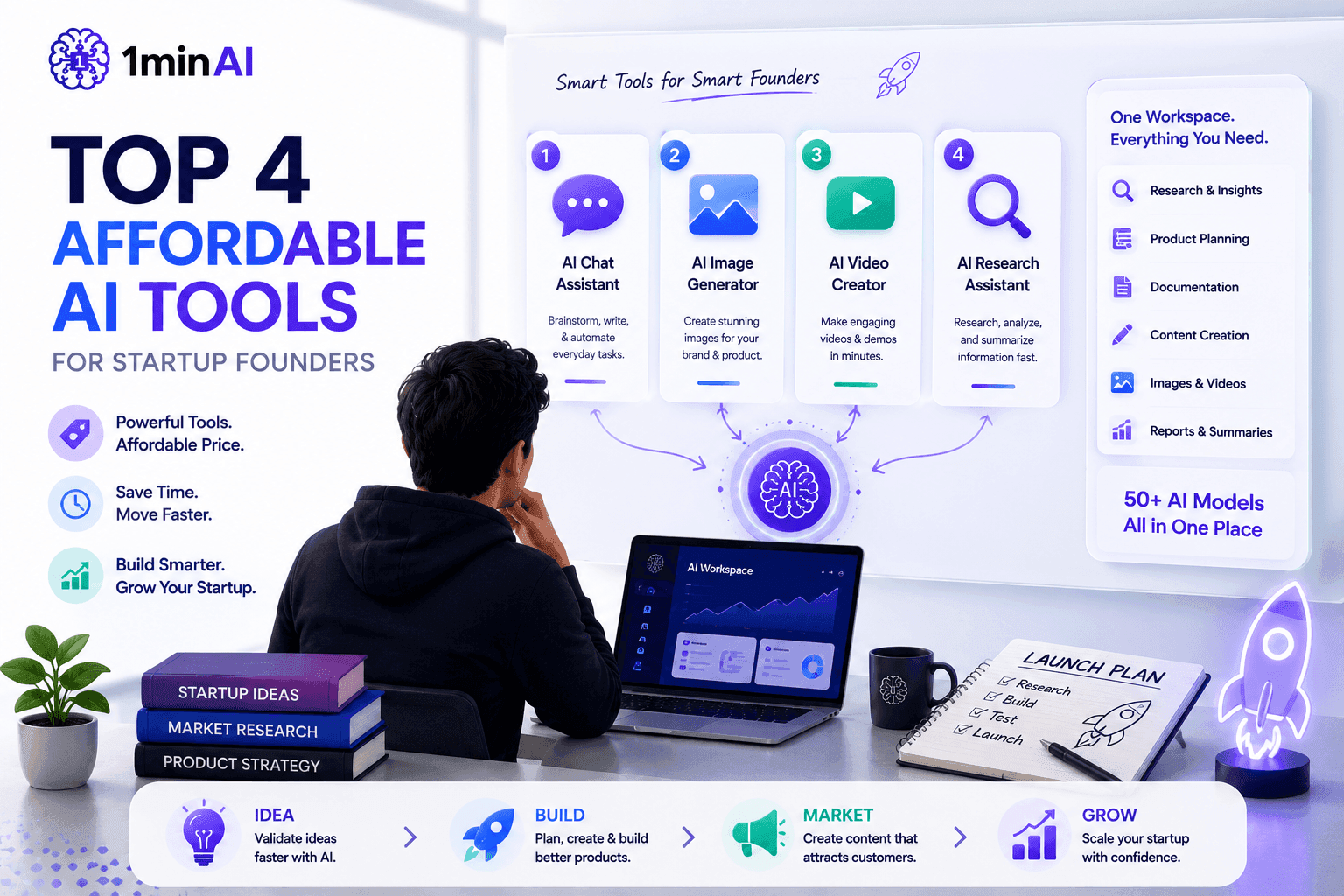
Top 4 Affordable AI Tools for Startup Founders
Discover the top 4 affordable AI tools for startup founders to validate ideas, build products, create content, and launch faster without overspending.
 Tram Ta
AI Features
Comprehensive AI features that streamline workflows, improve efficiency, and empower teams to achieve more.
Create Consistent Cartoon Content in Just a Few Steps
Create engaging cartoon videos for TikTok and Reels with 1min.AI. Research ideas, create characters, and turn images into animated videos in 3 simple steps.
Lien Anh VuOne Product, 10 UGC Creatives: How AI Makes Content Testing Easier
Create more authentic UGC with an AI UGC video generator, test more creative angles and scale affiliate content without filming every version.
Lien Anh Vu
1minAI: Free AI Grammar Checker
Check grammar for free with 1minAI’s AI grammar checker. Find grammar, spelling, and writing mistakes, improve clarity, and polish your content in seconds.
Tram TaAI Use Cases
A curated collection of AI use cases for business, productivity, and industry-specific applications.
Create Consistent Cartoon Content in Just a Few Steps
Create engaging cartoon videos for TikTok and Reels with 1min.AI. Research ideas, create characters, and turn images into animated videos in 3 simple steps.
Lien Anh VuOne Product, 10 UGC Creatives: How AI Makes Content Testing Easier
Create more authentic UGC with an AI UGC video generator, test more creative angles and scale affiliate content without filming every version.
Lien Anh Vu
Best Time to Post on Instagram: A Practical Guide for Better Engagement
Discover the best time to post on Instagram, including the best days and times for different audiences, plus tips to find the ideal posting schedule for your account.
Tram TaAI Tutorials
Learn how to use AI with practical, step-by-step tutorials.
Create Consistent Cartoon Content in Just a Few Steps
Create engaging cartoon videos for TikTok and Reels with 1min.AI. Research ideas, create characters, and turn images into animated videos in 3 simple steps.
Lien Anh Vu
Black Friday AI Tool Deals in 2026
Discover what Black Friday AI tool deals 2026 has to offer. Find out how to secure the 1min.AI lifetime deal via AppSumo, Dealify, Stack Social, and verify on Trustpilot, Slashdot, and Software Advice.
 Hang Nguyen
[Seedance 2.5 New] Better AI Product Videos, Less Rework in 1min.AI
Use Seedance 2.5 image to video on 1min.AI to create more consistent AI product videos, reduce failed generations, save credits, and improve UGC workflows.
Lien Anh VuAI Guides
Learn AI faster with practical guides, real-world examples, and actionable best practices.
Create Consistent Cartoon Content in Just a Few Steps
Create engaging cartoon videos for TikTok and Reels with 1min.AI. Research ideas, create characters, and turn images into animated videos in 3 simple steps.
Lien Anh Vu
Safely Buy AI Tools Online: 2026 Black Friday Guide
Discover how to find and secure the best Black Friday AI deals online. Learn expert strategies to avoid scams, combat subscription fatigue, and verify software.
Hang Nguyen[Seedance 2.5 New] Better AI Product Videos, Less Rework in 1min.AI
Use Seedance 2.5 image to video on 1min.AI to create more consistent AI product videos, reduce failed generations, save credits, and improve UGC workflows.
Lien Anh VuAI Solutions
Browse the best AI solutions for automation, coding, research, productivity, customer support, marketing, and business workflows.
Create Consistent Cartoon Content in Just a Few Steps
Create engaging cartoon videos for TikTok and Reels with 1min.AI. Research ideas, create characters, and turn images into animated videos in 3 simple steps.
Lien Anh VuOne Product, 10 UGC Creatives: How AI Makes Content Testing Easier
Create more authentic UGC with an AI UGC video generator, test more creative angles and scale affiliate content without filming every version.
Lien Anh Vu
Free AI Tattoo Generator: Custom Designs
Turn any idea into a custom tattoo design with 1min.AI's free AI tattoo generator. Describe your idea, pick a style, and download in seconds.
 Trang Tran
AI Models
Explore the world's leading AI models in one place.
Create Consistent Cartoon Content in Just a Few Steps
Create engaging cartoon videos for TikTok and Reels with 1min.AI. Research ideas, create characters, and turn images into animated videos in 3 simple steps.
Lien Anh VuOne Product, 10 UGC Creatives: How AI Makes Content Testing Easier
Create more authentic UGC with an AI UGC video generator, test more creative angles and scale affiliate content without filming every version.
Lien Anh Vu[Seedance 2.5 New] Better AI Product Videos, Less Rework in 1min.AI
Use Seedance 2.5 image to video on 1min.AI to create more consistent AI product videos, reduce failed generations, save credits, and improve UGC workflows.
Lien Anh VuAI Comparisons
Compare AI tools, models, and platforms to find the best fit for your needs.

Kling AI Vs Veo 3: Which Model Wins?
Kling AI vs Veo 3: compare motion, native audio, pricing & free tiers to see which AI video generator wins for your project - try both on 1min.AI.
Trang Tran[Seedance 2.5 New] Better AI Product Videos, Less Rework in 1min.AI
Use Seedance 2.5 image to video on 1min.AI to create more consistent AI product videos, reduce failed generations, save credits, and improve UGC workflows.
Lien Anh Vu
DeepSeek V4 Pro vs Flash Comparison
Compare DeepSeek V4 Pro vs DeepSeek V4 Flash metrics. Optimize your agentic apps and improve AI fact checking on 1min.ai today.
Ngoc HongAI Integrations
Seamlessly integrate AI with the tools you already use to automate work and boost productivity.

POV: You Have 10+ Posts to Make Every Day
Learn how to build an AI content workflow that helps content creators produce 10+ social media posts a day faster with AI brainstorming, image generation, and content creation.
Lien Anh Vu
How to Use an AI Fashion Video Generator for Fashion Week 2026
Turn Fashion Week 2026 ideas into stunning fashion videos with AI. Learn how to brainstorm, create visuals, and transform images into videos with one simple workflow.
Lien Anh Vu
Stop Switching Between AI Apps: How AI Integration Transforms Employer Branding
Discover how AI integration helps HR teams streamline employer branding by combining AI writing, documents, images, video, and multiple AI models into one workspace.
Tram TaAI for Industries
Find the best AI tools and workflows for healthcare, finance, education, legal, manufacturing, retail, real estate, and more

7 Low-Cost AI Business Ideas for Your Startup
Explore 7 low-cost AI business ideas you can start with a small budget, from content and video services to AI consulting, reselling, and automation.
Tram Ta
Free AI Image Generator For Ecommerce
Turn phone photos into studio, white-background, and lifestyle product images. Try the best AI image generator for ecommerce online free with 1min.AI.
Trang Tran
Free Property Management Email Templates
Free property management email templates for tenants and owners: rent reminders, renewals, maintenance updates. Copy, customize, and send in minutes.
Trang TranAI Agents
Discover and run AI agents to automate tasks across your work and daily life.
1minAI: Free AI Grammar Checker
Check grammar for free with 1minAI’s AI grammar checker. Find grammar, spelling, and writing mistakes, improve clarity, and polish your content in seconds.
Tram Ta
AI Agents for Facebook
Use an AI Agent for Facebook to create content, generate images, schedule posts, and publish from your documents and conversations.
Ngoc Hong
AI Agent vs AI Assistant: Which One Actually Saves Designers More Time?
Learn the difference between AI Agent vs AI Assistant and discover which solution helps designers automate repetitive work, reduce revisions, and save more time.
Lien Anh VuAI Workflows
Explore ready-to-use AI workflows for productivity, marketing, sales, support, and more.
Create Consistent Cartoon Content in Just a Few Steps
Create engaging cartoon videos for TikTok and Reels with 1min.AI. Research ideas, create characters, and turn images into animated videos in 3 simple steps.
Lien Anh VuOne Product, 10 UGC Creatives: How AI Makes Content Testing Easier
Create more authentic UGC with an AI UGC video generator, test more creative angles and scale affiliate content without filming every version.
Lien Anh VuPOV: You Have 10+ Posts to Make Every Day
Learn how to build an AI content workflow that helps content creators produce 10+ social media posts a day faster with AI brainstorming, image generation, and content creation.
Lien Anh VuNewsletter
Weekly AI Innovations with 1minAI

🔮 Weekly AI Innovations #136: Grok 4.6 and Smart Data Retention
Discover the latest 1min.ai updates! Upgrade to Grok 4.6 for blazing-fast AI, and check our new Data Retention policies to secure your files today.
Hang Nguyen
🔮 Weekly AI Innovations #139: Dawn of the next-gen AI
Discover the immense power of GPT-6 Astra and Claude Fable 5.1. Unlock next-generation AI models on 1min.ai to solve complex tasks effortlessly.
Hang Nguyen
🔮 Weekly AI Innovations #138: Claude Sonnet 5, Fable 5 & Wan 2.7
Explode your creative potential with massive 1min.ai updates! Access Claude Sonnet 5, Fable 5, and Alibaba Wan 2.7 for unmatched multi-modal generation today.
Hang Nguyen