
AI Agent vs LLM: Which One Do You Need?

Trang Tran
September 28, 2026
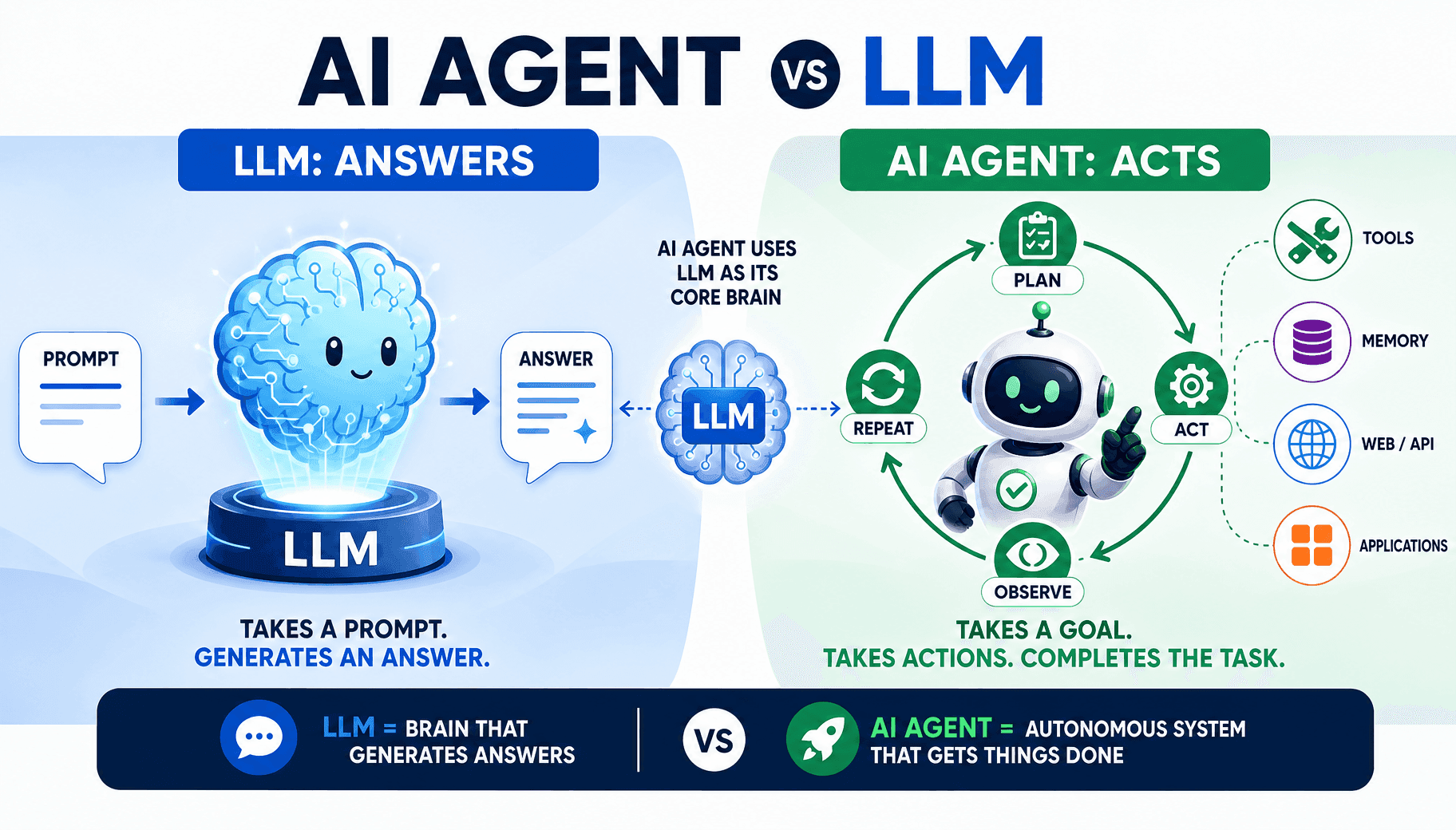
AI agent vs LLM: learn the key differences, real examples, and use cases, then see which one you need to get your task done. Simple, clear, no jargon.
Every AI product now claims to be "powered by LLMs" or "built on agents." That makes it hard to tell whether you need a smart text tool or a system that can finish work for you.
The short answer: An LLM (large language model) generates text from a prompt and then stops. An AI agent uses an LLM as its "brain" and adds tools, memory, and a planning loop so it can complete multi-step tasks on its own. In one line: an LLM answers, an agent acts.
Quick takeaways
- An LLM is a model. An AI agent is a system built around a model.
- Choose an LLM for single-step language tasks such as drafting, summarizing, and explaining.
- Choose an AI agent when a task needs several steps, external tools, or ongoing follow-through.
- Most agents run on top of an LLM, so the real question is rarely "one or the other."
This guide covers the difference in plain language, real examples, and a simple checklist to help you decide.
What Is an LLM?
A large language model is an AI model trained on massive amounts of text to understand and generate language. GPT, Claude, Gemini, and Qwen are well-known examples.
An LLM takes your prompt, predicts the best response, and returns it. It is very good at:
- Writing and rewriting content
- Summarizing long documents
- Translating between languages
- Explaining concepts and answering questions
- Generating and reviewing code
On its own, an LLM has clear limits. It works inside a single context window, so it does not carry knowledge between separate sessions. It also cannot send an email, update a spreadsheet, or check a website unless other software connects it to those tools.
What Is an AI Agent?
An AI agent is a system that works toward a goal instead of just answering a prompt. You give it an objective, and it decides which steps to take, uses tools to take them, checks the results, and adjusts.
Most agents follow the same loop: reason, act, observe, repeat. That loop is what separates an agent from a single model call.
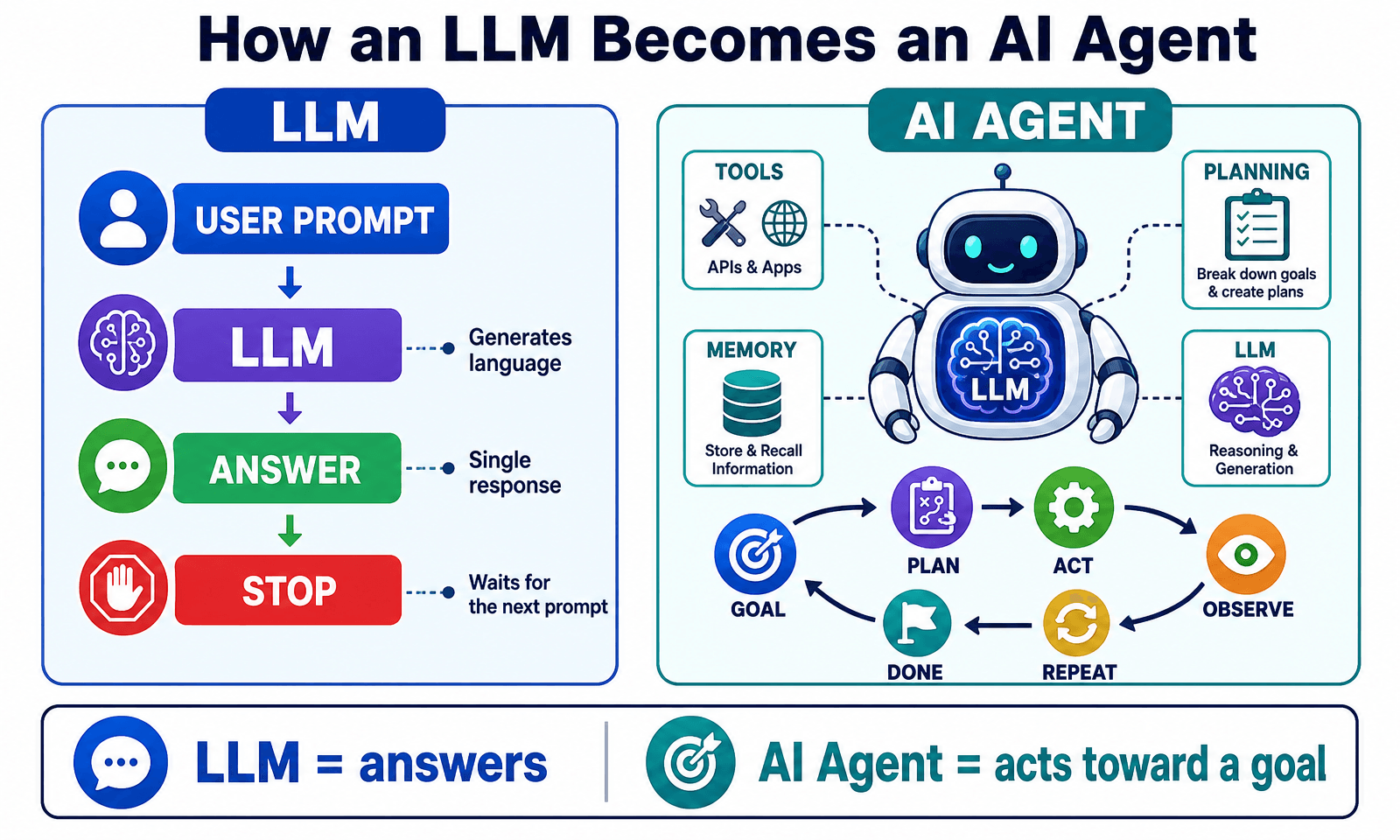
How an LLM-Based AI Agent Works
An LLM-based AI agent combines four parts:
- LLM (reasoning): Interprets the goal and decides the next step.
- Tools: APIs, web search, code execution, and apps the agent can operate.
- Memory: Stores progress and context so work can continue across steps and sessions.
- Planning and orchestration: Breaks the goal into tasks, handles errors, and knows when to stop.
Anthropic draws a useful line in its guide to building effective agents. Workflows run LLMs and tools through predefined code paths, while agents let the LLM direct its own process and tool use. If every step is fixed in advance, you have a workflow. If the model chooses the steps, you have an agent.
Types of AI Agents
AI agents are commonly grouped into simple reflex, model-based, goal-based, utility-based, and learning agents. Some lists add hierarchical and multi-agent systems, which is how you get "7 types." Modern LLM-based agents are usually goal-based or learning agents.
The Difference Between AI Agent and LLM
Here is how the two compare side by side:
| Dimension | LLM | AI Agent |
|---|---|---|
| What it is | A language model | A system built around a model |
| Main role | Understands and generates language | Pursues goals and completes tasks |
| Input | A prompt | A goal or objective |
| Execution | One response, then it stops | Loops until the task is done |
| Memory | Limited to the current context window | Short-term and long-term memory |
| Tool use | Only text output unless connected | Calls APIs, runs code, uses apps |
| Autonomy | Waits for the next prompt | Decides its own next step |
| Cost and speed | One call, fast and cheap | Many calls, slower and costlier |
| Best for | Single-step language tasks | Multi-step, cross-tool workflows |
Execution: One Response vs. a Loop
An LLM produces an answer and waits for you. An agent keeps working. It plans, takes an action, reads the result, and decides what to do next until the goal is reached.
Memory: Context Window vs. Persistent Memory
An LLM only knows what fits in its current context. An agent can save progress, preferences, and past results, so it can pick up a long task where it left off.
Tools: Describing Actions vs. Taking Them
Ask an LLM to "book a meeting" and it will write a polite message. Connect an agent to your calendar and it can find a free slot and book it.
AI Agent vs LLM Use Cases
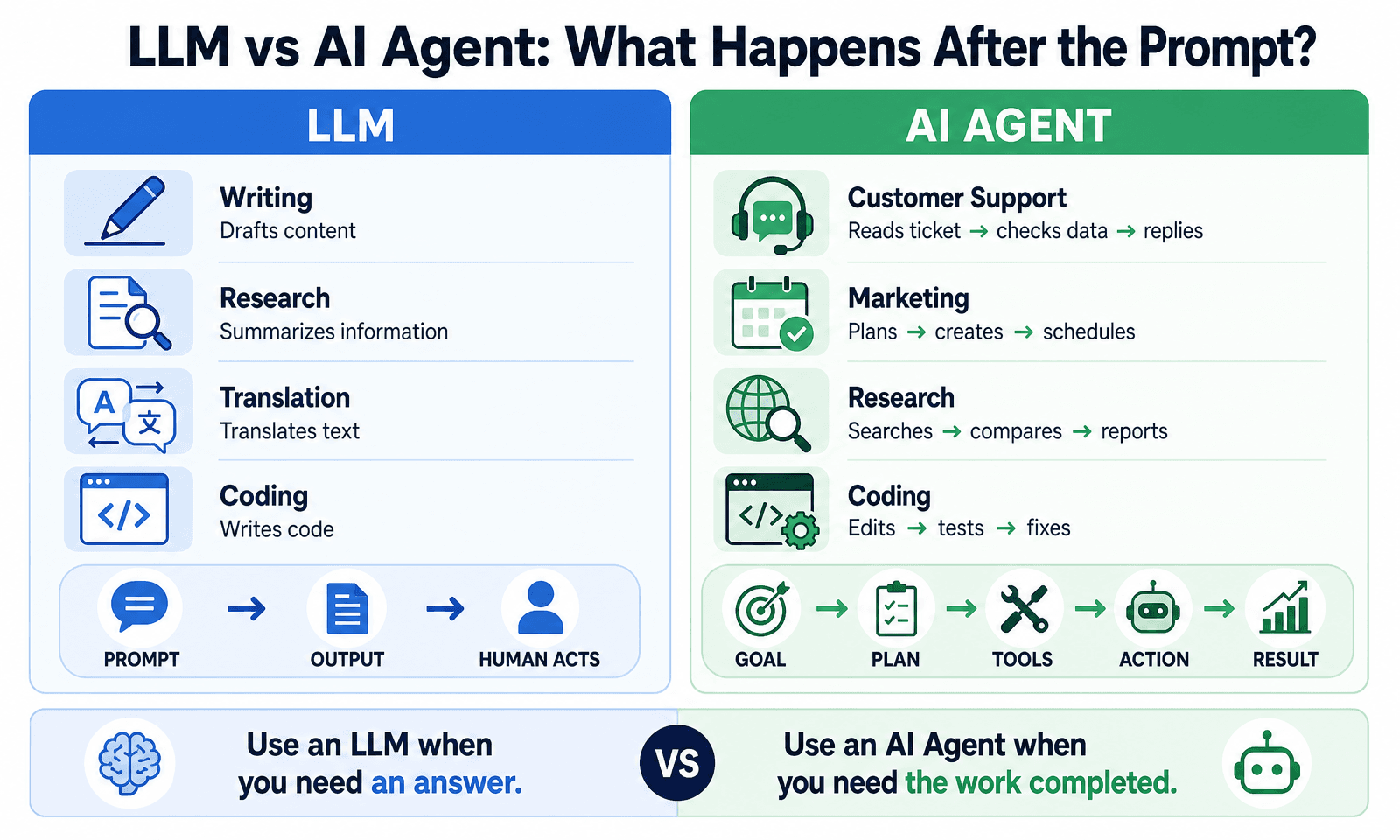
The right choice depends on what happens after the AI responds. If a human reads the output and acts on it, an LLM is enough. If the AI needs to act, you need an agent.
When to Choose an LLM
- Drafting emails, blog posts, or ad copy
- Summarizing reports, articles, or transcripts
- Translating or paraphrasing content
- Explaining a concept or answering a question
- Getting quick coding help
When to Choose an AI Agent
- The task has multiple steps that depend on each other
- The work spans several apps or systems
- You need continuous monitoring or scheduled follow-through
- The result should be a finished action, not just a suggestion
LLM vs AI Agent Examples
| Task | LLM approach | AI agent approach |
|---|---|---|
| Customer support | Drafts a reply for a human to send | Reads the ticket, checks order data, replies, and updates the ticket |
| Marketing | Writes a caption on request | Plans a content calendar, creates posts, and schedules them |
| Research | Summarizes a document you paste in | Searches sources, compares findings, and compiles a report |
| Coding | Writes a function on request | Edits files, runs tests, and fixes failures |
For a closer look at this in practice, see how an AI agent for social media management handles planning and publishing without step-by-step prompting.
Which One Do You Need? A Quick Checklist
Answer these four questions about your task:
| Question | If yes |
|---|---|
| Is the output text that you will review and use yourself? | LLM |
| Does the task need actions inside other apps? | AI agent |
| Does it repeat on a schedule or trigger? | AI agent |
| Is a wrong action costly if no one checks it? | LLM first, agent with human review |
Agents are more powerful, but they also cost more, run slower, and need oversight. A simple prompt to a strong LLM is often the better first step.
Common Questions About AI Agents and LLMs
Is ChatGPT an LLM or an Agent?
GPT is the LLM. ChatGPT is a chatbot product built on it. Chat mode works like an LLM, while agent-style features let the same model browse, use tools, and complete multi-step tasks. The same logic applies to Claude. It is a family of LLMs, and it becomes agentic when it runs inside a system with tools and a loop.
AI Agent vs Chatbot
A chatbot answers in conversation, and many are simply an LLM with a chat window. An agent goes further and takes actions in other systems. A chatbot tells you how to reset a password, while an agent resets it.
AI Agents vs Large Language Models vs Agentic AI
"Agentic AI" describes the broader approach of AI systems that act with autonomy, often with several agents working together. An LLM is a component, an AI agent is a system, and agentic AI is the pattern.
Where Does MCP Fit In?
The Model Context Protocol (MCP) is an open standard for connecting AI models to external tools and data. It is not an alternative to agents. It is one way agents get access to the tools they use.
How to Create an AI Agent (and Where to Start)
You do not need to build an agent from scratch to benefit from this shift. A practical path looks like this:
- Start with an LLM. Test your task with a strong model and refine the prompt.
- Find the repeating steps. Note where you copy, paste, or hand results to another tool.
- Add tools and memory. Connect the apps the task touches and store the context it needs.
- Keep a human check. Review results before giving an agent access to important systems.
Start With the Right LLM on 1min.AI
1min.AI is an all-in-one AI platform with a Multi AI Chat where you can work with leading LLMs from providers such as OpenAI, Anthropic, and Google in one place. It also includes tools for writing, images, documents, audio, video, and code. A shared workspace with a Prompt List, Brand Voice List, and Asset List keeps your work consistent across projects. It is a practical way to test which model handles your task best before you automate it.
Get Early Access to the 1min.AI Agent
1min.AI is also building its AI Agent. Tell the team which tasks you want an agent to handle through the early access form. After admin approval, eligible teams receive credits, and approved submitters receive exclusive discount codes by email.
AI Agent vs LLM: FAQ
Is an LLM the same as an AI agent?
No. An LLM is a language model that generates output from a prompt. An AI agent is a system that uses an LLM together with tools, memory, and planning to complete tasks.
Can an AI agent work without an LLM?
Yes. Rule-based and reinforcement learning agents existed long before LLMs. However, most modern agents use an LLM because it handles natural language instructions and messy real-world input well.
Are AI agents better than LLMs?
Not always. An LLM is simpler, faster, and cheaper for single-step tasks. Agents add value when a job needs multiple steps, tools, or ongoing work, but they are more complex and need more oversight.
Do AI agents always use tools and memory?
Most useful agents do. Tools let them act, and memory lets them stay on track across steps. A minimal agent can loop on its own output without external tools, but that is rare in real work.
What is the difference between an AI agent and an LLM in one sentence?
An LLM generates language from a prompt, while an AI agent uses an LLM plus tools, memory, and a planning loop to complete a goal.
Final Thoughts
The AI agent vs LLM question is really about the job you want done. If you need better words, an LLM is enough. If you need finished work across tools, an agent is the right fit. Most teams will use both, starting with an LLM and adding agents where repetitive multi-step work piles up.
So which one do you need? Start with an LLM for words, and add an AI agent when you need finished work.
Alternatives
Discover the best alternatives to 1minAI and compare features, pricing, and use cases.

1min.AI vs OpenRouter
1min.AI vs. OpenRouter: Compare the ready-to-use AI creation product against the technical API tool. Find out if you need a zero-code creative studio or a coding infrastructure hub.
 Ngoc Hong
1minAI vs Hix AI
Compare 5 HIX AI alternatives for AI chat, research, writing, images, video, pricing, and flexible AI workflows.
Ngoc Hong
1min.AI vs Easy Peasy AI
Looking for an Easy Peasy AI alternative? Compare Easy Peasy AI and 1min.AI for content workflows, AI models, and professional teams.
Ngoc HongAI Tools
Discover the best AI tools to boost productivity, creativity, and everyday work.
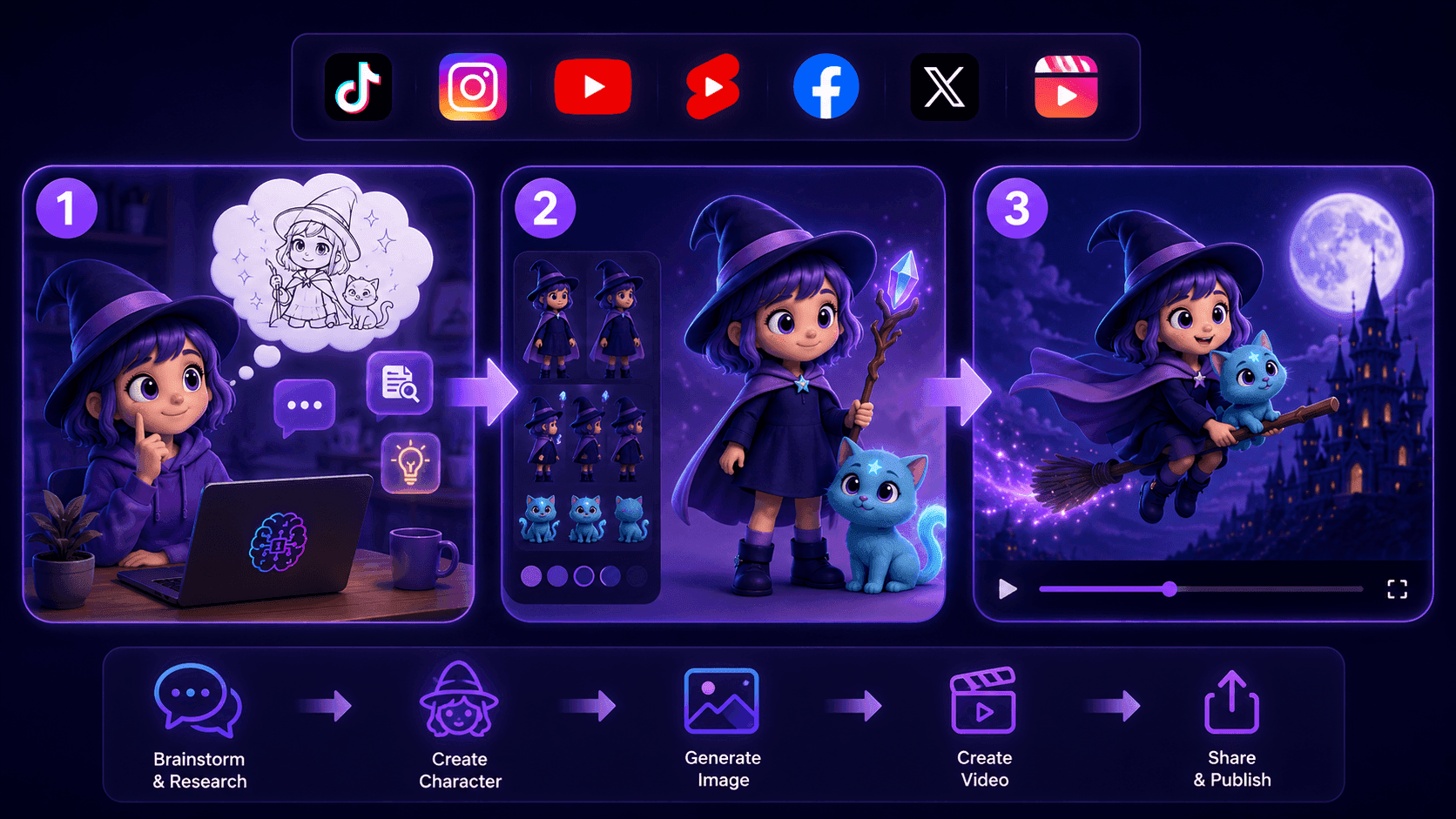
Create Consistent Cartoon Content in Just a Few Steps
Create engaging cartoon videos for TikTok and Reels with 1min.AI. Research ideas, create characters, and turn images into animated videos in 3 simple steps.
 Lien Anh Vu
One Product, 10 UGC Creatives: How AI Makes Content Testing Easier
Create more authentic UGC with an AI UGC video generator, test more creative angles and scale affiliate content without filming every version.
Lien Anh Vu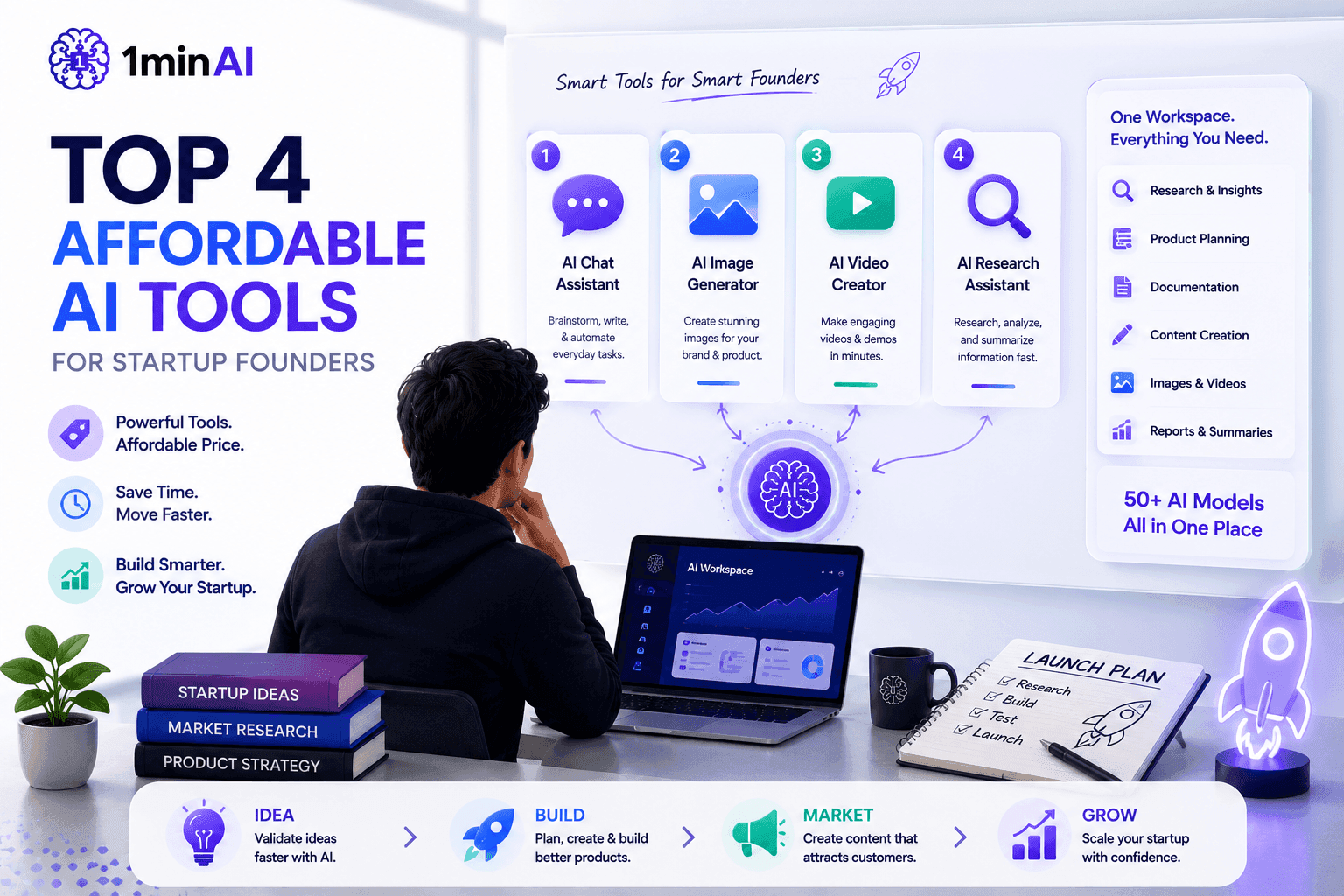
Top 4 Affordable AI Tools for Startup Founders
Discover the top 4 affordable AI tools for startup founders to validate ideas, build products, create content, and launch faster without overspending.
 Tram Ta
AI Features
Comprehensive AI features that streamline workflows, improve efficiency, and empower teams to achieve more.
Create Consistent Cartoon Content in Just a Few Steps
Create engaging cartoon videos for TikTok and Reels with 1min.AI. Research ideas, create characters, and turn images into animated videos in 3 simple steps.
Lien Anh VuOne Product, 10 UGC Creatives: How AI Makes Content Testing Easier
Create more authentic UGC with an AI UGC video generator, test more creative angles and scale affiliate content without filming every version.
Lien Anh Vu
1minAI: Free AI Grammar Checker
Check grammar for free with 1minAI’s AI grammar checker. Find grammar, spelling, and writing mistakes, improve clarity, and polish your content in seconds.
Tram TaAI Use Cases
A curated collection of AI use cases for business, productivity, and industry-specific applications.
Create Consistent Cartoon Content in Just a Few Steps
Create engaging cartoon videos for TikTok and Reels with 1min.AI. Research ideas, create characters, and turn images into animated videos in 3 simple steps.
Lien Anh VuOne Product, 10 UGC Creatives: How AI Makes Content Testing Easier
Create more authentic UGC with an AI UGC video generator, test more creative angles and scale affiliate content without filming every version.
Lien Anh Vu
Best Time to Post on Instagram: A Practical Guide for Better Engagement
Discover the best time to post on Instagram, including the best days and times for different audiences, plus tips to find the ideal posting schedule for your account.
Tram TaAI Tutorials
Learn how to use AI with practical, step-by-step tutorials.
Create Consistent Cartoon Content in Just a Few Steps
Create engaging cartoon videos for TikTok and Reels with 1min.AI. Research ideas, create characters, and turn images into animated videos in 3 simple steps.
Lien Anh Vu
Black Friday AI Tool Deals in 2026
Discover what Black Friday AI tool deals 2026 has to offer. Find out how to secure the 1min.AI lifetime deal via AppSumo, Dealify, Stack Social, and verify on Trustpilot, Slashdot, and Software Advice.
 Hang Nguyen
[Seedance 2.5 New] Better AI Product Videos, Less Rework in 1min.AI
Use Seedance 2.5 image to video on 1min.AI to create more consistent AI product videos, reduce failed generations, save credits, and improve UGC workflows.
Lien Anh VuAI Guides
Learn AI faster with practical guides, real-world examples, and actionable best practices.
Create Consistent Cartoon Content in Just a Few Steps
Create engaging cartoon videos for TikTok and Reels with 1min.AI. Research ideas, create characters, and turn images into animated videos in 3 simple steps.
Lien Anh Vu
Safely Buy AI Tools Online: 2026 Black Friday Guide
Discover how to find and secure the best Black Friday AI deals online. Learn expert strategies to avoid scams, combat subscription fatigue, and verify software.
Hang Nguyen[Seedance 2.5 New] Better AI Product Videos, Less Rework in 1min.AI
Use Seedance 2.5 image to video on 1min.AI to create more consistent AI product videos, reduce failed generations, save credits, and improve UGC workflows.
Lien Anh VuAI Solutions
Browse the best AI solutions for automation, coding, research, productivity, customer support, marketing, and business workflows.
Create Consistent Cartoon Content in Just a Few Steps
Create engaging cartoon videos for TikTok and Reels with 1min.AI. Research ideas, create characters, and turn images into animated videos in 3 simple steps.
Lien Anh VuOne Product, 10 UGC Creatives: How AI Makes Content Testing Easier
Create more authentic UGC with an AI UGC video generator, test more creative angles and scale affiliate content without filming every version.
Lien Anh Vu
Free AI Tattoo Generator: Custom Designs
Turn any idea into a custom tattoo design with 1min.AI's free AI tattoo generator. Describe your idea, pick a style, and download in seconds.
 Trang Tran
AI Models
Explore the world's leading AI models in one place.
Create Consistent Cartoon Content in Just a Few Steps
Create engaging cartoon videos for TikTok and Reels with 1min.AI. Research ideas, create characters, and turn images into animated videos in 3 simple steps.
Lien Anh VuOne Product, 10 UGC Creatives: How AI Makes Content Testing Easier
Create more authentic UGC with an AI UGC video generator, test more creative angles and scale affiliate content without filming every version.
Lien Anh Vu[Seedance 2.5 New] Better AI Product Videos, Less Rework in 1min.AI
Use Seedance 2.5 image to video on 1min.AI to create more consistent AI product videos, reduce failed generations, save credits, and improve UGC workflows.
Lien Anh VuAI Comparisons
Compare AI tools, models, and platforms to find the best fit for your needs.
Kling AI Vs Veo 3: Which Model Wins?
Kling AI vs Veo 3: compare motion, native audio, pricing & free tiers to see which AI video generator wins for your project - try both on 1min.AI.
Trang Tran[Seedance 2.5 New] Better AI Product Videos, Less Rework in 1min.AI
Use Seedance 2.5 image to video on 1min.AI to create more consistent AI product videos, reduce failed generations, save credits, and improve UGC workflows.
Lien Anh Vu
DeepSeek V4 Pro vs Flash Comparison
Compare DeepSeek V4 Pro vs DeepSeek V4 Flash metrics. Optimize your agentic apps and improve AI fact checking on 1min.ai today.
Ngoc HongAI Integrations
Seamlessly integrate AI with the tools you already use to automate work and boost productivity.
POV: You Have 10+ Posts to Make Every Day
Learn how to build an AI content workflow that helps content creators produce 10+ social media posts a day faster with AI brainstorming, image generation, and content creation.
Lien Anh Vu
How to Use an AI Fashion Video Generator for Fashion Week 2026
Turn Fashion Week 2026 ideas into stunning fashion videos with AI. Learn how to brainstorm, create visuals, and transform images into videos with one simple workflow.
Lien Anh Vu
Stop Switching Between AI Apps: How AI Integration Transforms Employer Branding
Discover how AI integration helps HR teams streamline employer branding by combining AI writing, documents, images, video, and multiple AI models into one workspace.
Tram TaAI for Industries
Find the best AI tools and workflows for healthcare, finance, education, legal, manufacturing, retail, real estate, and more
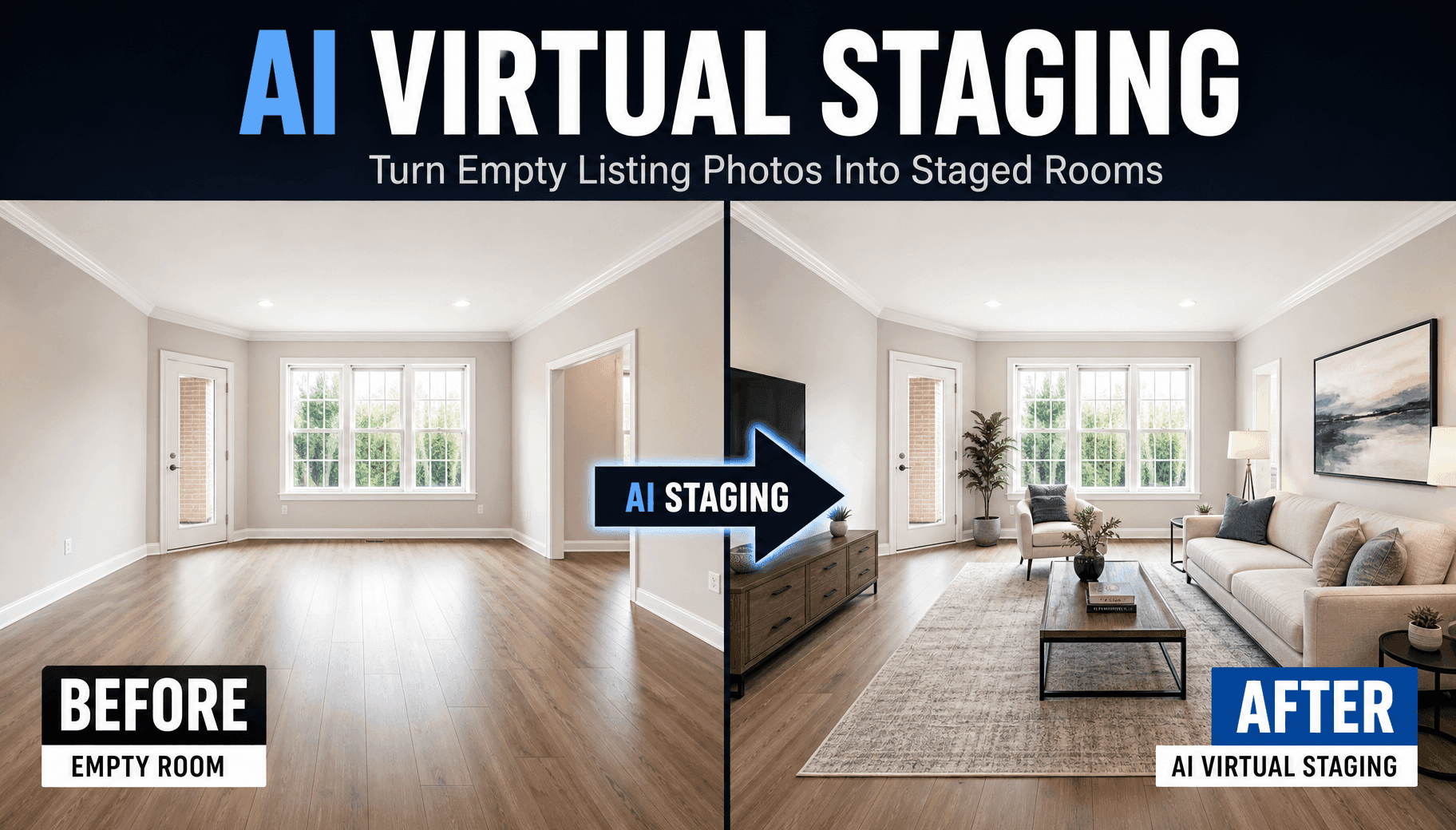
Free AI Virtual Staging: Furnish Any Room
Stage any real estate listing with AI virtual staging: upload a photo, pick a style, and get a photorealistic furnished room in seconds, free to try.
Trang Tran
Free AI Real Estate Video Generator
Turn listing photos into narrated property videos with AI real estate video tools. See how 1min.AI creates walkthroughs, voiceovers & captions in minutes.
Trang Tran
The Problem With AI Design? It Looks Too AI
AI-generated designs can look polished but still feel artificial. Here are 5 prompt techniques designers can use to create more realistic, intentional visuals.
Lien Anh VuAI Agents
Discover and run AI agents to automate tasks across your work and daily life.
1minAI: Free AI Grammar Checker
Check grammar for free with 1minAI’s AI grammar checker. Find grammar, spelling, and writing mistakes, improve clarity, and polish your content in seconds.
Tram Ta
AI Agents for Facebook
Use an AI Agent for Facebook to create content, generate images, schedule posts, and publish from your documents and conversations.
Ngoc Hong
AI Agent vs AI Assistant: Which One Actually Saves Designers More Time?
Learn the difference between AI Agent vs AI Assistant and discover which solution helps designers automate repetitive work, reduce revisions, and save more time.
Lien Anh VuAI Workflows
Explore ready-to-use AI workflows for productivity, marketing, sales, support, and more.
Create Consistent Cartoon Content in Just a Few Steps
Create engaging cartoon videos for TikTok and Reels with 1min.AI. Research ideas, create characters, and turn images into animated videos in 3 simple steps.
Lien Anh VuOne Product, 10 UGC Creatives: How AI Makes Content Testing Easier
Create more authentic UGC with an AI UGC video generator, test more creative angles and scale affiliate content without filming every version.
Lien Anh VuPOV: You Have 10+ Posts to Make Every Day
Learn how to build an AI content workflow that helps content creators produce 10+ social media posts a day faster with AI brainstorming, image generation, and content creation.
Lien Anh VuNewsletter
Weekly AI Innovations with 1minAI
🔮 Weekly AI Innovations #138: Claude Sonnet 5, Fable 5 & Wan 2.7
Explode your creative potential with massive 1min.ai updates! Access Claude Sonnet 5, Fable 5, and Alibaba Wan 2.7 for unmatched multi-modal generation today.
Hang Nguyen
🔮 Weekly AI Innovations #137: ElevenLabs Music & AI social Profile Control
The newest 1min.ai updates deliver professional music generation and highly requested privacy tools. Dive into a seamless workflow today!
Hang Nguyen
🔮 Weekly AI Innovations #136: Grok 4.6 and Smart Data Retention
Discover the latest 1min.ai updates! Upgrade to Grok 4.6 for blazing-fast AI, and check our new Data Retention policies to secure your files today.
Hang Nguyen