What SOC 2 Compliance Means for AI Tools

Lien Anh Vu
October 27, 2026
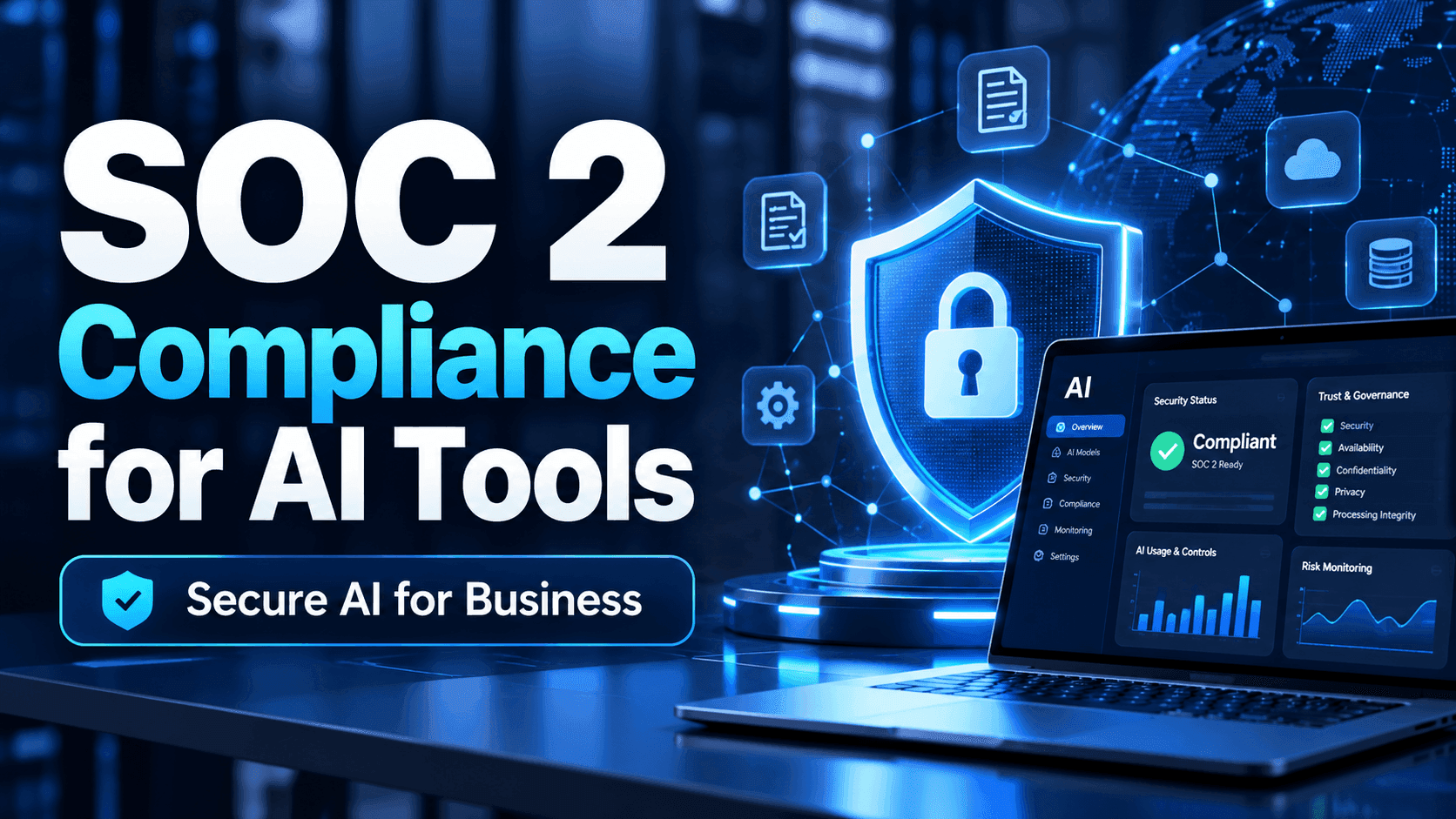
Learn what SOC 2 compliance means for AI tools and what businesses should check for security data privacy and vendor trust before choosing a platform.
AI tools are becoming part of everyday business workflows. Marketing teams use them to write campaigns, agencies upload client briefs, sales teams summarize research, and employees analyze internal documents. As more company data moves through AI platforms, choosing a tool based only on features, model quality, or price is no longer enough.
Security and compliance are now part of the buying decision.
One term business buyers increasingly encounter is SOC 2 compliance. It can provide useful evidence about how a technology company manages security controls, but seeing “SOC 2” on a website should not automatically end your vendor review.
Before choosing an AI platform, businesses should understand what SOC 2 actually covers, whether an audit is complete, what systems are included, and how the provider handles customer data beyond the audit itself.
Why SOC 2 Compliance Matters When Choosing AI Tools
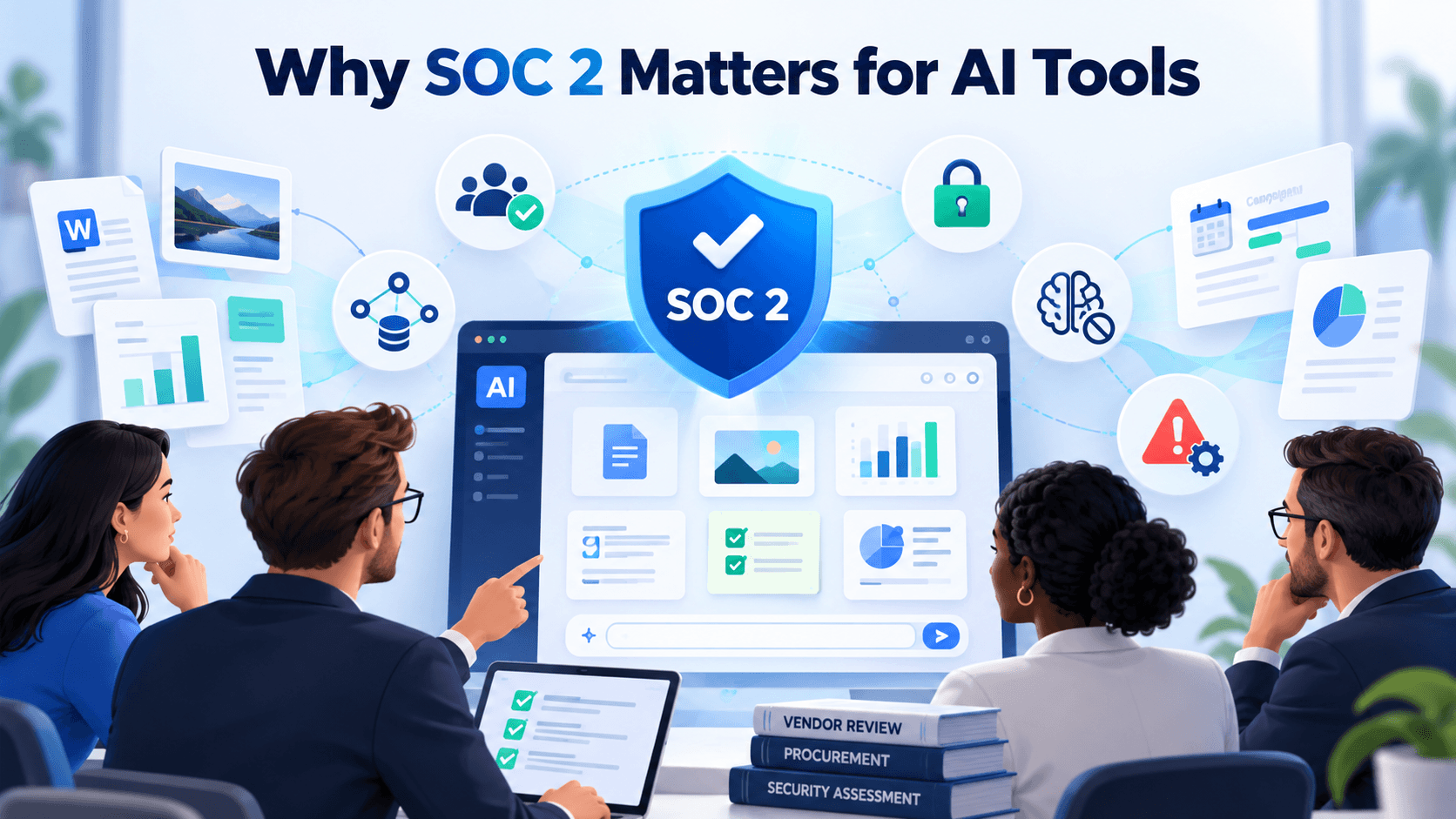
AI platforms may process more than simple prompts. Depending on the workflow, users can upload documents, images, customer research, campaign plans, business reports, or other internal information.
That creates additional questions for agencies and B2B teams. Who can access the data? How is it protected? Is customer content used to train AI models? Which third-party providers process it? What happens if there is a security incident?
SOC 2 helps buyers evaluate part of that picture.
It is an independent assurance framework commonly used by technology and SaaS companies to demonstrate that security and related controls have been designed and operated according to defined criteria.
For a business buyer, SOC 2 can therefore act as a useful trust signal during procurement. It does not guarantee that every workflow is safe, but it gives security, finance, and technology teams more evidence to review than a simple marketing claim.
This is particularly relevant for agencies because they often handle information that belongs to their clients. A campaign brief, customer insight report, unpublished launch plan, or internal brand document may require more careful vendor assessment than public marketing copy.
SOC 2 Type I and SOC 2 Type II
Not every SOC 2 assessment represents the same thing.
SOC 2 Type I evaluates whether relevant controls are appropriately designed at a particular point in time.
SOC 2 Type II goes further by assessing how those controls operate over a defined period.
For business buyers, Type II can provide stronger operational evidence because the review is not limited to how controls are designed on one specific date.
However, teams should also pay attention to the vendor's exact wording.
An AI provider may say that it is preparing for SOC 2, undergoing an audit, or has completed a SOC 2 examination. Those statuses are different.
If an audit is still underway, the company should not be treated as though the final report has already been issued.
This distinction is especially important when SOC 2 is part of a client's procurement requirement.
What to Check Beyond the SOC 2 Label
SOC 2 can support a vendor review, but it should not be the only security question your team asks.
A useful evaluation should also cover the following areas.
Data Encryption
Start by checking how data is protected while it moves between your browser and the platform and how stored information is protected.
For example, 1min.AI currently documents HTTPS with TLS for data in transit and encryption for production databases storing customer data. It also states that production databases and Secure Shell access are protected from the public internet.
Encryption is a fundamental control, but buyers should still ask which data and services each protection applies to.
Access Controls
The next question is who can access critical systems.
A business AI platform should have controls that restrict unnecessary employee access and add stronger authentication around sensitive infrastructure.
1min.AI documents approval requirements for access to critical systems and multi-factor authentication for staff who have access to those systems. It also states that access is removed when employees leave the company.
For companies handling client information, this is particularly relevant because external attackers are not the only security risk. Internal access should also be controlled.
Data Training
AI buyers increasingly want to know whether their prompts, files, or other customer content will be used to train models.
This question should be evaluated separately from storage.
A platform may retain information for one purpose without using it for model training, so asking only whether data is “stored” does not give you the full answer.
1min.AI currently states on its main website that it does not use customer data to train AI models.
For confidential workflows, businesses should still review the relevant privacy terms and confirm how the specific feature they plan to use handles data.
Data Retention and Deletion
Retention is another important consideration.
A marketing agency may be comfortable storing public campaign research but have stricter requirements for client documents. A finance or technology team may have different internal retention policies altogether.
1min.AI's current privacy guidance recommends reviewing retention, deletion, external processing, and model-training questions separately rather than assuming that one security statement answers all of them.
That is a useful approach for evaluating any AI vendor.
Subprocessors
Most modern SaaS and AI platforms rely on third-party services for infrastructure, analytics, security, collaboration, or AI processing.
These companies are often called subprocessors.
Knowing which vendors participate in the workflow helps business teams understand where information may be processed and which additional providers need to be considered during a security review.
1min.AI currently publishes subprocessor information through its Trust Center and identifies providers across infrastructure, AI, security compliance, engineering, collaboration, analytics, and related services.
Incident Response and Backups
Security controls also need to account for what happens when something goes wrong.
Business buyers should ask whether the vendor maintains regular backups, tests those backups, documents security incidents, and follows a defined response process.
1min.AI states that it regularly backs up data, tests backup integrity, records and investigates security incidents, and maintains a defined incident response plan.
These controls matter because security is not only about preventing incidents. It is also about how an organization responds when an issue occurs.
What Is the Current SOC 2 Status of 1min.AI
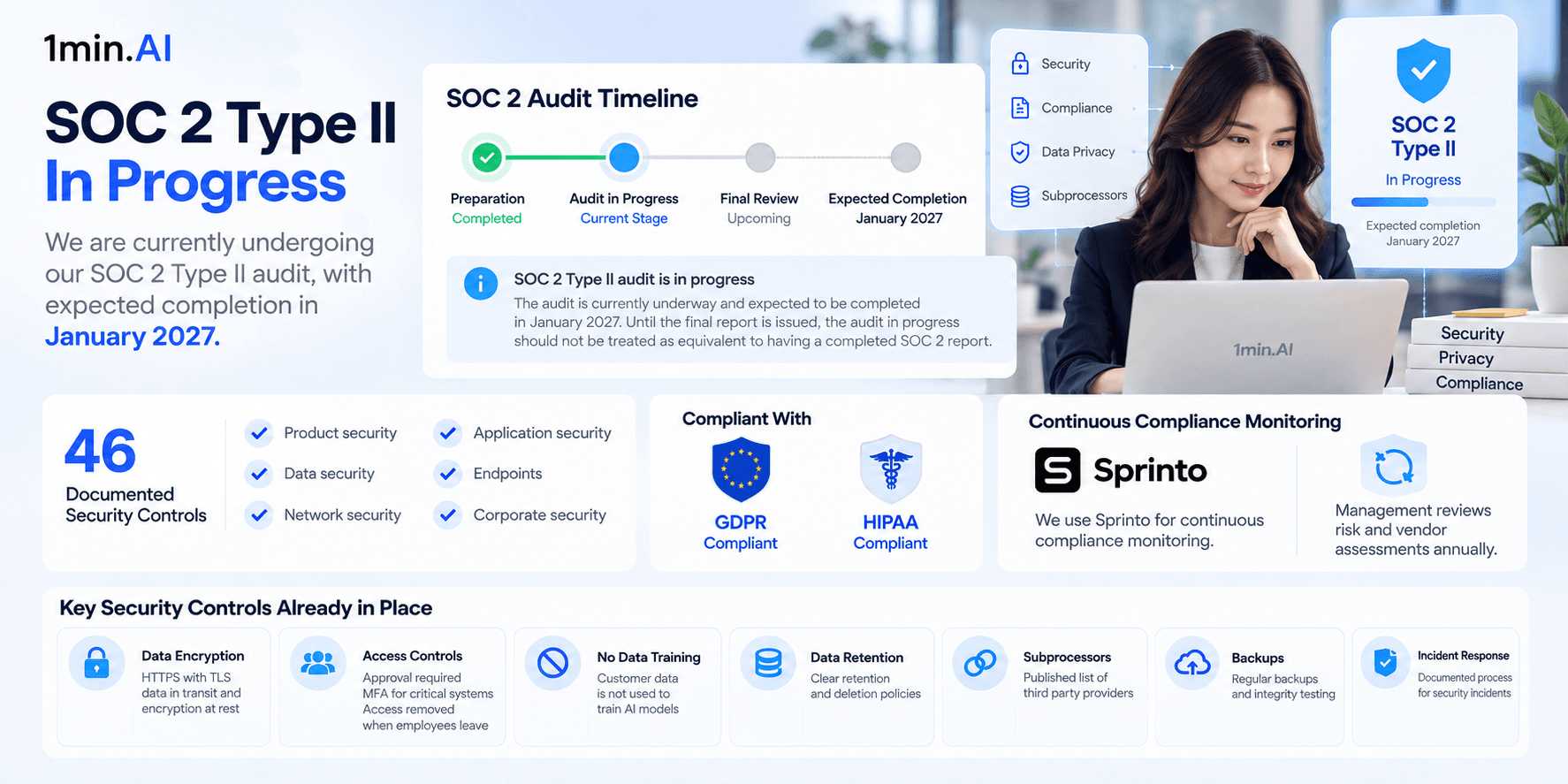
1min.AI currently lists SOC 2 Type II as in progress.
Its published security information states that the audit is expected to be completed in January 2027. Until the final report is issued, the accurate description is that the SOC 2 Type II audit is underway rather than completed.
This distinction is important.
If your company or client specifically requires a completed SOC 2 Type II report, an audit in progress should not be treated as equivalent to having that report.
At the same time, buyers can already review other documented controls while monitoring the SOC 2 process.
1min.AI currently publishes 46 controls covering areas including product security, data security, network security, application security, endpoints, and corporate security. Its public security information also lists GDPR and HIPAA as compliant.
The company states that it uses Sprinto for continuous compliance monitoring and that management reviews risk and vendor assessments annually.
For procurement teams, these details provide evidence to examine while the SOC 2 Type II process continues.
Why This Matters for Agencies and B2B Teams
The security requirements of an AI platform depend heavily on what you plan to do with it.
A freelancer using AI to brainstorm public social media ideas has a different risk profile from an agency uploading confidential campaign briefs for several clients.
Likewise, a B2B team summarizing public industry reports has different requirements from a finance team processing confidential internal information.
This is why businesses should classify workflows before approving an AI tool.
A simple approach is to separate work into lower-risk and higher-risk categories.
Lower-risk workflows may include public research, generic brainstorming, publicly available product information, or draft content that contains no confidential details.
Higher-risk workflows may include unpublished client strategy, confidential company reports, customer information, regulated data, credentials, or other sensitive material.
The higher the sensitivity, the stronger the vendor evidence and internal approval process should be.
1min.AI's own business security guidance recommends matching documented controls to the company's intended workflow rather than relying solely on the number of security controls or a compliance label.
Can Using One AI Workspace Simplify Vendor Management
Many agencies and marketing teams now use multiple AI products for writing, image generation, research, video, audio, and automation.
That can improve capabilities, but every additional service may also introduce another login, privacy policy, subprocessor chain, billing relationship, and vendor that needs to be reviewed.
1min.AI positions itself as an all-in-one AI workspace with tools for AI chat, writing, images, documents, audio, video, and AI Agents.
Consolidating tools does not automatically make a company more secure. However, it can simplify parts of vendor and workflow management because fewer separate platforms may need to be evaluated and administered.
For smaller agencies without a dedicated security team, this operational simplicity can be valuable.
The security decision should still be based on whether the platform's documented controls match the sensitivity of the work being processed.
How to Evaluate SOC 2 Compliance Before Buying an AI Tool
Before approving an AI platform for business use, ask a short set of questions.
What is the vendor's exact SOC 2 status?
Determine whether the audit is planned, underway, Type I complete, or Type II complete.
What is included in the scope?
Do not assume the entire company or every product feature is covered simply because a SOC 2 report exists.
How is customer data protected?
Review encryption in transit and at rest, access controls, and authentication requirements.
Is customer data used for AI training?
Look for a clear statement and confirm whether policies differ by product, model, or plan.
How long is customer data retained?
Understand deletion options and whether backups affect retention.
Which subprocessors are involved?
Review the external services that may participate in processing your data.
What happens during a security incident?
Look for documented incident response procedures and ways for customers to report security concerns.
Can the vendor provide supporting documentation?
A public Trust Center, Privacy Policy, DPA, security documentation, and eventually the applicable SOC 2 report can make procurement easier.
This framework is more useful than selecting a platform solely because its website displays a security badge.
Is 1min.AI Worth Evaluating for Business Use
For agencies and B2B teams, 1min.AI may be worth evaluating if the goal is to access multiple AI capabilities within one workspace while still having public security information available for review.
The platform currently documents encryption, access controls, MFA for staff accessing critical systems, backups, incident response processes, vendor management, continuous monitoring, and 46 security controls. Its SOC 2 Type II audit is still in progress.
That means businesses should evaluate the platform based on its current documented controls rather than treating a future SOC 2 result as already completed.
A sensible starting point is to test the platform with a lower-risk workflow first.
For example, an agency could begin with public research or generic marketing content before considering confidential client documents. This gives the team an opportunity to evaluate usability, permissions, data handling, and internal processes without immediately introducing its most sensitive information.
Frequently Asked Questions
What is SOC 2 compliance for AI tools
SOC 2 provides independent assurance around controls related to areas such as security, availability, processing integrity, confidentiality, and privacy. For AI buyers, it can provide useful evidence during a vendor security review.
Is SOC 2 required for AI platforms
No. SOC 2 is not mandatory for every AI provider. However, businesses and enterprise buyers commonly consider SOC 2 when evaluating SaaS and technology vendors.
What is the difference between SOC 2 Type I and Type II
Type I evaluates the design of controls at a specific point in time. Type II evaluates how those controls operate over a defined period.
Is 1min.AI SOC 2 Type II certified
Not yet. 1min.AI currently states that its SOC 2 Type II audit is in progress, with completion expected in January 2027.
Does 1min.AI use customer data to train AI models
1min.AI currently states that customer data is not used to train AI models. Businesses working with sensitive information should still review the relevant policies and requirements for their specific workflow.
Final Thoughts
SOC 2 compliance can be an important factor when businesses choose AI tools, but it should be treated as part of a broader vendor review rather than a simple pass or fail badge.
Agencies and B2B teams should also evaluate encryption, access controls, data training policies, retention, subprocessors, incident response, and the sensitivity of the information they plan to process.
For 1min.AI, the current SOC 2 Type II audit is still in progress. In the meantime, businesses can review its existing security controls and compliance information through the public Trust Center and decide whether those controls match their own requirements.
Review the 1min.AI Trust Center before using AI with sensitive business or client data.
- #Commercial
Alternatives
Discover the best alternatives to 1minAI and compare features, pricing, and use cases.

1min.AI vs OpenRouter
1min.AI vs. OpenRouter: Compare the ready-to-use AI creation product against the technical API tool. Find out if you need a zero-code creative studio or a coding infrastructure hub.
 Ngoc Hong
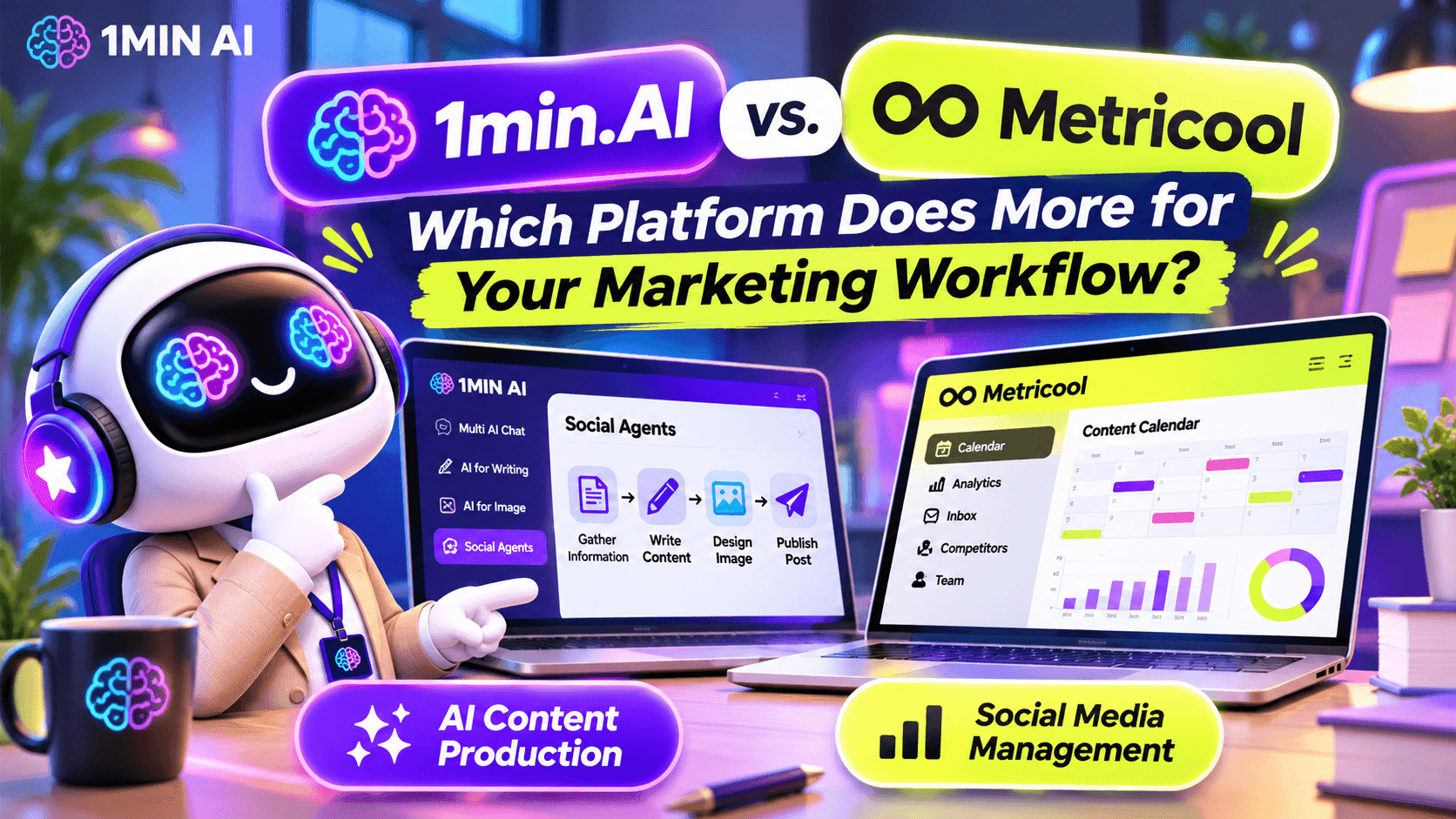
1min.AI vs. Metricool: Which Platform Does More for Your Marketing Workflow?
Compare 1min.AI vs. Metricool across content creation, visual production, scheduling, analytics, MCP, and pricing to find the right platform for your marketing workflow.
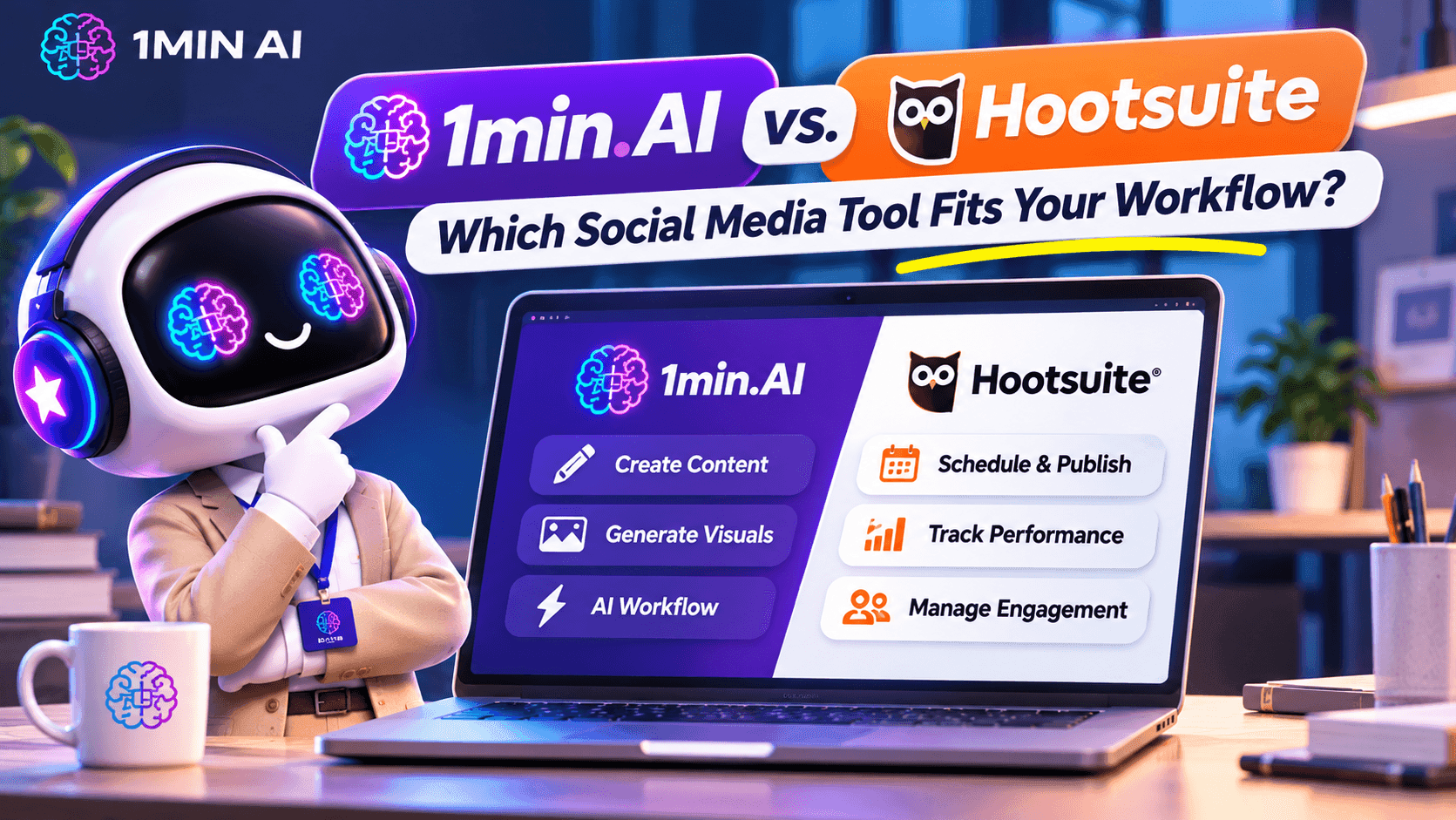
1min.AI vs. Hootsuite: Which Social Media Tool Fits Your Workflow?
Compare 1min.AI vs. Hootsuite to explore their AI content creation, social media publishing, analytics, pricing, and collaboration features. Find the right tool for your workflow.
AI Tools
Discover the best AI tools to boost productivity, creativity, and everyday work.
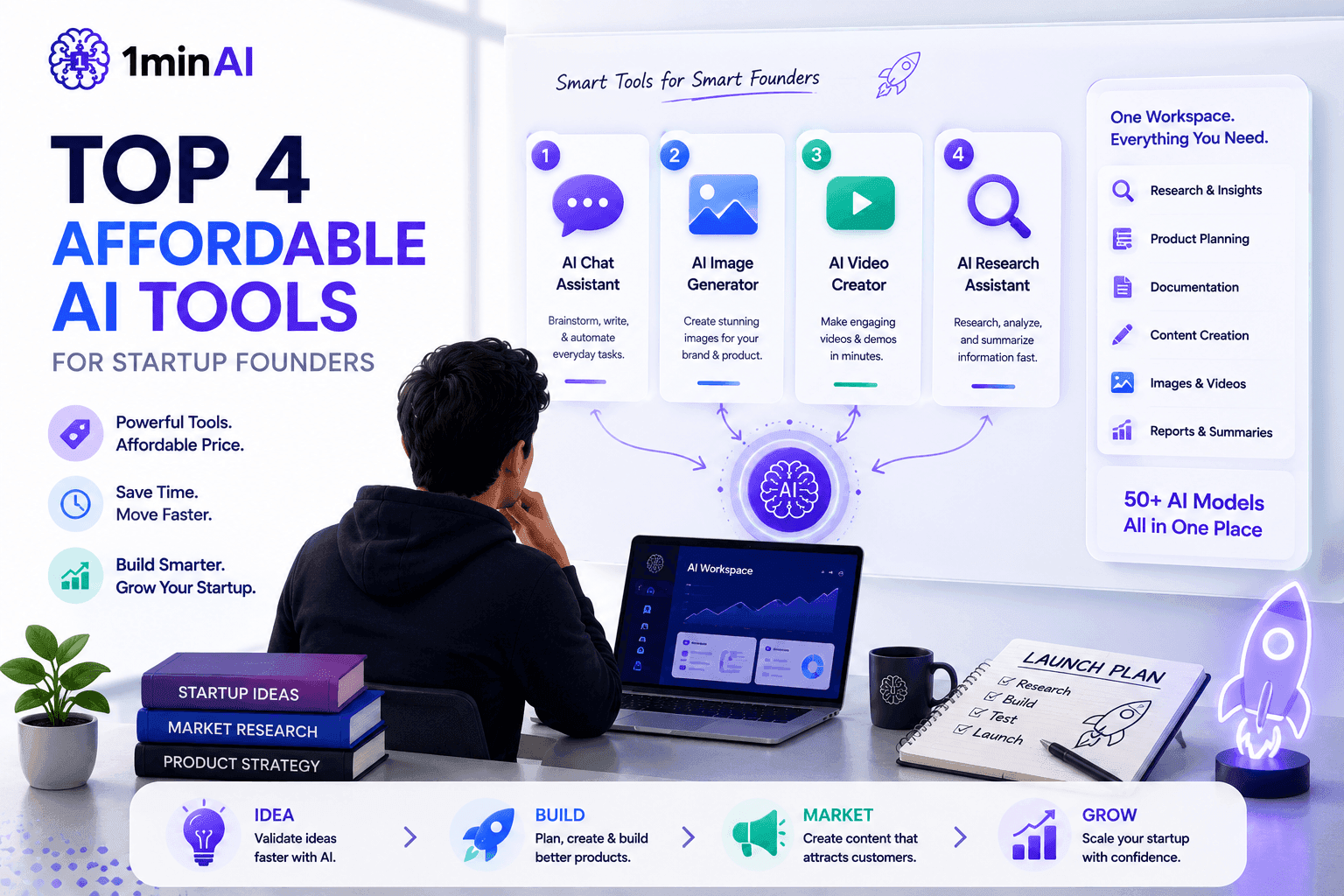
Top 4 Affordable AI Tools for Startup Founders
Discover the top 4 affordable AI tools for startup founders to validate ideas, build products, create content, and launch faster without overspending.
 Tram Ta
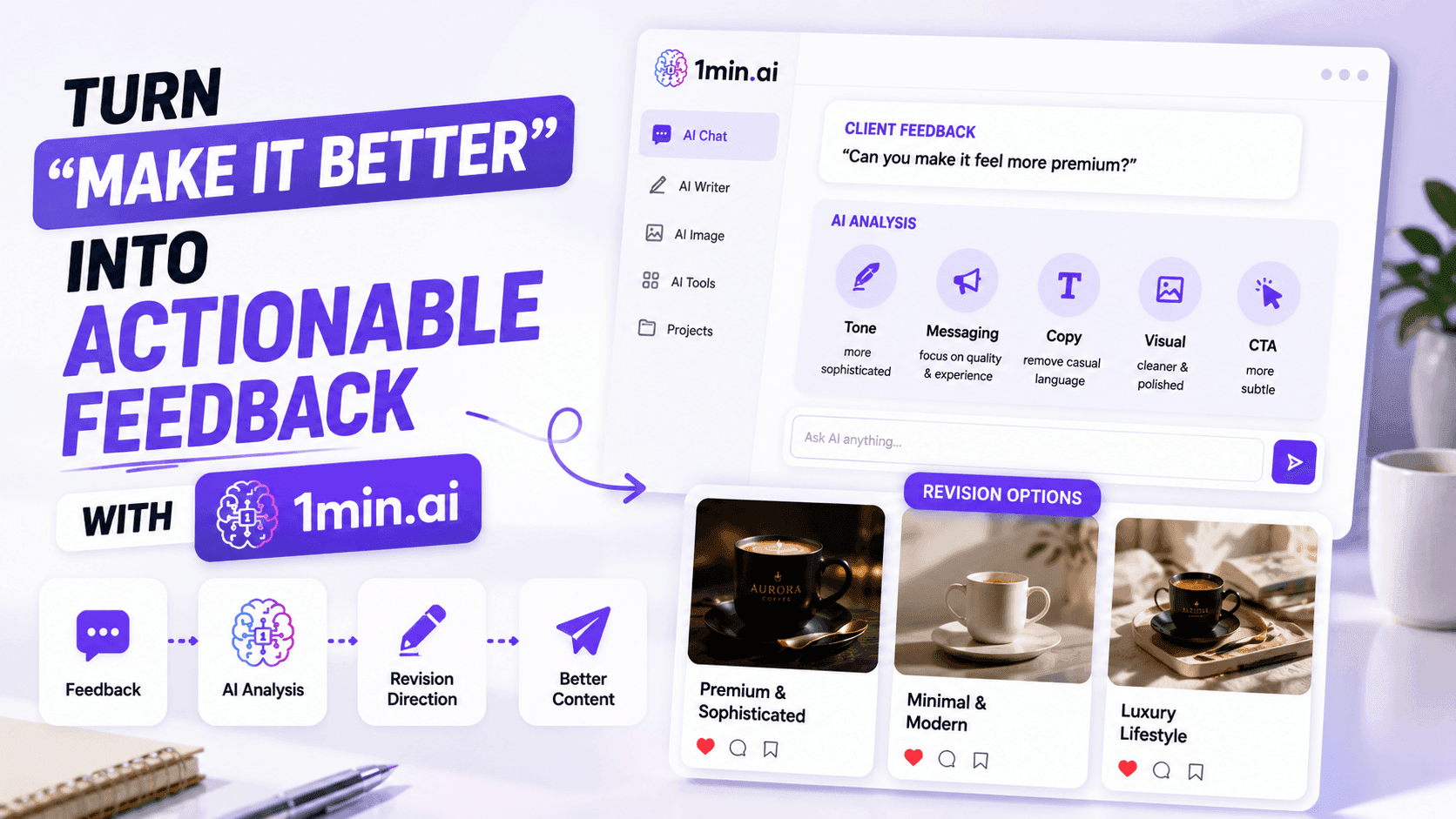
Turn “Make It Better” Into Better Content With AI
Use AI to turn vague client feedback into clear revisions, reduce unnecessary edits, and deliver better content faster.
 Lien Anh Vu
Free AI X Comment
Create funny, witty, or insightful comments for Twitter with our AI-powered Twitter Comment Generator. Boost your engagement and stand out in the crowd!
 Trang Tran
AI Features
Comprehensive AI features that streamline workflows, improve efficiency, and empower teams to achieve more.
1minAI: Free AI Grammar Checker
Check grammar for free with 1minAI’s AI grammar checker. Find grammar, spelling, and writing mistakes, improve clarity, and polish your content in seconds.
Tram Ta
Build a Portfolio Website Faster with 1min.AI
Learn how freelance creatives can use 1min.AI to plan, write, design, and generate a professional portfolio website faster, even without strong coding skills.
Lien Anh VuFree AI X Comment
Create funny, witty, or insightful comments for Twitter with our AI-powered Twitter Comment Generator. Boost your engagement and stand out in the crowd!
Trang TranAI Use Cases
A curated collection of AI use cases for business, productivity, and industry-specific applications.
Best Time to Post on Instagram: A Practical Guide for Better Engagement
Discover the best time to post on Instagram, including the best days and times for different audiences, plus tips to find the ideal posting schedule for your account.
Tram TaTurn “Make It Better” Into Better Content With AI
Use AI to turn vague client feedback into clear revisions, reduce unnecessary edits, and deliver better content faster.
Lien Anh VuBuild a Portfolio Website Faster with 1min.AI
Learn how freelance creatives can use 1min.AI to plan, write, design, and generate a professional portfolio website faster, even without strong coding skills.
Lien Anh VuAI Tutorials
Learn how to use AI with practical, step-by-step tutorials.
Black Friday AI Tool Deals in 2026
Discover what Black Friday AI tool deals 2026 has to offer. Find out how to secure the 1min.AI lifetime deal via AppSumo, Dealify, Stack Social, and verify on Trustpilot, Slashdot, and Software Advice.
 Hang Nguyen
Turn “Make It Better” Into Better Content With AI
Use AI to turn vague client feedback into clear revisions, reduce unnecessary edits, and deliver better content faster.
Lien Anh Vu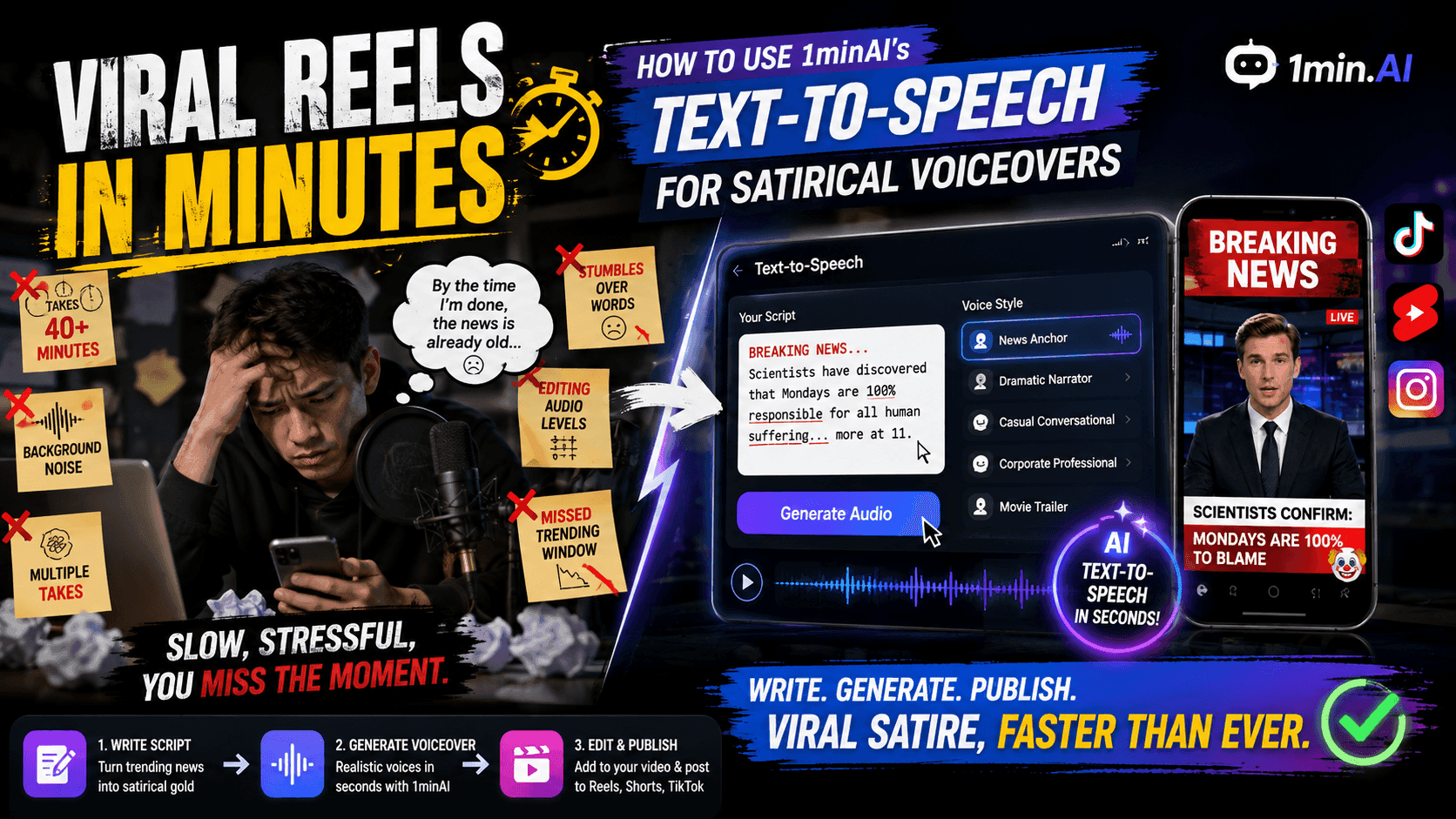
Viral Reels in Minutes: How to Use 1minAI’s Text-to-Speech for Satirical Voiceovers
Learn how satirical page admins use 1minAI’s Text-to-Speech feature to generate instant news anchor and dramatic voiceovers for TikToks, Shorts, and Instagram Reels.
AI Guides
Learn AI faster with practical guides, real-world examples, and actionable best practices.

Safely Buy AI Tools Online: 2026 Black Friday Guide
Discover how to find and secure the best Black Friday AI deals online. Learn expert strategies to avoid scams, combat subscription fatigue, and verify software.
Hang Nguyen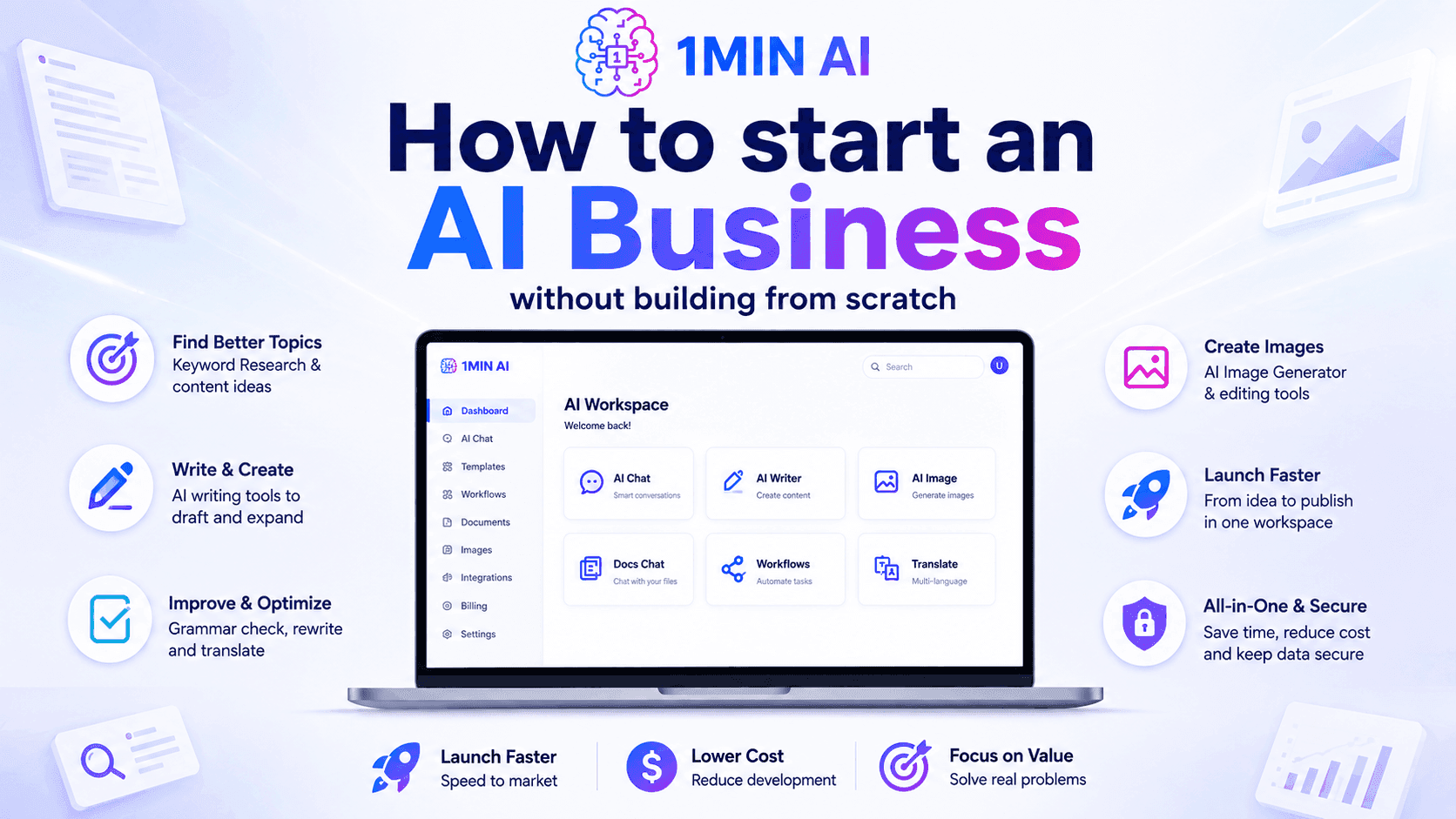
How to start an AI business without building from scratch
Learn how to start an AI business, validate your idea, and launch faster without building costly AI infrastructure from scratch.
Ngoc Hong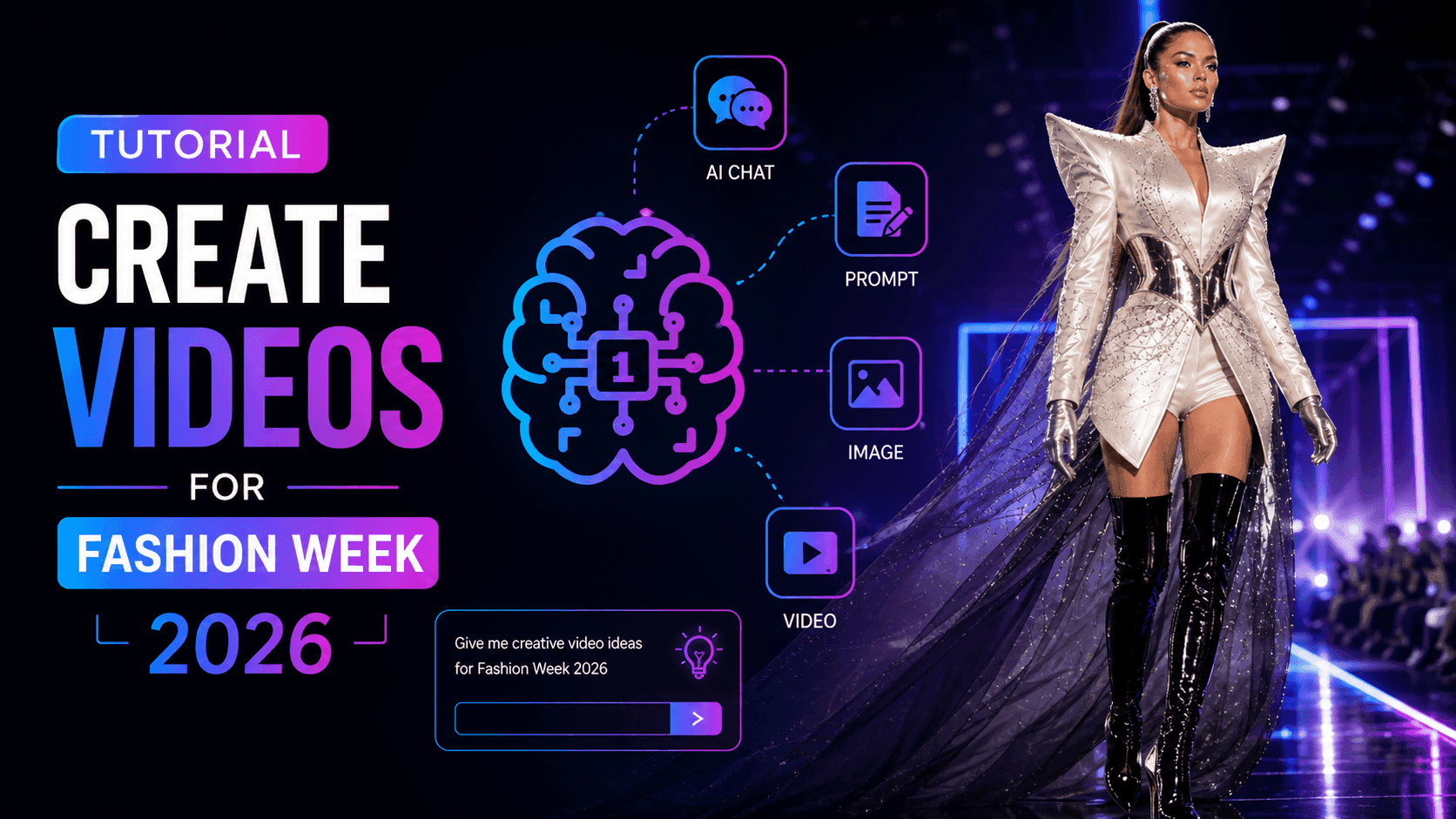
How to Use an AI Fashion Video Generator for Fashion Week 2026
Turn Fashion Week 2026 ideas into stunning fashion videos with AI. Learn how to brainstorm, create visuals, and transform images into videos with one simple workflow.
Lien Anh VuAI Solutions
Browse the best AI solutions for automation, coding, research, productivity, customer support, marketing, and business workflows.
Safely Buy AI Tools Online: 2026 Black Friday Guide
Discover how to find and secure the best Black Friday AI deals online. Learn expert strategies to avoid scams, combat subscription fatigue, and verify software.
Hang Nguyen
Free AI Tattoo Generator: Custom Designs
Turn any idea into a custom tattoo design with 1min.AI's free AI tattoo generator. Describe your idea, pick a style, and download in seconds.
Trang TranTurn “Make It Better” Into Better Content With AI
Use AI to turn vague client feedback into clear revisions, reduce unnecessary edits, and deliver better content faster.
Lien Anh VuAI Models
Explore the world's leading AI models in one place.
Free AI Chat With Claude Fable 5.2 On 1min.AI
Free AI chat with Claude Fable 5.2 on 1min.AI. Compare Fable 5.2 vs Opus 5.5, see Fable 5.2 benchmarks, and start chatting in minutes.
Trang Tran
GPT-6.2 Sol: Specs, Pricing & Free Access
Explore GPT-6.2 Sol specs, pricing, and how it compares with GPT-6.1 Sol and Claude Opus 5.5, then try it free in 1min.AI Multi AI Chat.
Trang Tran
GPT 6.2 Astra: Pricing, Benchmarks & Free Access
GPT 6.2 Astra release date, pricing, Reddit feedback and Opus 5.5 comparison. See what it does best and chat with it on 1min.AI for free.
Trang TranAI Comparisons
Compare AI tools, models, and platforms to find the best fit for your needs.
Gemini 4 Neon vs Hydrogen: Specs, Price & Picks
Gemini 4 Neon vs Hydrogen, Carbon and Argon: compare price, benchmarks and use cases to pick the right model, then test them side by side on 1min.AI.
Trang Tran
Kling AI Vs Veo 3: Which Model Wins?
Kling AI vs Veo 3: compare motion, native audio, pricing & free tiers to see which AI video generator wins for your project - try both on 1min.AI.
Trang Tran
DeepSeek V4 Pro vs Flash Comparison
Compare DeepSeek V4 Pro vs DeepSeek V4 Flash metrics. Optimize your agentic apps and improve AI fact checking on 1min.ai today.
Ngoc HongAI Integrations
Seamlessly integrate AI with the tools you already use to automate work and boost productivity.
POV: You Have 10+ Posts to Make Every Day
Learn how to build an AI content workflow that helps content creators produce 10+ social media posts a day faster with AI brainstorming, image generation, and content creation.
Lien Anh Vu
Stop Switching Between AI Apps: How AI Integration Transforms Employer Branding
Discover how AI integration helps HR teams streamline employer branding by combining AI writing, documents, images, video, and multiple AI models into one workspace.
Tram Ta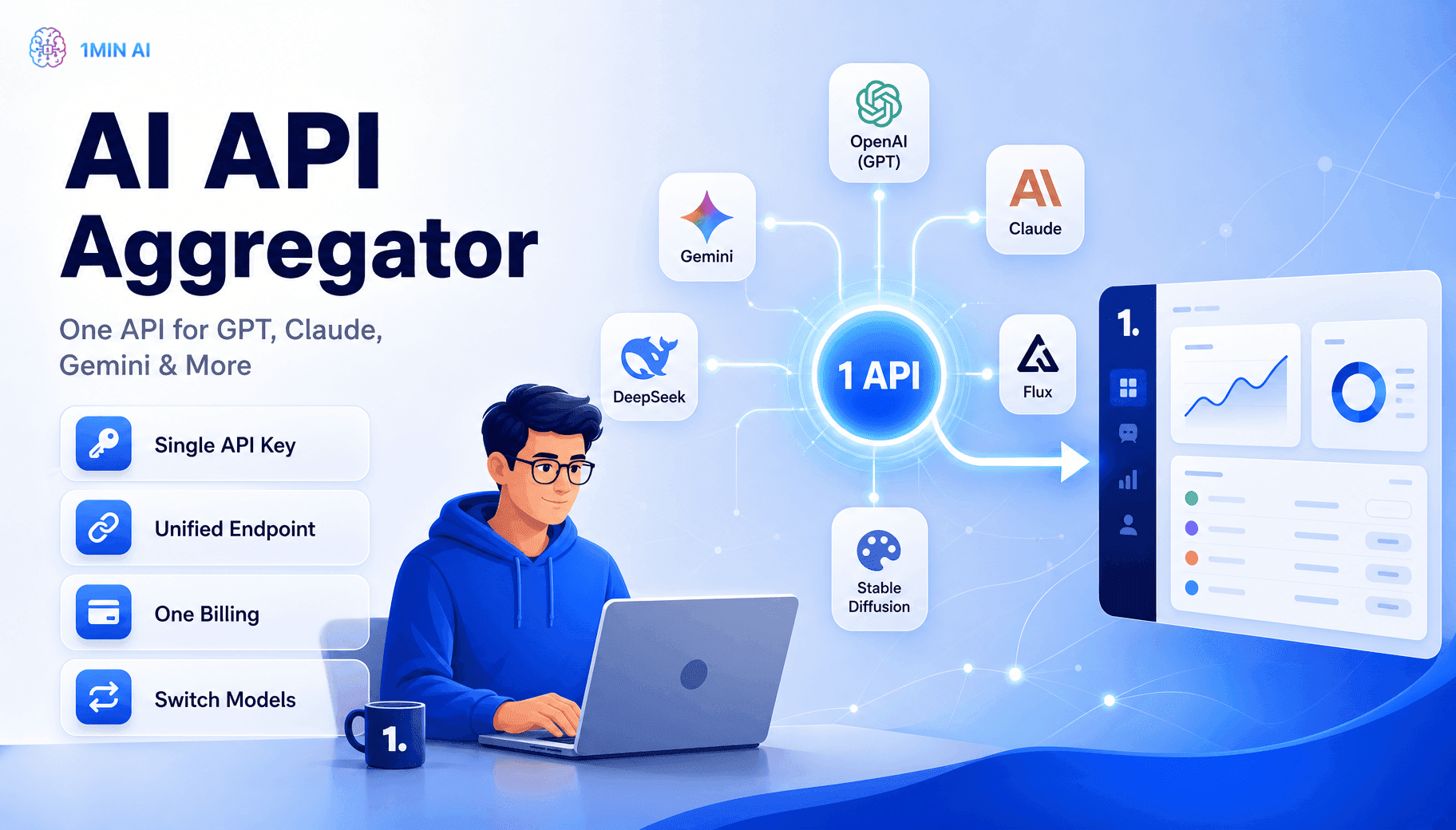
AI API Aggregator Explained For Developers
An AI API aggregator gives developers one unified API to call multiple AI models, cutting integration time and vendor lock in.
Trang TranAI for Industries
Find the best AI tools and workflows for healthcare, finance, education, legal, manufacturing, retail, real estate, and more

ChatGPT Trending Photo Prompts to Copy and Paste
Explore chatgpt trending photo prompt ideas you can copy and paste. Create viral AI portraits, collages, and aesthetic photos with ease.
Trang TranTry Image To Video AI With Prompt Online Free
Try image to video AI with prompt online free, no login and no watermark. Upload a photo, type the motion you want, and get a short video in minutes.
Trang Tran
No Photoshoot? Create AI Fashion Videos With Seedance 2.5
No photoshoot needed! Create stunning AI fashion videos with Seedance 2.5 on 1min.AI using outfit references, cinematic prompts, and surreal scenes.
Lien Anh VuAI Agents
Discover and run AI agents to automate tasks across your work and daily life.
1minAI: Free AI Grammar Checker
Check grammar for free with 1minAI’s AI grammar checker. Find grammar, spelling, and writing mistakes, improve clarity, and polish your content in seconds.
Tram Ta
AI Agents for Facebook
Use an AI Agent for Facebook to create content, generate images, schedule posts, and publish from your documents and conversations.
Ngoc Hong
AI Agent vs AI Assistant: Which One Actually Saves Designers More Time?
Learn the difference between AI Agent vs AI Assistant and discover which solution helps designers automate repetitive work, reduce revisions, and save more time.
Lien Anh VuAI Workflows
Explore ready-to-use AI workflows for productivity, marketing, sales, support, and more.
POV: You Have 10+ Posts to Make Every Day
Learn how to build an AI content workflow that helps content creators produce 10+ social media posts a day faster with AI brainstorming, image generation, and content creation.
Lien Anh VuHow to Use an AI Fashion Video Generator for Fashion Week 2026
Turn Fashion Week 2026 ideas into stunning fashion videos with AI. Learn how to brainstorm, create visuals, and transform images into videos with one simple workflow.
Lien Anh Vu
One Product, 10 UGC Creatives: How AI Makes Content Testing Easier
Create more authentic UGC with an AI UGC video generator, test more creative angles and scale affiliate content without filming every version.
Lien Anh VuNewsletter
Weekly AI Innovations with 1minAI

🔮 Weekly AI Innovations #147: 1min.ai Drops Major Shift: AI Circle, Kimi & Wan 3.0
Explore AI Circle (formerly AI Social), Kimi K3.1 Pro’s 2M context, and Alibaba Wan 3.0 & 3.0 Prime cinematic video on 1min.ai.
Hang Nguyen
🔮 Weekly AI Innovations #146: Mistral 3.5, Qwen Image & Cohere A+ are ready on 1min.ai
Deploy Mistral Large 3, Qwen Image 3.0, and Cohere Command A+ on 1min.ai. Boost RAG accuracy and cut visual generation latency in one unified AI workspace.
Hang Nguyen
🔮 Weekly AI Innovations #145: X Content Agent & GPT 6.1 Terra on 1min.ai
Scale viral reach with the X Content Agent on 1min.ai. Discover an end-to-end 4-stage pipeline with zero token burn, plus the launch of GPT 6.1 Terra.
Hang Nguyen