Multi-Agent vs Single Agent: How to Choose

Trang Tran
October 4, 2026
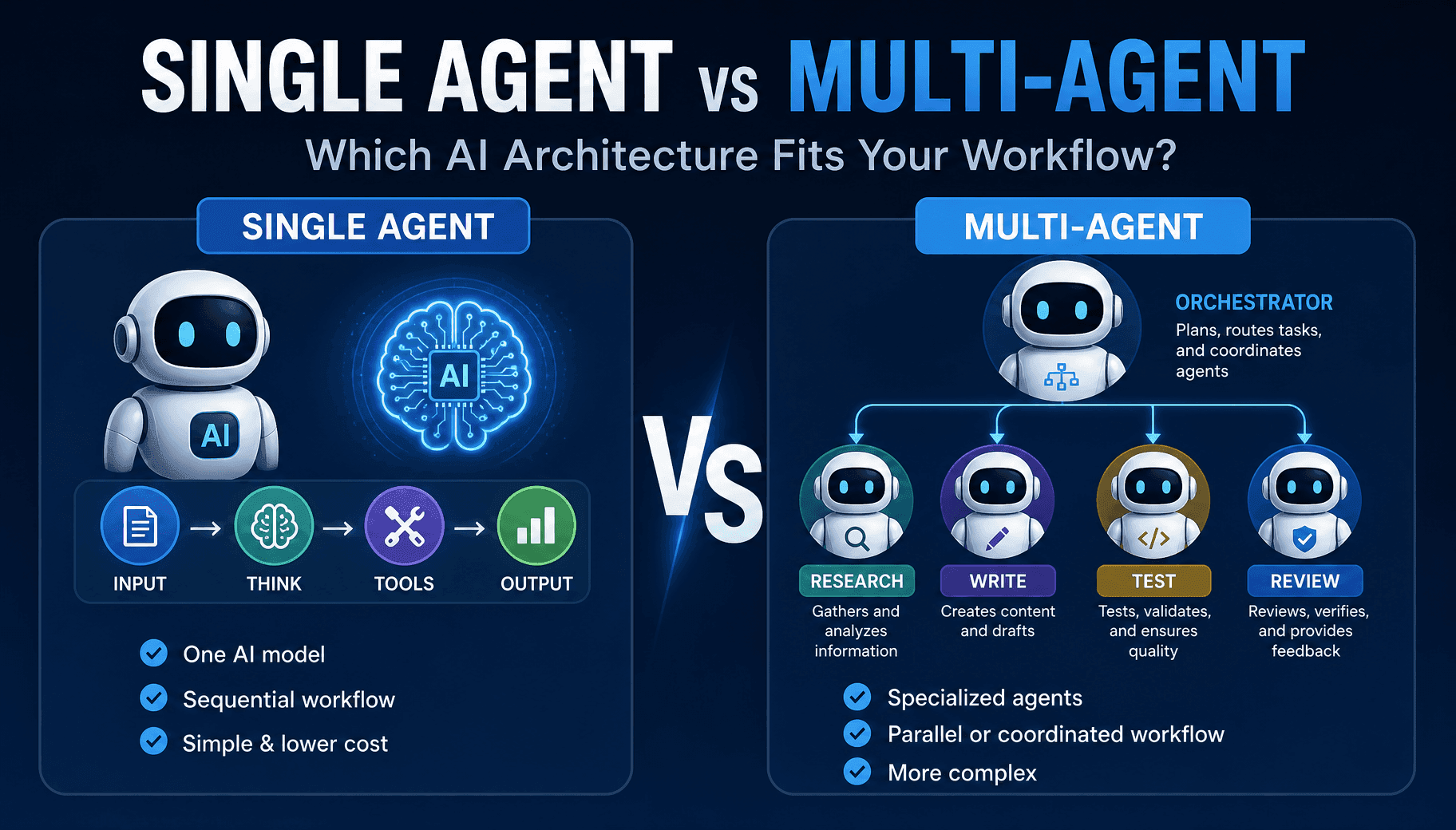
Multi-agent vs single agent: which AI architecture fits your workflow? Compare cost, speed, and use cases to choose the right design with 1min.AI.
A single-agent system uses one AI model to handle a task from start to finish. A multi-agent system splits the work across specialized agents coordinated by an orchestrator. Start with a single agent for narrow, sequential tasks. Move to multi-agent only when your workflow needs parallel execution, strict role separation, or domain-specific expertise that one agent can't cover well.
If you're building an AI-powered workflow and stuck deciding between these two architectures, this guide breaks down exactly when each one makes sense, what it costs you, and how to test your assumptions before committing to either.
What Is a Single-Agent System?
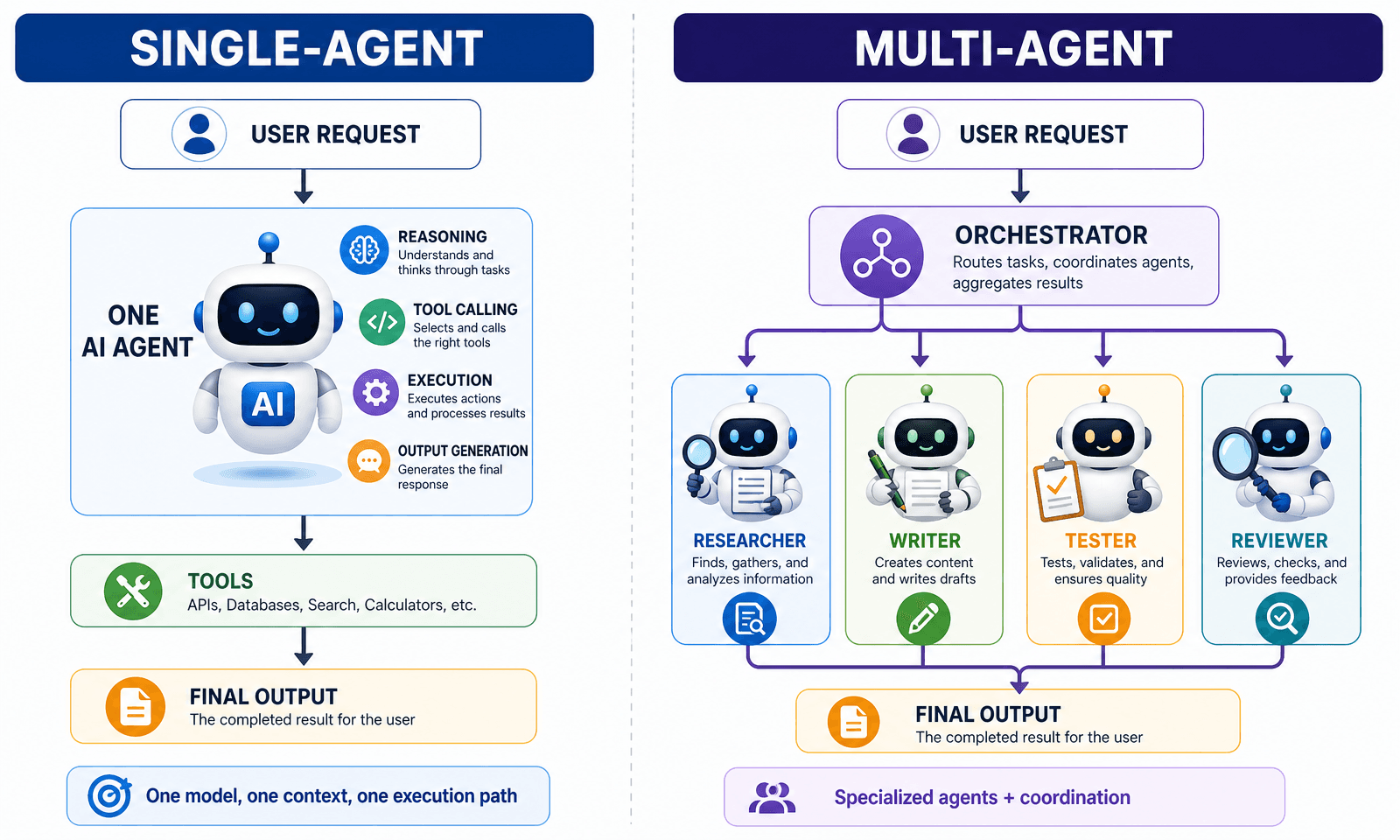
A single-agent system consolidates reasoning, tool-calling, and output generation into one AI instance working within one context window. It plans the task, decides which tools to use, executes them, and returns a result, all inside a single decision loop.
Single-Agent Architecture Explained
The architecture is simple by design: one LLM, one prompt context, one execution path. This makes single agents faster to build, cheaper to run, and easier to debug because there's no coordination logic between components to trace when something breaks.
Best Use Cases for Single-Agent Systems
Single agents work best when:
- The task follows a predictable, bounded workflow (FAQ answering, fixed API sequences)
- Speed and low latency matter more than depth
- Budget or token usage is a real constraint
- The problem domain is narrow enough to fit in one context window
Examples: a customer support lookup bot, a single-file code refactoring assistant, or a content summarizer.
What Is a Multi-Agent System?
A multi-agent system in AI assigns distinct sub-tasks (research, writing, testing, reviewing) to separate agents, either in parallel or through a pipeline, managed by a supervising orchestrator.
Multi-Agent System in AI: How Orchestration Works
The orchestrator receives the request, routes sub-tasks to the right specialized agent, and merges their outputs into a final response. Each agent can run its own tools, prompts, and even its own model, which is why multi-agent setups handle broad or multi-domain work better than a single model juggling everything at once.
Multi-Agent vs Single Agent Examples
A software engineering workflow illustrates the difference clearly:
Single agent: one model writes, tests, and reviews code in sequence within one context.
Multi-agent: Orchestrator → Coder → Tester → Reviewer, where each agent owns one responsibility and hands off to the next.
The same pattern applies to research tasks, where a Retriever agent gathers sources, a Writer agent drafts content, and a Verifier agent checks facts before the output ships.
Multi-Agent vs Single Agent: Pros and Cons
| Factor | Single Agent | Multi-Agent |
|---|---|---|
| Architecture | One central model | Orchestrator + specialized agents |
| Speed | Faster, sequential | Slower, multiple handoffs |
| Cost | Lower token usage | Higher, often several times more |
| Debugging | Predictable, easy to trace | Complex, non-deterministic |
| Best for | Narrow, single-domain tasks | Broad, parallel, multi-role tasks |
| Risk | Context overload on complex tasks | Coordination failures, fragmented context |
This tradeoff is exactly why two well-known AI labs recently disagreed in public: one argued multi-agent systems outperform single agents on research-heavy tasks because dividing context prevents any one agent from being overloaded. The other argued that splitting context across agents creates coordination failures and contradictions that a single agent never has to manage. Neither is universally right, the correct answer depends on your specific task.
Single-Agent vs Multi-Agent Systems: Why Not Both?
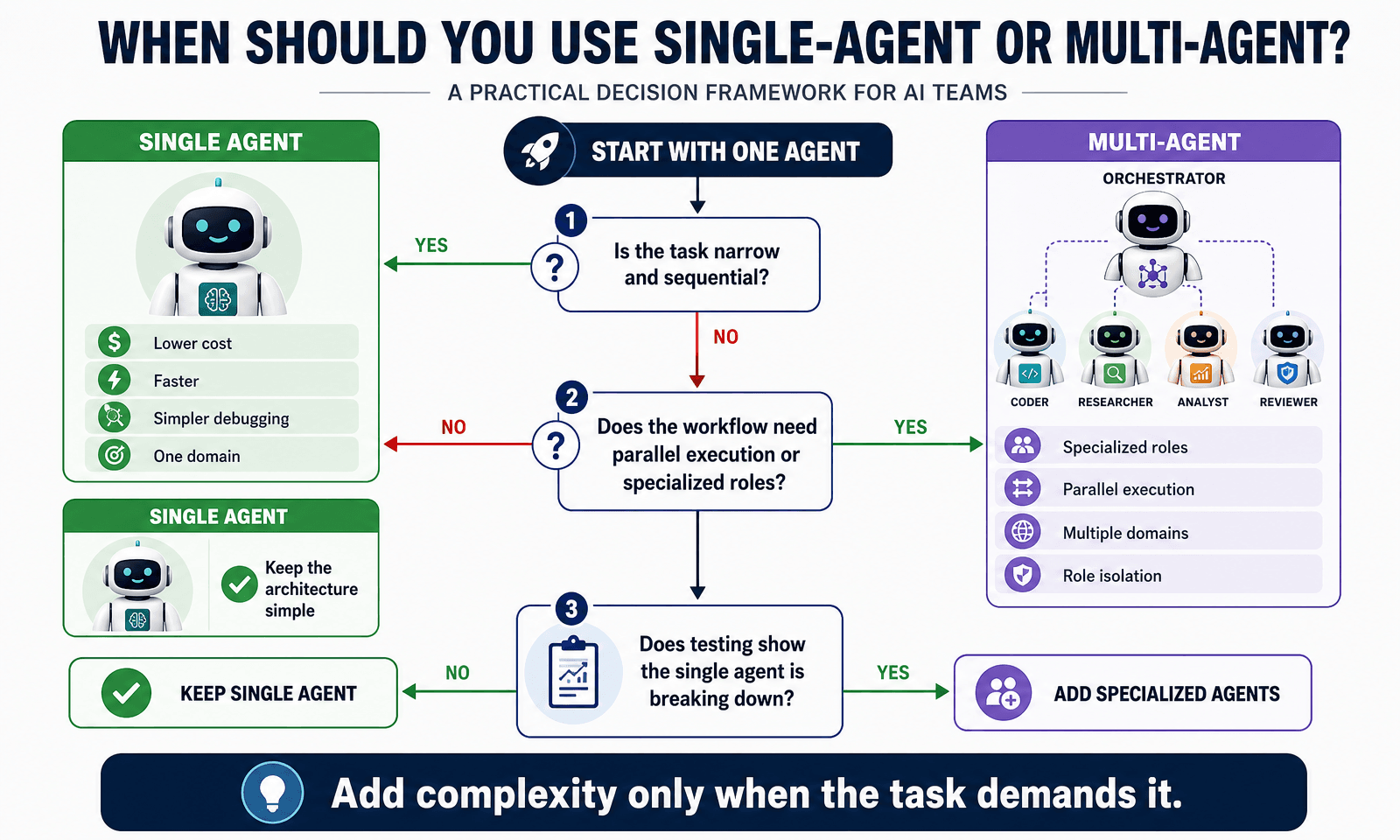
You don't have to pick one architecture forever. A common and lower-risk approach:
- Prototype with a single agent first. Validate whether role emulation (persona prompts, conditional logic, tool permissions) can handle the task without added coordination.
- Measure where it breaks. If accuracy drops, latency spikes, or the agent needs permissions for too many unrelated actions, that's your signal.
- Add agents only where testing proves it's needed. Don't split a workflow into five agents because it looks more sophisticated. Split it because a single agent measurably can't do the job.
Teams managing customer-facing workflows often follow this exact pattern, for example, when building an AI agent for social media management, starting with one agent handling scheduling and captions before adding a separate agent for engagement monitoring once volume justifies it.
How to Choose: A Decision Framework
| Situation | Recommended Approach |
|---|---|
| Task is narrow, cost-sensitive, or time-to-market matters | Single agent |
| You're unsure which architecture fits | Build a small comparative prototype first |
| Distinct teams own separate knowledge domains | Multi-agent |
| Compliance requires strict data or role isolation | Multi-agent |
| Roadmap spans 3+ unrelated functions long-term | Multi-agent, for modularity |
As a rule of thumb: start simple, add complexity only when the task demands it, not when it looks impressive on a diagram.
FAQs
Is multi-agent better than single agent?
Neither is universally better. Multi-agent systems win on complex, parallel, or multi-domain tasks. Single agents win on speed, cost, and simplicity for narrow, well-defined tasks.
Is ChatGPT a multi-agent system?
By default, ChatGPT operates as a single-agent conversational system. Some of its features, like tool use or plugin orchestration, resemble lightweight multi-agent coordination, but the core chat experience is single-agent.
What is the difference between A2A and MCP?
A2A (Agent-to-Agent) protocols define how separate agents communicate and hand off tasks to each other. MCP (Model Context Protocol) defines how a single agent connects to external tools and data sources. A2A governs agent-to-agent coordination; MCP governs agent-to-tool access.
What are the four types of agents?
AI agents are commonly grouped into four types based on capability: simple reflex agents (react to current input only), model-based agents (maintain internal state), goal-based agents (plan toward a specific outcome), and utility-based agents (optimize for the best outcome among several options).
The Bottom Line
Most teams don't need a multi-agent system on day one. Start with a single agent, test where it breaks, and scale to orchestrated agents only when the task genuinely requires specialized roles or parallel execution. 1min.AI is building agent capabilities around this exact principle, and teams who join early access get up to 3,000,000 credits to start testing once approved.
Alternatives
Discover the best alternatives to 1minAI and compare features, pricing, and use cases.

1min.AI vs OpenRouter
1min.AI vs. OpenRouter: Compare the ready-to-use AI creation product against the technical API tool. Find out if you need a zero-code creative studio or a coding infrastructure hub.
 Ngoc Hong
1min.AI vs Lovart
Compare 1min.AI vs Lovart across features, pricing, credits, brand tools, and use cases to find the right AI platform for your workflow.
Ngoc Hong
1min. AI vs Dola AI
Looking for a Dola AI alternative? Compare 1min.AI vs Dola AI on video generation, free plans, pricing and privacy to pick the right AI app.
Ngoc HongAI Tools
Discover the best AI tools to boost productivity, creativity, and everyday work.
Create Consistent Cartoon Content in Just a Few Steps
Create engaging cartoon videos for TikTok and Reels with 1min.AI. Research ideas, create characters, and turn images into animated videos in 3 simple steps.
 Lien Anh Vu
One Product, 10 UGC Creatives: How AI Makes Content Testing Easier
Create more authentic UGC with an AI UGC video generator, test more creative angles and scale affiliate content without filming every version.
Lien Anh Vu
Top 4 Affordable AI Tools for Startup Founders
Discover the top 4 affordable AI tools for startup founders to validate ideas, build products, create content, and launch faster without overspending.
 Tram Ta
AI Features
Comprehensive AI features that streamline workflows, improve efficiency, and empower teams to achieve more.
Create Consistent Cartoon Content in Just a Few Steps
Create engaging cartoon videos for TikTok and Reels with 1min.AI. Research ideas, create characters, and turn images into animated videos in 3 simple steps.
Lien Anh VuOne Product, 10 UGC Creatives: How AI Makes Content Testing Easier
Create more authentic UGC with an AI UGC video generator, test more creative angles and scale affiliate content without filming every version.
Lien Anh Vu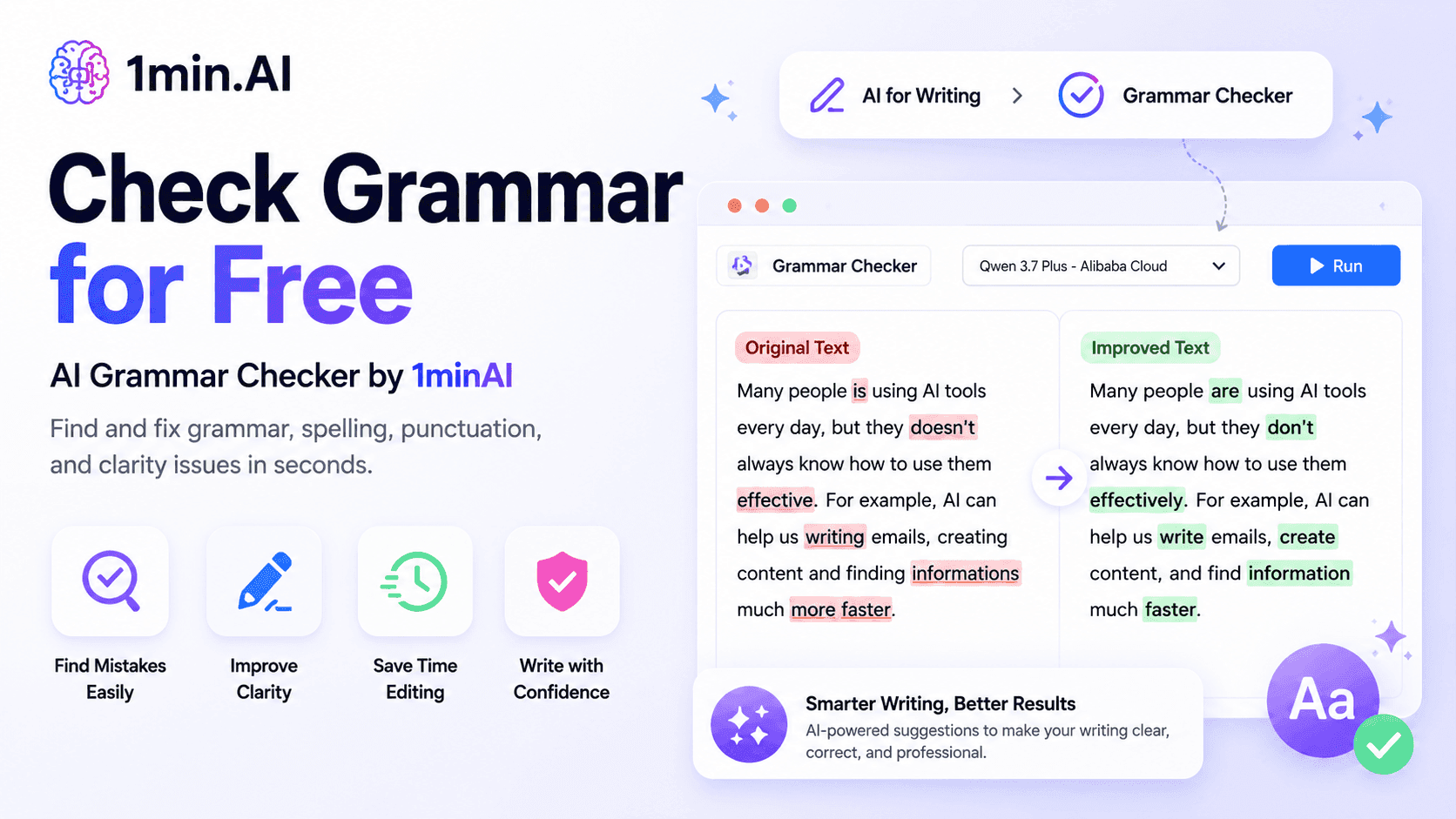
1minAI: Free AI Grammar Checker
Check grammar for free with 1minAI’s AI grammar checker. Find grammar, spelling, and writing mistakes, improve clarity, and polish your content in seconds.
Tram TaAI Use Cases
A curated collection of AI use cases for business, productivity, and industry-specific applications.
Create Consistent Cartoon Content in Just a Few Steps
Create engaging cartoon videos for TikTok and Reels with 1min.AI. Research ideas, create characters, and turn images into animated videos in 3 simple steps.
Lien Anh VuOne Product, 10 UGC Creatives: How AI Makes Content Testing Easier
Create more authentic UGC with an AI UGC video generator, test more creative angles and scale affiliate content without filming every version.
Lien Anh Vu
Best Time to Post on Instagram: A Practical Guide for Better Engagement
Discover the best time to post on Instagram, including the best days and times for different audiences, plus tips to find the ideal posting schedule for your account.
Tram TaAI Tutorials
Learn how to use AI with practical, step-by-step tutorials.
Create Consistent Cartoon Content in Just a Few Steps
Create engaging cartoon videos for TikTok and Reels with 1min.AI. Research ideas, create characters, and turn images into animated videos in 3 simple steps.
Lien Anh Vu
Black Friday AI Tool Deals in 2026
Discover what Black Friday AI tool deals 2026 has to offer. Find out how to secure the 1min.AI lifetime deal via AppSumo, Dealify, Stack Social, and verify on Trustpilot, Slashdot, and Software Advice.
 Hang Nguyen
[Seedance 2.5 New] Better AI Product Videos, Less Rework in 1min.AI
Use Seedance 2.5 image to video on 1min.AI to create more consistent AI product videos, reduce failed generations, save credits, and improve UGC workflows.
Lien Anh VuAI Guides
Learn AI faster with practical guides, real-world examples, and actionable best practices.
Create Consistent Cartoon Content in Just a Few Steps
Create engaging cartoon videos for TikTok and Reels with 1min.AI. Research ideas, create characters, and turn images into animated videos in 3 simple steps.
Lien Anh Vu
Safely Buy AI Tools Online: 2026 Black Friday Guide
Discover how to find and secure the best Black Friday AI deals online. Learn expert strategies to avoid scams, combat subscription fatigue, and verify software.
Hang Nguyen[Seedance 2.5 New] Better AI Product Videos, Less Rework in 1min.AI
Use Seedance 2.5 image to video on 1min.AI to create more consistent AI product videos, reduce failed generations, save credits, and improve UGC workflows.
Lien Anh VuAI Solutions
Browse the best AI solutions for automation, coding, research, productivity, customer support, marketing, and business workflows.
Create Consistent Cartoon Content in Just a Few Steps
Create engaging cartoon videos for TikTok and Reels with 1min.AI. Research ideas, create characters, and turn images into animated videos in 3 simple steps.
Lien Anh VuOne Product, 10 UGC Creatives: How AI Makes Content Testing Easier
Create more authentic UGC with an AI UGC video generator, test more creative angles and scale affiliate content without filming every version.
Lien Anh Vu
Free AI Tattoo Generator: Custom Designs
Turn any idea into a custom tattoo design with 1min.AI's free AI tattoo generator. Describe your idea, pick a style, and download in seconds.
 Trang Tran
AI Models
Explore the world's leading AI models in one place.
Create Consistent Cartoon Content in Just a Few Steps
Create engaging cartoon videos for TikTok and Reels with 1min.AI. Research ideas, create characters, and turn images into animated videos in 3 simple steps.
Lien Anh VuOne Product, 10 UGC Creatives: How AI Makes Content Testing Easier
Create more authentic UGC with an AI UGC video generator, test more creative angles and scale affiliate content without filming every version.
Lien Anh Vu[Seedance 2.5 New] Better AI Product Videos, Less Rework in 1min.AI
Use Seedance 2.5 image to video on 1min.AI to create more consistent AI product videos, reduce failed generations, save credits, and improve UGC workflows.
Lien Anh VuAI Comparisons
Compare AI tools, models, and platforms to find the best fit for your needs.
Kling AI Vs Veo 3: Which Model Wins?
Kling AI vs Veo 3: compare motion, native audio, pricing & free tiers to see which AI video generator wins for your project - try both on 1min.AI.
Trang Tran[Seedance 2.5 New] Better AI Product Videos, Less Rework in 1min.AI
Use Seedance 2.5 image to video on 1min.AI to create more consistent AI product videos, reduce failed generations, save credits, and improve UGC workflows.
Lien Anh Vu
DeepSeek V4 Pro vs Flash Comparison
Compare DeepSeek V4 Pro vs DeepSeek V4 Flash metrics. Optimize your agentic apps and improve AI fact checking on 1min.ai today.
Ngoc HongAI Integrations
Seamlessly integrate AI with the tools you already use to automate work and boost productivity.
POV: You Have 10+ Posts to Make Every Day
Learn how to build an AI content workflow that helps content creators produce 10+ social media posts a day faster with AI brainstorming, image generation, and content creation.
Lien Anh Vu
How to Use an AI Fashion Video Generator for Fashion Week 2026
Turn Fashion Week 2026 ideas into stunning fashion videos with AI. Learn how to brainstorm, create visuals, and transform images into videos with one simple workflow.
Lien Anh Vu
Stop Switching Between AI Apps: How AI Integration Transforms Employer Branding
Discover how AI integration helps HR teams streamline employer branding by combining AI writing, documents, images, video, and multiple AI models into one workspace.
Tram TaAI for Industries
Find the best AI tools and workflows for healthcare, finance, education, legal, manufacturing, retail, real estate, and more
7 Low-Cost AI Business Ideas for Your Startup
Explore 7 low-cost AI business ideas you can start with a small budget, from content and video services to AI consulting, reselling, and automation.
Tram Ta
Free AI Image Generator For Ecommerce
Turn phone photos into studio, white-background, and lifestyle product images. Try the best AI image generator for ecommerce online free with 1min.AI.
Trang Tran
Free Property Management Email Templates
Free property management email templates for tenants and owners: rent reminders, renewals, maintenance updates. Copy, customize, and send in minutes.
Trang TranAI Agents
Discover and run AI agents to automate tasks across your work and daily life.
1minAI: Free AI Grammar Checker
Check grammar for free with 1minAI’s AI grammar checker. Find grammar, spelling, and writing mistakes, improve clarity, and polish your content in seconds.
Tram Ta
AI Agents for Facebook
Use an AI Agent for Facebook to create content, generate images, schedule posts, and publish from your documents and conversations.
Ngoc Hong
AI Agent vs AI Assistant: Which One Actually Saves Designers More Time?
Learn the difference between AI Agent vs AI Assistant and discover which solution helps designers automate repetitive work, reduce revisions, and save more time.
Lien Anh VuAI Workflows
Explore ready-to-use AI workflows for productivity, marketing, sales, support, and more.
Create Consistent Cartoon Content in Just a Few Steps
Create engaging cartoon videos for TikTok and Reels with 1min.AI. Research ideas, create characters, and turn images into animated videos in 3 simple steps.
Lien Anh VuOne Product, 10 UGC Creatives: How AI Makes Content Testing Easier
Create more authentic UGC with an AI UGC video generator, test more creative angles and scale affiliate content without filming every version.
Lien Anh VuPOV: You Have 10+ Posts to Make Every Day
Learn how to build an AI content workflow that helps content creators produce 10+ social media posts a day faster with AI brainstorming, image generation, and content creation.
Lien Anh VuNewsletter
Weekly AI Innovations with 1minAI
🔮 Weekly AI Innovations #136: Grok 4.6 and Smart Data Retention
Discover the latest 1min.ai updates! Upgrade to Grok 4.6 for blazing-fast AI, and check our new Data Retention policies to secure your files today.
Hang Nguyen
🔮 Weekly AI Innovations #139: Dawn of the next-gen AI
Discover the immense power of GPT-6 Astra and Claude Fable 5.1. Unlock next-generation AI models on 1min.ai to solve complex tasks effortlessly.
Hang Nguyen
🔮 Weekly AI Innovations #138: Claude Sonnet 5, Fable 5 & Wan 2.7
Explode your creative potential with massive 1min.ai updates! Access Claude Sonnet 5, Fable 5, and Alibaba Wan 2.7 for unmatched multi-modal generation today.
Hang Nguyen