
How To Qualify Sales Leads Before A Sales Call

Ngoc Hong
September 24, 2026
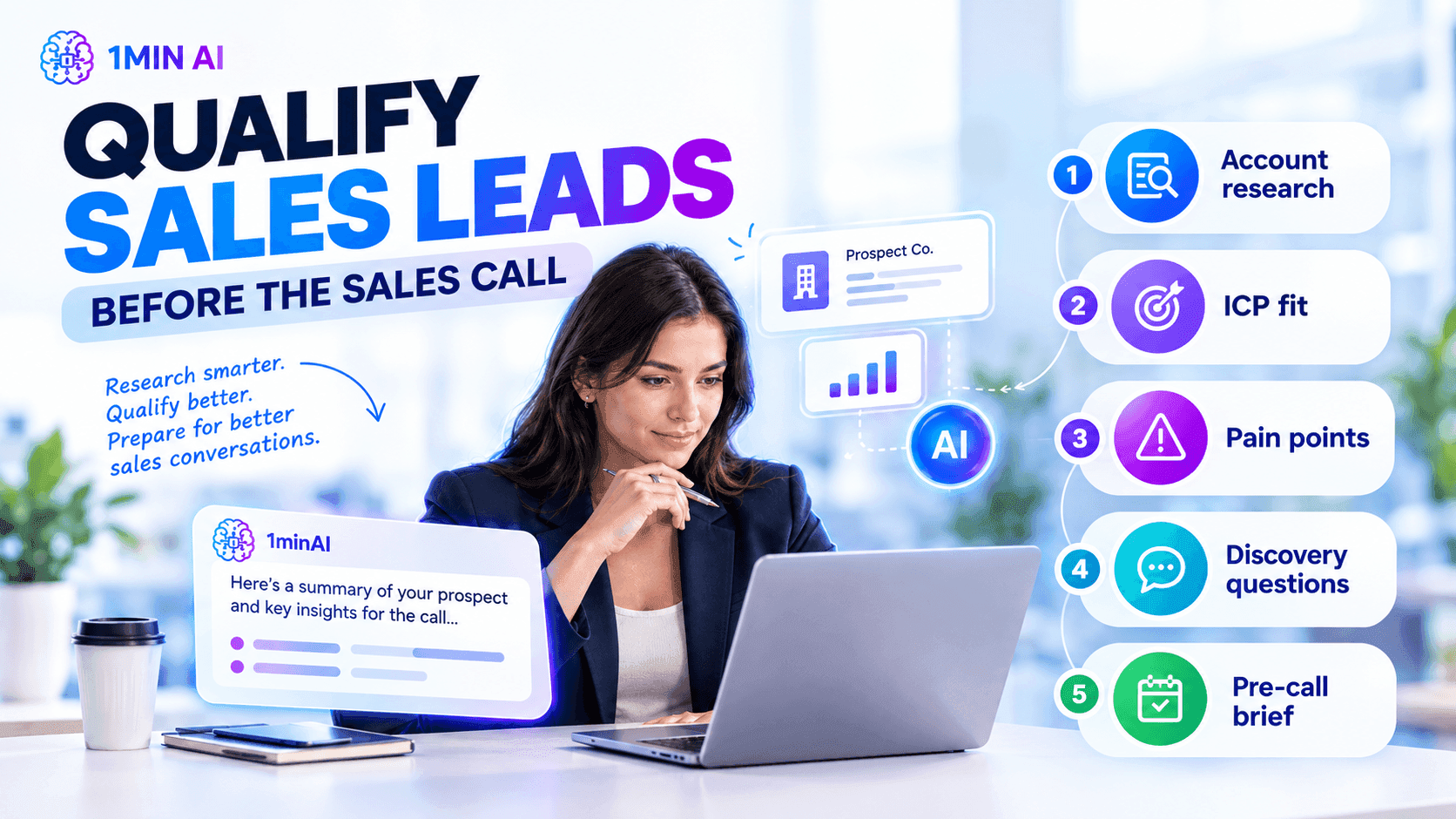
Learn how to qualify sales leads before a sales call with 7 practical steps, from account research to buying signals and AI-assisted preparation.
Qualifying sales leads before a sales call helps Account Executives focus on relevant prospects, understand business needs, and prepare more productive conversations.
Instead of entering every call with the same questions, sales teams can use structured research to evaluate account fit, identify potential pain points, and understand buying signals.
With the right process and an AI sales assistant, lead qualification becomes more consistent and efficient.
Why lead qualification matters
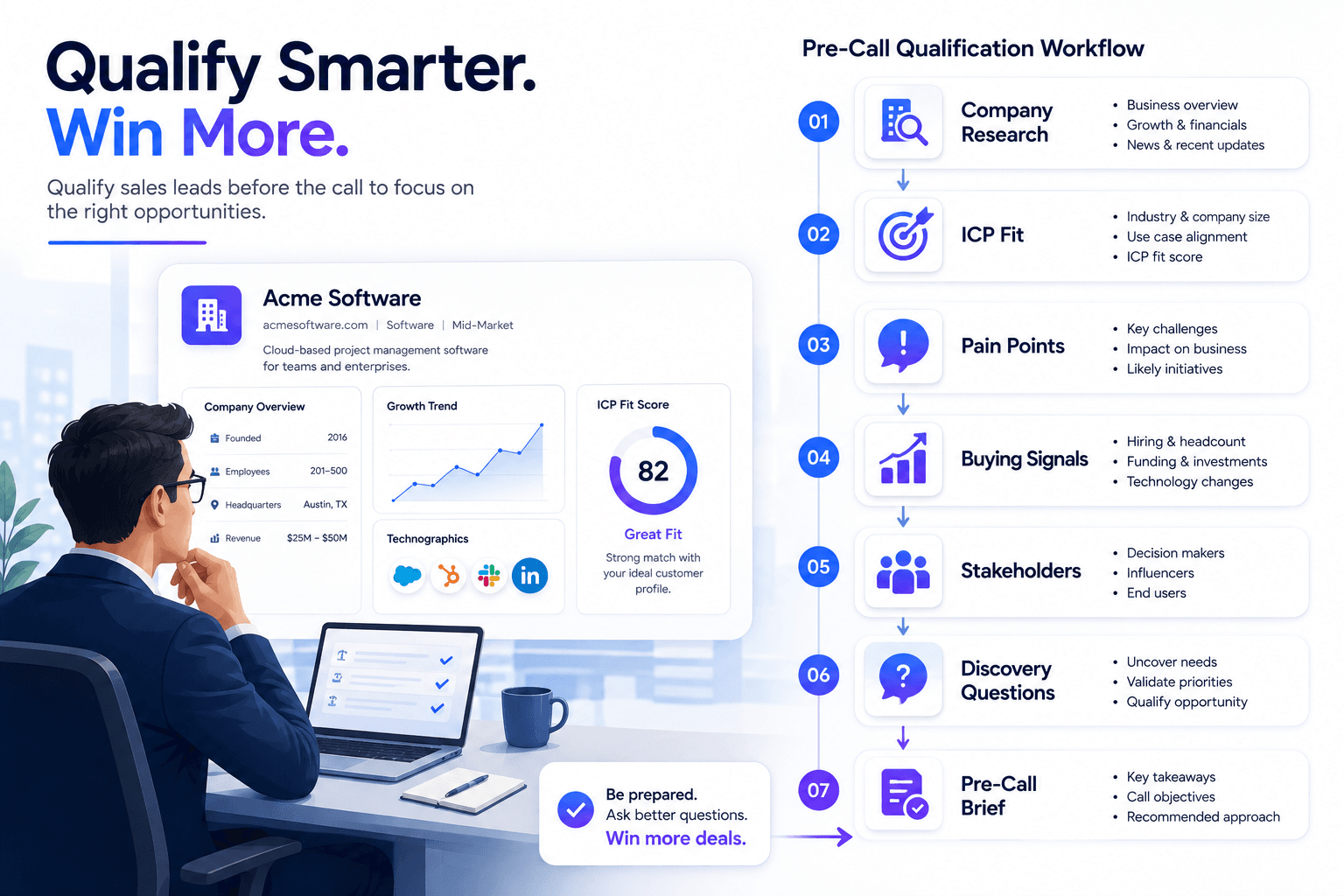
Effective lead qualification helps sales teams determine whether a prospect matches their Ideal Customer Profile (ICP) and has a relevant business need.
Without proper preparation, AEs may spend time on accounts that lack budget, urgency, decision-making authority, or a clear use case.
A structured qualification process helps you:
- Prioritize high-potential accounts
- Identify relevant business challenges
- Prepare targeted discovery questions
- Reduce time spent on low-fit leads
- Create more productive sales conversations
The goal is not to reject prospects too quickly. It is to understand whether the opportunity deserves further attention.
7 steps to qualify sales leads before a sales call
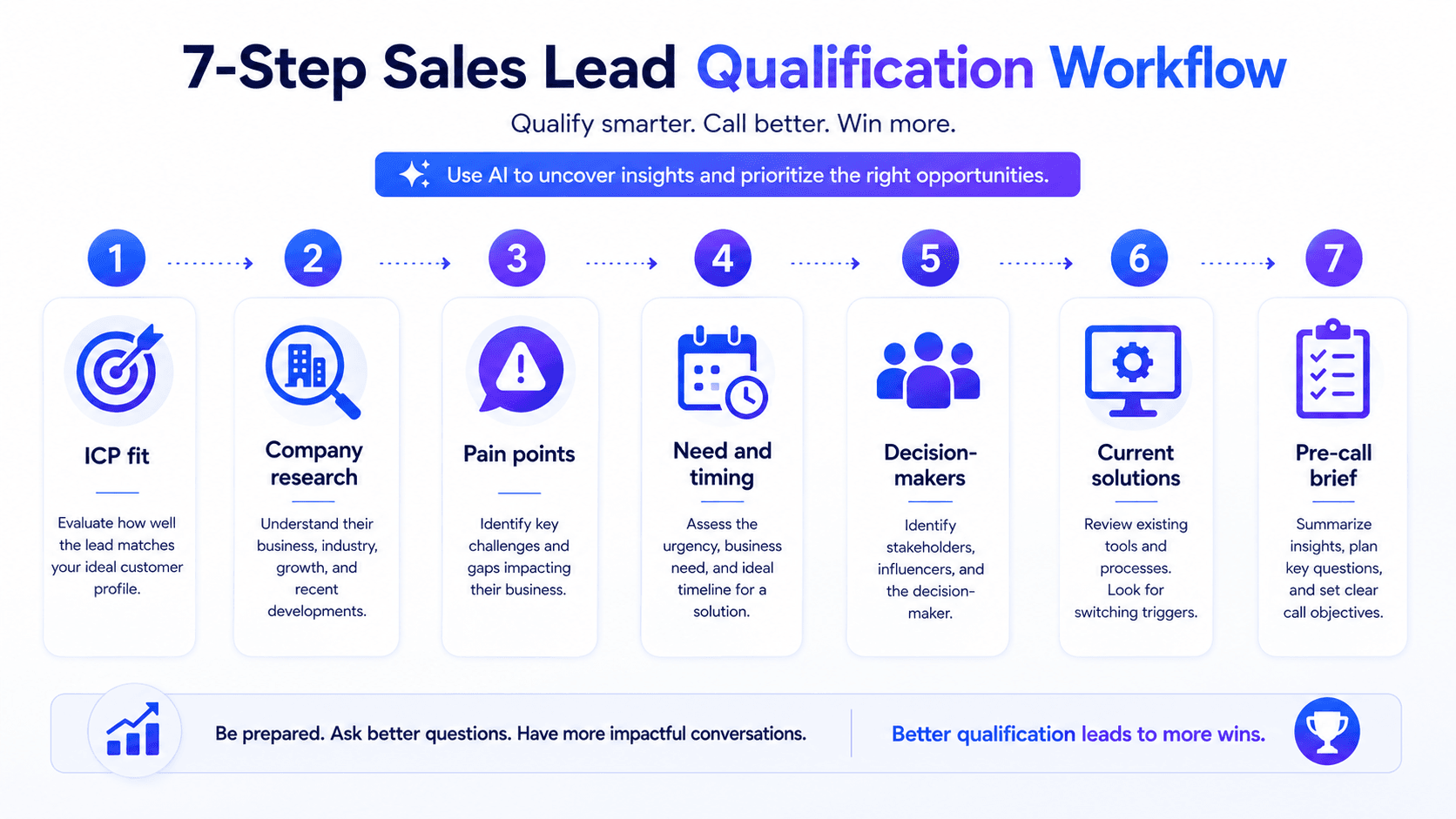
1. Check prospect ICP fit
Start by evaluating whether the prospect matches your Ideal Customer Profile (ICP).
Review key factors such as:
- Industry
- Company size
- Geographic location
- Business model
- Revenue range
- Technology adoption
- Potential use cases
For example, a B2B SaaS company selling enterprise software may prioritize organizations with established sales teams and complex customer workflows.
A prospect that does not match your ICP may still be valuable, but it requires a different qualification approach.
2. Research the company's business context
Before contacting a prospect, understand what the company does and what may influence its purchasing decisions.
Review:
- Company website
- Product or service offerings
- Recent announcements
- Target customers
- Growth initiatives
- Industry challenges
Using AI research tools can help organize information from multiple sources and create a clearer account overview.
However, always verify important facts before using them in a sales conversation.
3. Identify potential pain points
The next step is to identify problems your product or service may help solve.
Look for signals related to:
- Operational inefficiencies
- Manual processes
- Hiring or expansion
- New product launches
- Customer experience issues
- Technology changes
- Revenue or productivity goals
Avoid assuming that every company has the same challenges.
Instead, separate verified information from reasonable hypotheses. This helps you prepare discovery questions without presenting assumptions as facts.
4. Evaluate need, timing, and business impact
A qualified lead usually has a relevant problem, but the urgency of that problem also matters.
Consider the following questions:
- Is the prospect currently facing this challenge?
- What happens if the problem remains unresolved?
- Is there a specific project or deadline?
- Could solving the problem create measurable business value?
- Has the company already started looking for a solution?
Timing is especially important. A prospect may be a strong fit but not ready to purchase immediately.
Use the call to understand the situation rather than forcing the prospect into a predefined sales stage.
5. Understand stakeholders and decision-makers
Identifying the right stakeholders helps you understand how purchasing decisions are made.
Depending on the product, relevant stakeholders may include:
- End users
- Department managers
- Technical teams
- Procurement
- Finance
- Executive decision-makers
Research the prospect's role and responsibilities before the call.
You can also use AI agents to organize stakeholder information and prepare role-specific discovery questions. Review the generated results carefully before using them.
6. Review current solutions and alternatives
Understand how the prospect currently handles the problem.
Their existing solution may include:
- Internal processes
- Spreadsheets
- Competitor software
- Manual work
- Multiple disconnected tools
- An existing automation system
Ask yourself:
- What solution are they using today?
- What limitations might they experience?
- Have they recently changed tools?
- What would motivate them to consider an alternative?
This research helps you position your product around the prospect's actual needs instead of relying on generic selling points.
7. Create a pre-call qualification brief
Summarize your research into a short, structured brief before the sales call.
A useful qualification brief can include:
| Section | Information to include |
|---|---|
| Account overview | Industry, size, and business model |
| ICP fit | Reasons the account matches your target profile |
| Business context | Key initiatives and company developments |
| Potential pain points | Verified problems and research-based hypotheses |
| Buying signals | Relevant changes, projects, or priorities |
| Stakeholders | Key contacts and potential decision-makers |
| Discovery questions | Questions tailored to the prospect |
| Next steps | Information needed during the call |
You can use an AI writing and blog article generator to organize research notes into a concise pre-call document.
How an AI sales assistant supports lead qualification
An AI sales assistant can help AEs reduce manual preparation by organizing research and generating structured insights.
For example, AI can help you:
- Summarize company information
- Identify potential business challenges
- Extract buying signals
- Organize stakeholder details
- Generate discovery questions
- Create a pre-call qualification brief
- Separate facts from assumptions
A useful prompt could be:
Act as a B2B sales research assistant.
Analyze the company information provided below and help me prepare for a discovery call.
Identify:
- Company overview and ICP fit
- Potential business pain points
- Relevant buying signals
- Possible stakeholders
- Information that still needs verification
- Five discovery questions tailored to this account
Do not invent facts. Clearly separate verified information from assumptions.
For research-heavy workflows, AI can also help review and organize information from multiple documents. However, important company details, financial information, and buying signals should always be verified independently.
How 1minAI helps build a lead qualification workflow
Lead qualification often requires multiple AI capabilities, including research, analysis, writing, and summarization.
With AI workflow automation, sales teams can organize different preparation stages into a repeatable process.
A practical workflow could look like this:
Account research → Lead qualification → Pain point analysis → Discovery questions → Pre-call brief
Different AI models can support different stages:
- Research tools for gathering and verifying information
- Reasoning models for analyzing business context
- Writing tools for preparing questions and summaries
- AI agents for connecting repeatable workflow steps
This approach can reduce unnecessary tool switching and make the qualification process easier to repeat across multiple accounts.
AI-generated information should still be reviewed before it is used in customer-facing conversations. AI fact-checking workflows can help identify claims that require additional verification.
Final thoughts
Learning how to qualify sales leads before a sales call requires more than checking company size or industry.
Effective qualification combines account research, ICP fit, business context, pain points, buying signals, and stakeholder analysis.
AI can support this process by organizing information and accelerating preparation, but sales professionals should still verify facts and use human judgment during discovery.
The goal is simple: enter every sales call with better context, more relevant questions, and a clearer understanding of the prospect's potential needs.
Build a repeatable lead qualification workflow with multiple AI models inside 1minAI.
🚀 Get early access to the 1min.AI AI Agent
Curious how an AI agent for sales research and lead qualification could fit into your workflow? Tell 1min.AI what you would want it to handle—from account research and lead scoring to pain point analysis and pre-call preparation—and help shape the future of AI-powered sales workflows.
Join the AI Agent waitlist for early access and stay updated on launch opportunities.
Alternatives
Discover the best alternatives to 1minAI and compare features, pricing, and use cases.

1min.AI vs OpenRouter
1min.AI vs. OpenRouter: Compare the ready-to-use AI creation product against the technical API tool. Find out if you need a zero-code creative studio or a coding infrastructure hub.
 Ngoc Hong
1min.AI vs Easy Peasy AI
Looking for an Easy Peasy AI alternative? Compare Easy Peasy AI and 1min.AI for content workflows, AI models, and professional teams.
Ngoc Hong
1min.AI vs Taskade
Compare 1min.AI vs Taskade for AI content creation, automation, agents, and creative workflows to find the right workspace.
Ngoc HongAI Tools
Discover the best AI tools to boost productivity, creativity, and everyday work.
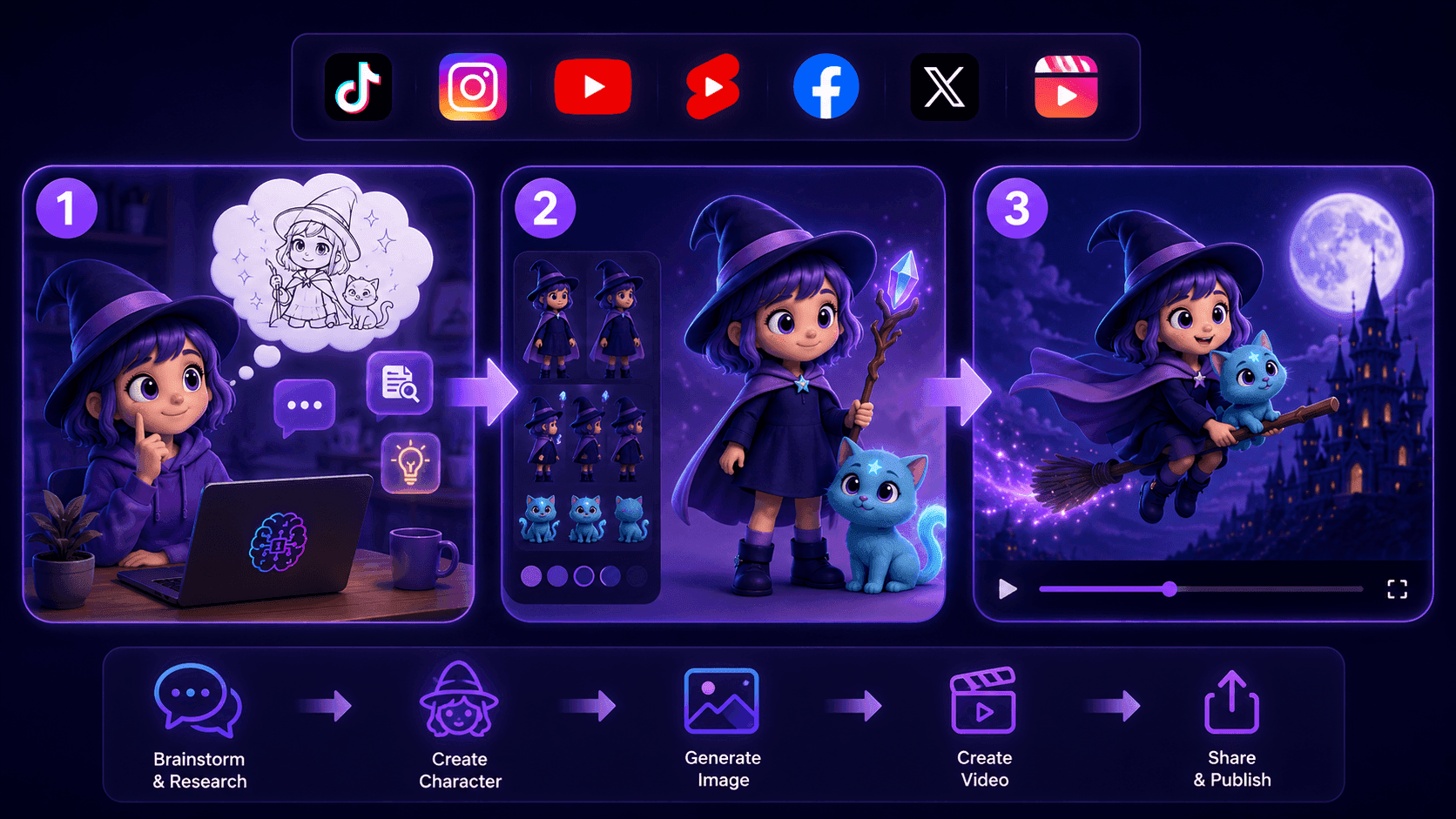
Create Consistent Cartoon Content in Just a Few Steps
Create engaging cartoon videos for TikTok and Reels with 1min.AI. Research ideas, create characters, and turn images into animated videos in 3 simple steps.
 Lien Anh Vu
One Product, 10 UGC Creatives: How AI Makes Content Testing Easier
Create more authentic UGC with an AI UGC video generator, test more creative angles and scale affiliate content without filming every version.
Lien Anh Vu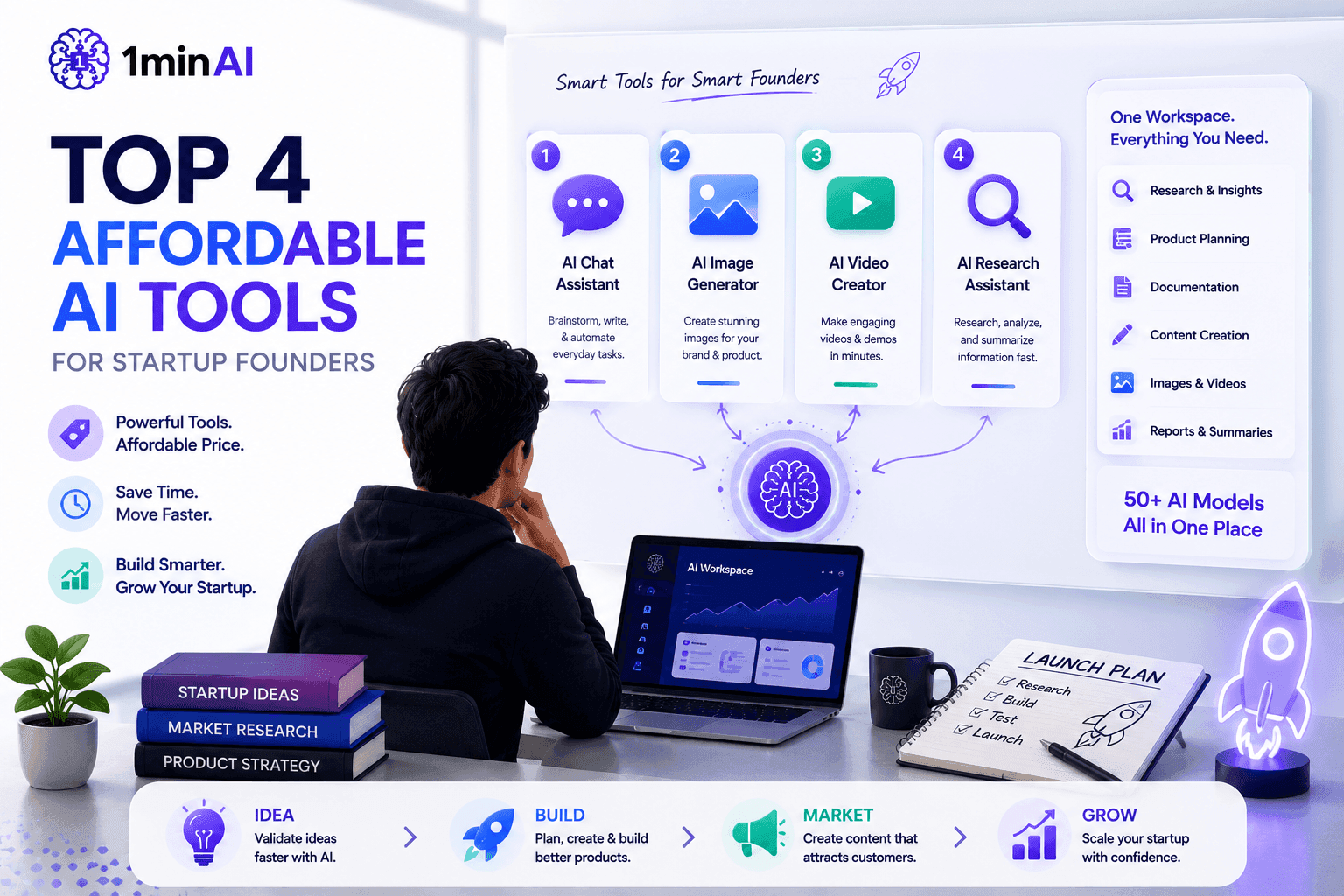
Top 4 Affordable AI Tools for Startup Founders
Discover the top 4 affordable AI tools for startup founders to validate ideas, build products, create content, and launch faster without overspending.
 Tram Ta
AI Features
Comprehensive AI features that streamline workflows, improve efficiency, and empower teams to achieve more.
Create Consistent Cartoon Content in Just a Few Steps
Create engaging cartoon videos for TikTok and Reels with 1min.AI. Research ideas, create characters, and turn images into animated videos in 3 simple steps.
Lien Anh VuOne Product, 10 UGC Creatives: How AI Makes Content Testing Easier
Create more authentic UGC with an AI UGC video generator, test more creative angles and scale affiliate content without filming every version.
Lien Anh Vu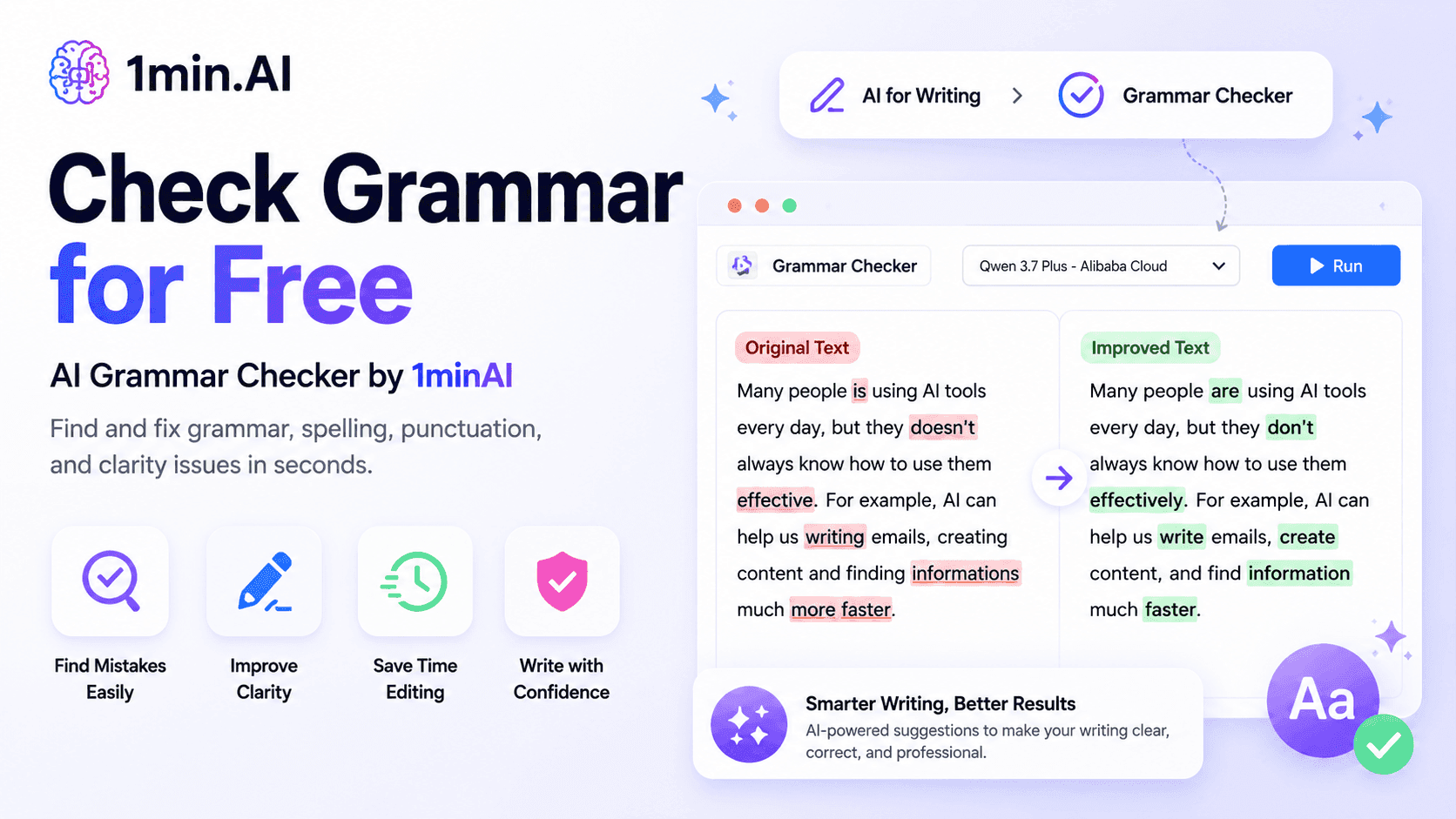
1minAI: Free AI Grammar Checker
Check grammar for free with 1minAI’s AI grammar checker. Find grammar, spelling, and writing mistakes, improve clarity, and polish your content in seconds.
Tram TaAI Use Cases
A curated collection of AI use cases for business, productivity, and industry-specific applications.
Create Consistent Cartoon Content in Just a Few Steps
Create engaging cartoon videos for TikTok and Reels with 1min.AI. Research ideas, create characters, and turn images into animated videos in 3 simple steps.
Lien Anh VuOne Product, 10 UGC Creatives: How AI Makes Content Testing Easier
Create more authentic UGC with an AI UGC video generator, test more creative angles and scale affiliate content without filming every version.
Lien Anh Vu
Best Time to Post on Instagram: A Practical Guide for Better Engagement
Discover the best time to post on Instagram, including the best days and times for different audiences, plus tips to find the ideal posting schedule for your account.
Tram TaAI Tutorials
Learn how to use AI with practical, step-by-step tutorials.
Create Consistent Cartoon Content in Just a Few Steps
Create engaging cartoon videos for TikTok and Reels with 1min.AI. Research ideas, create characters, and turn images into animated videos in 3 simple steps.
Lien Anh Vu
Black Friday AI Tool Deals in 2026
Discover what Black Friday AI tool deals 2026 has to offer. Find out how to secure the 1min.AI lifetime deal via AppSumo, Dealify, Stack Social, and verify on Trustpilot, Slashdot, and Software Advice.
 Hang Nguyen
[Seedance 2.5 New] Better AI Product Videos, Less Rework in 1min.AI
Discover how AI image-to-video product consistency helps creators reduce failed generations, save AI credits, and produce more usable commercial and UGC content.
Lien Anh VuAI Guides
Learn AI faster with practical guides, real-world examples, and actionable best practices.
Create Consistent Cartoon Content in Just a Few Steps
Create engaging cartoon videos for TikTok and Reels with 1min.AI. Research ideas, create characters, and turn images into animated videos in 3 simple steps.
Lien Anh Vu
Safely Buy AI Tools Online: 2026 Black Friday Guide
Discover how to find and secure the best Black Friday AI deals online. Learn expert strategies to avoid scams, combat subscription fatigue, and verify software.
Hang Nguyen[Seedance 2.5 New] Better AI Product Videos, Less Rework in 1min.AI
Discover how AI image-to-video product consistency helps creators reduce failed generations, save AI credits, and produce more usable commercial and UGC content.
Lien Anh VuAI Solutions
Browse the best AI solutions for automation, coding, research, productivity, customer support, marketing, and business workflows.
Create Consistent Cartoon Content in Just a Few Steps
Create engaging cartoon videos for TikTok and Reels with 1min.AI. Research ideas, create characters, and turn images into animated videos in 3 simple steps.
Lien Anh VuOne Product, 10 UGC Creatives: How AI Makes Content Testing Easier
Create more authentic UGC with an AI UGC video generator, test more creative angles and scale affiliate content without filming every version.
Lien Anh Vu
Free AI Tattoo Generator: Custom Designs
Turn any idea into a custom tattoo design with 1min.AI's free AI tattoo generator. Describe your idea, pick a style, and download in seconds.
 Trang Tran
AI Models
Explore the world's leading AI models in one place.
Create Consistent Cartoon Content in Just a Few Steps
Create engaging cartoon videos for TikTok and Reels with 1min.AI. Research ideas, create characters, and turn images into animated videos in 3 simple steps.
Lien Anh VuOne Product, 10 UGC Creatives: How AI Makes Content Testing Easier
Create more authentic UGC with an AI UGC video generator, test more creative angles and scale affiliate content without filming every version.
Lien Anh Vu[Seedance 2.5 New] Better AI Product Videos, Less Rework in 1min.AI
Discover how AI image-to-video product consistency helps creators reduce failed generations, save AI credits, and produce more usable commercial and UGC content.
Lien Anh VuAI Comparisons
Compare AI tools, models, and platforms to find the best fit for your needs.

Kling AI Vs Veo 3: Which Model Wins?
Kling AI vs Veo 3: compare motion, native audio, pricing & free tiers to see which AI video generator wins for your project - try both on 1min.AI.
Trang Tran[Seedance 2.5 New] Better AI Product Videos, Less Rework in 1min.AI
Discover how AI image-to-video product consistency helps creators reduce failed generations, save AI credits, and produce more usable commercial and UGC content.
Lien Anh Vu
DeepSeek V4 Pro vs Flash Comparison
Compare DeepSeek V4 Pro vs DeepSeek V4 Flash metrics. Optimize your agentic apps and improve AI fact checking on 1min.ai today.
Ngoc HongAI Integrations
Seamlessly integrate AI with the tools you already use to automate work and boost productivity.
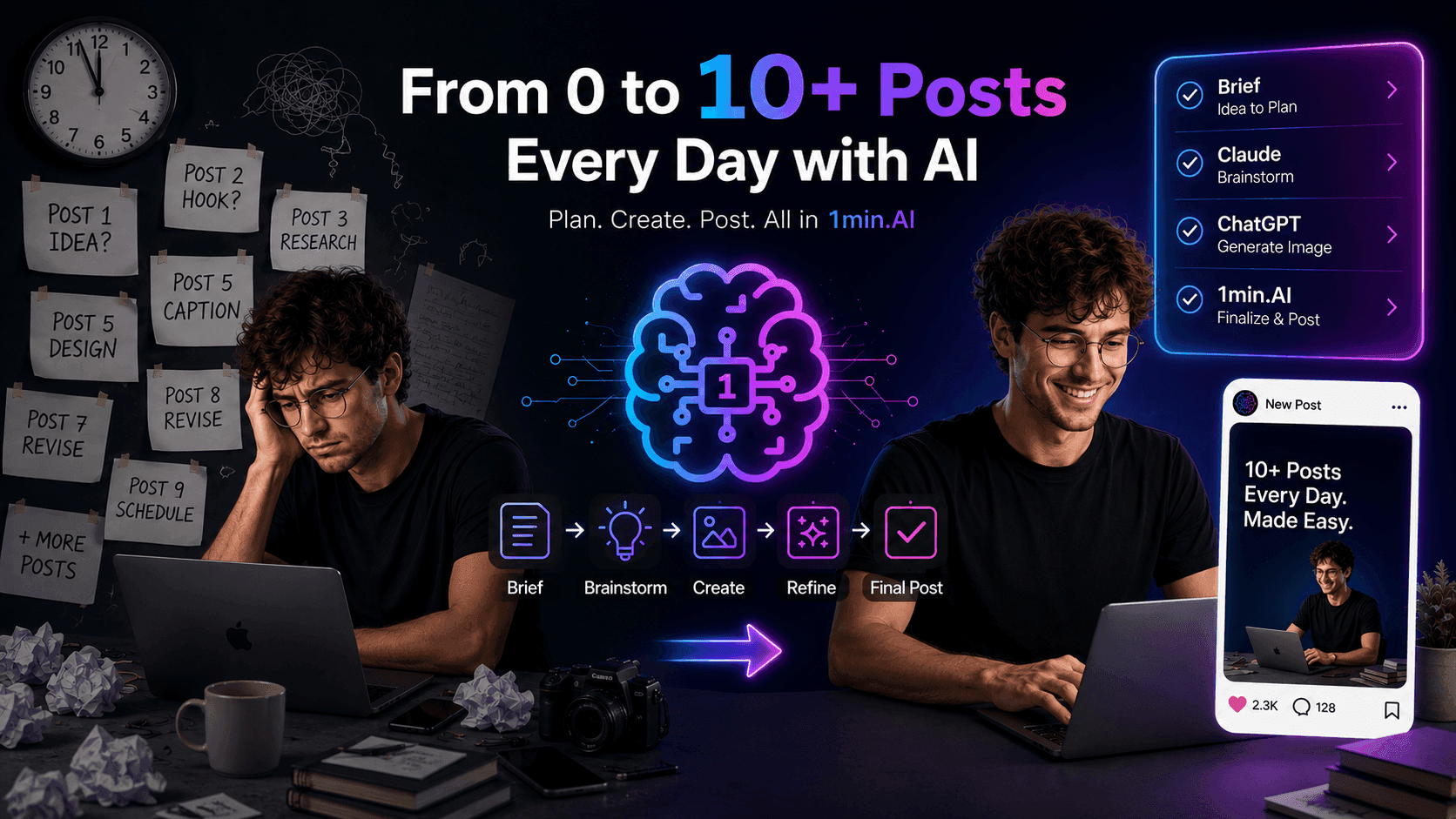
POV: You Have 10+ Posts to Make Every Day
Learn how to build an AI content workflow that helps content creators produce 10+ social media posts a day faster with AI brainstorming, image generation, and content creation.
Lien Anh Vu
How to Use an AI Fashion Video Generator for Fashion Week 2026
Turn Fashion Week 2026 ideas into stunning fashion videos with AI. Learn how to brainstorm, create visuals, and transform images into videos with one simple workflow.
Lien Anh Vu
Stop Switching Between AI Apps: How AI Integration Transforms Employer Branding
Discover how AI integration helps HR teams streamline employer branding by combining AI writing, documents, images, video, and multiple AI models into one workspace.
Tram TaAI for Industries
Find the best AI tools and workflows for healthcare, finance, education, legal, manufacturing, retail, real estate, and more

Free AI Real Estate Video Generator
Turn listing photos into narrated property videos with AI real estate video tools. See how 1min.AI creates walkthroughs, voiceovers & captions in minutes.
Trang Tran
Free AI Virtual Staging: Furnish Any Room
Stage any real estate listing with AI virtual staging: upload a photo, pick a style, and get a photorealistic furnished room in seconds, free to try.
Trang Tran
The Problem With AI Design? It Looks Too AI
AI-generated designs can look polished but still feel artificial. Here are 5 prompt techniques designers can use to create more realistic, intentional visuals.
Lien Anh VuAI Agents
Discover and run AI agents to automate tasks across your work and daily life.
1minAI: Free AI Grammar Checker
Check grammar for free with 1minAI’s AI grammar checker. Find grammar, spelling, and writing mistakes, improve clarity, and polish your content in seconds.
Tram Ta
AI Agents for Facebook
Use an AI Agent for Facebook to create content, generate images, schedule posts, and publish from your documents and conversations.
Ngoc Hong
AI Agent vs AI Assistant: Which One Actually Saves Designers More Time?
Learn the difference between AI Agent vs AI Assistant and discover which solution helps designers automate repetitive work, reduce revisions, and save more time.
Lien Anh VuAI Workflows
Explore ready-to-use AI workflows for productivity, marketing, sales, support, and more.
Create Consistent Cartoon Content in Just a Few Steps
Create engaging cartoon videos for TikTok and Reels with 1min.AI. Research ideas, create characters, and turn images into animated videos in 3 simple steps.
Lien Anh VuOne Product, 10 UGC Creatives: How AI Makes Content Testing Easier
Create more authentic UGC with an AI UGC video generator, test more creative angles and scale affiliate content without filming every version.
Lien Anh VuPOV: You Have 10+ Posts to Make Every Day
Learn how to build an AI content workflow that helps content creators produce 10+ social media posts a day faster with AI brainstorming, image generation, and content creation.
Lien Anh VuNewsletter
Weekly AI Innovations with 1minAI

🔮 Weekly AI Innovations #138: Claude Sonnet 5, Fable 5 & Wan 2.7
Explode your creative potential with massive 1min.ai updates! Access Claude Sonnet 5, Fable 5, and Alibaba Wan 2.7 for unmatched multi-modal generation today.
Hang Nguyen
🔮 Weekly AI Innovations #137: ElevenLabs Music & AI social Profile Control
The newest 1min.ai updates deliver professional music generation and highly requested privacy tools. Dive into a seamless workflow today!
Hang Nguyen
🔮 Weekly AI Innovations #136: Grok 4.6 and Smart Data Retention
Discover the latest 1min.ai updates! Upgrade to Grok 4.6 for blazing-fast AI, and check our new Data Retention policies to secure your files today.
Hang Nguyen