
DeepSeek Models: Top AI Models for Business Founders and SMEs

Tram Ta
November 10, 2026
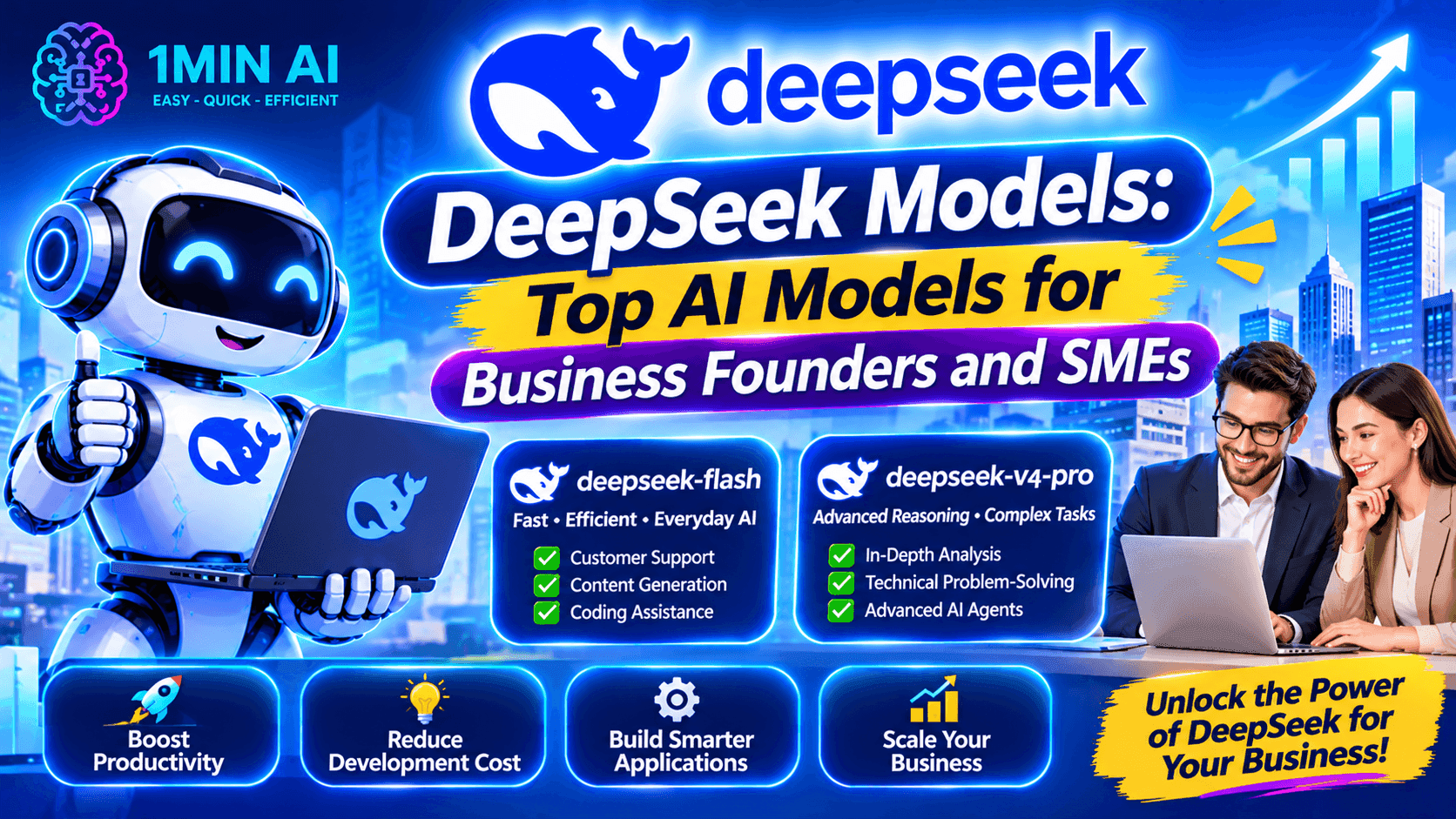
Explore the best DeepSeek models for business founders and SMEs. Compare capabilities, costs, and practical use cases for marketing, research, coding, and automation.
Choosing an AI model for your business is not simply about finding the most powerful option. Founders and small business teams need tools that can help them work faster, reduce repetitive tasks, control costs, and make better decisions.
DeepSeek models are worth exploring because they offer capable AI for tasks such as content creation, research, coding, document analysis, and business automation.
But which DeepSeek model should you choose? Should you prioritize speed, advanced reasoning, or affordability?
This guide compares the major DeepSeek model generations, explains their business applications, and shows how founders and SMEs can choose a model that fits their daily workflows.
What Are DeepSeek Models?
DeepSeek models are AI models developed by DeepSeek, a company known for building large language models with strong reasoning, coding, and general-purpose capabilities.
They can help users perform tasks such as:
- Writing emails, reports, proposals, and marketing content.
- Analyzing documents and extracting important information.
- Researching markets, competitors, and customer needs.
- Generating and explaining code.
- Supporting AI agents and automated workflows.
- Solving complex problems through multi-step reasoning.
DeepSeek has released several model generations, including DeepSeek-V3, DeepSeek-R1, and the V4 family.
For business users, it is important to distinguish between historical model names, current API identifiers, and the models actually serving requests. Older model names may be retired or redirected to newer versions.
The most relevant current API options to understand are:
| Model | Main strength | Potential business use |
|---|---|---|
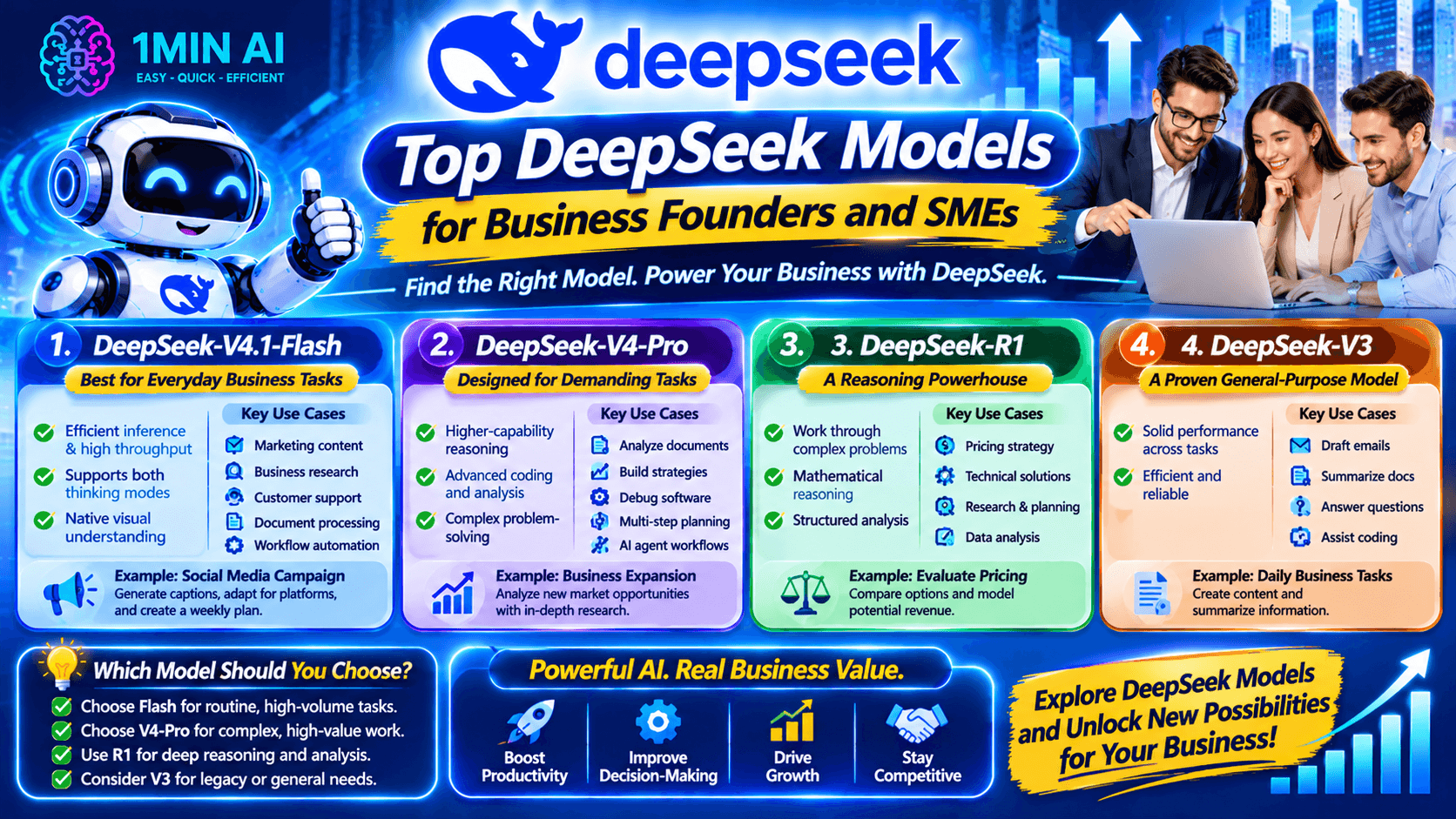
| DeepSeek-V4.1-Flash | Speed, efficiency, and multimodal input | Daily business tasks and high-volume workflows |
| DeepSeek-V4-Pro | Designed for more demanding reasoning and agentic tasks | Complex analysis, coding, and problem-solving |
| DeepSeek-R1 | Earlier reasoning-focused model generation | Understanding reasoning workflows and legacy integrations |
| DeepSeek-V3 | Earlier general-purpose model generation | Understanding DeepSeek's model evolution |
Important: DeepSeek-R1 and DeepSeek-V3 are useful historical references, not the default choices for a new integration. Check the current official model list before building a workflow around an older model identifier.
Top DeepSeek Models for Business Founders and SMEs
Not every business needs the same AI capabilities. A founder managing marketing, customer communication, and operations has different requirements from a developer building an AI-powered product.
Here are the models and generations worth understanding.
1. DeepSeek-V4.1-Flash: Best for Everyday Business Tasks
DeepSeek-V4.1-Flash is a practical starting point for businesses that need an AI model for frequent, everyday tasks.
It is designed to deliver efficient inference and high throughput while supporting both thinking and non-thinking modes. It also supports native visual understanding, making it useful for workflows involving text and images.
What makes it useful for SMEs?
- Marketing content: Generate social media captions, email drafts, product descriptions, and blog outlines.
- Business research: Summarize information and organize findings.
- Customer support: Draft responses to common customer questions.
- Document processing: Extract key details from reports, forms, and other business documents.
- Workflow automation: Power AI applications that classify information, generate responses, or process recurring requests.
Example: A founder planning a social media campaign
A small business owner wants to promote a new product but does not have a dedicated marketing team.
They can use a Flash-based workflow to:
- Describe the product and target audience.
- Generate several campaign angles.
- Create social media captions.
- Adapt the messaging for different platforms.
- Summarize the campaign into a weekly content plan.
Verdict: Start by evaluating DeepSeek-V4.1-Flash if your business needs an affordable, general-purpose model for frequent tasks. It is especially relevant for repetitive workflows where speed and operating cost matter.
2. DeepSeek-V4-Pro: Designed for More Demanding Tasks
DeepSeek-V4-Pro is positioned as a higher-capability model in the V4 family, intended for demanding reasoning, coding, and agentic work.
For an SME, these capabilities can be useful when a task requires more than generating a quick answer.
Potential applications include:
- Analyzing complex business documents.
- Developing detailed business strategies.
- Reviewing technical requirements.
- Building and debugging software.
- Breaking complicated problems into smaller steps.
- Supporting multi-step AI agent workflows.
Example: Analyzing a business expansion opportunity
Imagine a founder wants to evaluate whether to launch a product in a new market.
They can prepare a research package containing:
- Market research.
- Competitor information.
- Customer feedback.
- Estimated operating costs.
- Sales projections.
A capable reasoning model can help organize the information, identify assumptions, compare scenarios, and prepare a structured analysis.
The founder should still verify the underlying data and make the final business decision.
Important availability note: DeepSeek announced that requests using the deepseek-v4-pro API identifier would temporarily be routed to V4.1-Flash until V4.1-Pro launches. The API documentation may still list the Pro identifier and its associated specifications, so check the live model documentation before relying on a particular serving model.
Verdict: Understand V4-Pro as the higher-capability option in DeepSeek's V4 lineup, but verify its actual serving status before selecting it for production.
3. DeepSeek-R1: An Important Reasoning Model to Know
DeepSeek-R1 helped bring attention to DeepSeek's reasoning capabilities.
Unlike a model designed primarily for fast conversational responses, R1 was introduced as a reasoning-focused model that could work through more complex problems.
For business founders, its historical strengths are relevant to tasks such as:
- Breaking down complicated business questions.
- Working through mathematical problems.
- Exploring technical solutions.
- Analyzing structured information.
- Supporting research and planning.
Example: Evaluating a pricing strategy
A founder is considering three pricing options for a subscription product.
They can ask a reasoning-focused model to:
- Compare the advantages and disadvantages of each option.
- Calculate potential revenue under different assumptions.
- Identify risks related to customer acquisition and retention.
- Suggest questions to validate with customers.
The model can help structure the analysis, but the business owner must supply reliable figures and validate the assumptions.
Is DeepSeek-R1 still the best choice?
Not necessarily. R1 belongs to an earlier generation, and model availability can change. If you are starting a new project, compare the current DeepSeek models rather than assuming an older model remains the best option.
Verdict: R1 is important for understanding DeepSeek's reasoning-model development, but new business integrations should prioritize currently supported model identifiers.
4. DeepSeek-V3: A Previous General-Purpose Model
DeepSeek-V3 was an earlier general-purpose model family designed for tasks such as writing, coding, and general AI assistance.
It helped establish DeepSeek's reputation for delivering capable models with an emphasis on computational efficiency.
Business users may encounter V3 in older tutorials, API examples, or existing applications.
Its historical applications included:
- Drafting business emails.
- Generating marketing copy.
- Summarizing documents.
- Answering general questions.
- Assisting with programming tasks.
However, older model references should not automatically be treated as current recommendations.
If you are maintaining an existing application that uses a V3 identifier, check DeepSeek's official migration guidance and model list before making changes.
Verdict: V3 is useful context when understanding DeepSeek's development, but businesses building new workflows should evaluate the currently supported models.
DeepSeek Model Comparison: Which One Should Your Business Choose?
A model that performs well in a benchmark is not necessarily the best model for every business.
The right choice depends on your workload, budget, required accuracy, and technical setup.
Here is a practical comparison:
| Model | Main focus | Best-fit business scenario | Recommendation |
|---|---|---|---|
| V4.1-Flash | Efficient general-purpose AI | Marketing, document processing, customer support | Evaluate first |
| V4-Pro | Advanced reasoning and complex tasks | Technical analysis and demanding problem-solving | Check current serving status |
| R1 | Earlier reasoning-focused generation | Legacy workflows and model research | Not the default for new projects |
| V3 | Earlier general-purpose generation | Legacy applications | Consider migration |
Consider These Four Factors Before Choosing
1. Task complexity
If you need to generate product descriptions or summarize meeting notes, a fast general-purpose model may be enough.
If your task involves complex technical analysis or multi-step problem-solving, evaluate a higher-capability reasoning model.
2. Usage volume
A business generating hundreds of customer responses or processing large numbers of documents should pay close attention to inference cost and throughput.
3. Input format
Some workflows involve more than text. For example, a retailer may want to analyze product images, while an operations team may need to extract information from documents.
Check whether the model supports the input formats your application requires.
4. Integration requirements
If you are building an application, check the API identifier, context window, output limits, tool-calling support, and compatibility with your existing infrastructure.
How Business Founders and SMEs Can Apply DeepSeek Models
The real value of an AI model comes from how you use it. Here are five practical ways to apply DeepSeek in a small business.
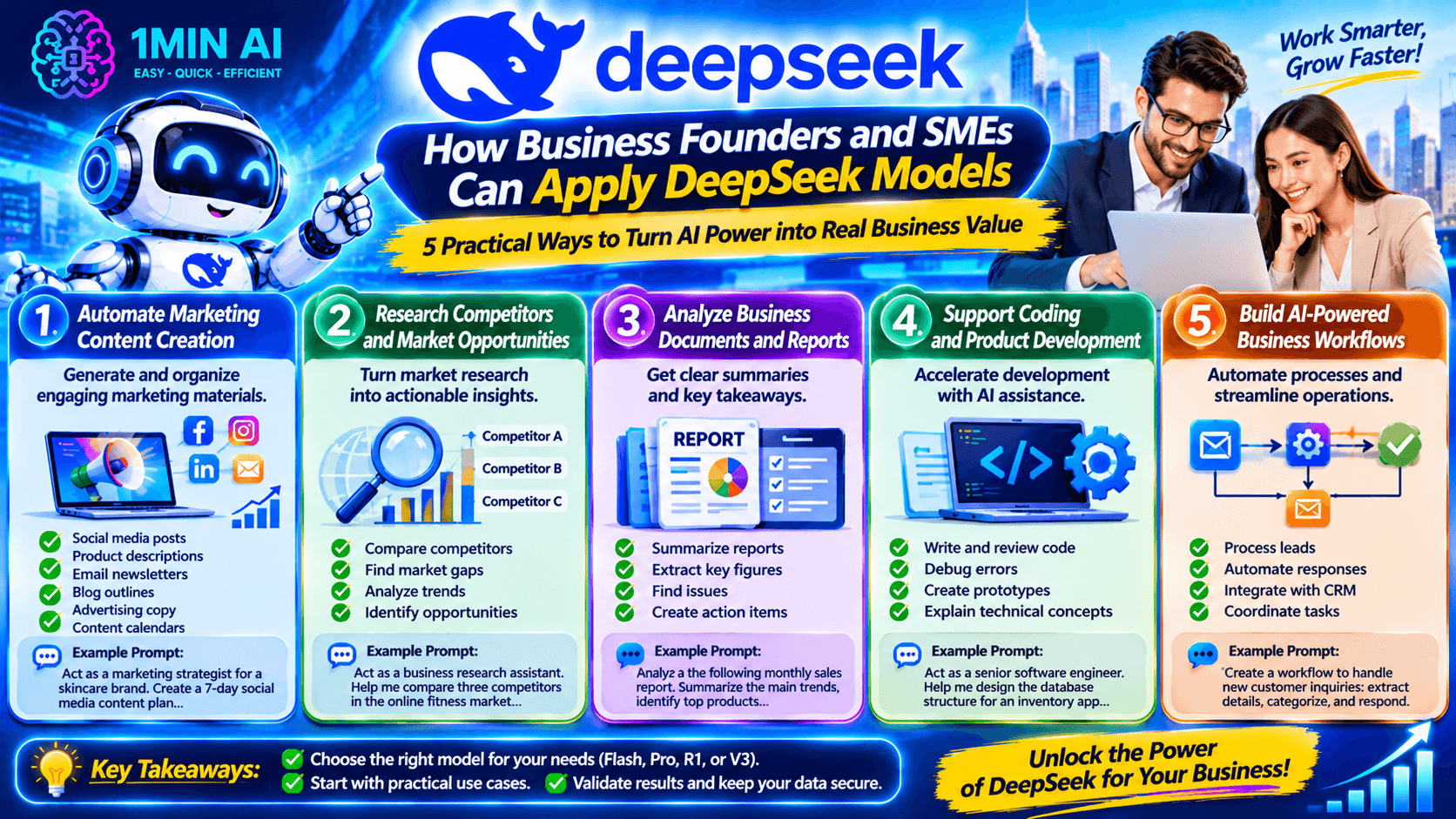
1. Automate Marketing Content Creation
Small businesses often struggle to publish consistently because they lack dedicated content teams.
DeepSeek can help generate and organize marketing materials, including:
- Social media posts.
- Product descriptions.
- Email newsletters.
- Blog outlines.
- Advertising copy.
- Content calendars.
Example prompt:
"Act as a marketing strategist for a small skincare brand. Create a 7-day social media content plan to promote our new moisturizer. Our target audience is women aged 25–40 who are interested in simple skincare routines. Include a content theme, caption idea, suggested visual, and call to action for each day."
You can use an efficient model for first drafts, then review the content for brand voice, factual accuracy, and compliance before publishing.
2. Research Competitors and Market Opportunities
Founders need to understand their markets before investing time and money in new products.
DeepSeek can help organize research and turn raw information into structured comparisons.
Example prompt:
"Act as a business research assistant. Help me compare three competitors in the online fitness coaching market. Create a comparison framework covering target customers, product positioning, pricing strategy, key features, strengths, weaknesses, and potential market gaps.
Do not invent competitor information. Mark missing information as 'Not available' and list what I should research next."
This approach is useful because it encourages the model to distinguish between available information and assumptions.
For reliable results, provide source materials or use verified research sources rather than relying on generated market claims alone.
3. Analyze Business Documents and Reports
SMEs work with many documents, including sales reports, customer feedback, product specifications, and internal procedures.
A capable model can help extract information and turn it into useful summaries.
For example, you could ask it to:
- Summarize a long report.
- Extract important figures.
- Identify recurring customer complaints.
- Compare information across documents.
- Turn meeting notes into action items.
Example prompt:
"Analyze the following monthly sales report. Summarize the main performance trends, identify the three products with the strongest sales, highlight potential problems, and suggest five questions the management team should investigate.
Use only the information in the report. Do not invent missing figures."
Before uploading business documents, check the platform's data-handling policies and avoid sharing confidential or sensitive information without appropriate safeguards.
4. Support Coding and Product Development
Not every startup has a large engineering team.
AI coding assistance can help founders and developers understand code, generate prototypes, debug errors, and document technical processes.
Potential applications include:
- Creating simple website components.
- Writing SQL queries.
- Explaining unfamiliar code.
- Generating test cases.
- Debugging common programming errors.
- Drafting API integration examples.
Example prompt:
"Act as a senior software engineer. I am building a simple inventory management application for a small retail business.
Help me design the database structure. Include tables for products, suppliers, inventory transactions, and users. Explain the purpose of each table and show how the tables relate to each other.
Keep the design simple enough for an MVP."
Always test generated code, review security implications, and validate the architecture before deploying it.
5. Build AI-Powered Business Workflows
Beyond individual prompts, DeepSeek models can be integrated into applications and AI agents.
For example, an automated lead-processing workflow could:
- Receive a new customer inquiry.
- Extract the customer's name, contact details, and requirements.
- Categorize the inquiry.
- Draft a relevant response.
- Send the information to a CRM for review.
A model can support individual steps, while the surrounding application handles permissions, data storage, integrations, and approval rules.
For more complex workflows, explore DeepSeek Super Agent and Multi AI Chat & AI Agent.
How Much Does It Cost to Use DeepSeek Models?
Cost is an important consideration for founders and SMEs, especially when AI becomes part of a daily business process.
DeepSeek API pricing is based on token usage. You pay for the input and output tokens processed by the model rather than simply paying a fixed amount for each question.
According to the official pricing documentation, the listed rates are:
| Model identifier | Input: cache miss (off-peak) | Input: cache hit (off-peak) | Output (off-peak) |
|---|---|---|---|
deepseek-flash | $0.15 / 1M tokens | $0.003 / 1M tokens | $0.60 / 1M tokens |
deepseek-v4-pro | $0.66 / 1M tokens | $0.022 / 1M tokens | $1.98 / 1M tokens |
These are API rates, not monthly subscription prices.
Keep these details in mind:
- Off-peak rates are half of peak rates.
- Peak and off-peak periods are defined in DeepSeek's official pricing documentation.
- Cache-hit and cache-miss input rates are different.
- Prices and model availability can change.
- The model identifier does not always guarantee that a distinct model version is serving the request.
For an SME, the best approach is to estimate usage with a small pilot before scaling an AI workflow across the company.
You can also explore 1minAI's AI API Aggregator for Developers and Free AI API for Developers to learn about alternative ways to work with AI APIs.
How to Access and Work with DeepSeek Models
There are several ways to use DeepSeek, depending on whether you are an everyday business user or a developer.
Option 1: Use DeepSeek's Official Platform
The official DeepSeek platform is a straightforward starting point if you want to experiment with AI chat and explore available features.
You can use it to test prompts, draft content, summarize information, and evaluate whether AI can help with your business tasks.
Option 2: Integrate DeepSeek Through Its API
Developers can connect supported DeepSeek models to their own applications using the official API.
A typical integration involves:
- Creating an API account.
- Generating an API key.
- Selecting a currently supported model identifier.
- Connecting through the API endpoint.
- Testing responses and monitoring token usage.
For a step-by-step guide, see the previous article: DeepSeek API: A Complete Guide to Getting Started and Building AI Applications.
You can also follow 1minAI's API key creation guide when setting up an API key for 1minAI's API services. Remember that a 1minAI API key and a DeepSeek API key are separate credentials.
Option 3: Compare AI Models in One Workspace
Sometimes, the challenge is not accessing an AI model. It is deciding which model produces the most useful result.
For example, a founder may want to compare different AI responses to the same business question before using the output in a marketing campaign or business plan.
With 1minAI Multi AI Chat, users can explore multiple AI models in one workspace and compare their responses.
A practical workflow looks like this:
- Enter a business question or task.
- Compare responses from available AI models.
- Identify useful ideas and differences.
- Refine the strongest response.
- Review the final output before using it.
You can also explore 1minAI's Multi AI Chat & AI Agent to learn more about combining multi-model AI chat with agent workflows.
Conclusion
DeepSeek models offer useful capabilities for founders and SMEs looking to apply AI to everyday business operations.
For most businesses, the smartest approach is to start with a model suited to frequent, repeatable tasks, then evaluate more advanced capabilities when a workflow genuinely requires them.
DeepSeek-V4.1-Flash is a practical model to evaluate for everyday work, while V4-Pro is worth understanding for more demanding tasks—provided its current serving status is verified. Earlier models such as R1 and V3 remain important parts of DeepSeek's development history, but should not automatically be treated as the best choices for new projects.
Ultimately, the right model is the one that helps your business save time, improve work quality, and deliver measurable value without adding unnecessary complexity.
- #Commerce
- #Information
Alternatives
Discover the best alternatives to 1minAI and compare features, pricing, and use cases.

1min.AI vs OpenRouter
1min.AI vs. OpenRouter: Compare the ready-to-use AI creation product against the technical API tool. Find out if you need a zero-code creative studio or a coding infrastructure hub.
 Ngoc Hong

1min.AI vs ContentStudio Alternative
Compare 1min.AI vs ContentStudio for Facebook content creation, brand context, AI images, publishing, team workflows, and pricing.
Ngoc Hong
Meta Muse Alternatives: 6 Options for Every Workflow
Looking for Meta Muse alternatives? Compare ChatGPT, Gemini, Claude, Perplexity, OpenClaw and 1min.AI by price, availability, and privacy.
Ngoc HongAI Tools
Discover the best AI tools to boost productivity, creativity, and everyday work.
Create Consistent Cartoon Content in Just a Few Steps
Create engaging cartoon videos for TikTok and Reels with 1min.AI. Research ideas, create characters, and turn images into animated videos in 3 simple steps.
 Lien Anh Vu
One Product, 10 UGC Creatives: How AI Makes Content Testing Easier
Create more authentic UGC with an AI UGC video generator, test more creative angles and scale affiliate content without filming every version.
Lien Anh Vu
Top 4 Affordable AI Tools for Startup Founders
Discover the top 4 affordable AI tools for startup founders to validate ideas, build products, create content, and launch faster without overspending.
 Tram Ta
AI Features
Comprehensive AI features that streamline workflows, improve efficiency, and empower teams to achieve more.
Create Consistent Cartoon Content in Just a Few Steps
Create engaging cartoon videos for TikTok and Reels with 1min.AI. Research ideas, create characters, and turn images into animated videos in 3 simple steps.
Lien Anh VuOne Product, 10 UGC Creatives: How AI Makes Content Testing Easier
Create more authentic UGC with an AI UGC video generator, test more creative angles and scale affiliate content without filming every version.
Lien Anh Vu
1minAI: Free AI Grammar Checker
Check grammar for free with 1minAI’s AI grammar checker. Find grammar, spelling, and writing mistakes, improve clarity, and polish your content in seconds.
Tram TaAI Use Cases
A curated collection of AI use cases for business, productivity, and industry-specific applications.
Create Consistent Cartoon Content in Just a Few Steps
Create engaging cartoon videos for TikTok and Reels with 1min.AI. Research ideas, create characters, and turn images into animated videos in 3 simple steps.
Lien Anh VuOne Product, 10 UGC Creatives: How AI Makes Content Testing Easier
Create more authentic UGC with an AI UGC video generator, test more creative angles and scale affiliate content without filming every version.
Lien Anh Vu
Best Time to Post on Instagram: A Practical Guide for Better Engagement
Discover the best time to post on Instagram, including the best days and times for different audiences, plus tips to find the ideal posting schedule for your account.
Tram TaAI Tutorials
Learn how to use AI with practical, step-by-step tutorials.

Black Friday AI Tool Deals in 2026
Discover what Black Friday AI tool deals 2026 has to offer. Find out how to secure the 1min.AI lifetime deal via AppSumo, Dealify, Stack Social, and verify on Trustpilot, Slashdot, and Software Advice.
 Hang Nguyen
Create Consistent Cartoon Content in Just a Few Steps
Create engaging cartoon videos for TikTok and Reels with 1min.AI. Research ideas, create characters, and turn images into animated videos in 3 simple steps.
Lien Anh Vu
[Seedance 2.5 New] Better AI Product Videos, Less Rework in 1min.AI
Use Seedance 2.5 image to video on 1min.AI to create more consistent AI product videos, reduce failed generations, save credits, and improve UGC workflows.
Lien Anh VuAI Guides
Learn AI faster with practical guides, real-world examples, and actionable best practices.

Safely Buy AI Tools Online: 2026 Black Friday Guide
Discover how to find and secure the best Black Friday AI deals online. Learn expert strategies to avoid scams, combat subscription fatigue, and verify software.
Hang NguyenCreate Consistent Cartoon Content in Just a Few Steps
Create engaging cartoon videos for TikTok and Reels with 1min.AI. Research ideas, create characters, and turn images into animated videos in 3 simple steps.
Lien Anh Vu[Seedance 2.5 New] Better AI Product Videos, Less Rework in 1min.AI
Use Seedance 2.5 image to video on 1min.AI to create more consistent AI product videos, reduce failed generations, save credits, and improve UGC workflows.
Lien Anh VuAI Solutions
Browse the best AI solutions for automation, coding, research, productivity, customer support, marketing, and business workflows.
Safely Buy AI Tools Online: 2026 Black Friday Guide
Discover how to find and secure the best Black Friday AI deals online. Learn expert strategies to avoid scams, combat subscription fatigue, and verify software.
Hang NguyenCreate Consistent Cartoon Content in Just a Few Steps
Create engaging cartoon videos for TikTok and Reels with 1min.AI. Research ideas, create characters, and turn images into animated videos in 3 simple steps.
Lien Anh VuOne Product, 10 UGC Creatives: How AI Makes Content Testing Easier
Create more authentic UGC with an AI UGC video generator, test more creative angles and scale affiliate content without filming every version.
Lien Anh VuAI Models
Explore the world's leading AI models in one place.
Create Consistent Cartoon Content in Just a Few Steps
Create engaging cartoon videos for TikTok and Reels with 1min.AI. Research ideas, create characters, and turn images into animated videos in 3 simple steps.
Lien Anh VuOne Product, 10 UGC Creatives: How AI Makes Content Testing Easier
Create more authentic UGC with an AI UGC video generator, test more creative angles and scale affiliate content without filming every version.
Lien Anh Vu[Seedance 2.5 New] Better AI Product Videos, Less Rework in 1min.AI
Use Seedance 2.5 image to video on 1min.AI to create more consistent AI product videos, reduce failed generations, save credits, and improve UGC workflows.
Lien Anh VuAI Comparisons
Compare AI tools, models, and platforms to find the best fit for your needs.

Kling AI Vs Veo 3: Which Model Wins?
Kling AI vs Veo 3: compare motion, native audio, pricing & free tiers to see which AI video generator wins for your project - try both on 1min.AI.
 Trang Tran
[Seedance 2.5 New] Better AI Product Videos, Less Rework in 1min.AI
Use Seedance 2.5 image to video on 1min.AI to create more consistent AI product videos, reduce failed generations, save credits, and improve UGC workflows.
Lien Anh Vu
DeepSeek V4 Pro vs Flash Comparison
Compare DeepSeek V4 Pro vs DeepSeek V4 Flash metrics. Optimize your agentic apps and improve AI fact checking on 1min.ai today.
Ngoc HongAI Integrations
Seamlessly integrate AI with the tools you already use to automate work and boost productivity.
POV: You Have 10+ Posts to Make Every Day
Learn how to build an AI content workflow that helps content creators produce 10+ social media posts a day faster with AI brainstorming, image generation, and content creation.
Lien Anh Vu
How to Use an AI Fashion Video Generator for Fashion Week 2026
Turn Fashion Week 2026 ideas into stunning fashion videos with AI. Learn how to brainstorm, create visuals, and transform images into videos with one simple workflow.
Lien Anh Vu
Stop Switching Between AI Apps: How AI Integration Transforms Employer Branding
Discover how AI integration helps HR teams streamline employer branding by combining AI writing, documents, images, video, and multiple AI models into one workspace.
Tram TaAI for Industries
Find the best AI tools and workflows for healthcare, finance, education, legal, manufacturing, retail, real estate, and more

Voice Cloning AI Free: How to Clone Any Voice Online in Minutes
Try voice cloning AI free with 1min.AI. Upload a 5-second clip, pick an ElevenLabs model, choose from 32 languages, and turn text to speech in your own voice.
Trang Tran
Text To Video AI Free Without Watermark Online
Create text to video AI free without watermark online with 1min.AI. Pick top models, turn prompts into HD clips, and download clean videos fast. Try it free.
Trang Tran
Free AI Image Editor With Prompt No Restrictions
Looking for a free AI image editor with prompt no restrictions? Edit backgrounds, objects and text by typing, no watermark. Try 1min.AI’s flexible editor now.
Trang TranAI Agents
Discover and run AI agents to automate tasks across your work and daily life.
1minAI: Free AI Grammar Checker
Check grammar for free with 1minAI’s AI grammar checker. Find grammar, spelling, and writing mistakes, improve clarity, and polish your content in seconds.
Tram Ta
AI Agents for Facebook
Use an AI Agent for Facebook to create content, generate images, schedule posts, and publish from your documents and conversations.
Ngoc Hong
AI Agent vs AI Assistant: Which One Actually Saves Designers More Time?
Learn the difference between AI Agent vs AI Assistant and discover which solution helps designers automate repetitive work, reduce revisions, and save more time.
Lien Anh VuAI Workflows
Explore ready-to-use AI workflows for productivity, marketing, sales, support, and more.
Create Consistent Cartoon Content in Just a Few Steps
Create engaging cartoon videos for TikTok and Reels with 1min.AI. Research ideas, create characters, and turn images into animated videos in 3 simple steps.
Lien Anh VuOne Product, 10 UGC Creatives: How AI Makes Content Testing Easier
Create more authentic UGC with an AI UGC video generator, test more creative angles and scale affiliate content without filming every version.
Lien Anh VuPOV: You Have 10+ Posts to Make Every Day
Learn how to build an AI content workflow that helps content creators produce 10+ social media posts a day faster with AI brainstorming, image generation, and content creation.
Lien Anh VuNewsletter
Weekly AI Innovations with 1minAI

🔮 Weekly AI Innovations #145: X Content Agent & GPT 6.1 Terra on 1min.ai
Scale viral reach with the X Content Agent on 1min.ai. Discover an end-to-end 4-stage pipeline with zero token burn, plus the launch of GPT 6.1 Terra.
Hang Nguyen
🔮 Weekly AI Innovations #144: LinkedIn Content Agent: Complete B2B Publishing Pipeline
Scale B2B influence with the LinkedIn Content Agent on 1min.ai. Discover an end-to-end 4-stage pipeline with zero redundant token burn and 1-click publishing.
Hang Nguyen
🔮 Weekly AI Innovations #143: Update GPT-6, GPT-6.1 & Ideogram 4.0
Access GPT-6 Sol, Luna, GPT-6.1 Sol, and Ideogram 4.0 on 1min.ai. Boost typography accuracy to 98.4% and cut reasoning latency by 45% in one platform.
Hang Nguyen