
Fable 5.2 vs Opus 5.5: Overview, Which Claude Model to Choose

Tram Ta
November 18, 2026
Compare Claude Fable 5.2 vs Opus 5.5 features, coding, reasoning, and pricing. Discover which model fits your workflow and try both on 1minAI.
Claude Opus 5.5 is positioned as the recommended starting point for most everyday professional work, including coding, research, and knowledge tasks. Claude Fable 5.2 is designed for more demanding reasoning, deep research, and long-running agentic workflows.
So, which model should you choose? Is Fable 5.2 worth the additional cost? And how can you try both Claude models on 1minAI?
In this guide, we'll compare Fable 5.2 vs Opus 5.5, examine their specifications and practical applications, and show you how to explore both models through 1minAI.
What Is Claude Fable 5.2?
Claude Fable 5.2 is an advanced model from Anthropic designed for tasks that require extensive reasoning and long-running AI workflows.
It is positioned above Opus in Anthropic's current model lineup for the most demanding workloads.
Instead of focusing only on quick answers, Fable 5.2 is designed to work through complicated problems involving multiple steps, extensive context, and detailed analysis.
Key capabilities of Claude Fable 5.2
Advanced reasoning
Fable 5.2 is designed to handle difficult questions that require connecting information, evaluating alternatives, and developing structured conclusions.
Long-running agentic work
It is suitable for workflows where an AI system needs to work through a sequence of tasks over an extended period.
Deep research
Users can apply it to complex research tasks that involve collecting information, comparing findings, identifying gaps, and preparing a final deliverable.
Large-context analysis
With a one-million-token context window, Fable 5.2 can process substantial amounts of input, such as technical documentation, research materials, and large project briefs.
Technical problem-solving
It can help developers and researchers work through difficult technical challenges, review complex requirements, and develop structured solutions.
Who should use Claude Fable 5.2?
Fable 5.2 is particularly interesting for:
- Developers handling complicated software engineering problems.
- Researchers conducting multi-step investigations.
- Technical teams working with extensive documentation.
- Professionals managing complex analytical projects.
- Users building workflows that require long-running agentic reasoning.
If you want to explore the model directly, visit Free AI Chat with Claude Fable 5.2 on 1minAI.
What Is Claude Opus 5.5?
Claude Opus 5.5 is Anthropic's advanced model for long-running agentic coding and knowledge work.
While Fable 5.2 targets particularly demanding reasoning tasks, Opus 5.5 is designed to deliver strong performance across a broader range of professional workflows.
Anthropic recommends starting with Opus 5.5 for most workloads.
Key capabilities of Claude Opus 5.5
Advanced coding
Opus 5.5 can assist with software development, debugging, refactoring, and complex systems engineering.
Professional knowledge work
It is suitable for research, business analysis, writing, and preparing structured professional documents.
Long-running coding agents
Developers can use it in workflows involving autonomous coding agents, large-scale refactoring, and complicated software projects.
Vision and computer use
Opus 5.5 supports image understanding and computer-use workflows when connected tools and environments provide those capabilities.
Cost-conscious model selection
Its published API token prices are half those of Fable 5.2, making it a practical starting point when its capabilities are sufficient.
Who should use Claude Opus 5.5?
Opus 5.5 is a strong starting point for:
- Software developers and programmers.
- Business founders and professionals.
- Content creators and researchers.
- Students working on complex assignments.
- Teams building AI-assisted workflows.
You can explore the model through Claude Opus 5.5 on 1minAI or read our related guide on Claude Opus 5.5 for students.
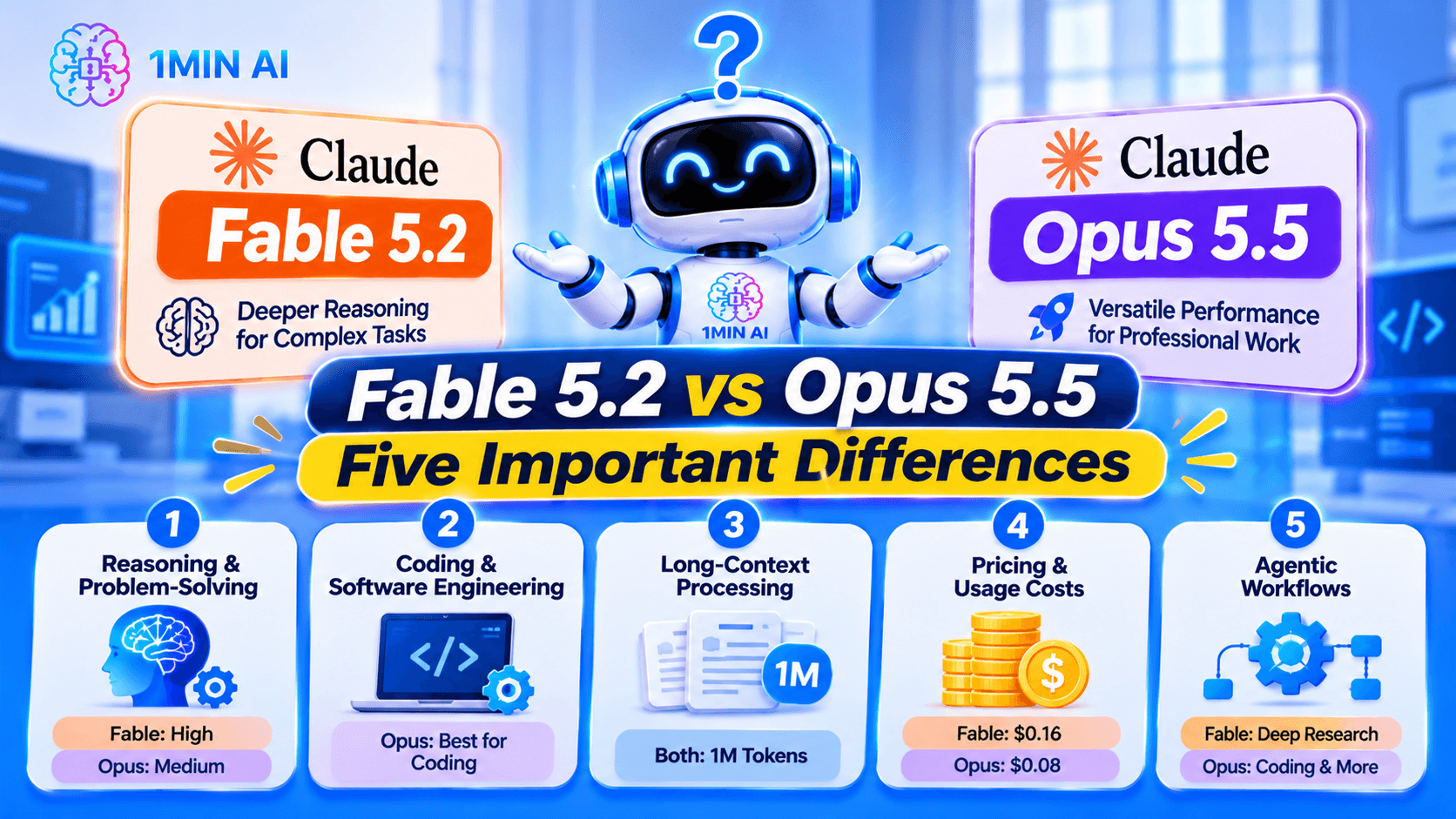
Fable 5.2 vs Opus 5.5: Five Important Differences
Now let's examine how the two models differ in practical situations.
Difference 1: Reasoning and problem-solving
Both models support adaptive thinking, but their default effort settings differ.
Fable 5.2 uses high as its default effort, while Opus 5.5 uses medium.
This reflects their intended roles:
- Fable 5.2 is designed for particularly demanding reasoning and long-horizon agentic work.
- Opus 5.5 is intended for a broader range of professional tasks.
For example, imagine you are evaluating a complicated business expansion strategy.
You need to analyze market conditions, estimate operational risks, compare possible approaches, and develop an implementation plan.
Opus 5.5 is a sensible starting point for this work. If the analysis becomes unusually complex or requires deeper investigation across many dependencies, Fable 5.2 may be worth testing.
Example prompt:
Act as a senior business strategy consultant. Analyze the expansion plan below.
Identify the market opportunities, financial assumptions, operational risks, and potential challenges.
Compare three possible expansion strategies and recommend one based on the information provided.
Explain your reasoning, identify missing information, and create a practical implementation roadmap.
Business plan:
[Insert your plan]
Try the same prompt with both models to see which response better fits your needs.
Difference 2: Coding and software engineering
Both models can support software development, but they are intended for somewhat different levels of complexity.
Opus 5.5 is designed for long-running agentic coding, large-scale refactoring, and complex systems engineering.
Fable 5.2 is positioned for particularly demanding reasoning and extended technical workflows.
Consider these examples:
| Coding task | Suggested starting model |
|---|---|
| Explain a short function | Opus 5.5 |
| Generate a standard application component | Opus 5.5 |
| Debug a complicated issue | Opus 5.5, then Fable if needed |
| Refactor a large software project | Opus 5.5 |
| Investigate a difficult multi-stage technical problem | Fable 5.2 |
| Handle extensive technical research | Fable 5.2 |
These are practical starting recommendations, not guaranteed performance rankings. The best choice depends on the programming language, codebase, available tools, and task requirements.
You can also explore Claude vs Gemini for Coding to understand how Claude models fit into a broader coding workflow.
Difference 3: Long-context processing
One interesting point is that both models offer the same maximum context window.
| Context specification | Fable 5.2 | Opus 5.5 |
|---|---|---|
| Context window | 1M tokens | 1M tokens |
| Maximum output | 128K tokens | 128K tokens |
This means you do not need to choose Fable simply because you have a large document or codebase.
Both models can handle substantial context.
The difference is more about the reasoning requirements of the task than the amount of information you want to provide.
For example:
- Reviewing a large collection of meeting notes: start with Opus 5.5.
- Comparing extensive technical documentation: either model may work.
- Conducting a complicated multi-stage investigation: consider Fable 5.2.
A larger context window also does not guarantee perfect recall of every detail. Organize your input and ask the model to identify relevant evidence.
Difference 4: Pricing and usage costs
Cost is one of the clearest differences between the two models.
According to Anthropic's published API pricing, Fable 5.2 costs twice as much per input and output token as Opus 5.5.
| API pricing | Fable 5.2 | Opus 5.5 |
|---|---|---|
| Input per million tokens | $8 | $4 |
| Output per million tokens | $40 | $20 |
| Cached input per million tokens | $0.20 | $0.20 |
These are standard API token rates, not the prices charged by 1minAI.
For a simple illustration, consider a request using 10,000 input tokens and generating 2,000 output tokens.
| Estimated API cost | Fable 5.2 | Opus 5.5 |
|---|---|---|
| Input cost | $0.08 | $0.04 |
| Output cost | $0.08 | $0.04 |
| Total | $0.16 | $0.08 |
This example uses standard uncached input pricing and excludes any additional charges or discounts.
The result is straightforward: Opus 5.5 is more economical per token.
However, token price is not the only factor in overall cost. A more capable model may complete a difficult task with fewer attempts or less manual correction. You should evaluate the total cost of completing a task, not just the price of one request.
Difference 5: Agentic workflows
Both models support tool use and can be used in agentic workflows when connected to suitable tools.
However, Anthropic highlights different use cases:
Fable 5.2:
- Multi-step deep research.
- Long-running agent sessions.
- Analysis that leads to finished documents or other deliverables.
- Demanding reasoning across complex tasks.
Opus 5.5:
- Long-running autonomous coding agents.
- Large-scale code refactoring.
- Complex systems engineering.
- Vision-heavy workflows.
- Computer use.
The important distinction is that model capability alone does not provide an entire autonomous agent system.
An agent also needs tools, permissions, an execution environment, and an appropriate workflow.
Fable 5.2 vs Opus 5.5: Which Model Is Better for Different Users?
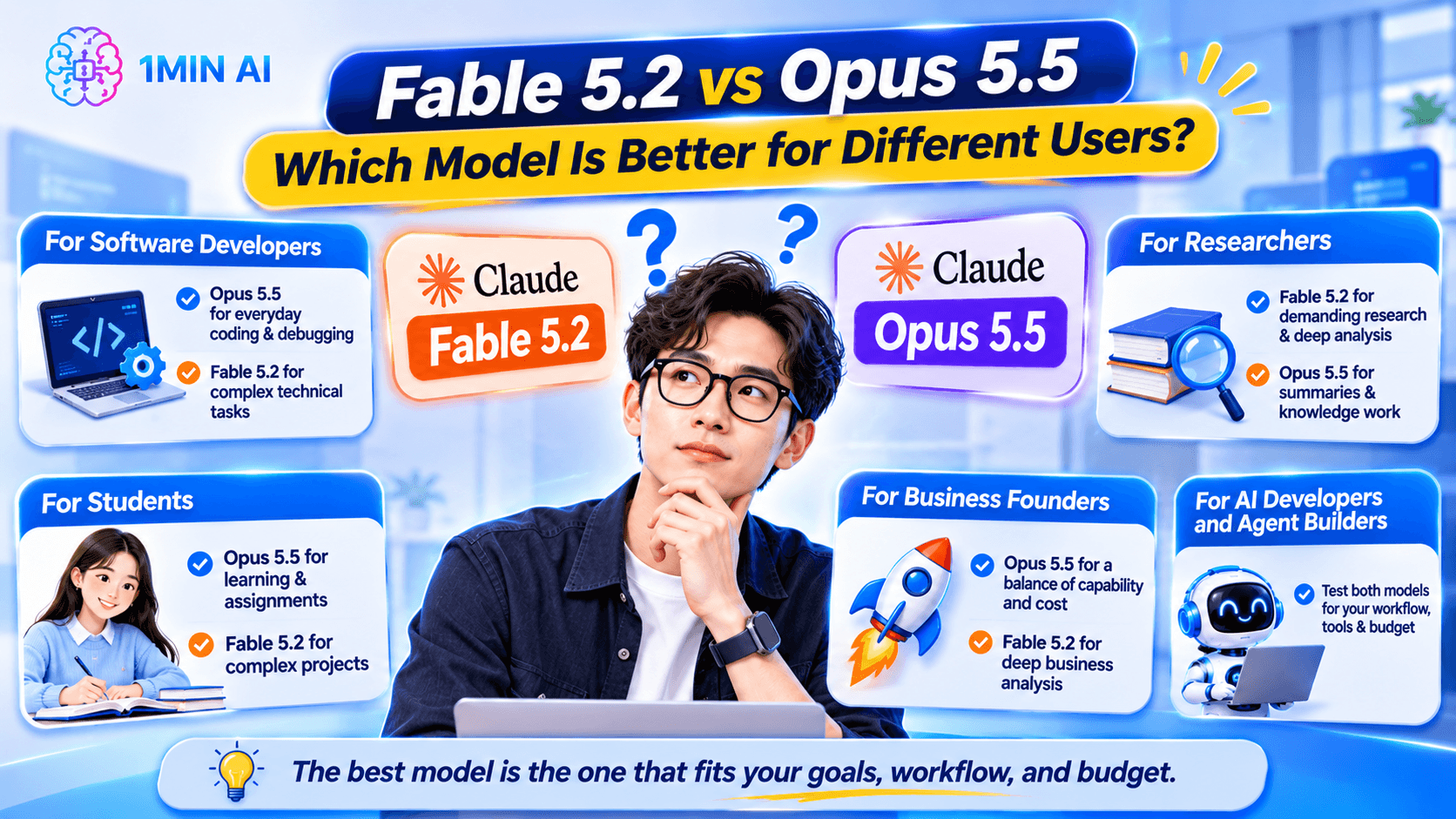
The best model depends on what you want to accomplish.
Here is a practical selection guide.
For software developers
Opus 5.5 is a strong starting point for everyday programming, debugging, and software engineering.
You can move to Fable 5.2 when the task involves particularly difficult reasoning or an extended technical investigation.
For researchers
Fable 5.2 is designed for demanding research workflows involving multiple stages of investigation and extensive analysis.
Opus 5.5 remains suitable for ordinary research, summaries, and knowledge work.
For students
Opus 5.5 can help explain difficult concepts, review assignments, organize research, and support learning.
Fable 5.2 may be worth trying when working on a particularly complex technical or research project.
For business founders
For many business tasks, Opus 5.5 offers a practical balance of capability and cost.
Use Fable 5.2 when you need deeper analysis of complicated business problems or extensive multi-step research.
For AI developers and agent builders
The right choice depends on your agent's workflow, tool requirements, evaluation results, and budget.
Test both models against the same tasks before selecting one for production.
How to Compare Fable 5.2 vs Opus 5.5 on 1minAI
Reading specifications is useful, but testing the models with your own tasks is a better way to understand their differences.
With 1minAI, you can explore available Claude models through Multi AI Chat and compare their responses in one workspace.
Follow these steps.
Step 1: Open 1minAI
Visit 1minAI and access the Multi AI Chat experience.
If you are new to the platform, create an account and review the available credits and usage conditions.
Step 2: Select Claude Fable 5.2
Open the model selector and choose Claude Fable 5.2 if it is available in your account.
You can also visit the dedicated Claude Fable 5.2 page.
Step 3: Select Claude Opus 5.5
Next, choose Claude Opus 5.5.
You can explore it through the relevant Claude Opus 5.5 guide for students.
Step 4: Give both models the same prompt
To make the comparison meaningful, use identical instructions and provide the same supporting information.
For example:
Act as a senior software architect. Review the following application requirements.
Identify architectural risks, recommend an implementation approach, explain important trade-offs, and create a prioritized development roadmap.
Separate confirmed facts from assumptions. Include potential testing requirements.
Requirements:
[Insert your project requirements]
Step 5: Compare the responses
Do not judge the models based only on response length or writing style.
Evaluate them using these criteria:
| Evaluation criteria | What to look for |
|---|---|
| Accuracy | Are the facts and technical recommendations correct? |
| Reasoning | Does the model address the important dependencies? |
| Completeness | Does it cover the full task? |
| Clarity | Is the response easy to understand and use? |
| Practical value | Can you apply the recommendations? |
| Cost efficiency | Is the improvement worth the additional model cost? |
This gives you a more useful comparison than relying on general model rankings.
Try both models on 1minAI: Claude Fable 5.2.
Final Verdict: Should You Choose Fable 5.2 or Opus 5.5?
There is no need to use the most expensive model for every task.
Claude Opus 5.5 is the recommended starting point for most professional workflows. It offers strong capabilities for coding, research, analysis, and knowledge work at half the published per-token price of Fable 5.2.
Claude Fable 5.2 is worth considering when you need particularly demanding reasoning, extensive research, or long-running agentic work that requires a higher capability ceiling.
Here is the final decision guide:
| Your priority | Recommended model |
|---|---|
| Everyday professional work | Opus 5.5 |
| Standard coding and debugging | Opus 5.5 |
| Research and document analysis | Opus 5.5 |
| Demanding multi-step research | Fable 5.2 |
| Particularly complex reasoning | Fable 5.2 |
| Long-horizon agentic work | Fable 5.2 |
| Lower API token costs | Opus 5.5 |
| Highest available capability for demanding tasks | Fable 5.2 |
The best approach is to start with Opus 5.5, evaluate its results, and switch to Fable 5.2 when the task genuinely needs more advanced reasoning.
With 1minAI, you can explore both Claude models through Multi AI Chat and compare their responses using your own prompts.
Ready to test the difference?
Visit 1minAI and explore Claude Fable 5.2 alongside other available AI models.
For more AI capabilities, visit 1minAI Features and try the 1minAI Agent.
Disclaimer: Model specifications, availability, API prices, and platform credit requirements may change. Check Anthropic's official documentation and the current 1minAI interface for the latest details.
- #Information
- #Commerce
Alternatives
Discover the best alternatives to 1minAI and compare features, pricing, and use cases.

1min.AI vs OpenRouter
1min.AI vs. OpenRouter: Compare the ready-to-use AI creation product against the technical API tool. Find out if you need a zero-code creative studio or a coding infrastructure hub.
 Ngoc Hong
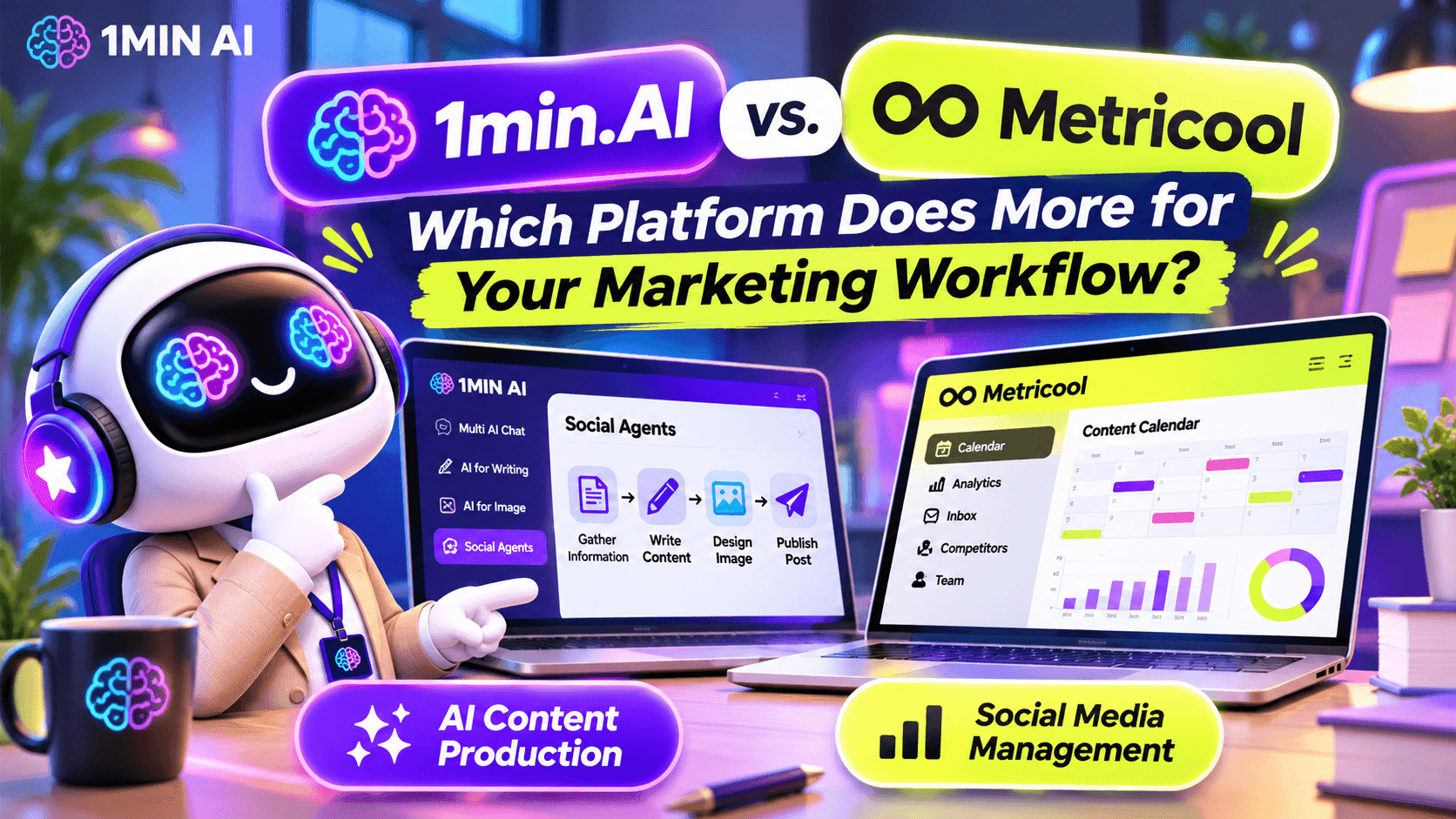
1min.AI vs. Metricool: Which Platform Does More for Your Marketing Workflow?
Compare 1min.AI vs. Metricool across content creation, visual production, scheduling, analytics, MCP, and pricing to find the right platform for your marketing workflow.
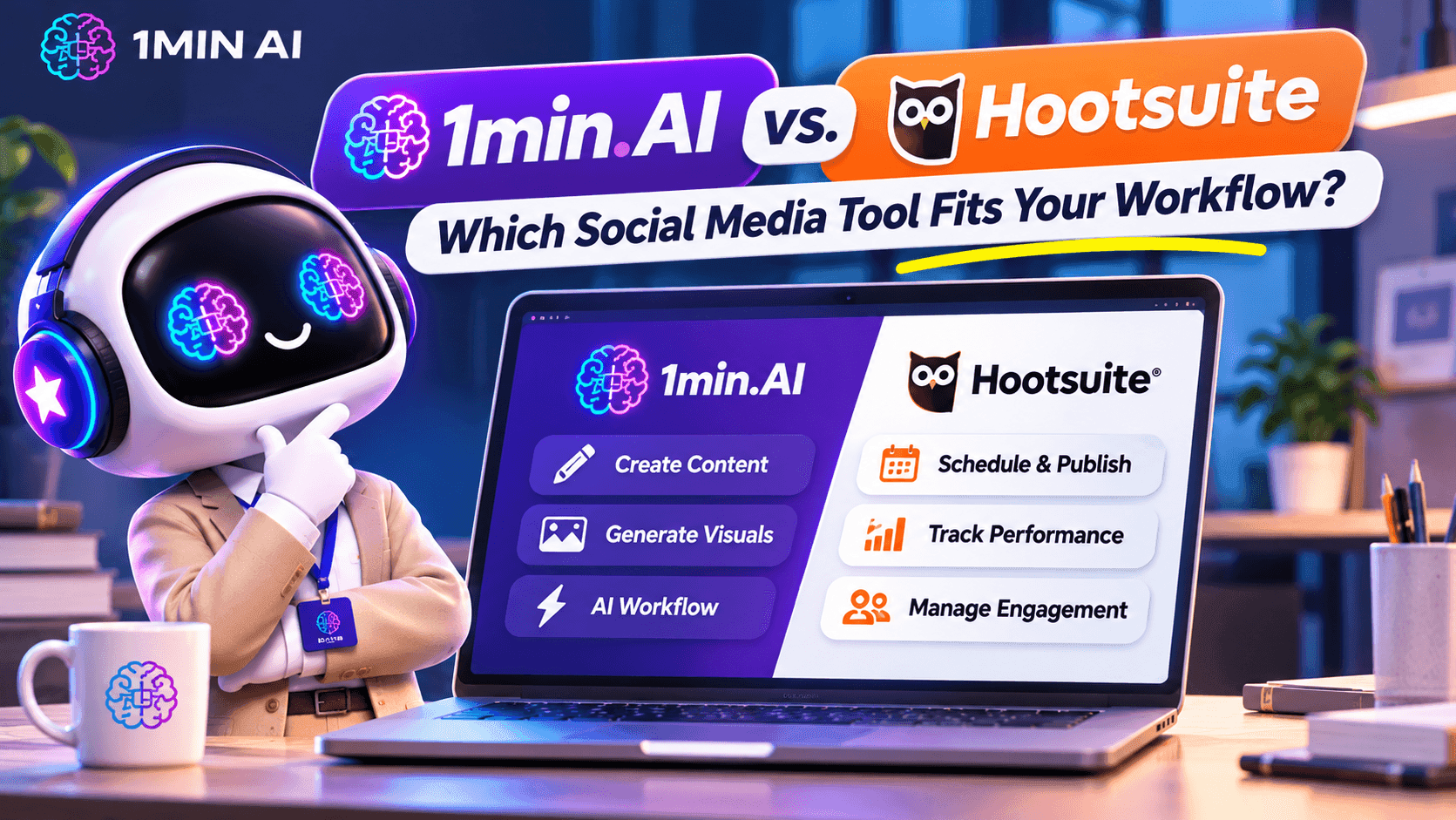
1min.AI vs. Hootsuite: Which Social Media Tool Fits Your Workflow?
Compare 1min.AI vs. Hootsuite to explore their AI content creation, social media publishing, analytics, pricing, and collaboration features. Find the right tool for your workflow.
AI Tools
Discover the best AI tools to boost productivity, creativity, and everyday work.
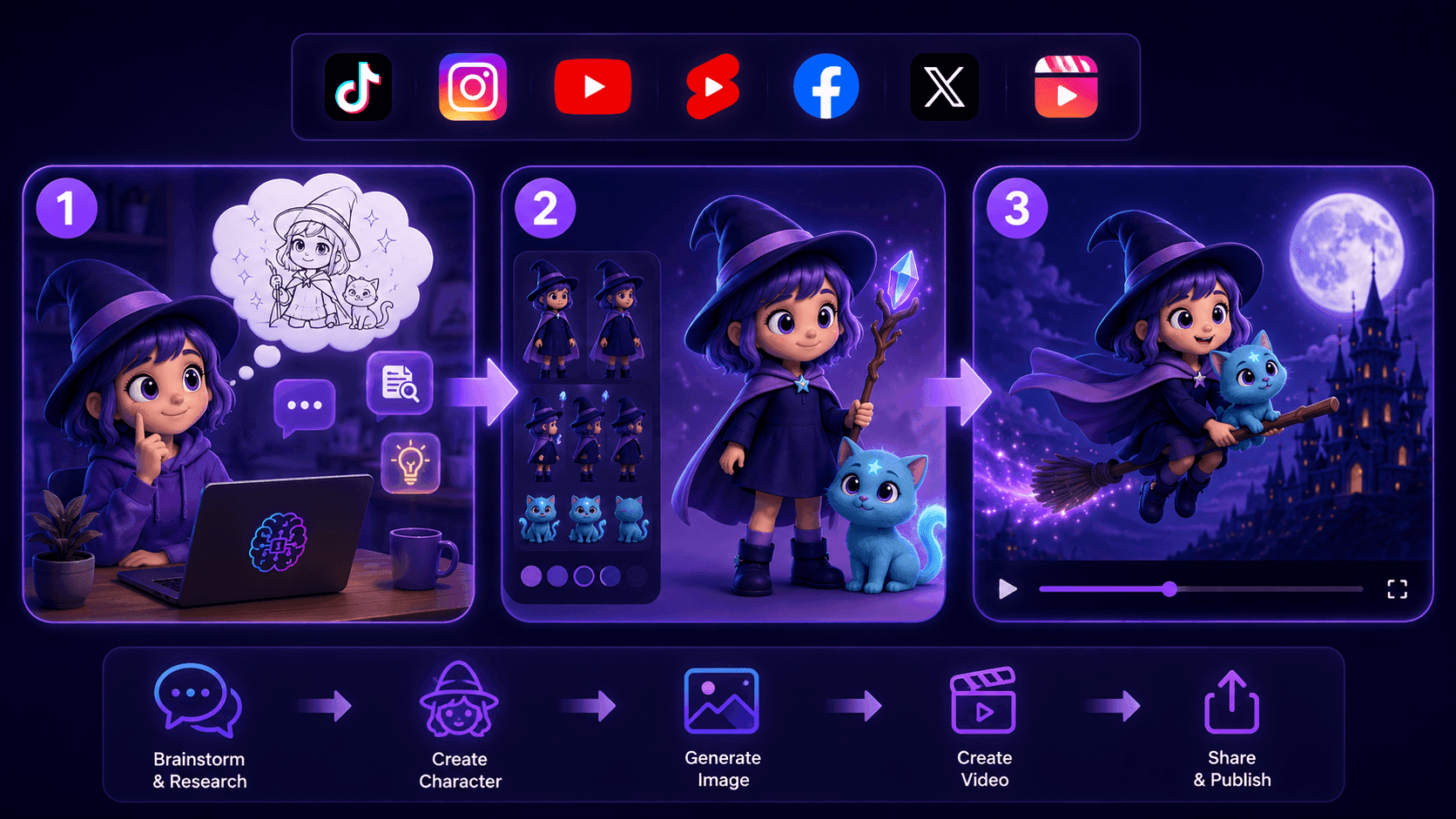
Create Consistent Cartoon Content in Just a Few Steps
Create engaging cartoon videos for TikTok and Reels with 1min.AI. Research ideas, create characters, and turn images into animated videos in 3 simple steps.
 Lien Anh Vu
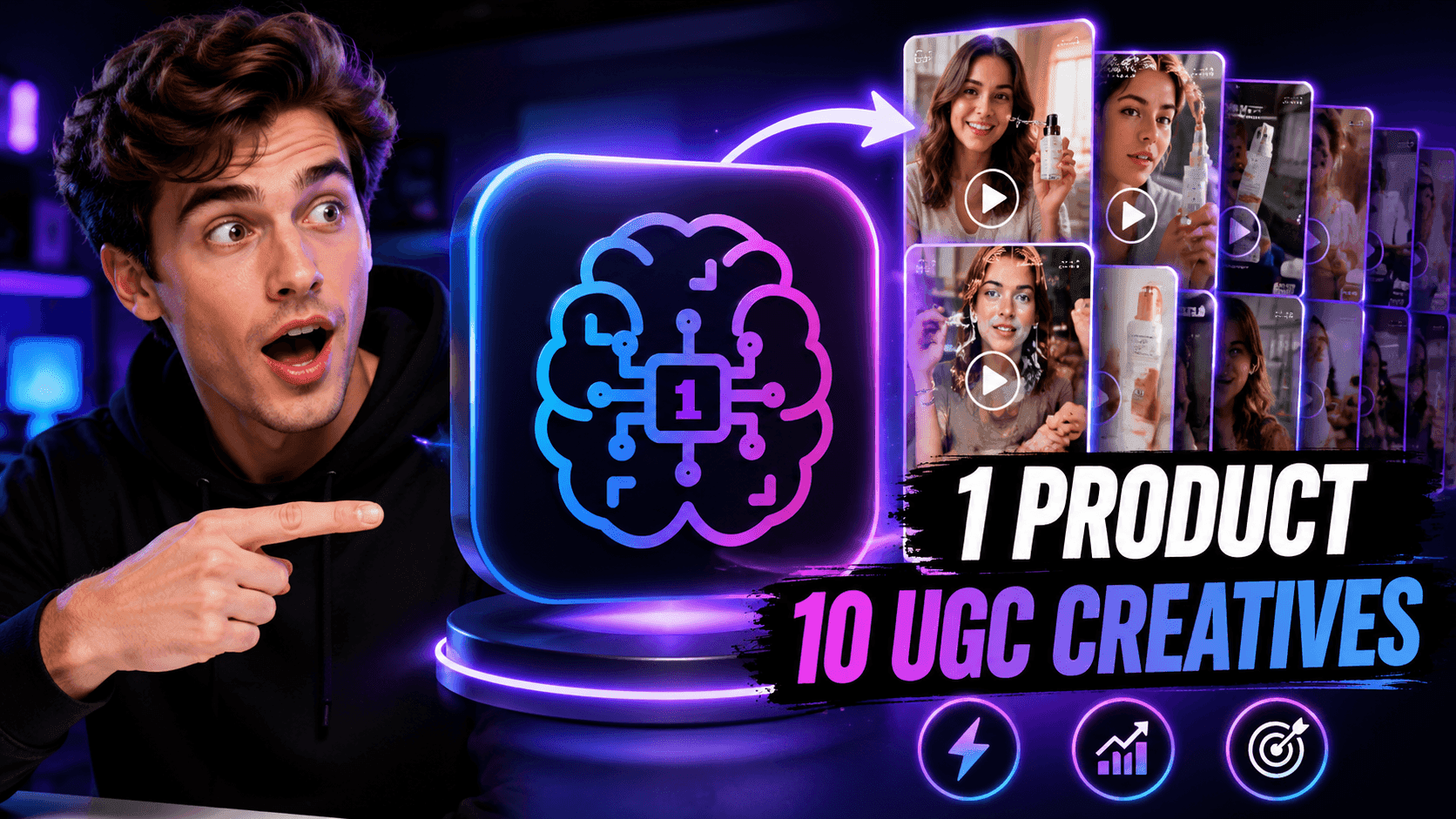
One Product, 10 UGC Creatives: How AI Makes Content Testing Easier
Create more authentic UGC with an AI UGC video generator, test more creative angles and scale affiliate content without filming every version.
Lien Anh Vu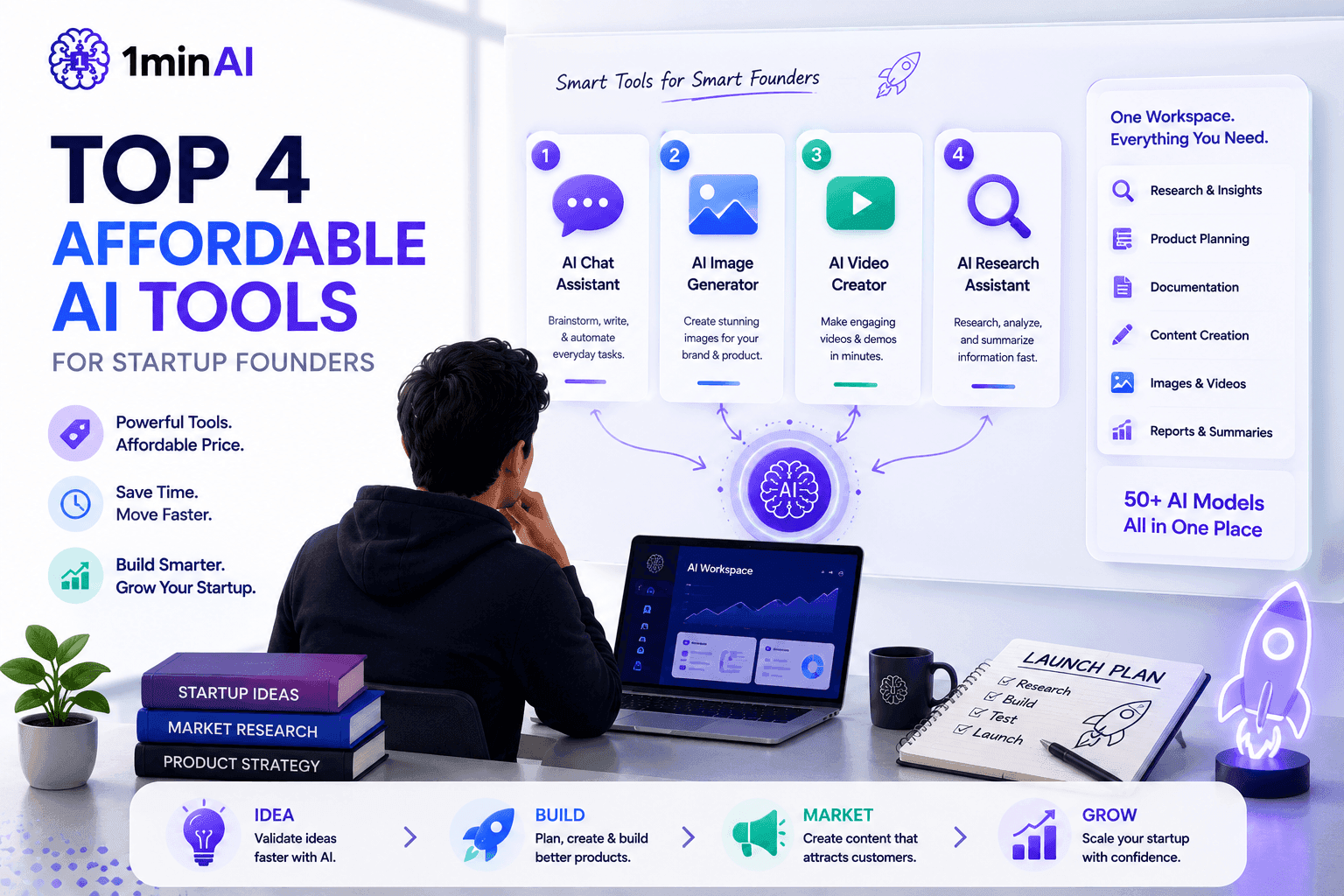
Top 4 Affordable AI Tools for Startup Founders
Discover the top 4 affordable AI tools for startup founders to validate ideas, build products, create content, and launch faster without overspending.
 Tram Ta
AI Features
Comprehensive AI features that streamline workflows, improve efficiency, and empower teams to achieve more.
Create Consistent Cartoon Content in Just a Few Steps
Create engaging cartoon videos for TikTok and Reels with 1min.AI. Research ideas, create characters, and turn images into animated videos in 3 simple steps.
Lien Anh VuOne Product, 10 UGC Creatives: How AI Makes Content Testing Easier
Create more authentic UGC with an AI UGC video generator, test more creative angles and scale affiliate content without filming every version.
Lien Anh Vu
1minAI: Free AI Grammar Checker
Check grammar for free with 1minAI’s AI grammar checker. Find grammar, spelling, and writing mistakes, improve clarity, and polish your content in seconds.
Tram TaAI Use Cases
A curated collection of AI use cases for business, productivity, and industry-specific applications.
Create Consistent Cartoon Content in Just a Few Steps
Create engaging cartoon videos for TikTok and Reels with 1min.AI. Research ideas, create characters, and turn images into animated videos in 3 simple steps.
Lien Anh VuOne Product, 10 UGC Creatives: How AI Makes Content Testing Easier
Create more authentic UGC with an AI UGC video generator, test more creative angles and scale affiliate content without filming every version.
Lien Anh Vu
Best Time to Post on Instagram: A Practical Guide for Better Engagement
Discover the best time to post on Instagram, including the best days and times for different audiences, plus tips to find the ideal posting schedule for your account.
Tram TaAI Tutorials
Learn how to use AI with practical, step-by-step tutorials.

Black Friday AI Tool Deals in 2026
Discover what Black Friday AI tool deals 2026 has to offer. Find out how to secure the 1min.AI lifetime deal via AppSumo, Dealify, Stack Social, and verify on Trustpilot, Slashdot, and Software Advice.
 Hang Nguyen
Create Consistent Cartoon Content in Just a Few Steps
Create engaging cartoon videos for TikTok and Reels with 1min.AI. Research ideas, create characters, and turn images into animated videos in 3 simple steps.
Lien Anh Vu
[Seedance 2.5 New] Better AI Product Videos, Less Rework in 1min.AI
Use Seedance 2.5 image to video on 1min.AI to create more consistent AI product videos, reduce failed generations, save credits, and improve UGC workflows.
Lien Anh VuAI Guides
Learn AI faster with practical guides, real-world examples, and actionable best practices.

Safely Buy AI Tools Online: 2026 Black Friday Guide
Discover how to find and secure the best Black Friday AI deals online. Learn expert strategies to avoid scams, combat subscription fatigue, and verify software.
Hang NguyenCreate Consistent Cartoon Content in Just a Few Steps
Create engaging cartoon videos for TikTok and Reels with 1min.AI. Research ideas, create characters, and turn images into animated videos in 3 simple steps.
Lien Anh Vu[Seedance 2.5 New] Better AI Product Videos, Less Rework in 1min.AI
Use Seedance 2.5 image to video on 1min.AI to create more consistent AI product videos, reduce failed generations, save credits, and improve UGC workflows.
Lien Anh VuAI Solutions
Browse the best AI solutions for automation, coding, research, productivity, customer support, marketing, and business workflows.
Safely Buy AI Tools Online: 2026 Black Friday Guide
Discover how to find and secure the best Black Friday AI deals online. Learn expert strategies to avoid scams, combat subscription fatigue, and verify software.
Hang NguyenCreate Consistent Cartoon Content in Just a Few Steps
Create engaging cartoon videos for TikTok and Reels with 1min.AI. Research ideas, create characters, and turn images into animated videos in 3 simple steps.
Lien Anh VuOne Product, 10 UGC Creatives: How AI Makes Content Testing Easier
Create more authentic UGC with an AI UGC video generator, test more creative angles and scale affiliate content without filming every version.
Lien Anh VuAI Models
Explore the world's leading AI models in one place.
Create Consistent Cartoon Content in Just a Few Steps
Create engaging cartoon videos for TikTok and Reels with 1min.AI. Research ideas, create characters, and turn images into animated videos in 3 simple steps.
Lien Anh VuOne Product, 10 UGC Creatives: How AI Makes Content Testing Easier
Create more authentic UGC with an AI UGC video generator, test more creative angles and scale affiliate content without filming every version.
Lien Anh Vu[Seedance 2.5 New] Better AI Product Videos, Less Rework in 1min.AI
Use Seedance 2.5 image to video on 1min.AI to create more consistent AI product videos, reduce failed generations, save credits, and improve UGC workflows.
Lien Anh VuAI Comparisons
Compare AI tools, models, and platforms to find the best fit for your needs.

Kling AI Vs Veo 3: Which Model Wins?
Kling AI vs Veo 3: compare motion, native audio, pricing & free tiers to see which AI video generator wins for your project - try both on 1min.AI.
 Trang Tran
[Seedance 2.5 New] Better AI Product Videos, Less Rework in 1min.AI
Use Seedance 2.5 image to video on 1min.AI to create more consistent AI product videos, reduce failed generations, save credits, and improve UGC workflows.
Lien Anh Vu
DeepSeek V4 Pro vs Flash Comparison
Compare DeepSeek V4 Pro vs DeepSeek V4 Flash metrics. Optimize your agentic apps and improve AI fact checking on 1min.ai today.
Ngoc HongAI Integrations
Seamlessly integrate AI with the tools you already use to automate work and boost productivity.

POV: You Have 10+ Posts to Make Every Day
Learn how to build an AI content workflow that helps content creators produce 10+ social media posts a day faster with AI brainstorming, image generation, and content creation.
Lien Anh Vu
How to Use an AI Fashion Video Generator for Fashion Week 2026
Turn Fashion Week 2026 ideas into stunning fashion videos with AI. Learn how to brainstorm, create visuals, and transform images into videos with one simple workflow.
Lien Anh Vu
Stop Switching Between AI Apps: How AI Integration Transforms Employer Branding
Discover how AI integration helps HR teams streamline employer branding by combining AI writing, documents, images, video, and multiple AI models into one workspace.
Tram TaAI for Industries
Find the best AI tools and workflows for healthcare, finance, education, legal, manufacturing, retail, real estate, and more

No Photoshoot? Create AI Fashion Videos With Seedance 2.5
No photoshoot needed! Create stunning AI fashion videos with Seedance 2.5 on 1min.AI using outfit references, cinematic prompts, and surreal scenes.
Lien Anh Vu
Voice Cloning AI Free: How to Clone Any Voice Online in Minutes
Try voice cloning AI free with 1min.AI. Upload a 5-second clip, pick an ElevenLabs model, choose from 32 languages, and turn text to speech in your own voice.
Trang Tran
Text To Video AI Free Without Watermark Online
Create text to video AI free without watermark online with 1min.AI. Pick top models, turn prompts into HD clips, and download clean videos fast. Try it free.
Trang TranAI Agents
Discover and run AI agents to automate tasks across your work and daily life.
1minAI: Free AI Grammar Checker
Check grammar for free with 1minAI’s AI grammar checker. Find grammar, spelling, and writing mistakes, improve clarity, and polish your content in seconds.
Tram Ta
AI Agents for Facebook
Use an AI Agent for Facebook to create content, generate images, schedule posts, and publish from your documents and conversations.
Ngoc Hong
AI Agent vs AI Assistant: Which One Actually Saves Designers More Time?
Learn the difference between AI Agent vs AI Assistant and discover which solution helps designers automate repetitive work, reduce revisions, and save more time.
Lien Anh VuAI Workflows
Explore ready-to-use AI workflows for productivity, marketing, sales, support, and more.
Create Consistent Cartoon Content in Just a Few Steps
Create engaging cartoon videos for TikTok and Reels with 1min.AI. Research ideas, create characters, and turn images into animated videos in 3 simple steps.
Lien Anh VuOne Product, 10 UGC Creatives: How AI Makes Content Testing Easier
Create more authentic UGC with an AI UGC video generator, test more creative angles and scale affiliate content without filming every version.
Lien Anh VuPOV: You Have 10+ Posts to Make Every Day
Learn how to build an AI content workflow that helps content creators produce 10+ social media posts a day faster with AI brainstorming, image generation, and content creation.
Lien Anh VuNewsletter
Weekly AI Innovations with 1minAI

🔮 Weekly AI Innovations #146: Mistral 3.5, Qwen Image & Cohere A+ are ready on 1min.ai
Deploy Mistral Large 3, Qwen Image 3.0, and Cohere Command A+ on 1min.ai. Boost RAG accuracy and cut visual generation latency in one unified AI workspace.
Hang Nguyen
🔮 Weekly AI Innovations #145: X Content Agent & GPT 6.1 Terra on 1min.ai
Scale viral reach with the X Content Agent on 1min.ai. Discover an end-to-end 4-stage pipeline with zero token burn, plus the launch of GPT 6.1 Terra.
Hang Nguyen
🔮 Weekly AI Innovations #144: LinkedIn Content Agent: Complete B2B Publishing Pipeline
Scale B2B influence with the LinkedIn Content Agent on 1min.ai. Discover an end-to-end 4-stage pipeline with zero redundant token burn and 1-click publishing.
Hang Nguyen