
5+ Best AI Prompts & Workflows for Content Marketing Tasks

Tram Ta
October 14, 2026
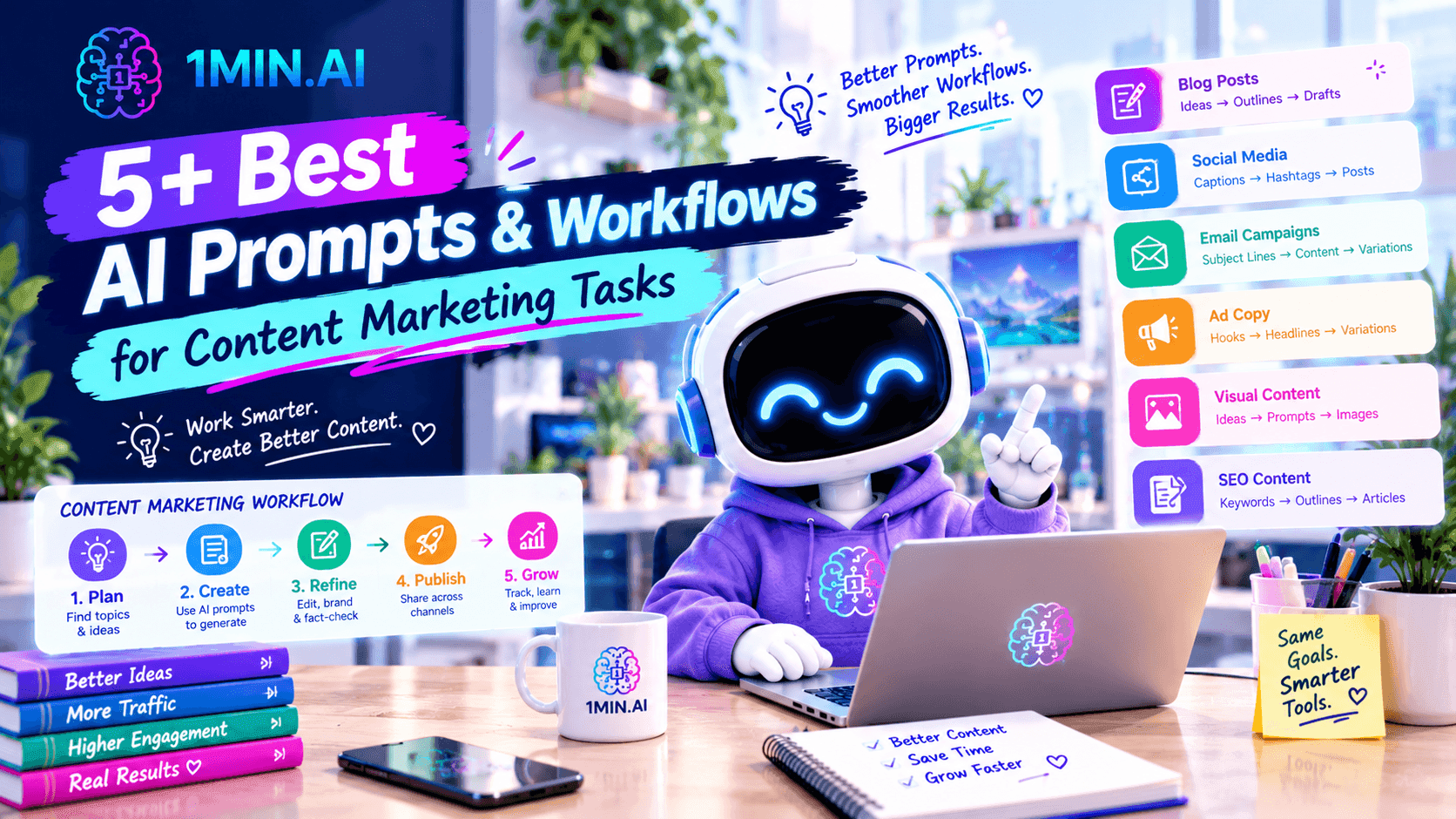
Discover 5+ effective AI prompts and workflows for content marketing, from content ideas and blog writing to social posts, repurposing, and campaign planning.
AI can make content marketing faster, but simply asking an AI chatbot to “write some content” rarely produces the best result. Content marketing involves several connected tasks: researching topics, planning content, writing drafts, optimizing messaging, creating social posts, repurposing existing assets, and maintaining a consistent brand voice.
The better approach is to build repeatable AI prompts and workflows for each stage. Instead of using AI as a one-click content generator, think of it as a production assistant that helps you move from:
Idea → Research → Draft → Edit → Repurpose → Distribute
Below are five practical AI workflows and prompts you can adapt for blogs, social media, email marketing, SEO content, and other content marketing tasks.
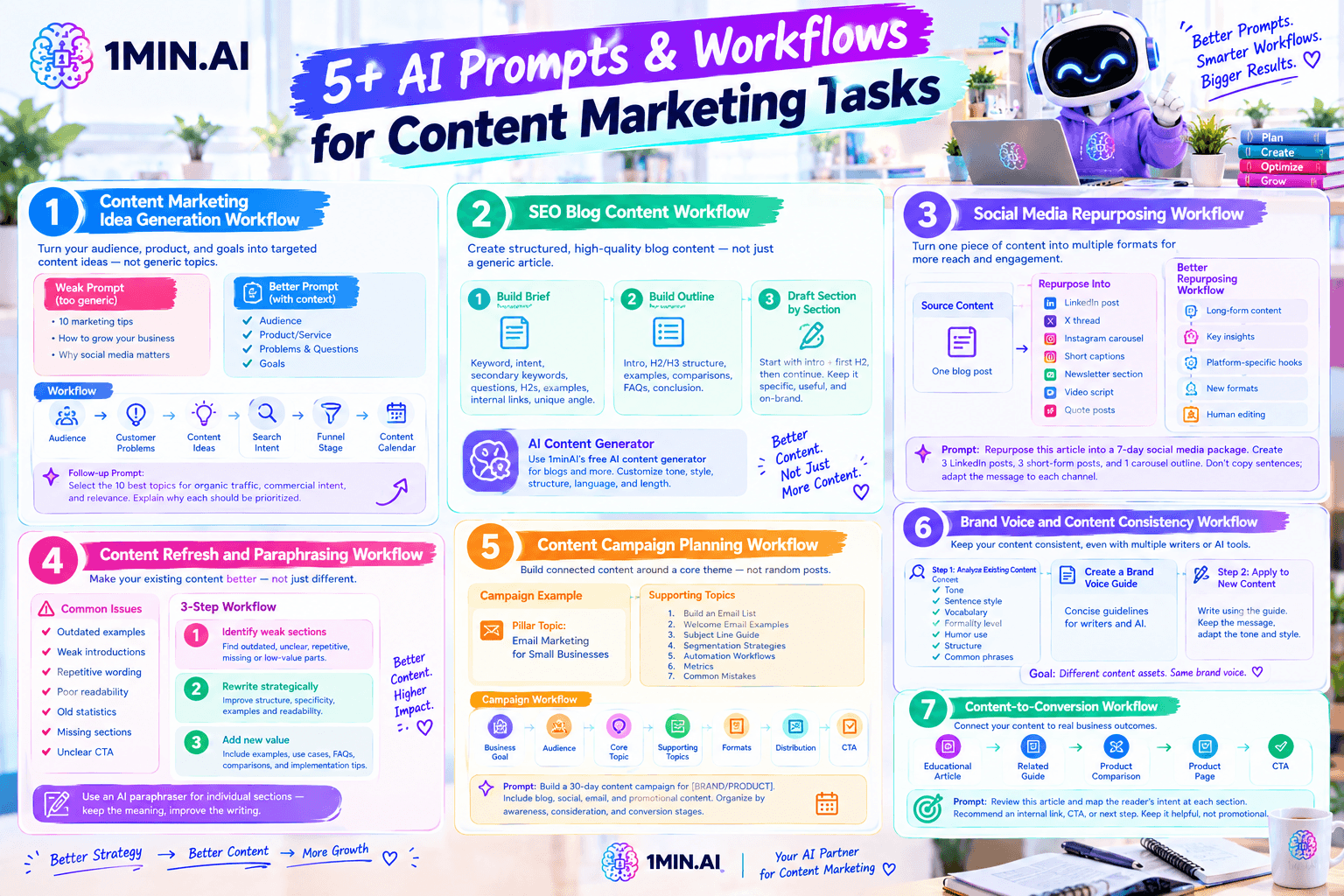
1. Content Marketing Idea Generation Workflow
One of the hardest parts of content marketing is deciding what to create next.
A weak brainstorming prompt produces generic topics such as:
- “10 marketing tips”
- “How to grow your business”
- “Why social media matters”
These topics are broad and often difficult to differentiate.
A better prompt gives AI information about your audience, product, customer problem, and content goal.
Prompt:
You are a content strategist for [BUSINESS/BRAND]. Our target audience is [AUDIENCE]. We sell [PRODUCT/SERVICE]. Generate 20 content marketing ideas based on the problems, questions, objections, and goals of this audience. Divide the ideas into educational, problem-solving, comparison, commercial, and thought-leadership topics. For each idea, provide a suggested title, search intent, target keyword, funnel stage, and recommended content format.
Workflow
Audience → Customer problems → Content ideas → Search intent → Funnel stage → Content calendar
This workflow is more useful than simply asking AI for “blog ideas” because it connects each idea to a business purpose.
You can also ask a second AI prompt to prioritize the ideas:
From the content ideas above, select the 10 topics with the strongest potential for organic traffic, commercial intent, and relevance to our product. Explain why each topic should be prioritized.
This gives you a starting point for an actual content strategy rather than a random list.
2. SEO Blog Content Workflow
Once you have selected a topic, AI can help structure the article before you write it.
The mistake is to immediately ask:
“Write a 2,000-word SEO article about [TOPIC].”
That often produces generic content.
Instead, separate the process into stages.
Step 1: Build the brief
Prompt:
Create an SEO content brief for the keyword “[KEYWORD].” Identify the primary search intent, likely secondary keywords, questions users want answered, recommended H2 sections, useful examples, potential internal-link opportunities, and a unique angle that would differentiate this article from competing content.
Step 2: Build the outline
Create a detailed outline for an article targeting “[KEYWORD].” The article should satisfy [SEARCH INTENT]. Include an introduction, H2/H3 structure, practical examples, comparison points where relevant, FAQs, and a conclusion. Avoid repetitive sections and generic filler.
Step 3: Draft section by section
Instead of generating the entire article in one prompt:
Write the introduction and the first H2 from this outline. Keep the writing practical, specific, and beginner-friendly. Use examples where they make the concept easier to understand.
Then continue section by section.
This approach gives you more control over:
- Accuracy
- Search intent
- Brand voice
- Internal links
- Content depth
- Repetition
A dedicated Free AI Content Generator can also accelerate the drafting stage with templates for blogs and other marketing formats. 1minAI currently supports multiple content types and customization for tone, style, structure, language, and length.
3. Social Media Repurposing Workflow
Creating one excellent article is only half the job.
The next challenge is getting more value from it.
A 2,000-word article may contain dozens of ideas that can become social content.
Source content
One blog post
Repurpose into
- LinkedIn post
- X thread
- Instagram carousel
- Short social captions
- Newsletter section
- Video script
- Quote posts
Prompt:
Repurpose the following article into a 7-day social media content package. Create 3 LinkedIn posts, 3 short-form social posts, and 1 carousel outline. Each asset should communicate a different insight from the original article. Do not simply copy sentences from the source. Preserve the original message while adapting the hook, structure, and length for each format. Here is the article: [PASTE CONTENT]
The important instruction is:
“Do not simply copy sentences from the source.”
Repurposing should adapt content to the channel, not duplicate it everywhere.
1minAI's AI content repurposing tool is designed around this workflow, turning one source into multiple content formats for different channels. The current tool supports sources such as blog posts, scripts, transcripts, and other written content.
Better repurposing workflow
Long-form content → Key insights → Platform-specific hooks → New formats → Human editing
This can help a small marketing team create more content without continuously starting from a blank page.
4. Content Refresh and Paraphrasing Workflow
Not every content marketing task requires a new article.
Sometimes the best opportunity is improving something you already published.
An old article might have:
- Outdated examples
- Weak introductions
- Repetitive wording
- Poor readability
- Old statistics
- Missing sections
- An unclear CTA
AI can help identify and rewrite weak sections, but you should not blindly paraphrase an old article and republish it as “new.”
Instead, use a content-refresh workflow.
Step 1: Identify weak sections
Prompt:
Review the following article and identify sections that are outdated, repetitive, unclear, too generic, or missing useful information. Create a table with the section, problem, recommended improvement, and priority.
Step 2: Rewrite strategically
Rewrite the following section to make it clearer and more useful for [TARGET AUDIENCE]. Preserve the factual meaning but improve the structure, specificity, examples, and readability. Avoid adding unsupported claims.
Step 3: Add new value
Suggest five useful additions that would make this article more comprehensive for someone searching for “[KEYWORD].” Prioritize practical examples, current use cases, FAQs, comparisons, and implementation advice.
For rewriting individual passages, you can also use an AI writing content paraphraser as part of the editing workflow.
The objective should be better content, not simply different wording.
5. Content Campaign Planning Workflow
Content marketing works better when individual pieces connect to a larger campaign.
Instead of publishing unrelated articles every week, build content around a core theme.
For example, suppose a SaaS company wants to promote an email marketing product.
The campaign could include:
Pillar topic: Email Marketing for Small Businesses
Then supporting content:
- How to Build an Email List
- Welcome Email Examples
- Email Subject Line Guide
- Email Segmentation Strategies
- Email Automation Workflows
- Email Marketing Metrics
- Common Email Marketing Mistakes
You can ask AI to organize the campaign.
Prompt:
Build a 30-day content marketing campaign for [BRAND/PRODUCT]. Our target audience is [AUDIENCE], and our main business goal is [GOAL]. Create a content calendar covering blog posts, social media, email, and promotional content. Organize the content into awareness, consideration, and conversion stages. Make sure each piece supports the same campaign theme without repeating the same topic.
Campaign workflow
Business goal → Audience → Core topic → Supporting topics → Content formats → Distribution → CTA
This makes AI more useful for strategy rather than only content production.
6. Brand Voice and Content Consistency Workflow
If multiple people or AI tools create content, maintaining a consistent brand voice can become difficult.
One article might sound professional.
Another might sound overly casual.
A third might use completely different terminology.
You can use a brand voice prompt to establish reusable guidelines.
Prompt:
Analyze the following examples of our existing brand content. Identify our tone, sentence style, vocabulary, level of formality, use of humor, preferred structure, and words or phrases we frequently use. Create a concise brand voice guide that another writer or AI model can follow. Do not invent characteristics that are not supported by the examples.
Then use the resulting guide:
Write the following content using this brand voice guide. Keep the information unchanged, but adapt the wording, tone, sentence structure, and terminology to match the brand. Avoid sounding overly promotional.
This is particularly useful when creating large amounts of AI-assisted content.
The goal is not to make every sentence identical.
The goal is to make different content assets feel as though they belong to the same brand.
7. Content-to-Conversion Workflow
Content marketing should eventually support a business objective.
That does not mean every article should aggressively sell something.
Instead, connect the content to an appropriate next step.
For example:
Educational article → Related guide → Product comparison → Product page → CTA
You can ask AI to map the journey.
Prompt:
Review this article and identify the reader's likely intent at each major section. Recommend one relevant internal link, CTA, lead magnet, or next-step action for each section. Keep recommendations helpful and contextually relevant rather than promotional.
This can help content teams connect SEO traffic with business outcomes.
Why Use an AI Tool for Content Marketing Instead of Chat Alone?
A general AI chatbot is useful, but content marketing often involves repeated specialized tasks.
You may need to generate a blog, rewrite a paragraph, create social posts, repurpose an article, produce visuals, and prepare an email campaign.
Doing all of this through separate chat prompts can become repetitive.
An all-in-one platform can reduce that friction.
For example, 1minAI's all-in-one AI workspace for content creators combines writing, image creation, video, repurposing, and other content workflows in one environment.
That means your workflow can move from:
Prompt → Content → Visual → Repurposing → Distribution
without requiring a completely different AI platform for every step.
Final Takeaway
The best way to use AI for content marketing is not to ask it to “create everything.”
Use AI where it creates leverage.
Let it help you:
- Generate ideas faster
- Build content briefs
- Create first drafts
- Rewrite weak sections
- Adapt content for different audiences
- Repurpose existing assets
- Plan campaigns
- Maintain consistent messaging
Then add the parts that make the content genuinely valuable: human expertise, original insights, real examples, accurate information, customer knowledge, and editorial judgment.
If you want to go beyond individual prompts, start by building one repeatable workflow—for example:
Content idea → SEO brief → Article → Social posts → Newsletter → Repurposed assets
Once that workflow works, you can repeat and improve it across your entire content marketing strategy.
For further information, explore AI tools for content creators
Discover more AI features: https://1min.ai/features
Try 1minAI agent now: https://app.1min.ai/ai-agent-demo
- #Information
Alternatives
Discover the best alternatives to 1minAI and compare features, pricing, and use cases.

1min.AI vs OpenRouter
1min.AI vs. OpenRouter: Compare the ready-to-use AI creation product against the technical API tool. Find out if you need a zero-code creative studio or a coding infrastructure hub.
 Ngoc Hong
1min.AI vs Jarvis AI
Compare 1min.AI vs Jarvis AI to discover which AI platform is better for writing, research, automation, and content creation. Find the best AI assistant for your workflow.
Ngoc Hong
1min.AI vs Taskade
Compare 1min.AI vs Taskade for AI content creation, automation, agents, and creative workflows to find the right workspace.
Ngoc HongAI Tools
Discover the best AI tools to boost productivity, creativity, and everyday work.
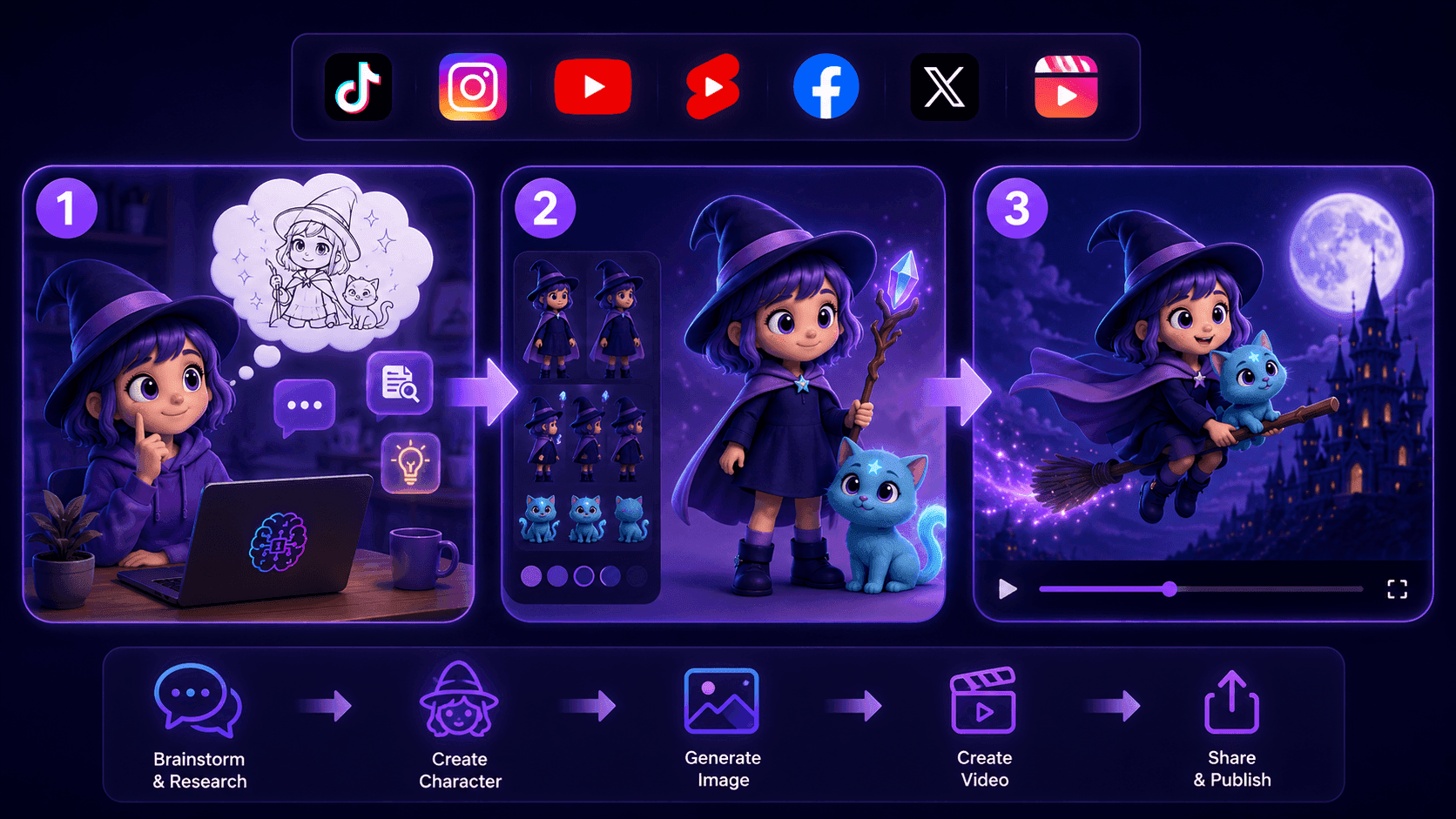
Create Consistent Cartoon Content in Just a Few Steps
Create engaging cartoon videos for TikTok and Reels with 1min.AI. Research ideas, create characters, and turn images into animated videos in 3 simple steps.
 Lien Anh Vu
One Product, 10 UGC Creatives: How AI Makes Content Testing Easier
Create more authentic UGC with an AI UGC video generator, test more creative angles and scale affiliate content without filming every version.
Lien Anh Vu
Top 4 Affordable AI Tools for Startup Founders
Discover the top 4 affordable AI tools for startup founders to validate ideas, build products, create content, and launch faster without overspending.
 Tram Ta
AI Features
Comprehensive AI features that streamline workflows, improve efficiency, and empower teams to achieve more.
Create Consistent Cartoon Content in Just a Few Steps
Create engaging cartoon videos for TikTok and Reels with 1min.AI. Research ideas, create characters, and turn images into animated videos in 3 simple steps.
Lien Anh VuOne Product, 10 UGC Creatives: How AI Makes Content Testing Easier
Create more authentic UGC with an AI UGC video generator, test more creative angles and scale affiliate content without filming every version.
Lien Anh Vu
1minAI: Free AI Grammar Checker
Check grammar for free with 1minAI’s AI grammar checker. Find grammar, spelling, and writing mistakes, improve clarity, and polish your content in seconds.
Tram TaAI Use Cases
A curated collection of AI use cases for business, productivity, and industry-specific applications.
Create Consistent Cartoon Content in Just a Few Steps
Create engaging cartoon videos for TikTok and Reels with 1min.AI. Research ideas, create characters, and turn images into animated videos in 3 simple steps.
Lien Anh VuOne Product, 10 UGC Creatives: How AI Makes Content Testing Easier
Create more authentic UGC with an AI UGC video generator, test more creative angles and scale affiliate content without filming every version.
Lien Anh Vu
Best Time to Post on Instagram: A Practical Guide for Better Engagement
Discover the best time to post on Instagram, including the best days and times for different audiences, plus tips to find the ideal posting schedule for your account.
Tram TaAI Tutorials
Learn how to use AI with practical, step-by-step tutorials.

Black Friday AI Tool Deals in 2026
Discover what Black Friday AI tool deals 2026 has to offer. Find out how to secure the 1min.AI lifetime deal via AppSumo, Dealify, Stack Social, and verify on Trustpilot, Slashdot, and Software Advice.
 Hang Nguyen
Create Consistent Cartoon Content in Just a Few Steps
Create engaging cartoon videos for TikTok and Reels with 1min.AI. Research ideas, create characters, and turn images into animated videos in 3 simple steps.
Lien Anh Vu
[Seedance 2.5 New] Better AI Product Videos, Less Rework in 1min.AI
Use Seedance 2.5 image to video on 1min.AI to create more consistent AI product videos, reduce failed generations, save credits, and improve UGC workflows.
Lien Anh VuAI Guides
Learn AI faster with practical guides, real-world examples, and actionable best practices.

Safely Buy AI Tools Online: 2026 Black Friday Guide
Discover how to find and secure the best Black Friday AI deals online. Learn expert strategies to avoid scams, combat subscription fatigue, and verify software.
Hang NguyenCreate Consistent Cartoon Content in Just a Few Steps
Create engaging cartoon videos for TikTok and Reels with 1min.AI. Research ideas, create characters, and turn images into animated videos in 3 simple steps.
Lien Anh Vu[Seedance 2.5 New] Better AI Product Videos, Less Rework in 1min.AI
Use Seedance 2.5 image to video on 1min.AI to create more consistent AI product videos, reduce failed generations, save credits, and improve UGC workflows.
Lien Anh VuAI Solutions
Browse the best AI solutions for automation, coding, research, productivity, customer support, marketing, and business workflows.
Safely Buy AI Tools Online: 2026 Black Friday Guide
Discover how to find and secure the best Black Friday AI deals online. Learn expert strategies to avoid scams, combat subscription fatigue, and verify software.
Hang NguyenCreate Consistent Cartoon Content in Just a Few Steps
Create engaging cartoon videos for TikTok and Reels with 1min.AI. Research ideas, create characters, and turn images into animated videos in 3 simple steps.
Lien Anh VuOne Product, 10 UGC Creatives: How AI Makes Content Testing Easier
Create more authentic UGC with an AI UGC video generator, test more creative angles and scale affiliate content without filming every version.
Lien Anh VuAI Models
Explore the world's leading AI models in one place.
Create Consistent Cartoon Content in Just a Few Steps
Create engaging cartoon videos for TikTok and Reels with 1min.AI. Research ideas, create characters, and turn images into animated videos in 3 simple steps.
Lien Anh VuOne Product, 10 UGC Creatives: How AI Makes Content Testing Easier
Create more authentic UGC with an AI UGC video generator, test more creative angles and scale affiliate content without filming every version.
Lien Anh Vu[Seedance 2.5 New] Better AI Product Videos, Less Rework in 1min.AI
Use Seedance 2.5 image to video on 1min.AI to create more consistent AI product videos, reduce failed generations, save credits, and improve UGC workflows.
Lien Anh VuAI Comparisons
Compare AI tools, models, and platforms to find the best fit for your needs.

Kling AI Vs Veo 3: Which Model Wins?
Kling AI vs Veo 3: compare motion, native audio, pricing & free tiers to see which AI video generator wins for your project - try both on 1min.AI.
 Trang Tran
[Seedance 2.5 New] Better AI Product Videos, Less Rework in 1min.AI
Use Seedance 2.5 image to video on 1min.AI to create more consistent AI product videos, reduce failed generations, save credits, and improve UGC workflows.
Lien Anh Vu
DeepSeek V4 Pro vs Flash Comparison
Compare DeepSeek V4 Pro vs DeepSeek V4 Flash metrics. Optimize your agentic apps and improve AI fact checking on 1min.ai today.
Ngoc HongAI Integrations
Seamlessly integrate AI with the tools you already use to automate work and boost productivity.
POV: You Have 10+ Posts to Make Every Day
Learn how to build an AI content workflow that helps content creators produce 10+ social media posts a day faster with AI brainstorming, image generation, and content creation.
Lien Anh Vu
How to Use an AI Fashion Video Generator for Fashion Week 2026
Turn Fashion Week 2026 ideas into stunning fashion videos with AI. Learn how to brainstorm, create visuals, and transform images into videos with one simple workflow.
Lien Anh Vu
Stop Switching Between AI Apps: How AI Integration Transforms Employer Branding
Discover how AI integration helps HR teams streamline employer branding by combining AI writing, documents, images, video, and multiple AI models into one workspace.
Tram TaAI for Industries
Find the best AI tools and workflows for healthcare, finance, education, legal, manufacturing, retail, real estate, and more
Best Business Productivity Tools for Startups to Maximize Profits | 1minAI
Discover the best business productivity tools for startups to save time, streamline workflows, reduce repetitive tasks, and support profitable growth with AI.
Tram Ta
Best AI Tool for Content Marketing |1minAI
Looking for the best AI tool for content marketing? See how 1minAI helps marketers research, write, repurpose, create visuals, and scale content from one AI workspace.
Tram Ta
7 Low-Cost AI Business Ideas for Your Startup
Explore 7 low-cost AI business ideas you can start with a small budget, from content and video services to AI consulting, reselling, and automation.
Tram TaAI Agents
Discover and run AI agents to automate tasks across your work and daily life.
1minAI: Free AI Grammar Checker
Check grammar for free with 1minAI’s AI grammar checker. Find grammar, spelling, and writing mistakes, improve clarity, and polish your content in seconds.
Tram Ta
AI Agents for Facebook
Use an AI Agent for Facebook to create content, generate images, schedule posts, and publish from your documents and conversations.
Ngoc Hong
AI Agent vs AI Assistant: Which One Actually Saves Designers More Time?
Learn the difference between AI Agent vs AI Assistant and discover which solution helps designers automate repetitive work, reduce revisions, and save more time.
Lien Anh VuAI Workflows
Explore ready-to-use AI workflows for productivity, marketing, sales, support, and more.
Create Consistent Cartoon Content in Just a Few Steps
Create engaging cartoon videos for TikTok and Reels with 1min.AI. Research ideas, create characters, and turn images into animated videos in 3 simple steps.
Lien Anh VuOne Product, 10 UGC Creatives: How AI Makes Content Testing Easier
Create more authentic UGC with an AI UGC video generator, test more creative angles and scale affiliate content without filming every version.
Lien Anh VuPOV: You Have 10+ Posts to Make Every Day
Learn how to build an AI content workflow that helps content creators produce 10+ social media posts a day faster with AI brainstorming, image generation, and content creation.
Lien Anh VuNewsletter
Weekly AI Innovations with 1minAI

🔮 Weekly AI Innovations #141: Seedance 2.5 & Stable Audio 3: Next-Gen AI
Explore Seedance 2.0, 2.5, and StabilityAI's Stable Audio 3 on 1min.ai. Generate studio-grade audio and synchronized motion with next-gen generative AI.
Hang Nguyen
🔮 Weekly AI Innovations #140: Deepseek 4.1 Flash & Gemini Upgrades
Explore Deepseek 4.1 Flash and new Gemini models on 1min.ai. Plus, check our update on your Billing - Usage page for better clarity.
Hang Nguyen
🔮 Weekly AI Innovations #139: Dawn of the next-gen AI
Discover the immense power of GPT-6 Astra and Claude Fable 5.1. Unlock next-generation AI models on 1min.ai to solve complex tasks effortlessly.
Hang Nguyen