
Top Influencer Marketing Trends in the Beauty Industry 2026

Tram Ta
October 15, 2026
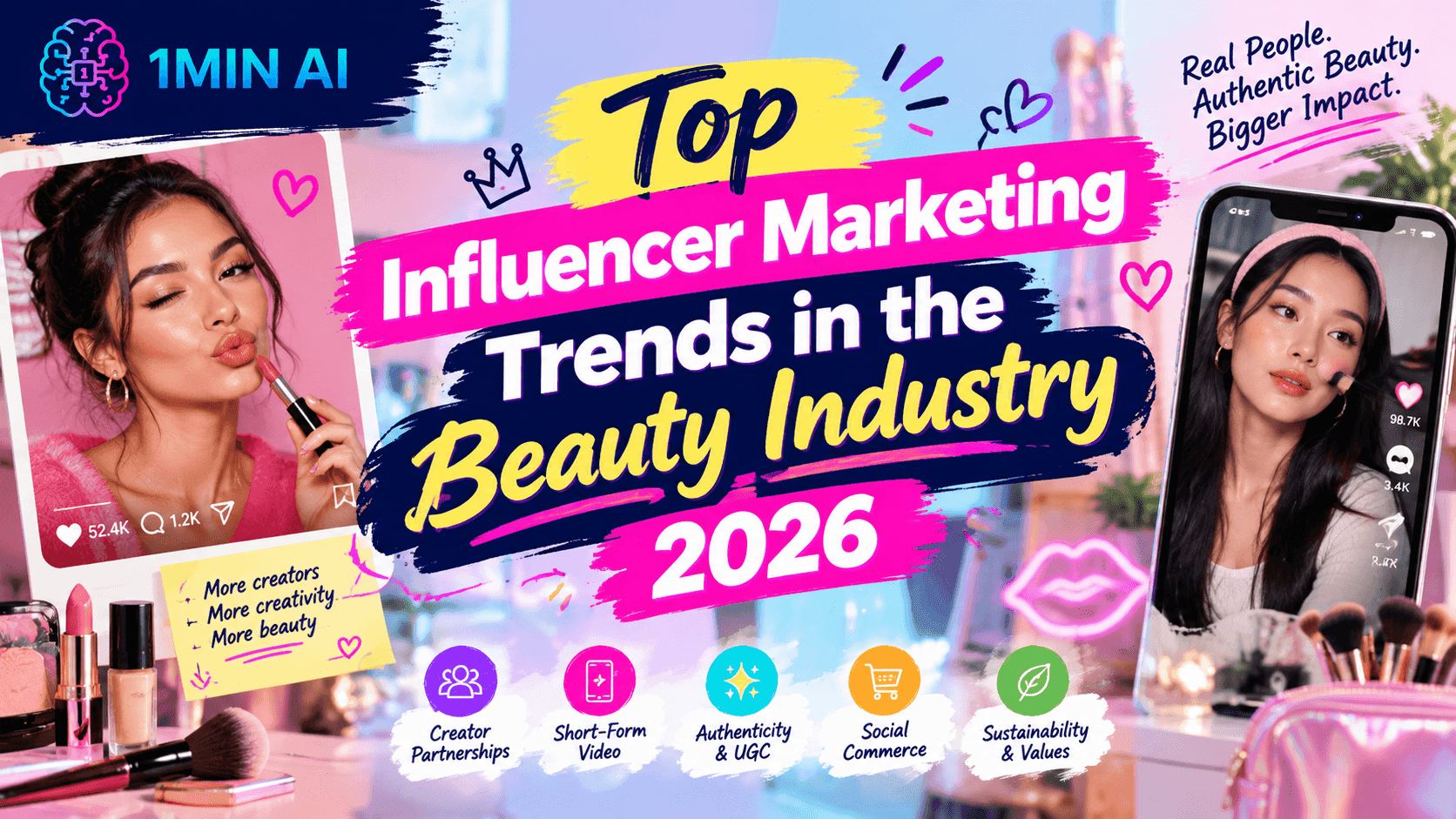
Explore the top influencer marketing trends in beauty for 2026, from skincare creators and TikTok Shop to authentic reviews, AI video, and creator partnerships.
Influencer marketing has become an important part of how beauty consumers discover products, learn about ingredients, compare routines, and decide what to buy. From skincare demonstrations to makeup tutorials, creators can show products in ways that traditional advertisements often cannot.
In 2026, beauty influencer marketing is evolving beyond sponsored posts and celebrity endorsements. Brands are exploring smaller creator communities, more educational content, social commerce, long-term partnerships, and AI-assisted production workflows. For beauty brands, the goal is not simply to get a product mentioned by a popular creator. It is to build trust, help consumers understand the product, and connect content performance with meaningful business outcomes.
Here are seven influencer marketing trends beauty brands should understand and how to apply them.
1. Micro-Influencers and Niche Beauty Creators
One of the most important influencer marketing trends is the continued focus on creators with specific audiences rather than follower count alone.
A creator with a smaller but engaged skincare audience may be a better fit for a sensitive-skin product than a celebrity whose followers have broad interests. Similarly, a makeup artist who specializes in mature skin, bridal makeup, or affordable cosmetics can offer expertise that is directly relevant to a particular customer group.
Beauty brands can explore creators in niches such as:
- Skincare routines and ingredient education
- Makeup tutorials for specific skin tones
- Affordable beauty and product comparisons
- Hair care and scalp care
- Fragrance reviews
- Dermatology-informed skincare education
- Minimalist routines and beauty for beginners
How brands can use this trend
Start by defining the customer you want to reach. Then evaluate creators based on audience relevance, content quality, engagement quality, and their history of discussing similar products.
Rather than selecting creators exclusively by follower count, test a small group of suitable partners. Compare performance before expanding the campaign.
For example, a sunscreen brand might work with creators who regularly explain sunscreen application, texture, and reapplication. Their content can answer practical questions that help potential customers evaluate the product.
Smaller creators are not automatically more effective, however. Results depend on audience fit, creative quality, product relevance, and campaign execution.
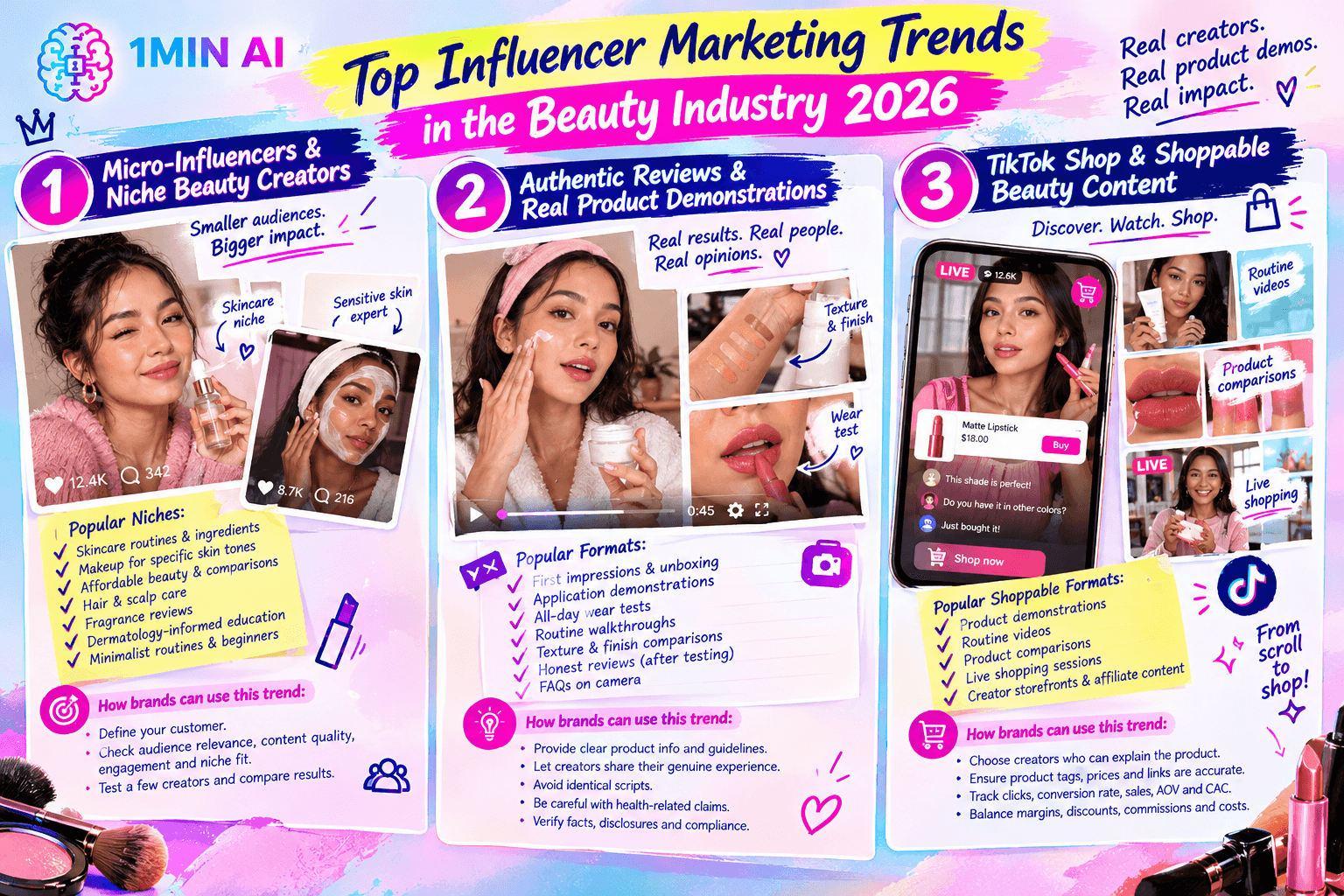
2. Authentic Reviews and Real Product Demonstrations
Beauty products are highly visual, but polished advertisements do not always answer the questions consumers have before buying.
Shoppers may want to see how a foundation blends, how a moisturizer feels under makeup, how a lipstick looks in natural light, or how a hair product performs on a particular hair type.
This creates opportunities for creator-led demonstrations that prioritize useful information over scripted praise.
Popular formats include:
- First impressions and unboxing videos
- Product application demonstrations
- Wear tests throughout the day
- Routine walkthroughs
- Texture and finish comparisons
- Honest reviews after a suitable testing period
- Frequently asked questions answered on camera
How brands can use this trend
Give creators clear information about the product, its intended audience, approved claims, and important usage instructions. Let them explain their genuine experience in their own voice.
Avoid demanding identical scripts from every creator. If all sponsored videos sound the same, audiences may find them less useful or less credible.
For skincare, be especially careful with claims about acne, pigmentation, anti-aging, or other health-related outcomes. Do not encourage creators to promise results that have not been substantiated.
Authenticity does not mean leaving content unreviewed. Brands should still verify factual claims, sponsorship disclosures, and compliance with relevant advertising rules.
3. TikTok Shop and Shoppable Beauty Content
Influencer marketing is increasingly connected to the shopping experience. Instead of watching a video, leaving the app, searching for the product, and then completing a purchase elsewhere, consumers may be able to discover and buy products within a social platform.
McKinsey's 2026 beauty industry analysis identifies shoppable video as a major part of US TikTok beauty sales, with live shopping also contributing to the channel.
For beauty brands, this makes creator content relevant to both awareness and conversion.
Popular shoppable beauty video formats
Product demonstrations: Show how a product is applied and explain its main features.
Routine videos: Demonstrate where a product fits into a morning, evening, or makeup routine.
Product comparisons: Explain the differences between two shades, formulas, or product types without making unsupported superiority claims.
Live shopping sessions: Let viewers ask questions while a creator demonstrates products and explains relevant offers.
Creator storefronts and affiliate content: Help audiences find featured products through trackable links or platform shopping features.
How brands can use this trend
Choose creators who can explain the product clearly and answer common customer questions. Make sure product tags, prices, availability, and landing pages are accurate.
Track more than video views. Depending on the campaign, monitor product clicks, conversion rate, sales attributed to creator links, average order value, and customer acquisition cost.
Social commerce can shorten the path from discovery to purchase, but profitability still depends on product margins, discounts, creator commissions, and fulfillment costs.
4. Educational Skincare Content and Expert Creators
Beauty consumers increasingly look for explanations, not just recommendations. They want to understand ingredients, product order, formulation differences, and how to build routines around their needs.
This creates opportunities for educational creators, including qualified dermatology professionals, cosmetic chemists, experienced makeup artists, and other specialists whose expertise matches the topic.
Examples of educational content include:
- Explaining how to layer skincare products
- Comparing product textures and formulations
- Demonstrating correct application techniques
- Discussing common makeup mistakes
- Explaining the purpose of particular ingredients
- Answering frequently asked customer questions
How brands can use this trend
Build campaigns around genuine customer questions. A moisturizer brand, for example, could collaborate with an appropriate expert to explain the difference between product texture, hydration, and skin type compatibility.
The creator should retain the ability to communicate accurately and independently. Sponsorship should not turn educational content into disguised medical advice or unsupported product claims.
Beauty brands can also turn recurring questions into a content series, allowing audiences to learn over time rather than relying on one sponsored post.
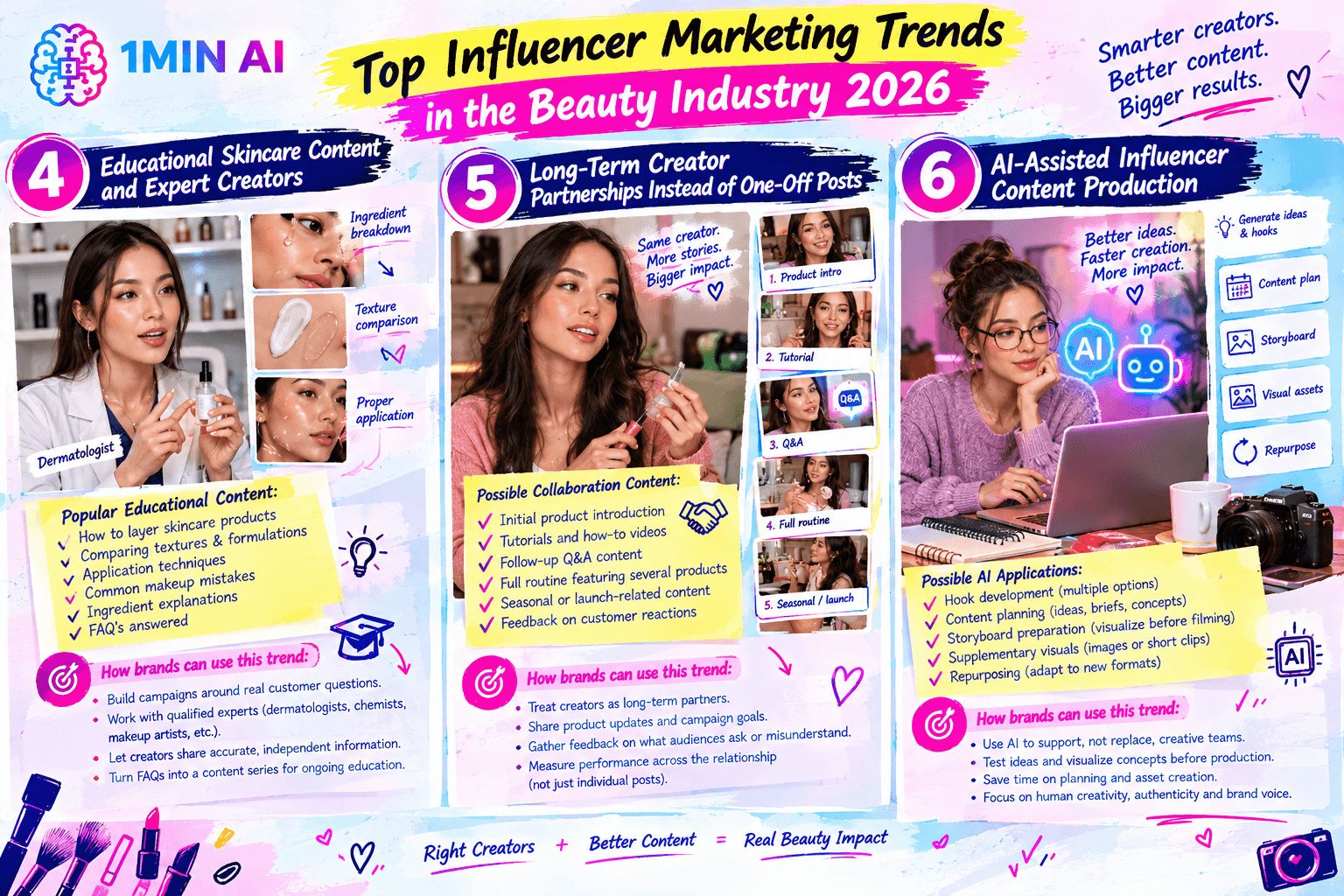
5. Long-Term Creator Partnerships Instead of One-Off Posts
A single sponsored video may introduce a product, but repeated exposure can help audiences understand a brand's positioning and see how a product fits into real routines.
Influencer marketing reporting in 2026 increasingly emphasizes deeper creator relationships, with creators contributing ideas and cultural insight rather than simply distributing finished advertising messages.
For beauty brands, long-term partnerships can support more consistent storytelling.
A collaboration might include:
- An initial product introduction
- A tutorial demonstrating how to use it
- Follow-up content answering audience questions
- A routine featuring several products
- Seasonal or launch-related content
- Feedback on customer reactions and common concerns
How brands can use this trend
Treat suitable creators as ongoing partners. Share product updates, explain campaign objectives, and gather feedback about what audiences ask or misunderstand.
Evaluate performance across the relationship rather than judging every post in isolation. Consider content quality, audience response, conversions, repeat purchases where measurable, and the cost of maintaining the partnership.
Long-term partnerships work best when the creator genuinely fits the brand and can communicate about the products credibly. A contract alone cannot create trust.
6. AI-Assisted Influencer Content Production
AI tools are becoming useful for the supporting work behind influencer campaigns. They can help marketing teams brainstorm ideas, draft hooks, generate storyboards, prepare visual concepts, and create supplementary video assets.
For beauty brands working across TikTok, Instagram Reels, YouTube Shorts, and other channels, this can make creative testing more manageable.
Possible applications include:
Hook development: Generate alternative opening lines for a product demonstration or tutorial.
Content planning: Turn campaign goals into a list of video concepts, creator briefs, and publishing ideas.
Storyboard preparation: Visualize how a product reveal or routine video might unfold before filming.
Supplementary visuals: Generate illustrative scenes or animate approved images for creative experiments.
Repurposing: Adapt a successful concept into a new format while preserving the original message and checking platform requirements.
7. Creator-Led Campaigns Built Around Trends and Short-Form Video
Short-form video gives beauty creators a way to combine demonstrations, storytelling, transformations, and entertainment in a format suited to mobile viewing.
However, following every viral sound or challenge is rarely a sustainable strategy. A trend works best when it reinforces the product story and feels natural for the creator's audience.
Beauty brands can adapt formats such as:
- Before-and-after styling transformations
- Get-ready-with-me routines
- “Things I wish I knew” educational videos
- Product empties and repurchase discussions
- Makeup looks inspired by a particular mood or occasion
- Seasonal beauty routines
- Myth-versus-fact explainers
How brands can use this trend
Monitor relevant creators and platform conversations to identify formats gaining attention. Then ask whether the trend fits your brand, product, and audience.
A lipstick brand might adapt a transformation format to demonstrate how different shades change the overall look. A hair-care company might work with a creator to explain a styling routine for a specific hair texture.
If you use AI to generate supplementary clips, 1minAI's Text to Video API documentation can help developers explore text-based video generation. Its Video Face Swap API documentation covers a specialized effect for suitable, permission-based creative projects.
These tools can support creative experimentation, but generated footage should not be presented as genuine product testing or a real customer's experience when it is not.
How 1minAI can support beauty marketing workflows
1minAI offers AI-powered tools that can help with parts of this process, including video generation and image-to-video workflows.
For example, a beauty marketing team could use AI to explore several visual concepts for a new product launch, prepare alternative hooks, and develop a rough storyboard before working with a creator on the final content.
Relevant tools include:
- 5 AI Tools Every TikTok Creator Should Use Daily for ideas on AI-assisted creator workflows.
- TikTok Hooks AI for developing and refining opening hooks.
- AI video generation with Veo 3.1 for exploring AI-generated video concepts.
- Luma AI Image to Video API documentation for technical information about image-to-video generation.
AI-generated content should support the creator's work, not replace the trust that comes from a real person's experience. If a video depicts product results, skin appearance, or product performance, make sure it does not mislead viewers.
Use real product imagery where accuracy matters, review generated assets carefully, and follow platform rules on AI disclosures and advertising.
How to Measure Influencer Marketing Performance for Beauty Brands
A beauty campaign can generate impressive views without producing meaningful sales. To understand whether an influencer strategy is working, choose metrics that match the campaign objective.
| Campaign objective | Metrics to consider |
|---|---|
| Brand awareness | Reach, impressions, video views, relevant audience growth |
| Engagement | Meaningful comments, shares, saves, engagement quality |
| Product education | Video completion, questions answered, saves, qualified traffic |
| Sales | Product clicks, conversion rate, attributed revenue, customer acquisition cost |
| Long-term growth | Repeat purchases, returning customers, creator relationship performance |
Use trackable links, campaign-specific codes, affiliate reporting, or other suitable attribution methods where available. No single measurement method captures every influence a creator has on a purchase, so interpret results in context.
Also compare the total campaign cost—including creator fees, product samples, commissions, production, and paid amplification—with the value generated.
For example, a campaign designed to educate consumers about a new skincare ingredient may be successful even if immediate sales are modest, provided it improves relevant engagement and supports later purchase decisions. A conversion-focused campaign should be evaluated more directly against sales and acquisition costs.
How to Build a Beauty Influencer Marketing Strategy
Use these steps to turn trends into a practical plan.
Step 1: Define your objective. Decide whether the campaign is intended to build awareness, explain a product, generate sales, or strengthen customer loyalty.
Step 2: Identify your audience. Consider skin concerns, hair types, makeup preferences, budgets, age groups, and shopping behavior relevant to the product.
Step 3: Select suitable creators. Evaluate audience fit, credibility, content quality, previous brand partnerships, and engagement quality.
Step 4: Choose the right format. Match the campaign to a product demonstration, tutorial, educational video, routine, live shopping session, or other suitable format.
Step 5: Create a clear brief. Share the objective, required product facts, key messages, deliverables, disclosure requirements, and restrictions. Leave room for the creator's authentic voice.
Step 6: Test and measure. Start with a manageable campaign, review performance, and identify which creators and formats merit further investment.
Step 7: Improve the next campaign. Use audience questions, sales data, and creative performance to refine your approach instead of simply repeating the same format.
Frequently Asked Questions
What are the biggest influencer marketing trends in beauty for 2026?
Important trends include micro-influencer partnerships, authentic product demonstrations, educational skincare content, social commerce, long-term creator relationships, AI-assisted production, and creator-led short-form video. Which trend matters most depends on the brand, product category, audience, and campaign goal.
Why is TikTok important for beauty influencer marketing?
TikTok combines short-form video, creator recommendations, product demonstrations, and shopping features. Recent beauty-industry research highlights the platform's growing role in product discovery and sales. Brands should still compare platforms based on their target audience and campaign results.
Are micro-influencers better than celebrity influencers for beauty brands?
Not always. Micro-influencers can offer niche audience relevance and closer community relationships, while celebrities may provide broader reach. The best choice depends on the campaign objective, budget, audience fit, and the creator's ability to communicate about the product credibly.
How can AI help with influencer marketing?
AI can assist with ideation, hook writing, content planning, storyboard development, and supplementary visual creation. Human creators remain important for genuine product experience, personal perspective, and audience relationships. Brands should review AI-generated content for accuracy and compliance.
How can beauty brands measure influencer marketing ROI?
Track metrics that align with the campaign goal. These may include reach, meaningful engagement, product clicks, conversions, attributed revenue, acquisition cost, and repeat purchases. Include creator fees, commissions, samples, and production expenses when evaluating profitability.
Conclusion
Influencer marketing in beauty is moving toward more useful content, stronger creator relationships, social commerce, and better measurement. Micro-influencers, educational skincare creators, authentic demonstrations, and short-form video all offer opportunities for brands that understand their audiences.
The strongest strategy is not to chase every viral trend. Choose formats that fit your product, work with creators who can explain it credibly, and measure whether the campaign achieves its intended goal.
AI tools can help your team develop ideas and experiment with creative concepts more efficiently. With 1minAI, beauty marketers can explore AI-assisted hooks and video workflows while keeping genuine creator experiences and product accuracy at the center of their campaigns.
For further information, explore 5 AI Tools Every TikTok Creator Should Use Daily.
Discover more AI features: https://1min.ai/features
Try 1minAI agent now: https://app.1min.ai/ai-agent-demo
- #Information
Alternatives
Discover the best alternatives to 1minAI and compare features, pricing, and use cases.
1min.AI vs OpenRouter
1min.AI vs. OpenRouter: Compare the ready-to-use AI creation product against the technical API tool. Find out if you need a zero-code creative studio or a coding infrastructure hub.
 Ngoc Hong
1min.AI vs Jarvis AI
Compare 1min.AI vs Jarvis AI to discover which AI platform is better for writing, research, automation, and content creation. Find the best AI assistant for your workflow.
Ngoc Hong
1min.AI vs Taskade
Compare 1min.AI vs Taskade for AI content creation, automation, agents, and creative workflows to find the right workspace.
Ngoc HongAI Tools
Discover the best AI tools to boost productivity, creativity, and everyday work.
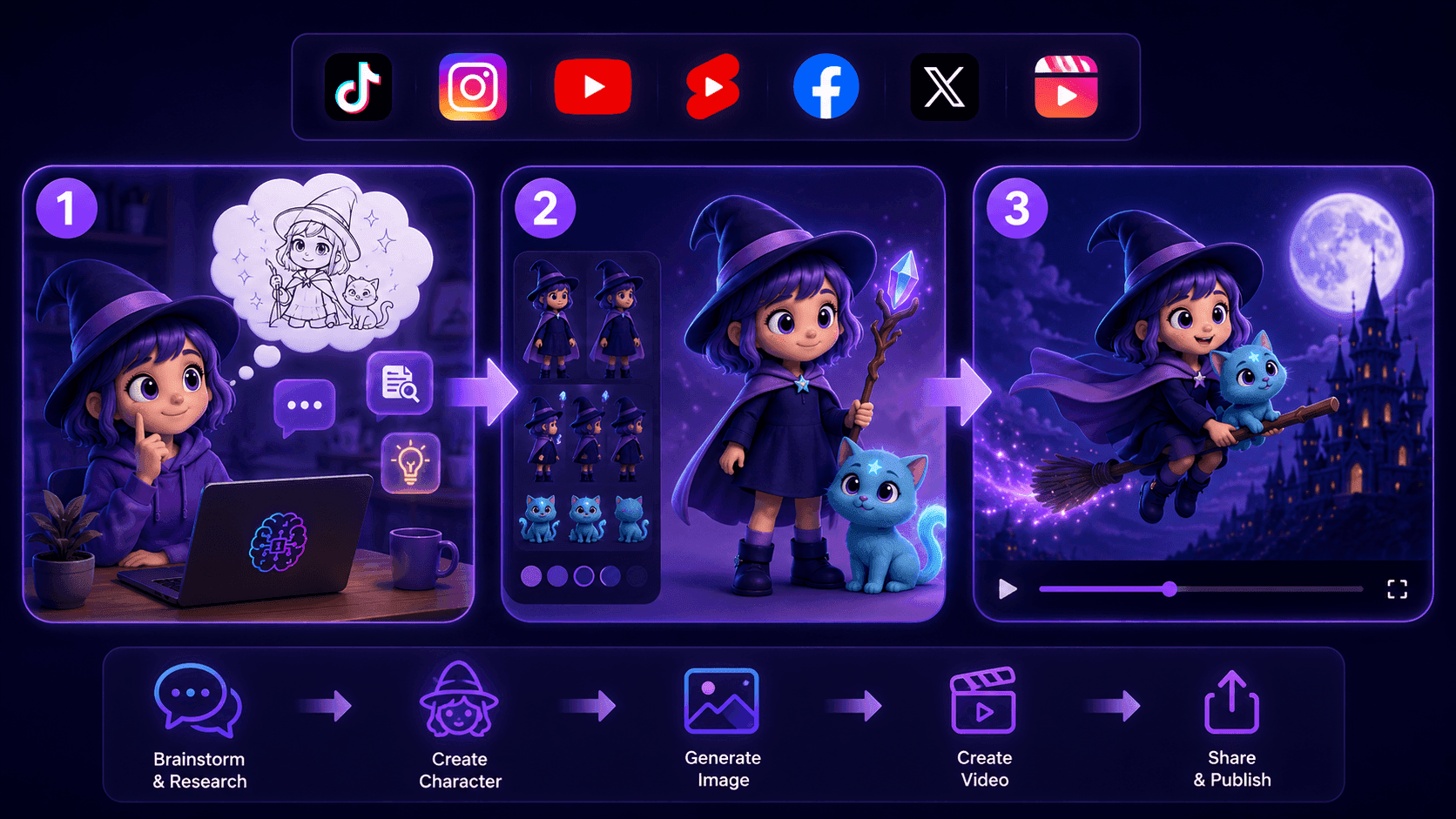
Create Consistent Cartoon Content in Just a Few Steps
Create engaging cartoon videos for TikTok and Reels with 1min.AI. Research ideas, create characters, and turn images into animated videos in 3 simple steps.
 Lien Anh Vu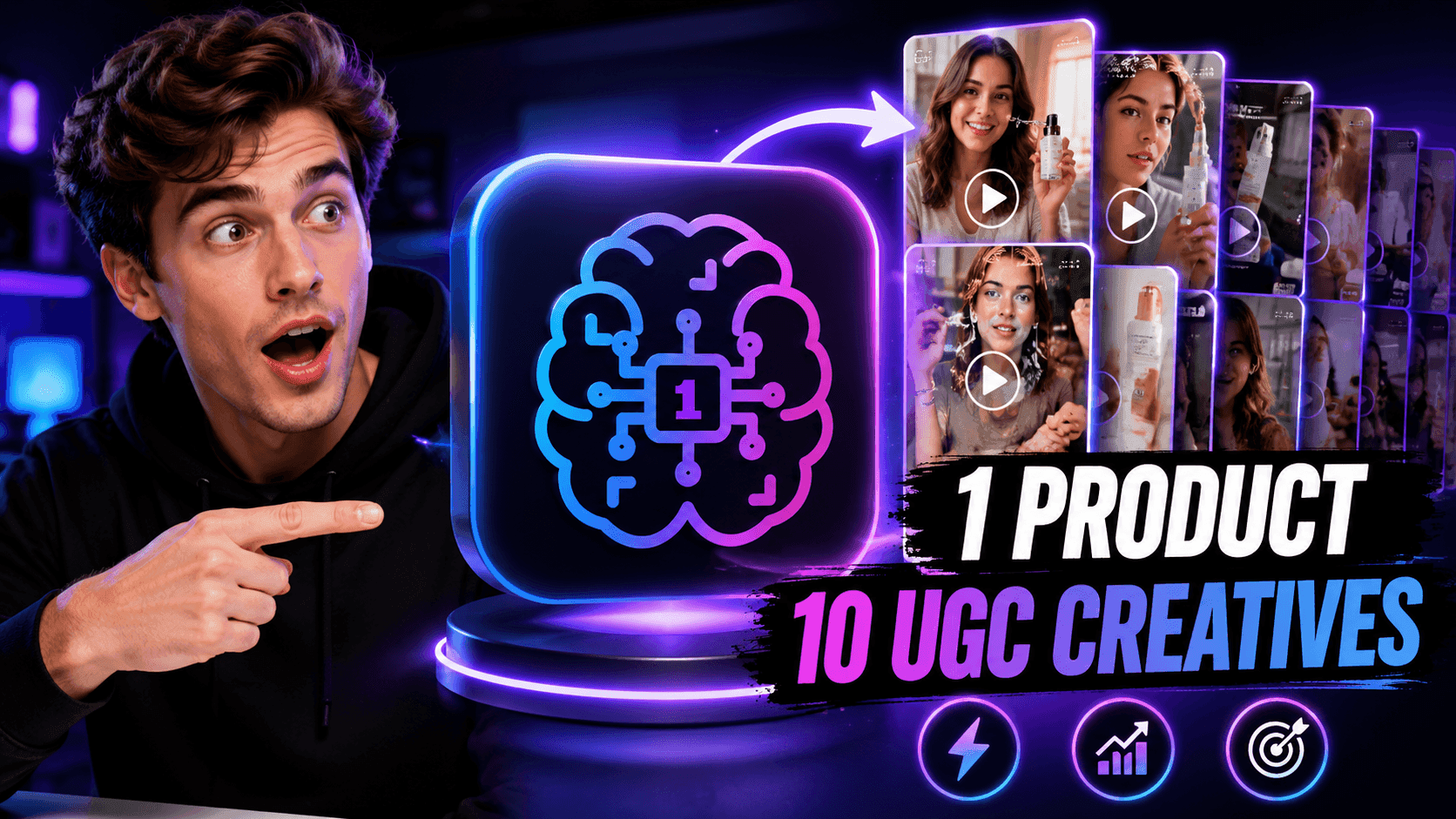
One Product, 10 UGC Creatives: How AI Makes Content Testing Easier
Create more authentic UGC with an AI UGC video generator, test more creative angles and scale affiliate content without filming every version.
Lien Anh Vu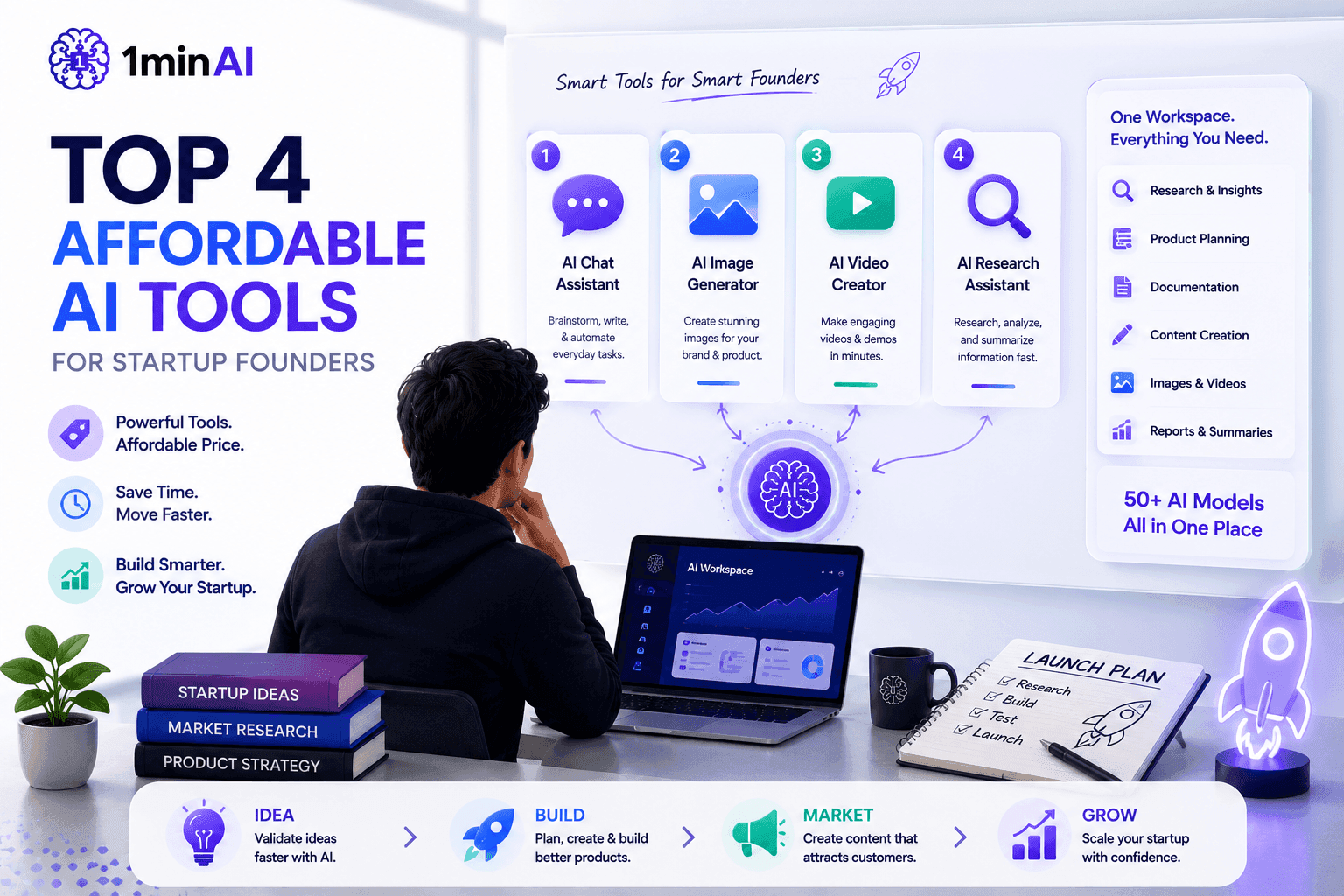
Top 4 Affordable AI Tools for Startup Founders
Discover the top 4 affordable AI tools for startup founders to validate ideas, build products, create content, and launch faster without overspending.
 Tram Ta
AI Features
Comprehensive AI features that streamline workflows, improve efficiency, and empower teams to achieve more.
Create Consistent Cartoon Content in Just a Few Steps
Create engaging cartoon videos for TikTok and Reels with 1min.AI. Research ideas, create characters, and turn images into animated videos in 3 simple steps.
Lien Anh VuOne Product, 10 UGC Creatives: How AI Makes Content Testing Easier
Create more authentic UGC with an AI UGC video generator, test more creative angles and scale affiliate content without filming every version.
Lien Anh Vu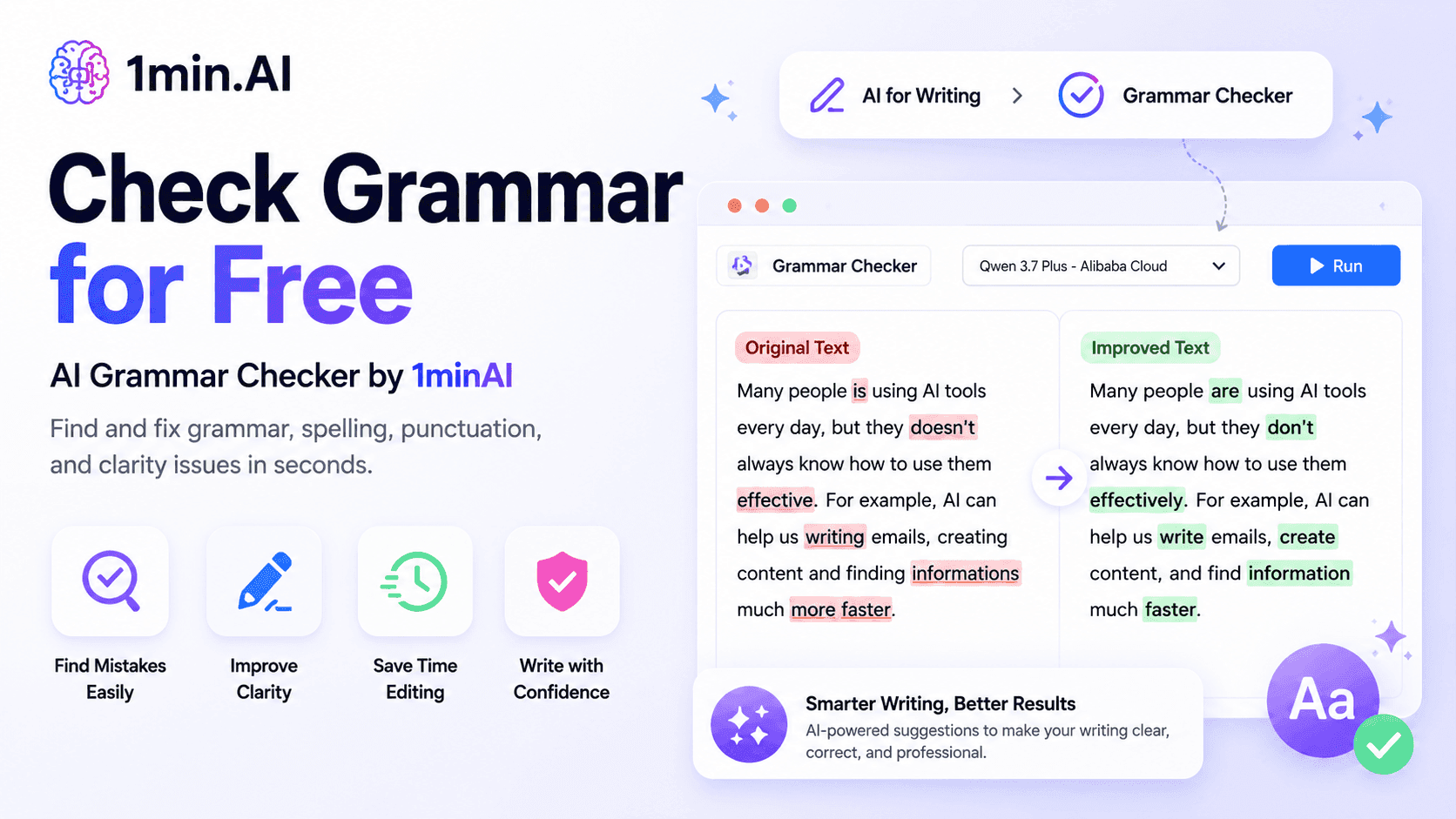
1minAI: Free AI Grammar Checker
Check grammar for free with 1minAI’s AI grammar checker. Find grammar, spelling, and writing mistakes, improve clarity, and polish your content in seconds.
Tram TaAI Use Cases
A curated collection of AI use cases for business, productivity, and industry-specific applications.
Create Consistent Cartoon Content in Just a Few Steps
Create engaging cartoon videos for TikTok and Reels with 1min.AI. Research ideas, create characters, and turn images into animated videos in 3 simple steps.
Lien Anh VuOne Product, 10 UGC Creatives: How AI Makes Content Testing Easier
Create more authentic UGC with an AI UGC video generator, test more creative angles and scale affiliate content without filming every version.
Lien Anh Vu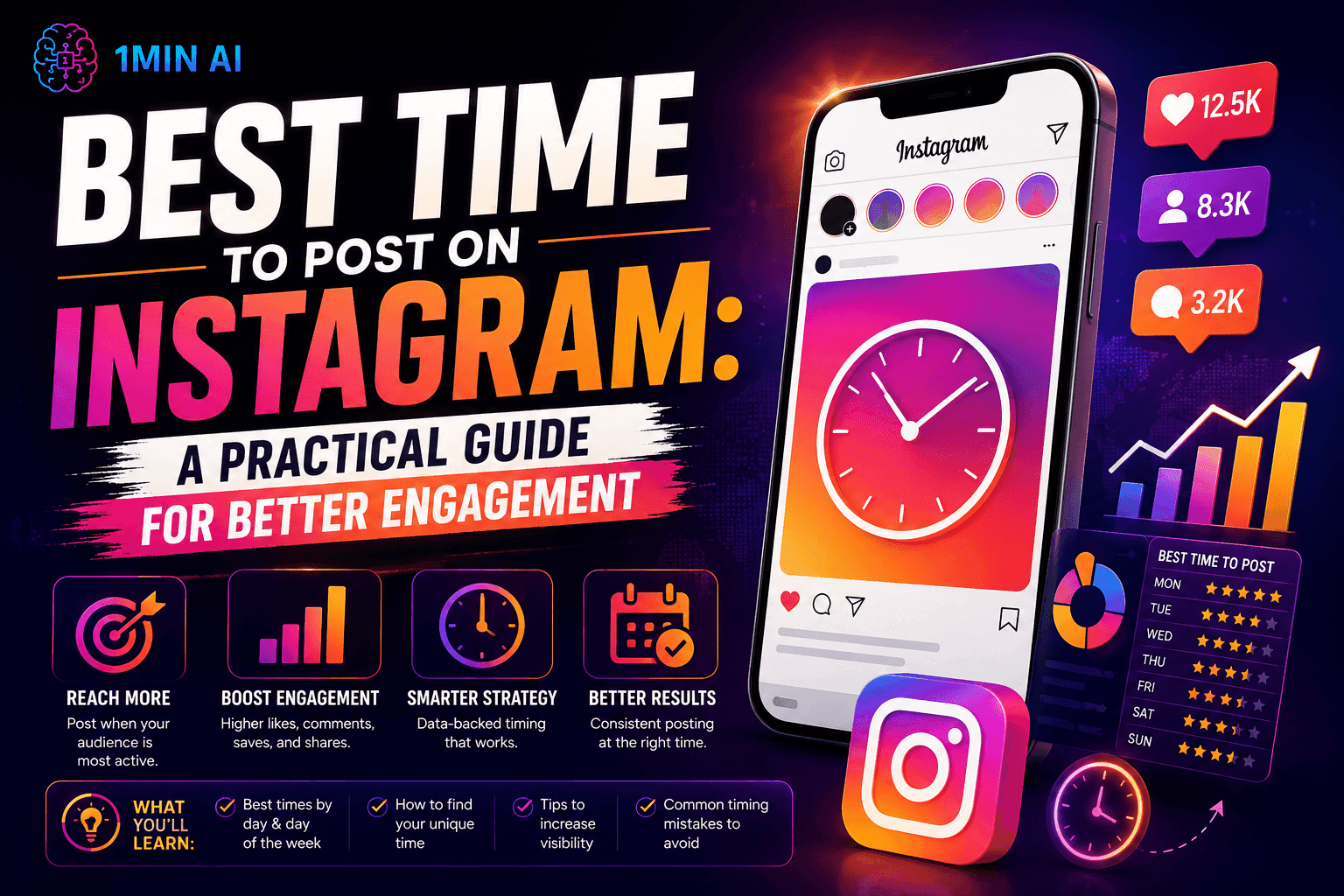
Best Time to Post on Instagram: A Practical Guide for Better Engagement
Discover the best time to post on Instagram, including the best days and times for different audiences, plus tips to find the ideal posting schedule for your account.
Tram TaAI Tutorials
Learn how to use AI with practical, step-by-step tutorials.
Black Friday AI Tool Deals in 2026
Discover what Black Friday AI tool deals 2026 has to offer. Find out how to secure the 1min.AI lifetime deal via AppSumo, Dealify, Stack Social, and verify on Trustpilot, Slashdot, and Software Advice.
 Hang Nguyen
Create Consistent Cartoon Content in Just a Few Steps
Create engaging cartoon videos for TikTok and Reels with 1min.AI. Research ideas, create characters, and turn images into animated videos in 3 simple steps.
Lien Anh Vu
[Seedance 2.5 New] Better AI Product Videos, Less Rework in 1min.AI
Use Seedance 2.5 image to video on 1min.AI to create more consistent AI product videos, reduce failed generations, save credits, and improve UGC workflows.
Lien Anh VuAI Guides
Learn AI faster with practical guides, real-world examples, and actionable best practices.

Safely Buy AI Tools Online: 2026 Black Friday Guide
Discover how to find and secure the best Black Friday AI deals online. Learn expert strategies to avoid scams, combat subscription fatigue, and verify software.
Hang NguyenCreate Consistent Cartoon Content in Just a Few Steps
Create engaging cartoon videos for TikTok and Reels with 1min.AI. Research ideas, create characters, and turn images into animated videos in 3 simple steps.
Lien Anh Vu[Seedance 2.5 New] Better AI Product Videos, Less Rework in 1min.AI
Use Seedance 2.5 image to video on 1min.AI to create more consistent AI product videos, reduce failed generations, save credits, and improve UGC workflows.
Lien Anh VuAI Solutions
Browse the best AI solutions for automation, coding, research, productivity, customer support, marketing, and business workflows.
Safely Buy AI Tools Online: 2026 Black Friday Guide
Discover how to find and secure the best Black Friday AI deals online. Learn expert strategies to avoid scams, combat subscription fatigue, and verify software.
Hang NguyenCreate Consistent Cartoon Content in Just a Few Steps
Create engaging cartoon videos for TikTok and Reels with 1min.AI. Research ideas, create characters, and turn images into animated videos in 3 simple steps.
Lien Anh VuOne Product, 10 UGC Creatives: How AI Makes Content Testing Easier
Create more authentic UGC with an AI UGC video generator, test more creative angles and scale affiliate content without filming every version.
Lien Anh VuAI Models
Explore the world's leading AI models in one place.
Create Consistent Cartoon Content in Just a Few Steps
Create engaging cartoon videos for TikTok and Reels with 1min.AI. Research ideas, create characters, and turn images into animated videos in 3 simple steps.
Lien Anh VuOne Product, 10 UGC Creatives: How AI Makes Content Testing Easier
Create more authentic UGC with an AI UGC video generator, test more creative angles and scale affiliate content without filming every version.
Lien Anh Vu[Seedance 2.5 New] Better AI Product Videos, Less Rework in 1min.AI
Use Seedance 2.5 image to video on 1min.AI to create more consistent AI product videos, reduce failed generations, save credits, and improve UGC workflows.
Lien Anh VuAI Comparisons
Compare AI tools, models, and platforms to find the best fit for your needs.
Kling AI Vs Veo 3: Which Model Wins?
Kling AI vs Veo 3: compare motion, native audio, pricing & free tiers to see which AI video generator wins for your project - try both on 1min.AI.
 Trang Tran
[Seedance 2.5 New] Better AI Product Videos, Less Rework in 1min.AI
Use Seedance 2.5 image to video on 1min.AI to create more consistent AI product videos, reduce failed generations, save credits, and improve UGC workflows.
Lien Anh Vu
DeepSeek V4 Pro vs Flash Comparison
Compare DeepSeek V4 Pro vs DeepSeek V4 Flash metrics. Optimize your agentic apps and improve AI fact checking on 1min.ai today.
Ngoc HongAI Integrations
Seamlessly integrate AI with the tools you already use to automate work and boost productivity.
POV: You Have 10+ Posts to Make Every Day
Learn how to build an AI content workflow that helps content creators produce 10+ social media posts a day faster with AI brainstorming, image generation, and content creation.
Lien Anh Vu
How to Use an AI Fashion Video Generator for Fashion Week 2026
Turn Fashion Week 2026 ideas into stunning fashion videos with AI. Learn how to brainstorm, create visuals, and transform images into videos with one simple workflow.
Lien Anh Vu
Stop Switching Between AI Apps: How AI Integration Transforms Employer Branding
Discover how AI integration helps HR teams streamline employer branding by combining AI writing, documents, images, video, and multiple AI models into one workspace.
Tram TaAI for Industries
Find the best AI tools and workflows for healthcare, finance, education, legal, manufacturing, retail, real estate, and more
Free AI Product Description Generator
Write product descriptions that sell in minutes. Use this free AI product description generator to turn details or a photo into on-brand copy. Try 1min.AI.
Trang Tran
Best Business Productivity Tools for Startups to Maximize Profits | 1minAI
Discover the best business productivity tools for startups to save time, streamline workflows, reduce repetitive tasks, and support profitable growth with AI.
Tram Ta
Best AI Tool for Content Marketing |1minAI
Looking for the best AI tool for content marketing? See how 1minAI helps marketers research, write, repurpose, create visuals, and scale content from one AI workspace.
Tram TaAI Agents
Discover and run AI agents to automate tasks across your work and daily life.
1minAI: Free AI Grammar Checker
Check grammar for free with 1minAI’s AI grammar checker. Find grammar, spelling, and writing mistakes, improve clarity, and polish your content in seconds.
Tram Ta
AI Agents for Facebook
Use an AI Agent for Facebook to create content, generate images, schedule posts, and publish from your documents and conversations.
Ngoc Hong
AI Agent vs AI Assistant: Which One Actually Saves Designers More Time?
Learn the difference between AI Agent vs AI Assistant and discover which solution helps designers automate repetitive work, reduce revisions, and save more time.
Lien Anh VuAI Workflows
Explore ready-to-use AI workflows for productivity, marketing, sales, support, and more.
Create Consistent Cartoon Content in Just a Few Steps
Create engaging cartoon videos for TikTok and Reels with 1min.AI. Research ideas, create characters, and turn images into animated videos in 3 simple steps.
Lien Anh VuOne Product, 10 UGC Creatives: How AI Makes Content Testing Easier
Create more authentic UGC with an AI UGC video generator, test more creative angles and scale affiliate content without filming every version.
Lien Anh VuPOV: You Have 10+ Posts to Make Every Day
Learn how to build an AI content workflow that helps content creators produce 10+ social media posts a day faster with AI brainstorming, image generation, and content creation.
Lien Anh VuNewsletter
Weekly AI Innovations with 1minAI

🔮 Weekly AI Innovations #141: Seedance 2.5 & Stable Audio 3: Next-Gen AI
Explore Seedance 2.0, 2.5, and StabilityAI's Stable Audio 3 on 1min.ai. Generate studio-grade audio and synchronized motion with next-gen generative AI.
Hang Nguyen
🔮 Weekly AI Innovations #140: Deepseek 4.1 Flash & Gemini Upgrades
Explore Deepseek 4.1 Flash and new Gemini models on 1min.ai. Plus, check our update on your Billing - Usage page for better clarity.
Hang Nguyen
🔮 Weekly AI Innovations #139: Dawn of the next-gen AI
Discover the immense power of GPT-6 Astra and Claude Fable 5.1. Unlock next-generation AI models on 1min.ai to solve complex tasks effortlessly.
Hang Nguyen