
GPT-6 vs Claude 5.5: Which Is Best for Business?

Ngoc Hong
October 15, 2026
Compare GPT-6 and Claude 5.5 for coding, research, and business workflows. Discover which AI model fits your team's needs, budget, and productivity goals.
GPT-6 vs Claude 5.5: Which Is Best for Business?
GPT-6 vs Claude 5.5 is a comparison that matters for businesses deciding which AI models to adopt. Both OpenAI and Anthropic offer powerful models for coding, research, document analysis, and complex professional tasks. But stronger benchmark scores do not always translate into better business outcomes.
For AI leaders, innovation teams, and automation agencies, the decision should consider performance, reliability, cost, and workflow compatibility.
This guide compares GPT-6 and Claude 5.5 using published benchmarks, official model specifications, and practical business use cases.
GPT-6 vs Claude 5.5: Key Differences at a Glance
GPT-6 and Claude 5.5 are model families rather than individual models. Each includes options for different levels of complexity and cost.
| Category | GPT-6 family | Claude 5.5 family |
|---|---|---|
| Developer | OpenAI | Anthropic |
| Flagship model | GPT-6 Astra | Claude Opus 5.5 |
| Professional work | GPT-6.1 Sol | Claude Sonnet 5.5 |
| Cost-efficient model | GPT-6 Luna | Claude Haiku 5.5 |
| Key strengths to evaluate | Advanced reasoning, coding, computer use | Complex analysis, coding, knowledge work |
| Main business consideration | Capability versus task cost | Quality, efficiency, and workload fit |
OpenAI positions Astra for its most demanding tasks and GPT-6.1 Sol for near-flagship capability at a lower price. Anthropic positions Opus for complex judgment, Sonnet for everyday professional work, and Haiku for high-volume operations.
Quick verdict: Claude Opus 5.5 leads GPT-6 Astra on several independent intelligence and coding benchmarks. However, GPT-6 Astra can complete certain benchmark workloads with fewer tokens and lower total task costs.
The better business choice depends on which trade-offs matter most.
Sources: OpenAI GPT-6 Model Guide | Anthropic Claude Sonnet 5.5
GPT-6 vs Claude 5.5 Benchmarks: Which Performs Better?
Independent benchmarks help businesses evaluate model capabilities beyond marketing claims.
Artificial Analysis compares Claude Opus 5.5 and GPT-6 Astra across reasoning, coding, automation, cost, and speed.
GPT-6 Astra vs Claude Opus 5.5: Independent Benchmarks
The following results compare both models at their Max reasoning-effort configurations.
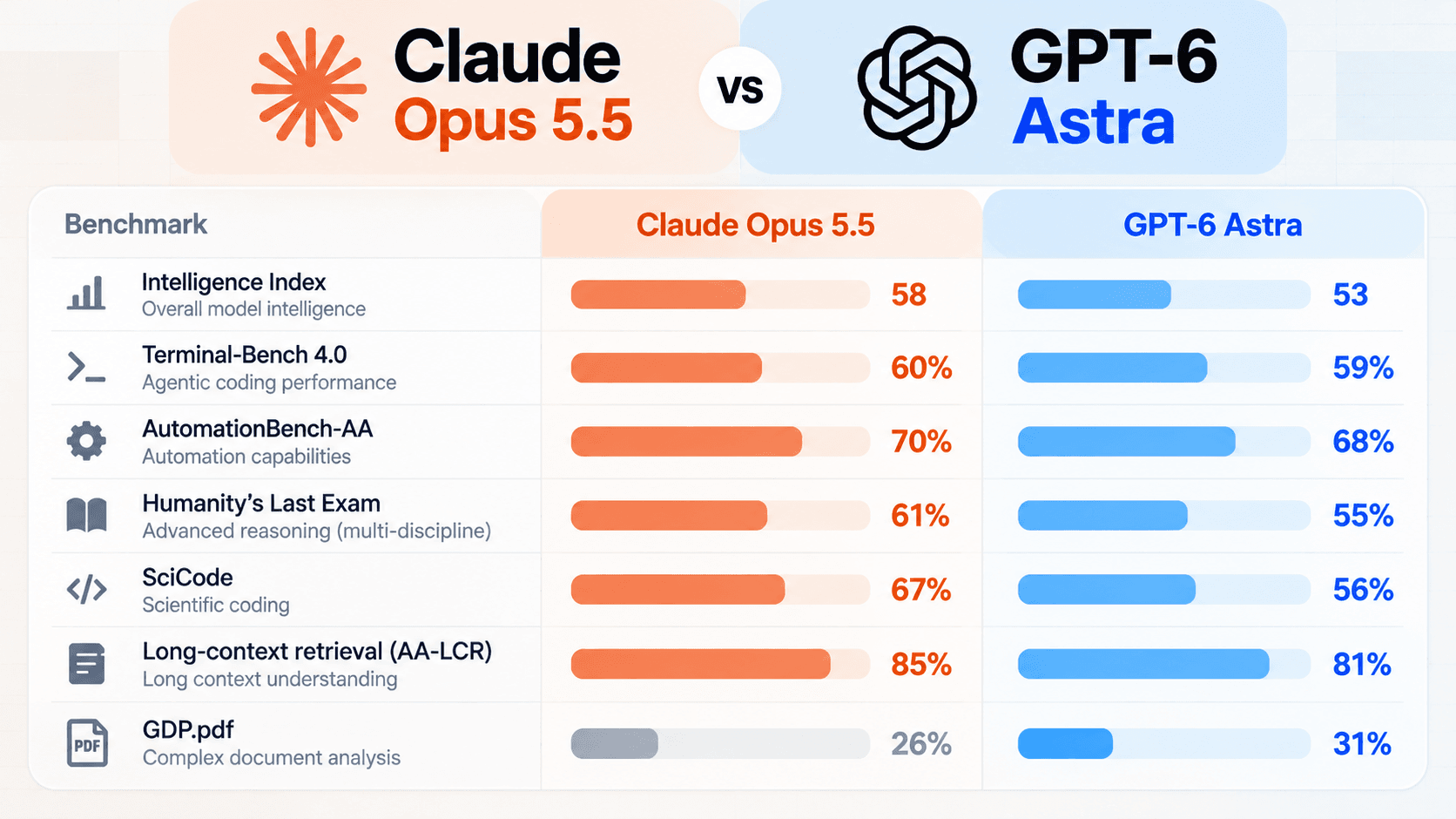
Source: Artificial Analysis — Claude Opus 5.5 vs GPT-6 Astra (Max)
Claude Opus 5.5 leads in overall intelligence, scientific coding, and several advanced reasoning evaluations.
GPT-6 Astra performs better on GDP.pdf, showing that the results are not uniformly in Claude's favor.
These scores also reflect specific testing configurations. A different reasoning-effort setting can change both performance and cost.
What Do These Benchmarks Mean for Business?
Different benchmarks measure different capabilities.
- Terminal-Bench 4.0: Evaluates an AI agent's ability to complete tasks using terminal-based tools.
- AutomationBench-AA: Measures performance on automation-oriented tasks.
- Humanity's Last Exam: Tests advanced knowledge and reasoning across disciplines.
- SciCode: Evaluates scientific programming capabilities.
- AA-LCR: Measures retrieval accuracy across long contexts.
For an automation agency, Terminal-Bench and AutomationBench may be more relevant than general knowledge scores.
For an enterprise research team, long-context retrieval and factual accuracy may matter more.
The key is choosing benchmarks that resemble your actual workload.
GPT-6 vs Claude 5.5: Speed, Context Window, and Cost
Performance is only one part of the decision.
Artificial Analysis also reports the following specifications and operational measurements for the flagship models at Max effort.
| Metric | Claude Opus 5.5 | GPT-6 Astra |
|---|---|---|
| Context window | 1M tokens | 1M tokens |
| Input price / 1M tokens | $4 | $10 |
| Output price / 1M tokens | $20 | $50 |
| Output speed | 95 tokens/s | 61 tokens/s |
| Average benchmark task cost | $5.98 | $3.26 |
Source: Artificial Analysis — Flagship Model Comparison
Claude Opus 5.5 has lower token prices and faster measured output generation.
However, GPT-6 Astra has a lower average cost per benchmark task in this configuration.
Why?
Models can consume different numbers of reasoning and output tokens to solve the same problem. A model with higher token prices may still cost less per completed task if it uses substantially fewer tokens.
For businesses, this makes cost per accepted task more useful than token pricing alone.
These figures describe the Artificial Analysis evaluation environment, not guaranteed latency or cost in production.
GPT-6 Sol vs Claude Sonnet 5.5: Everyday Business Work
Flagship models are not always necessary for daily operations.
GPT-6 Sol and Claude Sonnet 5.5 are relevant alternatives for professional writing, coding, and knowledge work.
Anthropic's published comparison reports:
| Benchmark | Claude Sonnet 5.5 | GPT-6 Sol |
|---|---|---|
| FrontierCode 1.1 (Main) | 46.2% (Max) | 49.3% |
| GDPval-AA v2.1 | 1,844 | 1,487 |
| AA-Briefcase v1.1 | 1,811 | 1,483 |
| Input price / 1M tokens | $2 | $2 |
| Output price / 1M tokens | $10 | $10 |
Source: Anthropic — Claude Sonnet 5.5 Performance Benchmarks
GPT-6 Sol scores higher in the listed FrontierCode result, while Claude Sonnet 5.5 leads on the knowledge-work evaluations.
Anthropic also reports that Sonnet 5.5 is more than 30% faster than Sonnet 5 and costs up to 30% less for most workloads.
These are Anthropic-published comparisons, and effort settings or evaluation conditions may differ between models.
For businesses, both models are worth testing on reports, presentations, software development, and other recurring professional tasks.
GPT-6 Luna vs Claude Haiku 5.5: High-Volume AI Tasks
Smaller models can offer better economics for repetitive operations.
Claude Haiku 5.5 and GPT-6 Luna target cost-sensitive workloads where speed and efficiency matter.
Anthropic reports the following benchmark results:
| Benchmark | Claude Haiku 5.5 | GPT-6 Luna |
|---|---|---|
| Terminal-Bench 4.0 | 39.2% | 16.4% |
| OSWorld 2.1 (offline subset) | 72.4% | 48.9% |
| FrontierCode 1.1 | 46.4% | 42.4% |
| GDPval-AA v2.1 | 1,620 | 1,437 |
| Input price / 1M tokens | $0.10* | $0.10 |
| Output price / 1M tokens | $0.50* | $0.50 |
Source: Anthropic — Claude Haiku 5.5 Benchmarks
Claude Haiku 5.5's listed rates apply to prompts up to 100,000 tokens; longer prompts have different pricing.
In Anthropic's published evaluations, Haiku 5.5 outperforms Luna across the listed tasks.
For businesses processing large volumes of customer requests, documents, or structured data, these results make Haiku 5.5 worth testing.
However, organizations should verify whether those advantages hold for their own inputs and latency requirements.
GPT-6 vs Claude 5.5 for Business Use Cases
The best model depends on what your organization needs to accomplish.
Coding and Software Development
Both model families offer strong candidates for software development.
GPT-6 Astra and Claude Opus 5.5 are relevant for complex coding tasks, while GPT-6.1 Sol and Claude Sonnet 5.5 offer alternatives for everyday development work.
Businesses should evaluate code quality using real repositories rather than benchmark scores alone.
Measure passing tests, debugging time, maintainability, and the number of revisions required.
For AI automation agencies, these metrics are often more useful than raw code-generation speed.
Research and Complex Analysis
Research workflows require accurate information, clear reasoning, and reliable interpretation of source material.
Claude Opus 5.5's results on advanced reasoning and long-context benchmarks make it a strong evaluation candidate.
GPT-6 Astra also offers capabilities for complex research, data analysis, and professional tasks.
For either model, organizations should verify important claims against trusted sources and include human review where decisions carry significant consequences.
Business Documents and Knowledge Work
Teams frequently use AI to draft reports, analyze documents, prepare presentations, and summarize internal information.
Claude Sonnet 5.5 performs strongly on published knowledge-work benchmarks, making it worth evaluating for document-heavy operations.
GPT-6 Sol and GPT-6.1 Sol are also relevant candidates for professional productivity.
The best choice should be based on factual accuracy, formatting quality, editing effort, and consistency with organizational requirements.
AI Automation and High-Volume Operations
Automation teams need models that deliver acceptable results repeatedly without unnecessary costs.
Claude Haiku 5.5 and GPT-6 Luna are relevant for classification, structured extraction, and routine processing.
However, benchmark scores alone do not establish production reliability.
Teams should also evaluate error handling, output validation, rate limits, and integration requirements.
How to Choose Between GPT-6 and Claude 5.5 for Better ROI
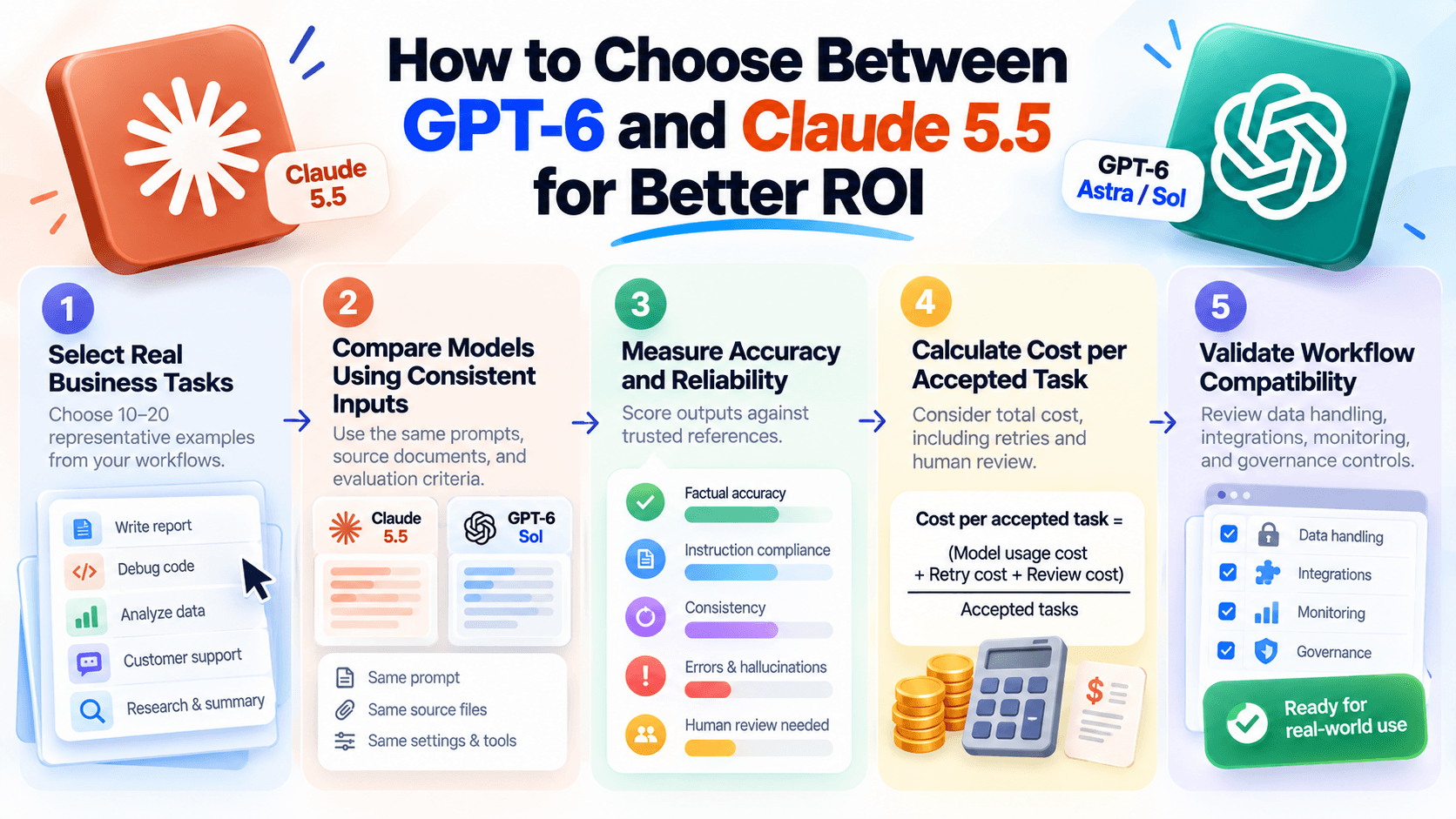
AI leaders should evaluate models against measurable business outcomes rather than relying solely on public rankings.
A practical framework includes five steps.
1. Select Real Business Tasks
Choose 10–20 representative examples from your workflows.
Include straightforward requests, complex tasks, and cases where your current model frequently fails.
2. Compare Models Using Consistent Inputs
Use equivalent prompts, source documents, and evaluation criteria.
For a fair comparison, document the reasoning-effort settings and tools available to each model.
3. Measure Accuracy and Reliability
Score outputs against trusted references.
Track factual errors, instruction compliance, consistency, and the amount of human correction required.
4. Calculate Cost per Accepted Task
Instead of focusing only on token prices, calculate:
Cost per accepted task = (Model usage cost + Retry cost + Review cost) ÷ Accepted tasks
This captures the actual expense of producing usable results.
5. Validate Workflow Compatibility
Before deploying a model, review data-handling requirements, integrations, monitoring, and governance controls.
A model that performs well in testing may still require significant integration work before it is suitable for production.
For a broader selection framework, read Best AI Chatbot for Business: How to Compare Options.
Compare AI Models in One Workspace With 1min.AI
Testing models across separate interfaces can make comparisons harder to manage.
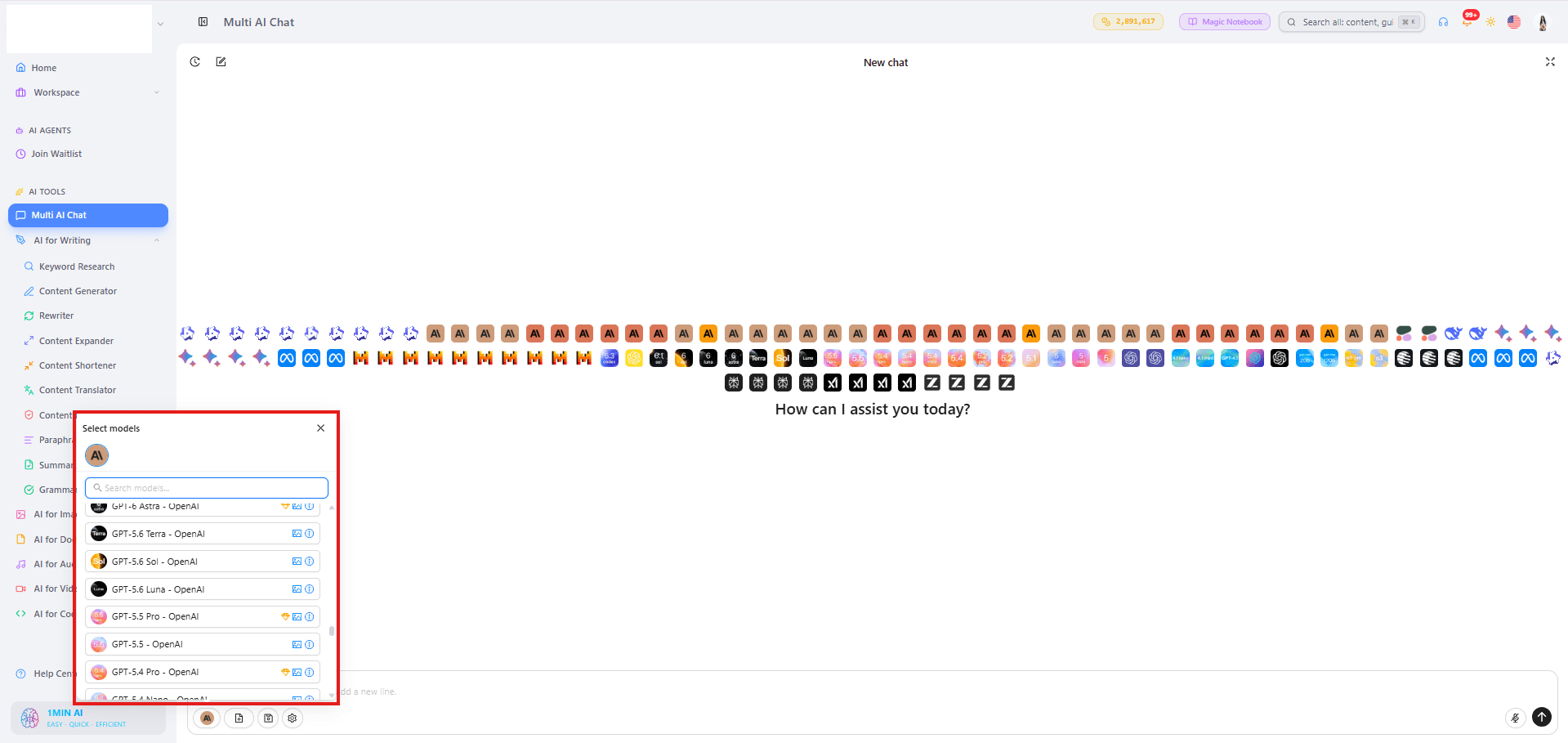
1min.AI provides a unified workspace for accessing multiple supported AI models and completing AI-powered tasks.
With Multi AI Chat, teams can send the same prompt to supported models and compare responses side by side.
Mix AI Models supports working with different models within a conversation, while Document Chat helps users interact with business documents.
For AI Champions and innovation teams, these features provide a practical starting point for comparing model outputs before committing to a wider implementation.
Specific GPT-6 and Claude 5.5 variants should be checked in the current 1min.AI model selection before testing.
A multi-model workspace can simplify evaluation, but production deployment still requires appropriate integrations, security reviews, and operational controls.
Final Verdict: GPT-6 or Claude 5.5?
Claude Opus 5.5 leads GPT-6 Astra on several independent intelligence and coding benchmarks. Claude Sonnet 5.5 and Haiku 5.5 also show strong results in Anthropic's published professional-work and small-model comparisons.
However, GPT-6 models remain competitive, and GPT-6 Astra demonstrates how higher token prices can coexist with lower benchmark-task costs.
For businesses, there is no universal winner.
Choose the model that delivers the required accuracy, reliability, and workflow compatibility at the lowest sustainable total cost.
Rather than switching providers based on the latest release, test multiple models against real workloads and measure the results.
Explore 1min.AI to compare supported AI models in one workspace and find the right fit for your business.
Frequently Asked Questions
Is GPT-6 better than Claude 5.5?
Not across every benchmark. Claude Opus 5.5 leads on several independent intelligence and coding evaluations, while GPT-6 Astra performs better on certain tests and can have lower benchmark-task costs.
Which is better for coding: GPT-6 or Claude 5.5?
Both offer competitive coding models. Claude Opus 5.5 performs strongly on Terminal-Bench 4.0, while GPT-6 Sol leads Claude Sonnet 5.5 on the listed FrontierCode comparison. Results depend on the model tier, effort setting, and coding task.
Which is cheaper: GPT-6 or Claude 5.5?
It depends on the model and workload. Claude Opus 5.5 has lower listed token prices than GPT-6 Astra, but the latter can use fewer tokens per task. Compare total accepted-task costs rather than token prices alone.
Is Claude 5.5 better for business documents?
Claude Sonnet 5.5 performs strongly on published knowledge-work benchmarks. However, businesses should compare it with GPT-6 models using their own documents and evaluation standards.
Can I compare GPT-6 and Claude 5.5 using 1min.AI?
1min.AI supports comparing responses from multiple available AI models through Multi AI Chat. Check the platform's current model list to confirm availability of the specific GPT-6 and Claude 5.5 variants you want to evaluate.
- #Informational
Alternatives
Discover the best alternatives to 1minAI and compare features, pricing, and use cases.

1min.AI vs OpenRouter
1min.AI vs. OpenRouter: Compare the ready-to-use AI creation product against the technical API tool. Find out if you need a zero-code creative studio or a coding infrastructure hub.
 Ngoc Hong
1min.AI vs Jarvis AI
Compare 1min.AI vs Jarvis AI to discover which AI platform is better for writing, research, automation, and content creation. Find the best AI assistant for your workflow.
Ngoc Hong
1min.AI vs Taskade
Compare 1min.AI vs Taskade for AI content creation, automation, agents, and creative workflows to find the right workspace.
Ngoc HongAI Tools
Discover the best AI tools to boost productivity, creativity, and everyday work.
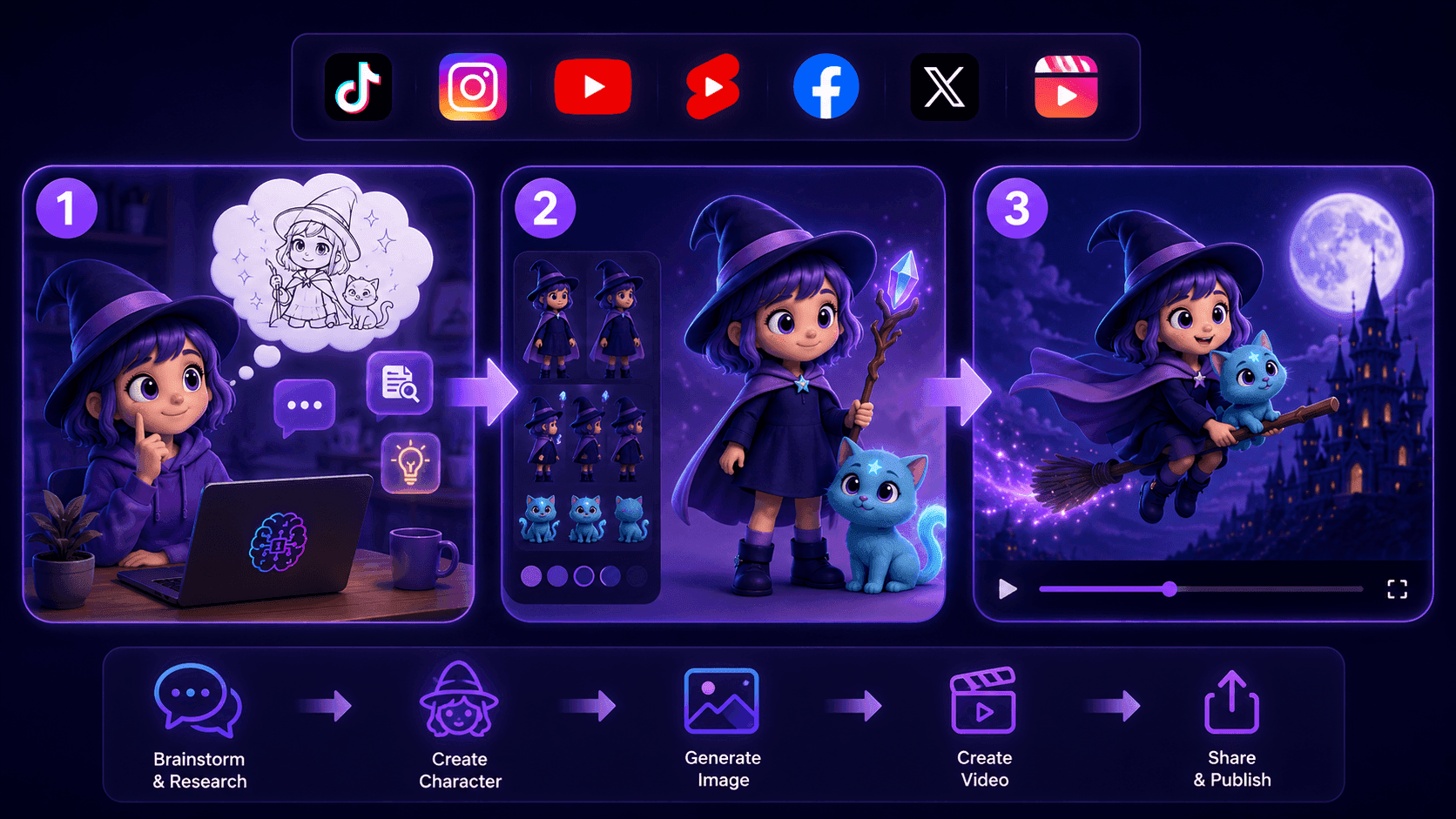
Create Consistent Cartoon Content in Just a Few Steps
Create engaging cartoon videos for TikTok and Reels with 1min.AI. Research ideas, create characters, and turn images into animated videos in 3 simple steps.
 Lien Anh Vu
One Product, 10 UGC Creatives: How AI Makes Content Testing Easier
Create more authentic UGC with an AI UGC video generator, test more creative angles and scale affiliate content without filming every version.
Lien Anh Vu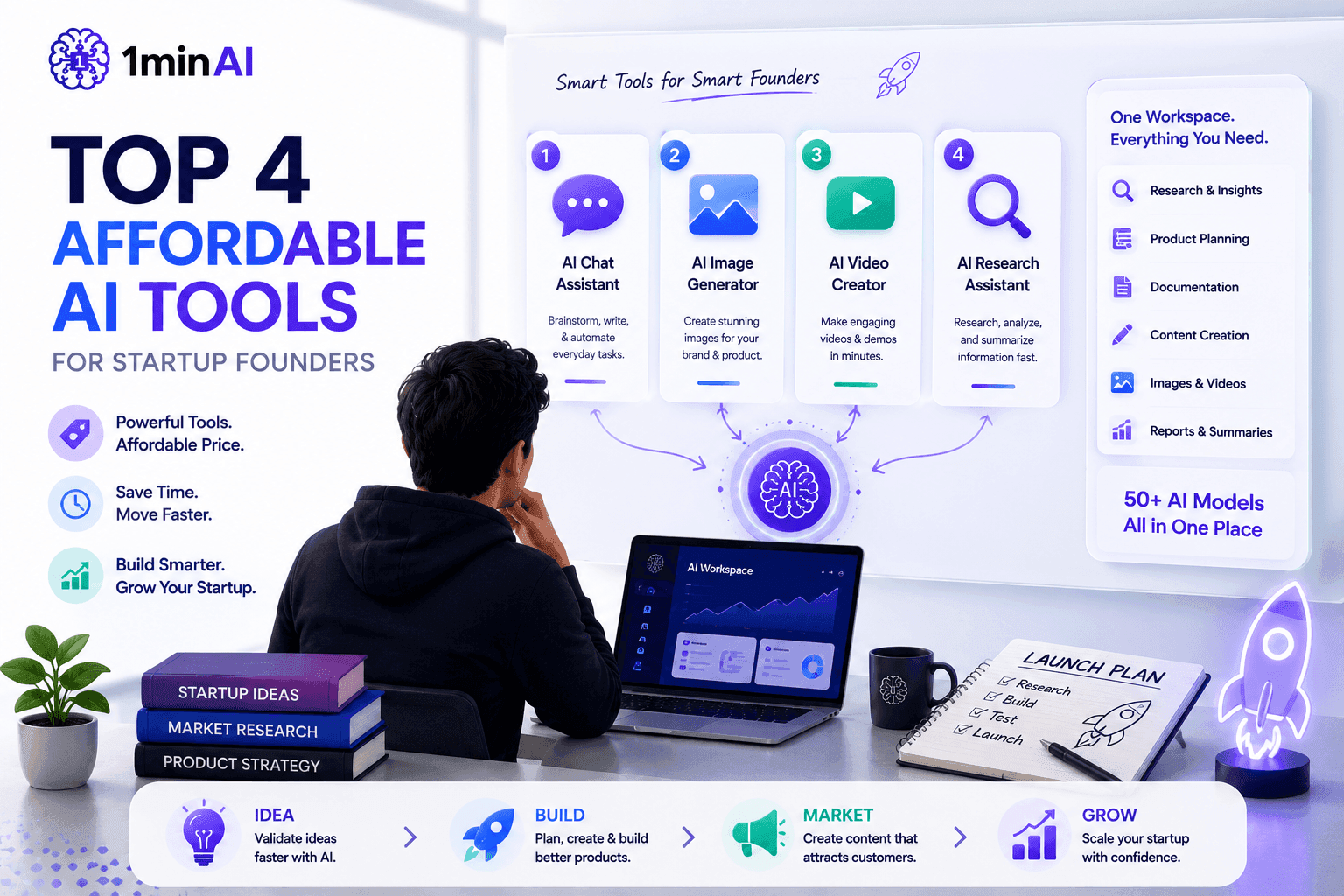
Top 4 Affordable AI Tools for Startup Founders
Discover the top 4 affordable AI tools for startup founders to validate ideas, build products, create content, and launch faster without overspending.
 Tram Ta
AI Features
Comprehensive AI features that streamline workflows, improve efficiency, and empower teams to achieve more.
Create Consistent Cartoon Content in Just a Few Steps
Create engaging cartoon videos for TikTok and Reels with 1min.AI. Research ideas, create characters, and turn images into animated videos in 3 simple steps.
Lien Anh VuOne Product, 10 UGC Creatives: How AI Makes Content Testing Easier
Create more authentic UGC with an AI UGC video generator, test more creative angles and scale affiliate content without filming every version.
Lien Anh Vu
1minAI: Free AI Grammar Checker
Check grammar for free with 1minAI’s AI grammar checker. Find grammar, spelling, and writing mistakes, improve clarity, and polish your content in seconds.
Tram TaAI Use Cases
A curated collection of AI use cases for business, productivity, and industry-specific applications.
Create Consistent Cartoon Content in Just a Few Steps
Create engaging cartoon videos for TikTok and Reels with 1min.AI. Research ideas, create characters, and turn images into animated videos in 3 simple steps.
Lien Anh VuOne Product, 10 UGC Creatives: How AI Makes Content Testing Easier
Create more authentic UGC with an AI UGC video generator, test more creative angles and scale affiliate content without filming every version.
Lien Anh Vu
Best Time to Post on Instagram: A Practical Guide for Better Engagement
Discover the best time to post on Instagram, including the best days and times for different audiences, plus tips to find the ideal posting schedule for your account.
Tram TaAI Tutorials
Learn how to use AI with practical, step-by-step tutorials.

Black Friday AI Tool Deals in 2026
Discover what Black Friday AI tool deals 2026 has to offer. Find out how to secure the 1min.AI lifetime deal via AppSumo, Dealify, Stack Social, and verify on Trustpilot, Slashdot, and Software Advice.
 Hang Nguyen
Create Consistent Cartoon Content in Just a Few Steps
Create engaging cartoon videos for TikTok and Reels with 1min.AI. Research ideas, create characters, and turn images into animated videos in 3 simple steps.
Lien Anh Vu
[Seedance 2.5 New] Better AI Product Videos, Less Rework in 1min.AI
Use Seedance 2.5 image to video on 1min.AI to create more consistent AI product videos, reduce failed generations, save credits, and improve UGC workflows.
Lien Anh VuAI Guides
Learn AI faster with practical guides, real-world examples, and actionable best practices.

Safely Buy AI Tools Online: 2026 Black Friday Guide
Discover how to find and secure the best Black Friday AI deals online. Learn expert strategies to avoid scams, combat subscription fatigue, and verify software.
Hang NguyenCreate Consistent Cartoon Content in Just a Few Steps
Create engaging cartoon videos for TikTok and Reels with 1min.AI. Research ideas, create characters, and turn images into animated videos in 3 simple steps.
Lien Anh Vu[Seedance 2.5 New] Better AI Product Videos, Less Rework in 1min.AI
Use Seedance 2.5 image to video on 1min.AI to create more consistent AI product videos, reduce failed generations, save credits, and improve UGC workflows.
Lien Anh VuAI Solutions
Browse the best AI solutions for automation, coding, research, productivity, customer support, marketing, and business workflows.
Safely Buy AI Tools Online: 2026 Black Friday Guide
Discover how to find and secure the best Black Friday AI deals online. Learn expert strategies to avoid scams, combat subscription fatigue, and verify software.
Hang NguyenCreate Consistent Cartoon Content in Just a Few Steps
Create engaging cartoon videos for TikTok and Reels with 1min.AI. Research ideas, create characters, and turn images into animated videos in 3 simple steps.
Lien Anh VuOne Product, 10 UGC Creatives: How AI Makes Content Testing Easier
Create more authentic UGC with an AI UGC video generator, test more creative angles and scale affiliate content without filming every version.
Lien Anh VuAI Models
Explore the world's leading AI models in one place.
Create Consistent Cartoon Content in Just a Few Steps
Create engaging cartoon videos for TikTok and Reels with 1min.AI. Research ideas, create characters, and turn images into animated videos in 3 simple steps.
Lien Anh VuOne Product, 10 UGC Creatives: How AI Makes Content Testing Easier
Create more authentic UGC with an AI UGC video generator, test more creative angles and scale affiliate content without filming every version.
Lien Anh Vu[Seedance 2.5 New] Better AI Product Videos, Less Rework in 1min.AI
Use Seedance 2.5 image to video on 1min.AI to create more consistent AI product videos, reduce failed generations, save credits, and improve UGC workflows.
Lien Anh VuAI Comparisons
Compare AI tools, models, and platforms to find the best fit for your needs.
Kling AI Vs Veo 3: Which Model Wins?
Kling AI vs Veo 3: compare motion, native audio, pricing & free tiers to see which AI video generator wins for your project - try both on 1min.AI.
 Trang Tran
[Seedance 2.5 New] Better AI Product Videos, Less Rework in 1min.AI
Use Seedance 2.5 image to video on 1min.AI to create more consistent AI product videos, reduce failed generations, save credits, and improve UGC workflows.
Lien Anh Vu
DeepSeek V4 Pro vs Flash Comparison
Compare DeepSeek V4 Pro vs DeepSeek V4 Flash metrics. Optimize your agentic apps and improve AI fact checking on 1min.ai today.
Ngoc HongAI Integrations
Seamlessly integrate AI with the tools you already use to automate work and boost productivity.
POV: You Have 10+ Posts to Make Every Day
Learn how to build an AI content workflow that helps content creators produce 10+ social media posts a day faster with AI brainstorming, image generation, and content creation.
Lien Anh Vu
How to Use an AI Fashion Video Generator for Fashion Week 2026
Turn Fashion Week 2026 ideas into stunning fashion videos with AI. Learn how to brainstorm, create visuals, and transform images into videos with one simple workflow.
Lien Anh Vu
Stop Switching Between AI Apps: How AI Integration Transforms Employer Branding
Discover how AI integration helps HR teams streamline employer branding by combining AI writing, documents, images, video, and multiple AI models into one workspace.
Tram TaAI for Industries
Find the best AI tools and workflows for healthcare, finance, education, legal, manufacturing, retail, real estate, and more
Free AI Product Description Generator
Write product descriptions that sell in minutes. Use this free AI product description generator to turn details or a photo into on-brand copy. Try 1min.AI.
Trang Tran
Best Business Productivity Tools for Startups to Maximize Profits | 1minAI
Discover the best business productivity tools for startups to save time, streamline workflows, reduce repetitive tasks, and support profitable growth with AI.
Tram Ta
Best AI Tool for Content Marketing |1minAI
Looking for the best AI tool for content marketing? See how 1minAI helps marketers research, write, repurpose, create visuals, and scale content from one AI workspace.
Tram TaAI Agents
Discover and run AI agents to automate tasks across your work and daily life.
1minAI: Free AI Grammar Checker
Check grammar for free with 1minAI’s AI grammar checker. Find grammar, spelling, and writing mistakes, improve clarity, and polish your content in seconds.
Tram Ta
AI Agents for Facebook
Use an AI Agent for Facebook to create content, generate images, schedule posts, and publish from your documents and conversations.
Ngoc Hong
AI Agent vs AI Assistant: Which One Actually Saves Designers More Time?
Learn the difference between AI Agent vs AI Assistant and discover which solution helps designers automate repetitive work, reduce revisions, and save more time.
Lien Anh VuAI Workflows
Explore ready-to-use AI workflows for productivity, marketing, sales, support, and more.
Create Consistent Cartoon Content in Just a Few Steps
Create engaging cartoon videos for TikTok and Reels with 1min.AI. Research ideas, create characters, and turn images into animated videos in 3 simple steps.
Lien Anh VuOne Product, 10 UGC Creatives: How AI Makes Content Testing Easier
Create more authentic UGC with an AI UGC video generator, test more creative angles and scale affiliate content without filming every version.
Lien Anh VuPOV: You Have 10+ Posts to Make Every Day
Learn how to build an AI content workflow that helps content creators produce 10+ social media posts a day faster with AI brainstorming, image generation, and content creation.
Lien Anh VuNewsletter
Weekly AI Innovations with 1minAI

🔮 Weekly AI Innovations #141: Seedance 2.5 & Stable Audio 3: Next-Gen AI
Explore Seedance 2.0, 2.5, and StabilityAI's Stable Audio 3 on 1min.ai. Generate studio-grade audio and synchronized motion with next-gen generative AI.
Hang Nguyen
🔮 Weekly AI Innovations #140: Deepseek 4.1 Flash & Gemini Upgrades
Explore Deepseek 4.1 Flash and new Gemini models on 1min.ai. Plus, check our update on your Billing - Usage page for better clarity.
Hang Nguyen
🔮 Weekly AI Innovations #139: Dawn of the next-gen AI
Discover the immense power of GPT-6 Astra and Claude Fable 5.1. Unlock next-generation AI models on 1min.ai to solve complex tasks effortlessly.
Hang Nguyen