
Gemini 4 Argon vs Opus 5.5: Benchmarks and Pricing

Trang Tran
November 17, 2026
Gemini 4 Argon vs Opus 5.5 compared on benchmarks, pricing and use cases. See which model fits your work, then test both side by side on 1min.AI.
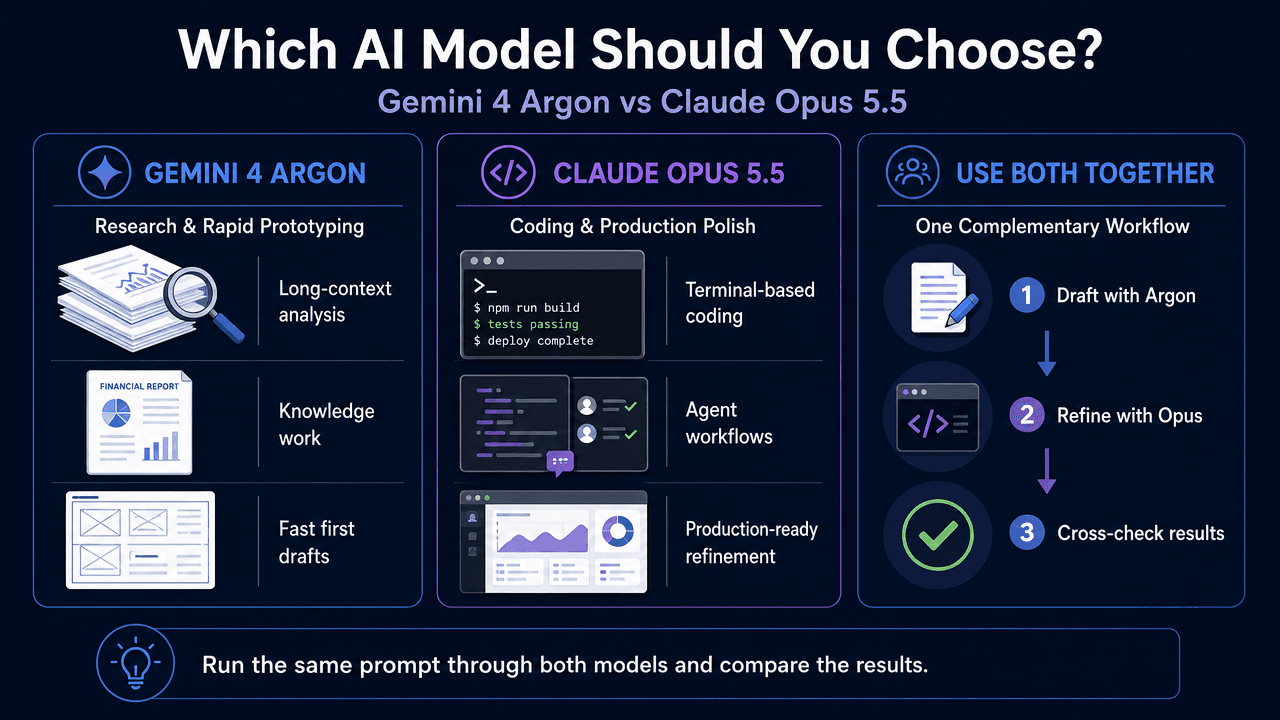
Argon vs Opus 5.5 comes down to the kind of work you do. Gemini 4 Argon leads on long-document research, knowledge work and fast prototyping. Claude Opus 5.5 leads on terminal-based coding, agent workflows and polished, production-ready output. Choose Opus 5.5 for code you plan to ship. Choose Argon for huge documents and quick first drafts. To confirm which one fits your task, run the same prompt through both models in 1min.AI Multi AI Chat.
Argon vs Opus 5.5 at a Glance
| Gemini 4 Argon | Claude Opus 5.5 | |
|---|---|---|
| Developer | Google DeepMind | Anthropic |
| Best at | Long context, legal and finance research, prototyping | Terminal coding, agents, front-end polish |
| Context window | 1,048,576 tokens | 1,000,000 tokens |
| Max output per response | 65,536 tokens by default (about 1M with long decode) | 128K tokens |
| API price per 1M tokens (input / output) | $2 / $10 through Nov 30, 2026, then $4 / $20 | $4 / $20 |
| Artificial Analysis Intelligence Index | 52.6 | 57.6 |
Gemini 4 Argon vs Opus 5.5 Benchmarks
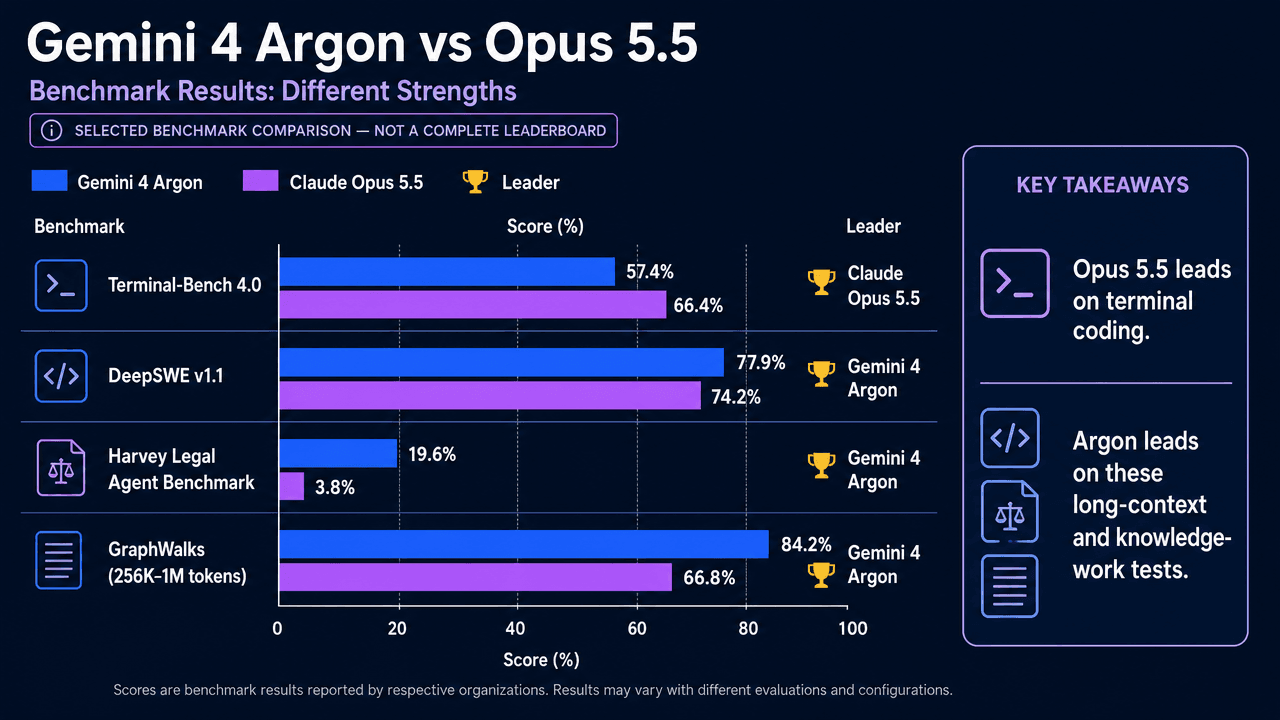
Google’s launch table shows Argon ahead on 14 of the 18 benchmarks where both models have scores. Opus 5.5 wins the rows that matter most to many developers, including terminal-based coding. These figures are vendor-reported, so treat them as a starting point.
Coding Benchmarks
| Benchmark | Argon | Opus 5.5 | Leader |
|---|---|---|---|
| Terminal-Bench 4.0 | 57.4% | 66.4% | Opus 5.5 |
| FrontierSWE v2 | 55.0% | 62.3% | Opus 5.5 |
| DeepSWE v1.1 (long-horizon engineering) | 77.9% | 74.2% | Argon |
| Vibe Code Bench | 91.9% | 90.3% | Effectively tied |
The pattern is clear. Opus 5.5 is stronger when an agent must work step by step in a command line. Argon is stronger on large, long-running engineering jobs such as big refactors.
Knowledge Work and Long Context Benchmarks
| Benchmark | Argon | Opus 5.5 | Leader |
|---|---|---|---|
| Vals Index | 68.9% | 67.0% | Argon |
| Harvey Legal Agent Benchmark | 19.6% | 3.8% | Argon |
| LABBench 2 (lab research) | 88.8% | 73.1% | Argon |
| GraphWalks, 256K to 1M tokens | 84.2% | 66.8% | Argon |
Argon’s biggest edge is on very long inputs. Between 256K and 1M tokens it holds its accuracy while Opus 5.5 drops off.
What Independent Scores Say
Independent boards are more favorable to Opus 5.5. Artificial Analysis rates it 57.6 against 52.6 for Argon. The two models were tested at different effort settings, so that gap is not a controlled comparison. Vals AI, on the other hand, ranks Argon first. Different tests measure different strengths, which is why a single score should never decide for you.
Argon vs Opus Pricing
Argon launched at half the API price of Opus 5.5. The two list prices match from December 1, 2026.
API Price per 1M Tokens
| Rate | Gemini 4 Argon | Claude Opus 5.5 |
|---|---|---|
| Input | $2 (then $4) | $4 |
| Output | $10 (then $20) | $20 |
| Cached input read | $0.10 (then $0.20) | $0.20 |
| Fast mode | Not listed | $8 input / $40 output, up to 2.5x speed |
Real Cost per Task
List price is only half the picture. Argon bills its reasoning tokens at the output rate, and Opus 5.5 always reasons, so token usage shapes the final cost. In published tests, Argon was cheaper on long agentic tasks, such as a robot-arm coding run at $0.72 against $1.09. On short factual questions it cost more, because it spends more tokens thinking before it answers. The best way to know your own cost is to test with your own prompts.
Credit Estimates on 1min.AI
On 1min.AI, the gap between the two models is small. Opus 5.5 uses about 10% more credits per page than Argon.
| Per page (about 500 words) | Gemini 4 Argon | Claude Opus 5.5 |
|---|---|---|
| Input | 8,004 credits | 8,804 credits |
| Output | 40,020 credits | 44,022 credits |
That means you can choose the model that fits the task rather than the one that fits a price sheet.
Which Is Better, Argon or Opus 5.5? Pick by Workload
Most people searching for “Argon vs Opus 5.5” want one thing: the right model for their task. Start here.
Best for Coding and Agentic Workflows: Opus 5.5
Claude Opus 5.5 is the stronger choice for multi-step coding, code review and agents that run in a terminal. In a published robot-arm coding test, it kept every constraint through the entire run, while Argon later broke an obstacle rule. If correctness must hold from start to finish, Opus 5.5 is the safer pick.
Best for Long-Document Research: Argon
Argon fits contracts, financial filings, research papers and large legacy codebases. It leads all four knowledge-work benchmarks in Google’s table and keeps its accuracy on inputs up to one million tokens. Reddit users describe it as the model you reach for when a whole codebase needs to be read and explained.
Best for Creative Prototyping and Front-End Design
This one is a split decision. Opus 5.5 usually produces cleaner interfaces and more complete builds. Argon produces a working draft much faster. In one published test, a simple 3D game took about 5 minutes with Argon and about 20 minutes with Opus 5.5, but the Opus version had richer detail. Use Argon to validate an idea, then Opus 5.5 to finish it.
Context Window, Output Limits and Speed
Both models handle roughly one million tokens of context. The difference is output. Argon shares its 1,048,576 tokens across input, thinking and output. It defaults to 65,536 output tokens per response and reaches about 1 million only with long decode. Opus 5.5 writes up to 128K tokens in one response with no extra setup.
Is Opus 5.5 faster? Opus 5.5 offers a fast mode with up to 2.5x speed. Argon generally returns working drafts sooner on prototyping tasks. Speed also depends on the effort level you choose, so test your own workload.
Argon vs Opus Reddit Reviews
Community feedback is anecdotal, but it shows useful patterns. Users often call Opus 5.5 the heavy lifter for logic and system design. They describe Argon as strong on messy codebases and structured data, and as a good reviewer to place beside Opus. Some report that Argon hallucinates more and needs verification through tests. That matches the benchmarks: each model has a clear lane, and they work well together.
Use Both Models in One Workflow
Many developers and content teams get the best results by pairing the two:
- Draft with Argon: Feed it large documents or a rough idea for a fast first version.
- Build with Opus 5.5: Hand the validated concept over for polished code or copy.
- Cross-check: Ask each model to review the other’s output.
On 1min.AI, you can run this workflow in one workspace. Open Multi AI Chat, select Gemini 4 Argon, then switch to Claude 5.5 Opus in the same conversation. Both models also power Content Generator, Code Generator, Summarizer, Presentation Generator and Document Translator, so each task gets the right model.
Where Does GPT-6 Astra Fit?
Searchers often add a third model to this comparison. Benchmarks place Argon in roughly the same tier as GPT-6 Astra. You can test all three in the same Multi AI Chat window and see which one handles your prompt best.
Test Argon and Opus 5.5 on Your Own Prompt
Benchmarks show peak ability. Your own task shows what actually works. Paste the same prompt into both models in 1min.AI and compare the results. It takes a few minutes, and you will know exactly which model to trust for your next project.
1min.AI is rated Excellent on Trustpilot and is recognized on SourceForge, Slashdot, Capterra, Software Advice and GetApp.
FAQs
Is Gemini 4 Argon better than Claude Opus 5.5?
It depends on the task. Argon scores higher on 14 of 18 shared benchmarks in Google’s table, mainly knowledge work and long context. Opus 5.5 leads terminal coding and the Artificial Analysis Intelligence Index, 57.6 to 52.6.
Which is better for coding, Argon or Opus 5.5?
Opus 5.5 is stronger for terminal-based agents and finished code, scoring 66.4% on Terminal-Bench 4.0 against 57.4%. Argon leads on DeepSWE v1.1, so it is competitive on large refactoring work.
How much does Argon cost compared to Opus 5.5?
Argon costs $2 input and $10 output per million tokens through November 30, 2026, then $4 and $20. Opus 5.5 costs $4 and $20.
Is Opus 5.5 good?
Yes. It is Anthropic’s flagship, delivering Claude Fable 5.1-level performance at a lower cost, with strong results in agentic coding, code review, computer use and financial analysis.
Is Opus 5.5 cheaper than Opus 5?
Yes. Anthropic lowered token prices by about 20% compared with Opus 5.
What is better than Opus 5?
Opus 5.5 is the newer model. It scores 66.4% on Terminal-Bench 4.0, up from 52.3% for Opus 5.
Is Opus the best AI model?
Not for every task. Opus 5.5 leads many coding benchmarks, while Argon leads long-context and legal research benchmarks. The best model depends on your workload.
- #Commerce
Alternatives
Discover the best alternatives to 1minAI and compare features, pricing, and use cases.

1min.AI vs OpenRouter
1min.AI vs. OpenRouter: Compare the ready-to-use AI creation product against the technical API tool. Find out if you need a zero-code creative studio or a coding infrastructure hub.
 Ngoc Hong
1min.AI vs. Metricool: Which Platform Does More for Your Marketing Workflow?
Compare 1min.AI vs. Metricool across content creation, visual production, scheduling, analytics, MCP, and pricing to find the right platform for your marketing workflow.
1min.AI vs. Hootsuite: Which Social Media Tool Fits Your Workflow?
Compare 1min.AI vs. Hootsuite to explore their AI content creation, social media publishing, analytics, pricing, and collaboration features. Find the right tool for your workflow.
AI Tools
Discover the best AI tools to boost productivity, creativity, and everyday work.
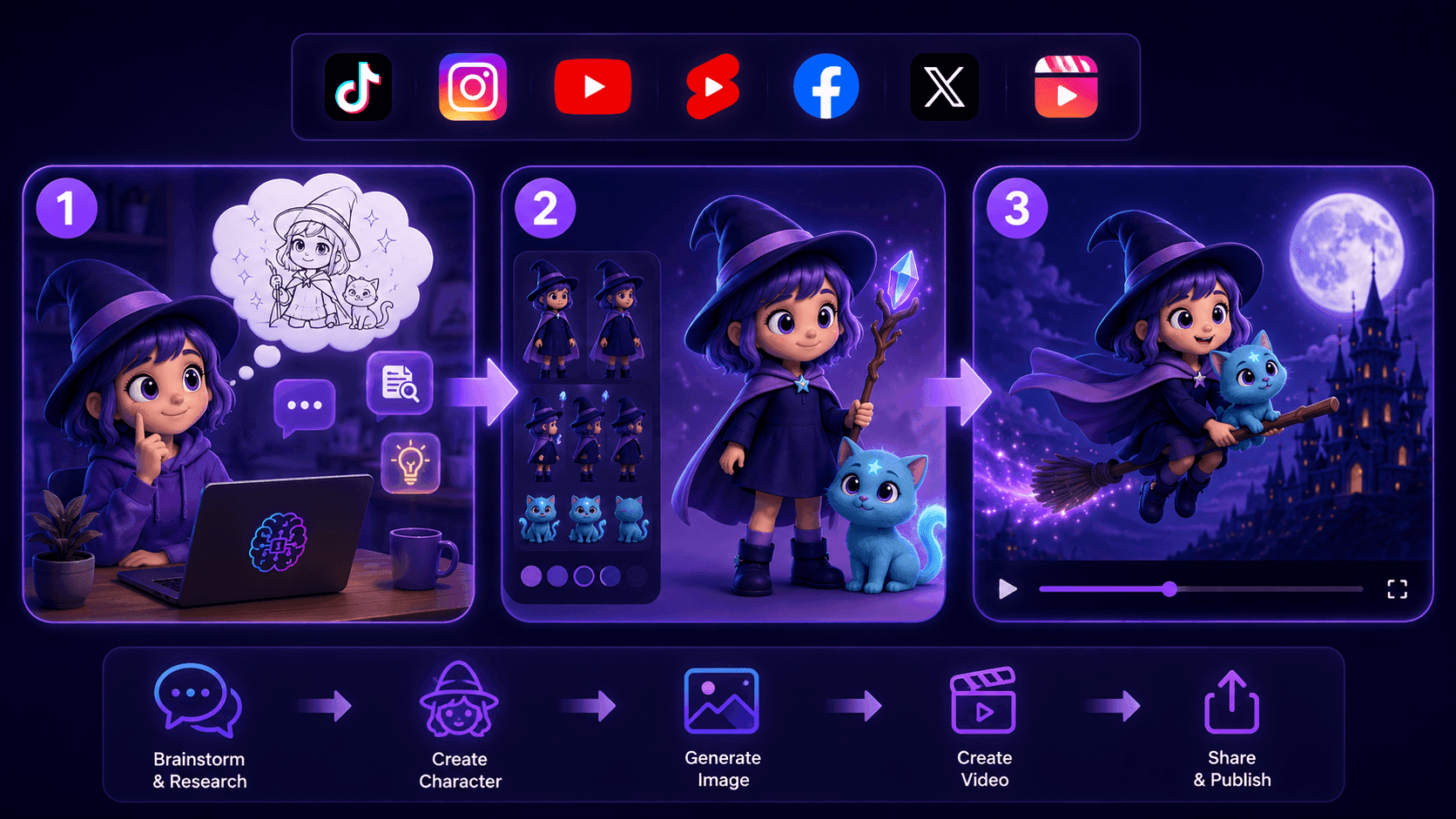
Create Consistent Cartoon Content in Just a Few Steps
Create engaging cartoon videos for TikTok and Reels with 1min.AI. Research ideas, create characters, and turn images into animated videos in 3 simple steps.
 Lien Anh Vu
One Product, 10 UGC Creatives: How AI Makes Content Testing Easier
Create more authentic UGC with an AI UGC video generator, test more creative angles and scale affiliate content without filming every version.
Lien Anh Vu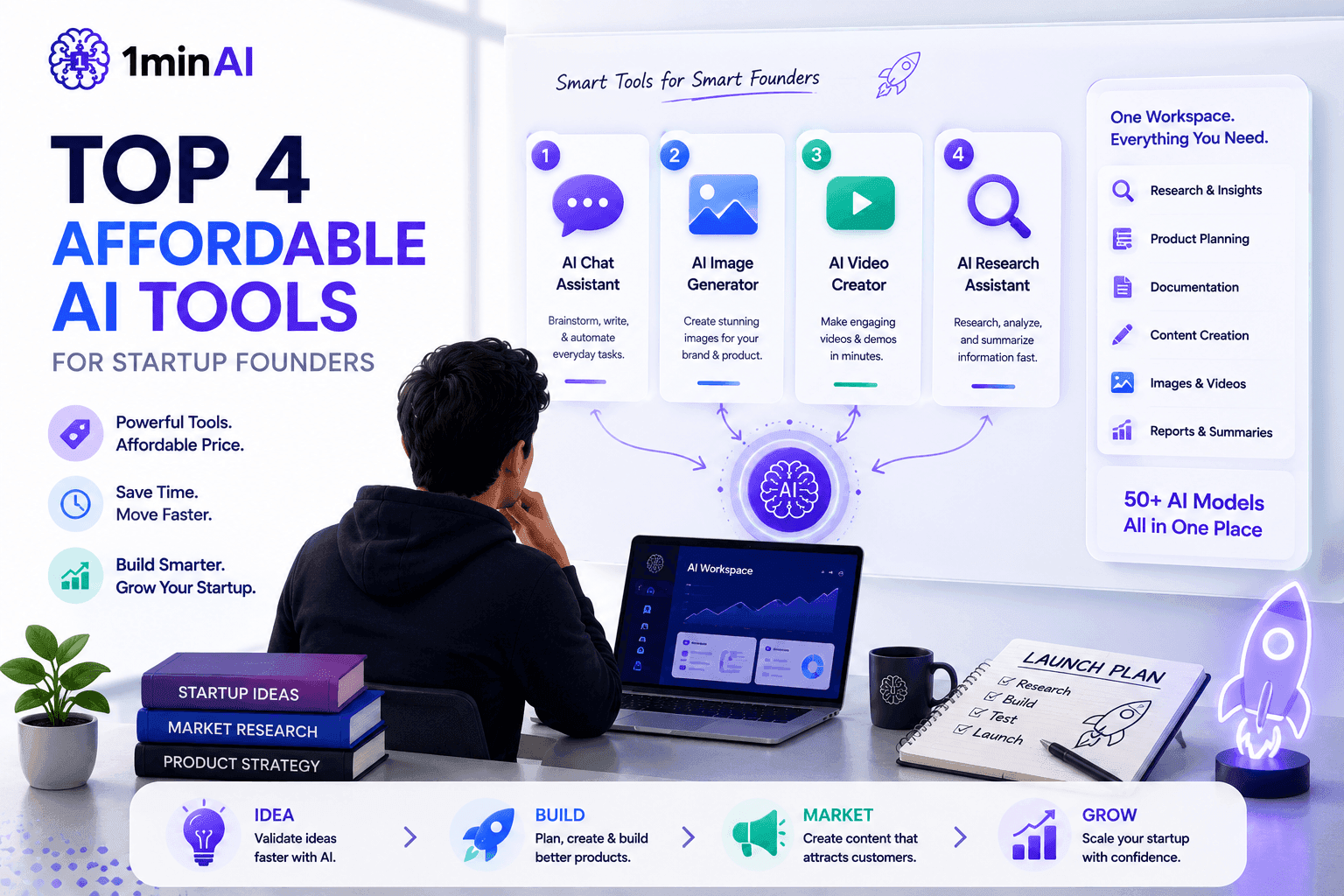
Top 4 Affordable AI Tools for Startup Founders
Discover the top 4 affordable AI tools for startup founders to validate ideas, build products, create content, and launch faster without overspending.
 Tram Ta
AI Features
Comprehensive AI features that streamline workflows, improve efficiency, and empower teams to achieve more.
Create Consistent Cartoon Content in Just a Few Steps
Create engaging cartoon videos for TikTok and Reels with 1min.AI. Research ideas, create characters, and turn images into animated videos in 3 simple steps.
Lien Anh VuOne Product, 10 UGC Creatives: How AI Makes Content Testing Easier
Create more authentic UGC with an AI UGC video generator, test more creative angles and scale affiliate content without filming every version.
Lien Anh Vu
1minAI: Free AI Grammar Checker
Check grammar for free with 1minAI’s AI grammar checker. Find grammar, spelling, and writing mistakes, improve clarity, and polish your content in seconds.
Tram TaAI Use Cases
A curated collection of AI use cases for business, productivity, and industry-specific applications.
Create Consistent Cartoon Content in Just a Few Steps
Create engaging cartoon videos for TikTok and Reels with 1min.AI. Research ideas, create characters, and turn images into animated videos in 3 simple steps.
Lien Anh VuOne Product, 10 UGC Creatives: How AI Makes Content Testing Easier
Create more authentic UGC with an AI UGC video generator, test more creative angles and scale affiliate content without filming every version.
Lien Anh Vu
Best Time to Post on Instagram: A Practical Guide for Better Engagement
Discover the best time to post on Instagram, including the best days and times for different audiences, plus tips to find the ideal posting schedule for your account.
Tram TaAI Tutorials
Learn how to use AI with practical, step-by-step tutorials.

Black Friday AI Tool Deals in 2026
Discover what Black Friday AI tool deals 2026 has to offer. Find out how to secure the 1min.AI lifetime deal via AppSumo, Dealify, Stack Social, and verify on Trustpilot, Slashdot, and Software Advice.
 Hang Nguyen
Create Consistent Cartoon Content in Just a Few Steps
Create engaging cartoon videos for TikTok and Reels with 1min.AI. Research ideas, create characters, and turn images into animated videos in 3 simple steps.
Lien Anh Vu
[Seedance 2.5 New] Better AI Product Videos, Less Rework in 1min.AI
Use Seedance 2.5 image to video on 1min.AI to create more consistent AI product videos, reduce failed generations, save credits, and improve UGC workflows.
Lien Anh VuAI Guides
Learn AI faster with practical guides, real-world examples, and actionable best practices.

Safely Buy AI Tools Online: 2026 Black Friday Guide
Discover how to find and secure the best Black Friday AI deals online. Learn expert strategies to avoid scams, combat subscription fatigue, and verify software.
Hang NguyenCreate Consistent Cartoon Content in Just a Few Steps
Create engaging cartoon videos for TikTok and Reels with 1min.AI. Research ideas, create characters, and turn images into animated videos in 3 simple steps.
Lien Anh Vu[Seedance 2.5 New] Better AI Product Videos, Less Rework in 1min.AI
Use Seedance 2.5 image to video on 1min.AI to create more consistent AI product videos, reduce failed generations, save credits, and improve UGC workflows.
Lien Anh VuAI Solutions
Browse the best AI solutions for automation, coding, research, productivity, customer support, marketing, and business workflows.
Safely Buy AI Tools Online: 2026 Black Friday Guide
Discover how to find and secure the best Black Friday AI deals online. Learn expert strategies to avoid scams, combat subscription fatigue, and verify software.
Hang NguyenCreate Consistent Cartoon Content in Just a Few Steps
Create engaging cartoon videos for TikTok and Reels with 1min.AI. Research ideas, create characters, and turn images into animated videos in 3 simple steps.
Lien Anh VuOne Product, 10 UGC Creatives: How AI Makes Content Testing Easier
Create more authentic UGC with an AI UGC video generator, test more creative angles and scale affiliate content without filming every version.
Lien Anh VuAI Models
Explore the world's leading AI models in one place.
Create Consistent Cartoon Content in Just a Few Steps
Create engaging cartoon videos for TikTok and Reels with 1min.AI. Research ideas, create characters, and turn images into animated videos in 3 simple steps.
Lien Anh VuOne Product, 10 UGC Creatives: How AI Makes Content Testing Easier
Create more authentic UGC with an AI UGC video generator, test more creative angles and scale affiliate content without filming every version.
Lien Anh Vu[Seedance 2.5 New] Better AI Product Videos, Less Rework in 1min.AI
Use Seedance 2.5 image to video on 1min.AI to create more consistent AI product videos, reduce failed generations, save credits, and improve UGC workflows.
Lien Anh VuAI Comparisons
Compare AI tools, models, and platforms to find the best fit for your needs.
Kling AI Vs Veo 3: Which Model Wins?
Kling AI vs Veo 3: compare motion, native audio, pricing & free tiers to see which AI video generator wins for your project - try both on 1min.AI.
 Trang Tran
[Seedance 2.5 New] Better AI Product Videos, Less Rework in 1min.AI
Use Seedance 2.5 image to video on 1min.AI to create more consistent AI product videos, reduce failed generations, save credits, and improve UGC workflows.
Lien Anh Vu
DeepSeek V4 Pro vs Flash Comparison
Compare DeepSeek V4 Pro vs DeepSeek V4 Flash metrics. Optimize your agentic apps and improve AI fact checking on 1min.ai today.
Ngoc HongAI Integrations
Seamlessly integrate AI with the tools you already use to automate work and boost productivity.
POV: You Have 10+ Posts to Make Every Day
Learn how to build an AI content workflow that helps content creators produce 10+ social media posts a day faster with AI brainstorming, image generation, and content creation.
Lien Anh Vu
How to Use an AI Fashion Video Generator for Fashion Week 2026
Turn Fashion Week 2026 ideas into stunning fashion videos with AI. Learn how to brainstorm, create visuals, and transform images into videos with one simple workflow.
Lien Anh Vu
Stop Switching Between AI Apps: How AI Integration Transforms Employer Branding
Discover how AI integration helps HR teams streamline employer branding by combining AI writing, documents, images, video, and multiple AI models into one workspace.
Tram TaAI for Industries
Find the best AI tools and workflows for healthcare, finance, education, legal, manufacturing, retail, real estate, and more
Try Image To Video AI With Prompt Online Free
Try image to video AI with prompt online free, no login and no watermark. Upload a photo, type the motion you want, and get a short video in minutes.
Trang Tran
No Photoshoot? Create AI Fashion Videos With Seedance 2.5
No photoshoot needed! Create stunning AI fashion videos with Seedance 2.5 on 1min.AI using outfit references, cinematic prompts, and surreal scenes.
Lien Anh Vu
Voice Cloning AI Free: How to Clone Any Voice Online in Minutes
Try voice cloning AI free with 1min.AI. Upload a 5-second clip, pick an ElevenLabs model, choose from 32 languages, and turn text to speech in your own voice.
Trang TranAI Agents
Discover and run AI agents to automate tasks across your work and daily life.
1minAI: Free AI Grammar Checker
Check grammar for free with 1minAI’s AI grammar checker. Find grammar, spelling, and writing mistakes, improve clarity, and polish your content in seconds.
Tram Ta
AI Agents for Facebook
Use an AI Agent for Facebook to create content, generate images, schedule posts, and publish from your documents and conversations.
Ngoc Hong
AI Agent vs AI Assistant: Which One Actually Saves Designers More Time?
Learn the difference between AI Agent vs AI Assistant and discover which solution helps designers automate repetitive work, reduce revisions, and save more time.
Lien Anh VuAI Workflows
Explore ready-to-use AI workflows for productivity, marketing, sales, support, and more.
Create Consistent Cartoon Content in Just a Few Steps
Create engaging cartoon videos for TikTok and Reels with 1min.AI. Research ideas, create characters, and turn images into animated videos in 3 simple steps.
Lien Anh VuOne Product, 10 UGC Creatives: How AI Makes Content Testing Easier
Create more authentic UGC with an AI UGC video generator, test more creative angles and scale affiliate content without filming every version.
Lien Anh VuPOV: You Have 10+ Posts to Make Every Day
Learn how to build an AI content workflow that helps content creators produce 10+ social media posts a day faster with AI brainstorming, image generation, and content creation.
Lien Anh VuNewsletter
Weekly AI Innovations with 1minAI
🔮 Weekly AI Innovations #146: Mistral 3.5, Qwen Image & Cohere A+ are ready on 1min.ai
Deploy Mistral Large 3, Qwen Image 3.0, and Cohere Command A+ on 1min.ai. Boost RAG accuracy and cut visual generation latency in one unified AI workspace.
Hang Nguyen
🔮 Weekly AI Innovations #145: X Content Agent & GPT 6.1 Terra on 1min.ai
Scale viral reach with the X Content Agent on 1min.ai. Discover an end-to-end 4-stage pipeline with zero token burn, plus the launch of GPT 6.1 Terra.
Hang Nguyen
🔮 Weekly AI Innovations #144: LinkedIn Content Agent: Complete B2B Publishing Pipeline
Scale B2B influence with the LinkedIn Content Agent on 1min.ai. Discover an end-to-end 4-stage pipeline with zero redundant token burn and 1-click publishing.
Hang Nguyen