
Anthropic Claude Opus 5.5 Guidance: How to Use It for Coding, Research, and Professional Work

Tram Ta
November 17, 2026
Get Anthropic Claude Opus 5.5 guidance with practical prompts, coding tips, and use cases. Learn how to explore Claude through 1minAI.
Artificial intelligence is becoming more capable of handling complex tasks, from debugging large software projects to analyzing business information and creating professional documents. Among Anthropic's latest models, Claude Opus 5.5 stands out as a powerful option for users who need deeper reasoning, advanced coding assistance, and reliable support for long-running work.
This guide provides practical Anthropic Claude Opus 5.5 guidance for developers, researchers, business professionals, and everyday AI users. You'll learn about its capabilities, explore useful prompts, discover how to improve your results, and find ways to work with Claude through 1minAI.
What Is Anthropic Claude Opus 5.5?
Claude Opus 5.5 is an advanced AI model developed by Anthropic and released on September 22, 2026. It is the first model in Anthropic's Claude 5.5 family and is designed for demanding coding, agentic workflows, and professional knowledge work.
Compared with Claude Opus 5, Opus 5.5 brings improvements in reasoning, task completion, coding efficiency, and communication. Anthropic also reports that it can cost approximately 40% less to run on typical workloads.
Rather than focusing only on generating quick answers, Claude Opus 5.5 is designed to handle more complicated tasks that require planning, analysis, and multiple steps.
Key capabilities of Claude Opus 5.5
1. Advanced coding and software development
Claude Opus 5.5 can assist with building features, debugging, refactoring, reviewing code, and working across large codebases.
It is particularly useful when a task requires understanding how different components interact rather than simply generating an isolated code snippet.
2. Complex reasoning and problem-solving
The model can analyze complicated instructions, break large problems into smaller tasks, compare possible approaches, and explain its conclusions.
3. Agentic workflows
Opus 5.5 is designed to support AI agents that coordinate tools, manage multi-step tasks, and continue working toward a defined objective.
4. Professional knowledge work
You can use it to analyze documents, prepare reports, organize information, evaluate business scenarios, and produce structured professional content.
5. Visual and document understanding
The model supports image inputs, making it useful for interpreting screenshots, charts, diagrams, and other visual information.
6. Improved communication
Anthropic highlights clearer communication as one of the improvements in Opus 5.5. It aims to present important information first and make complex work easier to review.
Claude Opus 5.5 vs. Claude Opus 5: What's New?
Claude Opus 5.5 is more than a routine model update. Anthropic reports improvements in performance, efficiency, and the ability to complete complex work.
Here is a high-level comparison based on Anthropic's release information.
| Comparison | Claude Opus 5 | Claude Opus 5.5 |
|---|---|---|
| Coding | Strong coding capabilities | Improved agentic coding and large codebase work |
| Reasoning | Advanced reasoning | Stronger performance on complex tasks |
| Long-running tasks | Supports complex workflows | More efficient multi-step task execution |
| Communication | Detailed responses | Clearer, more direct communication |
| API input price | $5 per million tokens | $4 per million tokens |
| API output price | $25 per million tokens | $20 per million tokens |
| Cached input reads | $0.50 per million tokens | $0.20 per million tokens |
Anthropic reports that Opus 5.5 can reduce typical workload costs by approximately 40% compared with Opus 5, combining lower token prices with improved token efficiency.
These are Anthropic API prices, not guaranteed prices on third-party AI platforms. Subscription usage and platform credit systems may work differently.
What about Claude Fable 5.1?
Claude Opus 5.5 and Claude Fable 5.1 are different models.
Anthropic describes Opus 5.5 as performing at the level of Fable 5.1 on most work, while maintaining its own Opus model identity and capabilities.
This distinction matters when choosing a model. Do not assume that an Opus 5.5 result, API identifier, or subscription entitlement is interchangeable with Fable 5.1.
How to Use Claude Opus 5.5 Effectively: 7 Practical Guidelines
The quality of an AI response depends on more than model capability. Your instructions, context, examples, and expectations all influence the result.
Here are seven practical guidelines for getting better results from Claude Opus 5.5.
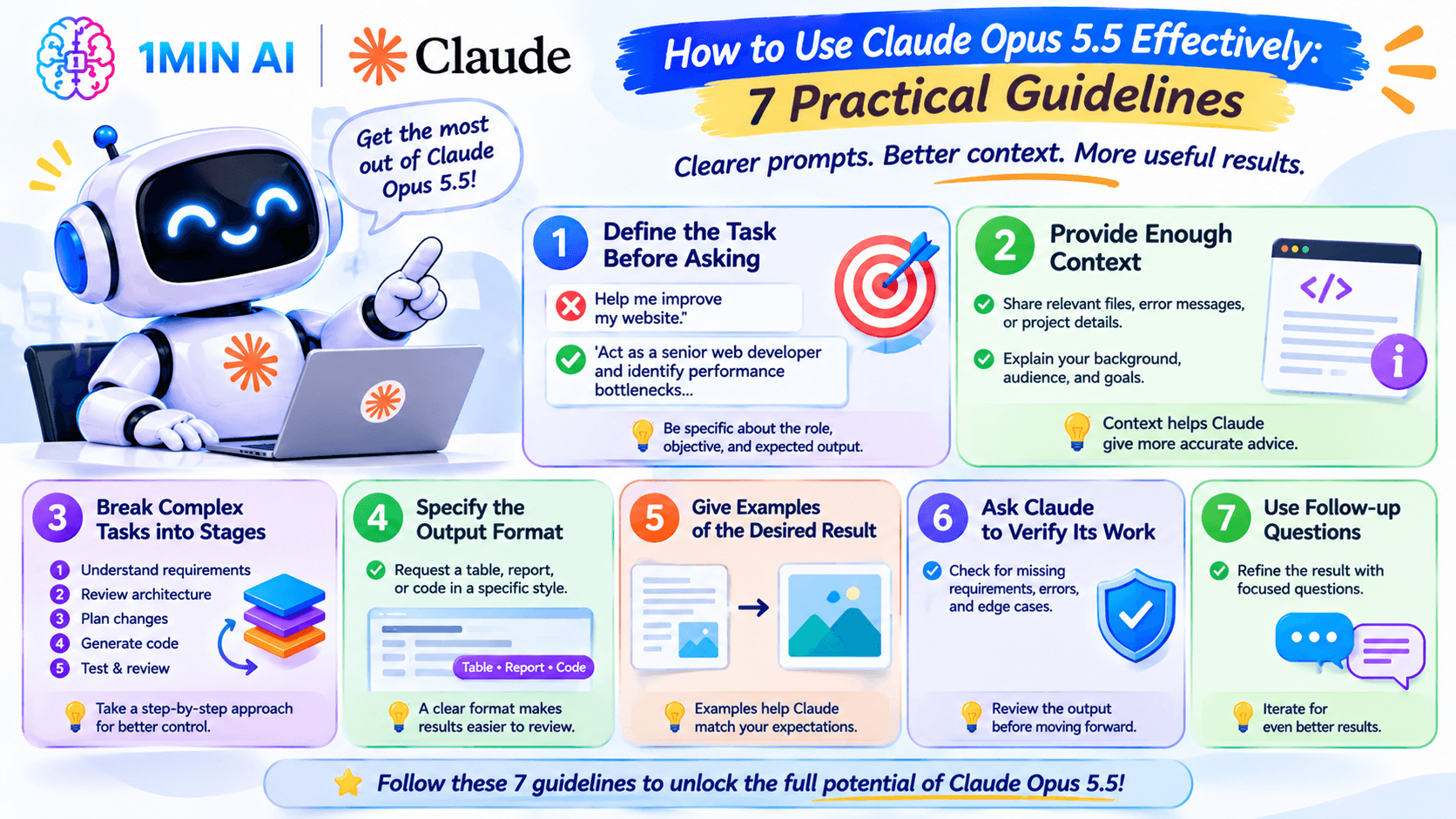
1. Define the task before asking for an answer
Avoid vague instructions such as:
Help me improve my website.
This does not tell Claude what needs improvement or how to evaluate success.
Instead, define the role, objective, context, and expected output.
Better prompt:
Act as a senior web developer specializing in website performance.
Review the website structure and code I provide. Identify potential performance bottlenecks, explain their impact, and prioritize improvements based on implementation difficulty and expected benefit.
Return a table with the issue, evidence, recommended solution, and priority. Do not suggest changes that could break existing functionality without explaining the risks.
This gives Claude a clear direction and a measurable output format.
2. Provide enough context
Claude performs better when it understands the background of your task.
For coding, provide relevant source files, error messages, framework versions, and expected behavior.
For research, explain the topic, audience, scope, and sources you want to use.
For business analysis, provide the relevant figures and assumptions.
Prompt example:
I am developing an e-commerce website using React and Node.js.
The checkout page becomes slow when customers add multiple products to their cart.
Analyze the code I provide and identify possible causes. Consider unnecessary API requests, repeated component rendering, and inefficient state management.
Explain your findings before proposing code changes.
Do not assume Claude knows the structure of your project unless you provide it.
3. Break complicated tasks into stages
Although Opus 5.5 is built for complex tasks, asking for too many unrelated outputs in one prompt can make the response difficult to evaluate.
A better approach is to divide a large assignment into manageable stages.
For example, when developing a website feature:
- Understand the requirements.
- Review the existing architecture.
- Identify the files that need changes.
- Propose an implementation plan.
- Generate or modify the code.
- Create tests.
- Review the final implementation.
This workflow gives you more opportunities to check the model's decisions before moving forward.
4. Specify the output format
If you need a report, request a report. If you need code, specify the programming language and structure.
For example:
Analyze the information below and return your answer in three sections:
- Executive summary
- Detailed findings
- Recommended next steps
Use concise language, include a comparison table where useful, and clearly distinguish verified information from assumptions.
Structured output is easier to review, reuse, and share.
5. Give examples of the desired result
Examples help Claude understand your expectations.
If you want a particular writing style, provide a sample paragraph. If you want a specific code structure, share a representative function.
Prompt example:
Rewrite the product description below in the same style as this example.
Style example: [Paste example]
Product information: [Paste product details]
Keep the tone professional and friendly. Avoid exaggerated claims and preserve all technical specifications.
6. Ask Claude to verify its work
Do not treat the first response as the final answer, especially when working with code or technical information.
Ask Claude to review its output against your requirements.
Prompt example:
Review your previous solution against the original requirements.
Check for:
- Missing requirements
- Incorrect assumptions
- Potential edge cases
- Security concerns
- Performance problems
Identify any problems and suggest corrections. Do not claim that tests passed unless you actually executed them.
This encourages a more useful review process instead of simply accepting the first result.
7. Use follow-up questions to improve the result
You do not need to write a perfect prompt immediately.
Start with a clear request, review the answer, and refine it through follow-up questions.
For example:
- Can you explain this solution in simpler language?
- What assumptions did you make?
- Can you provide another implementation?
- Which approach is easier to maintain?
- Can you identify potential problems before deployment?
A focused conversation often produces better results than repeatedly starting from scratch.
How to Access and Use Claude Through 1minAI
If you want to explore Claude without managing multiple AI tools separately, you can visit 1minAI.
1minAI is an all-in-one AI workspace that brings together multiple AI models and tools, including Multi AI Chat, writing, document, image, video, and coding-related workflows.
You can use the platform to explore available Claude models and compare AI responses within a broader workspace.
Important model availability note: The Claude pages linked below currently identify Claude 5 Sonnet and earlier Claude Fable offerings. They do not establish that Claude Opus 5.5 is available in every 1minAI account. Check the live model selector before assuming you can select Opus 5.5 directly.
Step 1: Visit 1minAI
Open 1minAI and explore the Multi AI Chat experience.
The platform provides access to different AI chat and productivity workflows.
Step 2: Check the available Claude models
Open the model selector and check which Anthropic models are currently available to your account.
You can also explore Claude 5 Sonnet on 1minAI as another Claude option.
Remember that Sonnet and Opus are different model tiers. If Opus 5.5 is not listed, do not assume that selecting Sonnet gives you Opus 5.5 capabilities.
Step 3: Start with a specific task
Choose a practical task, such as:
- Reviewing a code snippet.
- Summarizing a document.
- Creating a project outline.
- Explaining a technical concept.
- Comparing different implementation approaches.
Provide enough context and define the output you expect.
Step 4: Refine the response
Ask follow-up questions to clarify the answer, identify weaknesses, or request a different format.
If you want to compare approaches, you can also explore AI Chat with Multiple AI Assistants and compare responses from available models.
Step 5: Explore specialized coding workflows
For developers, 1minAI also provides specialized code-related tools.
You can explore:
- AI Code Translator to help convert code between programming languages.
- Code Generator API documentation to learn how to send code-generation requests through the 1minAI API.
The Code Generator API documentation describes a model-based code-generation endpoint. Check its available model list and current API specifications before assuming a particular Claude model is supported.
Claude Opus 5.5 vs. Claude Sonnet 5.5: Which Should You Choose?
Opus and Sonnet are designed for different levels of work.
In general, Opus is the more capable choice for complex reasoning and demanding tasks, while Sonnet is positioned for faster, more cost-efficient everyday work.
| Task | Suggested model |
|---|---|
| Complex software architecture | Opus 5.5 |
| Large codebase refactoring | Opus 5.5 |
| Difficult debugging | Opus 5.5 |
| Complex research analysis | Opus 5.5 |
| Everyday coding assistance | Sonnet 5.5 |
| Routine writing and summarization | Sonnet 5.5 |
| Fast brainstorming | Sonnet 5.5 |
The best choice depends on the complexity of the task, available model access, latency requirements, and cost.
If you want to compare Claude with another model family, read Claude vs. Gemini for Coding for a broader developer-focused comparison.
Common Mistakes to Avoid When Using Claude Opus 5.5
Even a highly capable model can produce inaccurate or incomplete results when the instructions are unclear.
Here are common mistakes to avoid:
| Common mistake | Better approach |
|---|---|
| Giving vague instructions | Define the objective and expected result |
| Providing insufficient context | Share relevant files, examples, and constraints |
| Asking for too many unrelated tasks | Break large assignments into stages |
| Accepting generated code immediately | Review and test the implementation |
| Assuming every answer is accurate | Verify important facts and calculations |
| Ignoring security considerations | Review permissions, inputs, and generated code |
| Confusing model names | Check the selected model and its version |
A useful habit is to treat Claude as a capable collaborator rather than an unquestionable source of truth.
Frequently Asked Questions About Anthropic Claude Opus 5.5
1. What is Claude Opus 5.5 best for?
Claude Opus 5.5 is designed for demanding coding, agentic workflows, complex reasoning, and professional knowledge work.
It is particularly useful for tasks involving multiple steps, large codebases, document analysis, and detailed problem-solving.
2. Is Claude Opus 5.5 better than Claude Opus 5?
Anthropic reports improvements in coding, reasoning, communication, and efficiency compared with Opus 5.
It also reports approximately 40% lower cost on typical workloads. Actual performance and cost savings depend on the task and usage pattern.
3. What is the Claude Opus 5.5 API model ID?
The documented API model identifier is:
claude-opus-5-5
Developers should check Anthropic's current API documentation for the latest model specifications and supported features.
4. How much does Claude Opus 5.5 cost?
Anthropic's published standard API prices are:
- Input: $4 per million tokens.
- Output: $20 per million tokens.
- Cache reads: $0.20 per million tokens.
- Cache writes: $5 per million tokens.
Fast mode has separate pricing. These are API rates, not subscription prices or 1minAI credit costs.
5. Can Claude Opus 5.5 help with large software projects?
Yes. It is designed to handle complex coding tasks, including codebase-wide migrations, debugging, refactoring, and code review.
However, provide relevant project context and verify all proposed changes with appropriate tests.
6. Can beginners use Claude Opus 5.5?
Yes. Beginners can use it to explain technical concepts, learn programming, summarize documents, and organize ideas.
The key is to describe your experience level and ask for explanations that match your knowledge.
7. Can I use Claude Opus 5.5 on 1minAI?
Check the current 1minAI model selector to see whether Opus 5.5 is available to your account.
1minAI has Claude-related chat pages, including Claude 5 Sonnet. However, the availability of a specific Opus 5.5 model should be confirmed in the live platform rather than inferred from another Claude model page.
Final Thoughts: Get More from Claude Opus 5.5 with Better Guidance
Claude Opus 5.5 is designed for users who need more than quick AI-generated answers. Its strengths in agentic coding, complex reasoning, and professional knowledge work make it useful for developers, researchers, and business professionals.
However, the model is only one part of the workflow. Clear instructions, relevant context, structured prompts, and careful verification are equally important.
Start with a specific task, provide the information Claude needs, and refine the output through focused follow-up questions.
If you want to explore Claude and other AI models in one workspace, visit 1minAI. Check the available Claude models, experiment with Multi AI Chat, and explore specialized coding tools to find a workflow that fits your needs.
Note: Model availability, API identifiers, pricing, and platform features may change. Verify current details with Anthropic and 1minAI before making purchasing or implementation decisions.
For more AI capabilities, visit 1minAI Features and try the 1minAI Agent.
- #Commerce
- #Information
Alternatives
Discover the best alternatives to 1minAI and compare features, pricing, and use cases.

1min.AI vs OpenRouter
1min.AI vs. OpenRouter: Compare the ready-to-use AI creation product against the technical API tool. Find out if you need a zero-code creative studio or a coding infrastructure hub.
 Ngoc Hong
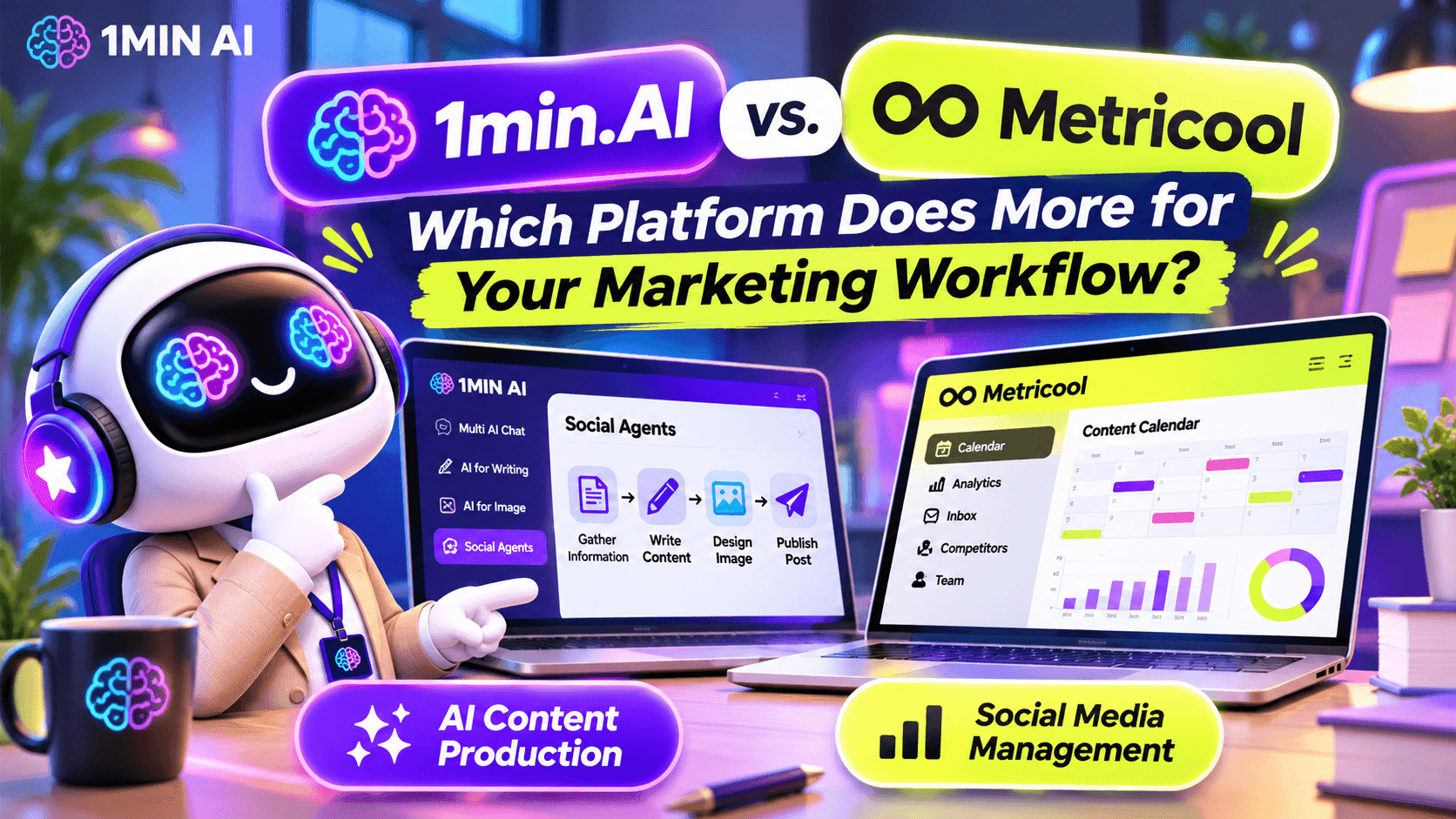
1min.AI vs. Metricool: Which Platform Does More for Your Marketing Workflow?
Compare 1min.AI vs. Metricool across content creation, visual production, scheduling, analytics, MCP, and pricing to find the right platform for your marketing workflow.

1min.AI vs. Hootsuite: Which Social Media Tool Fits Your Workflow?
Compare 1min.AI vs. Hootsuite to explore their AI content creation, social media publishing, analytics, pricing, and collaboration features. Find the right tool for your workflow.
AI Tools
Discover the best AI tools to boost productivity, creativity, and everyday work.
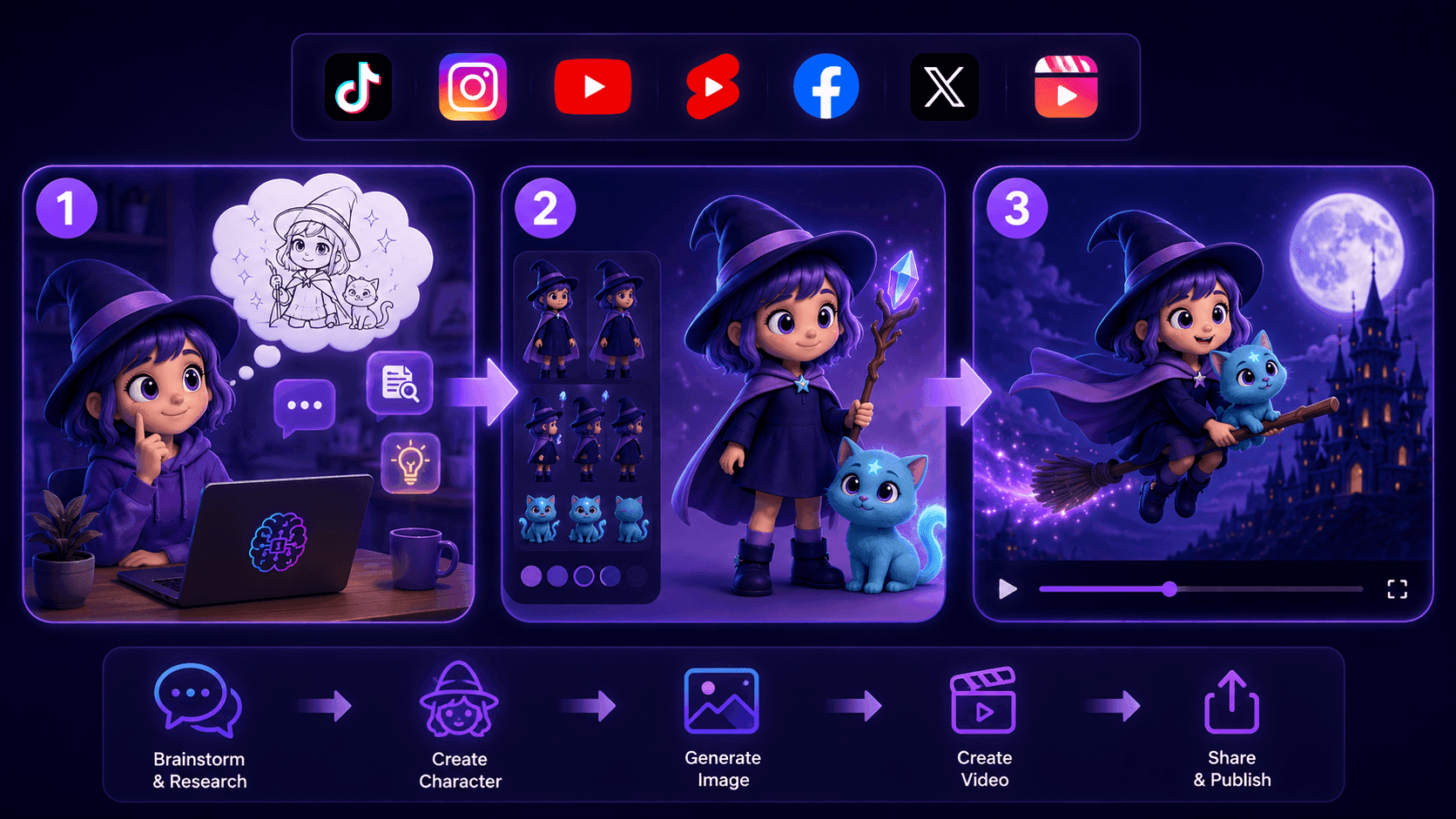
Create Consistent Cartoon Content in Just a Few Steps
Create engaging cartoon videos for TikTok and Reels with 1min.AI. Research ideas, create characters, and turn images into animated videos in 3 simple steps.
 Lien Anh Vu

One Product, 10 UGC Creatives: How AI Makes Content Testing Easier
Create more authentic UGC with an AI UGC video generator, test more creative angles and scale affiliate content without filming every version.
Lien Anh Vu
Top 4 Affordable AI Tools for Startup Founders
Discover the top 4 affordable AI tools for startup founders to validate ideas, build products, create content, and launch faster without overspending.
 Tram Ta
AI Features
Comprehensive AI features that streamline workflows, improve efficiency, and empower teams to achieve more.
Create Consistent Cartoon Content in Just a Few Steps
Create engaging cartoon videos for TikTok and Reels with 1min.AI. Research ideas, create characters, and turn images into animated videos in 3 simple steps.
Lien Anh VuOne Product, 10 UGC Creatives: How AI Makes Content Testing Easier
Create more authentic UGC with an AI UGC video generator, test more creative angles and scale affiliate content without filming every version.
Lien Anh Vu
1minAI: Free AI Grammar Checker
Check grammar for free with 1minAI’s AI grammar checker. Find grammar, spelling, and writing mistakes, improve clarity, and polish your content in seconds.
Tram TaAI Use Cases
A curated collection of AI use cases for business, productivity, and industry-specific applications.
Create Consistent Cartoon Content in Just a Few Steps
Create engaging cartoon videos for TikTok and Reels with 1min.AI. Research ideas, create characters, and turn images into animated videos in 3 simple steps.
Lien Anh VuOne Product, 10 UGC Creatives: How AI Makes Content Testing Easier
Create more authentic UGC with an AI UGC video generator, test more creative angles and scale affiliate content without filming every version.
Lien Anh Vu
Best Time to Post on Instagram: A Practical Guide for Better Engagement
Discover the best time to post on Instagram, including the best days and times for different audiences, plus tips to find the ideal posting schedule for your account.
Tram TaAI Tutorials
Learn how to use AI with practical, step-by-step tutorials.

Black Friday AI Tool Deals in 2026
Discover what Black Friday AI tool deals 2026 has to offer. Find out how to secure the 1min.AI lifetime deal via AppSumo, Dealify, Stack Social, and verify on Trustpilot, Slashdot, and Software Advice.
 Hang Nguyen
Create Consistent Cartoon Content in Just a Few Steps
Create engaging cartoon videos for TikTok and Reels with 1min.AI. Research ideas, create characters, and turn images into animated videos in 3 simple steps.
Lien Anh Vu
[Seedance 2.5 New] Better AI Product Videos, Less Rework in 1min.AI
Use Seedance 2.5 image to video on 1min.AI to create more consistent AI product videos, reduce failed generations, save credits, and improve UGC workflows.
Lien Anh VuAI Guides
Learn AI faster with practical guides, real-world examples, and actionable best practices.

Safely Buy AI Tools Online: 2026 Black Friday Guide
Discover how to find and secure the best Black Friday AI deals online. Learn expert strategies to avoid scams, combat subscription fatigue, and verify software.
Hang NguyenCreate Consistent Cartoon Content in Just a Few Steps
Create engaging cartoon videos for TikTok and Reels with 1min.AI. Research ideas, create characters, and turn images into animated videos in 3 simple steps.
Lien Anh Vu[Seedance 2.5 New] Better AI Product Videos, Less Rework in 1min.AI
Use Seedance 2.5 image to video on 1min.AI to create more consistent AI product videos, reduce failed generations, save credits, and improve UGC workflows.
Lien Anh VuAI Solutions
Browse the best AI solutions for automation, coding, research, productivity, customer support, marketing, and business workflows.
Safely Buy AI Tools Online: 2026 Black Friday Guide
Discover how to find and secure the best Black Friday AI deals online. Learn expert strategies to avoid scams, combat subscription fatigue, and verify software.
Hang NguyenCreate Consistent Cartoon Content in Just a Few Steps
Create engaging cartoon videos for TikTok and Reels with 1min.AI. Research ideas, create characters, and turn images into animated videos in 3 simple steps.
Lien Anh VuOne Product, 10 UGC Creatives: How AI Makes Content Testing Easier
Create more authentic UGC with an AI UGC video generator, test more creative angles and scale affiliate content without filming every version.
Lien Anh VuAI Models
Explore the world's leading AI models in one place.
Create Consistent Cartoon Content in Just a Few Steps
Create engaging cartoon videos for TikTok and Reels with 1min.AI. Research ideas, create characters, and turn images into animated videos in 3 simple steps.
Lien Anh VuOne Product, 10 UGC Creatives: How AI Makes Content Testing Easier
Create more authentic UGC with an AI UGC video generator, test more creative angles and scale affiliate content without filming every version.
Lien Anh Vu[Seedance 2.5 New] Better AI Product Videos, Less Rework in 1min.AI
Use Seedance 2.5 image to video on 1min.AI to create more consistent AI product videos, reduce failed generations, save credits, and improve UGC workflows.
Lien Anh VuAI Comparisons
Compare AI tools, models, and platforms to find the best fit for your needs.

Kling AI Vs Veo 3: Which Model Wins?
Kling AI vs Veo 3: compare motion, native audio, pricing & free tiers to see which AI video generator wins for your project - try both on 1min.AI.
 Trang Tran
[Seedance 2.5 New] Better AI Product Videos, Less Rework in 1min.AI
Use Seedance 2.5 image to video on 1min.AI to create more consistent AI product videos, reduce failed generations, save credits, and improve UGC workflows.
Lien Anh Vu
DeepSeek V4 Pro vs Flash Comparison
Compare DeepSeek V4 Pro vs DeepSeek V4 Flash metrics. Optimize your agentic apps and improve AI fact checking on 1min.ai today.
Ngoc HongAI Integrations
Seamlessly integrate AI with the tools you already use to automate work and boost productivity.

POV: You Have 10+ Posts to Make Every Day
Learn how to build an AI content workflow that helps content creators produce 10+ social media posts a day faster with AI brainstorming, image generation, and content creation.
Lien Anh Vu
How to Use an AI Fashion Video Generator for Fashion Week 2026
Turn Fashion Week 2026 ideas into stunning fashion videos with AI. Learn how to brainstorm, create visuals, and transform images into videos with one simple workflow.
Lien Anh Vu
Stop Switching Between AI Apps: How AI Integration Transforms Employer Branding
Discover how AI integration helps HR teams streamline employer branding by combining AI writing, documents, images, video, and multiple AI models into one workspace.
Tram TaAI for Industries
Find the best AI tools and workflows for healthcare, finance, education, legal, manufacturing, retail, real estate, and more

No Photoshoot? Create AI Fashion Videos With Seedance 2.5
No photoshoot needed! Create stunning AI fashion videos with Seedance 2.5 on 1min.AI using outfit references, cinematic prompts, and surreal scenes.
Lien Anh Vu
Voice Cloning AI Free: How to Clone Any Voice Online in Minutes
Try voice cloning AI free with 1min.AI. Upload a 5-second clip, pick an ElevenLabs model, choose from 32 languages, and turn text to speech in your own voice.
Trang Tran
Text To Video AI Free Without Watermark Online
Create text to video AI free without watermark online with 1min.AI. Pick top models, turn prompts into HD clips, and download clean videos fast. Try it free.
Trang TranAI Agents
Discover and run AI agents to automate tasks across your work and daily life.
1minAI: Free AI Grammar Checker
Check grammar for free with 1minAI’s AI grammar checker. Find grammar, spelling, and writing mistakes, improve clarity, and polish your content in seconds.
Tram Ta
AI Agents for Facebook
Use an AI Agent for Facebook to create content, generate images, schedule posts, and publish from your documents and conversations.
Ngoc Hong
AI Agent vs AI Assistant: Which One Actually Saves Designers More Time?
Learn the difference between AI Agent vs AI Assistant and discover which solution helps designers automate repetitive work, reduce revisions, and save more time.
Lien Anh VuAI Workflows
Explore ready-to-use AI workflows for productivity, marketing, sales, support, and more.
Create Consistent Cartoon Content in Just a Few Steps
Create engaging cartoon videos for TikTok and Reels with 1min.AI. Research ideas, create characters, and turn images into animated videos in 3 simple steps.
Lien Anh VuOne Product, 10 UGC Creatives: How AI Makes Content Testing Easier
Create more authentic UGC with an AI UGC video generator, test more creative angles and scale affiliate content without filming every version.
Lien Anh VuPOV: You Have 10+ Posts to Make Every Day
Learn how to build an AI content workflow that helps content creators produce 10+ social media posts a day faster with AI brainstorming, image generation, and content creation.
Lien Anh VuNewsletter
Weekly AI Innovations with 1minAI

🔮 Weekly AI Innovations #145: X Content Agent & GPT 6.1 Terra on 1min.ai
Scale viral reach with the X Content Agent on 1min.ai. Discover an end-to-end 4-stage pipeline with zero token burn, plus the launch of GPT 6.1 Terra.
Hang Nguyen
🔮 Weekly AI Innovations #144: LinkedIn Content Agent: Complete B2B Publishing Pipeline
Scale B2B influence with the LinkedIn Content Agent on 1min.ai. Discover an end-to-end 4-stage pipeline with zero redundant token burn and 1-click publishing.
Hang Nguyen
🔮 Weekly AI Innovations #143: Update GPT-6, GPT-6.1 & Ideogram 4.0
Access GPT-6 Sol, Luna, GPT-6.1 Sol, and Ideogram 4.0 on 1min.ai. Boost typography accuracy to 98.4% and cut reasoning latency by 45% in one platform.
Hang Nguyen