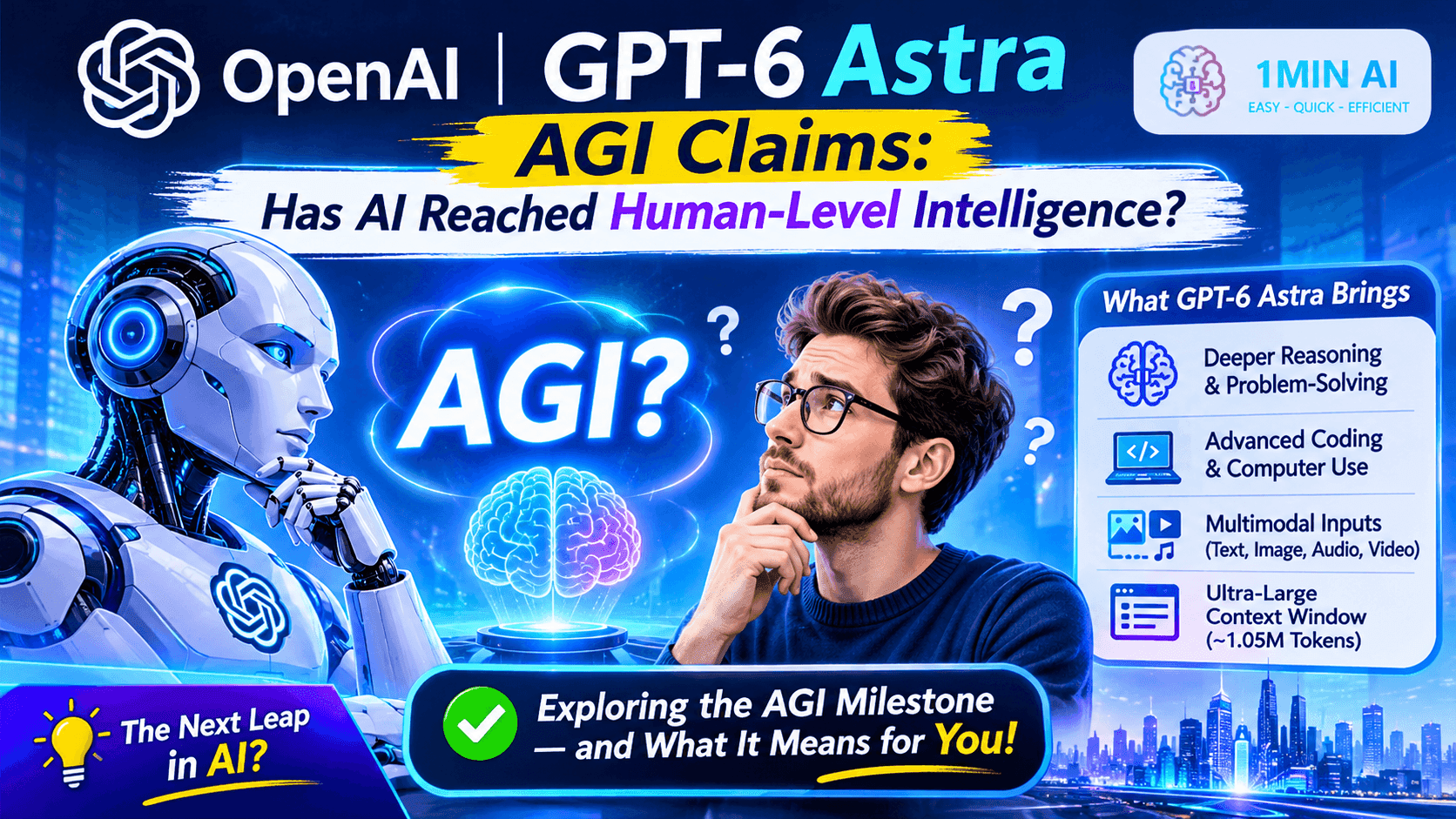
OpenAI GPT-6 Astra AGI Claims: Has AI Reached Human-Level Intelligence?

Tram Ta
November 3, 2026
Explore OpenAI GPT-6 Astra AGI claims, benchmark results, expert skepticism, and what the model's capabilities mean. Learn how to test GPT-6 Astra on 1minAI.
When OpenAI describes a new AI model as a potential turning point toward artificial general intelligence (AGI), the announcement raises a bigger question than whether the model can answer questions or write code: Has AI become capable of performing a broad range of intellectual tasks at a human level?
The discussion surrounding GPT-6 Astra brings that question into focus. OpenAI has presented Astra as a major advance in reasoning, computer use, software engineering, scientific work, and professional task completion. Meanwhile, researchers and independent evaluators emphasize that impressive benchmark results do not automatically establish that a system has achieved AGI.
So, what do the OpenAI GPT-6 Astra AGI claims actually mean? In this article, we'll examine the claims, the available evidence, the limitations of benchmark-based comparisons, and how you can explore GPT-6 Astra yourself through 1minAI.
What Are OpenAI's GPT-6 Astra AGI Claims?
Artificial general intelligence is commonly used to describe AI capable of learning, reasoning, and performing a broad range of intellectual tasks rather than being limited to narrow, predefined functions. However, researchers do not agree on one universally accepted definition or a single test that conclusively establishes AGI.
OpenAI's announcement of GPT-6 Astra emphasized significant improvements across multiple areas, including computer use, browsing, coding, cybersecurity, scientific discovery, and professional work.
OpenAI President Greg Brockman also made public comments suggesting that Astra could mark the arrival of AGI. Those remarks helped intensify the debate about whether the latest generation of AI systems has crossed a meaningful threshold.
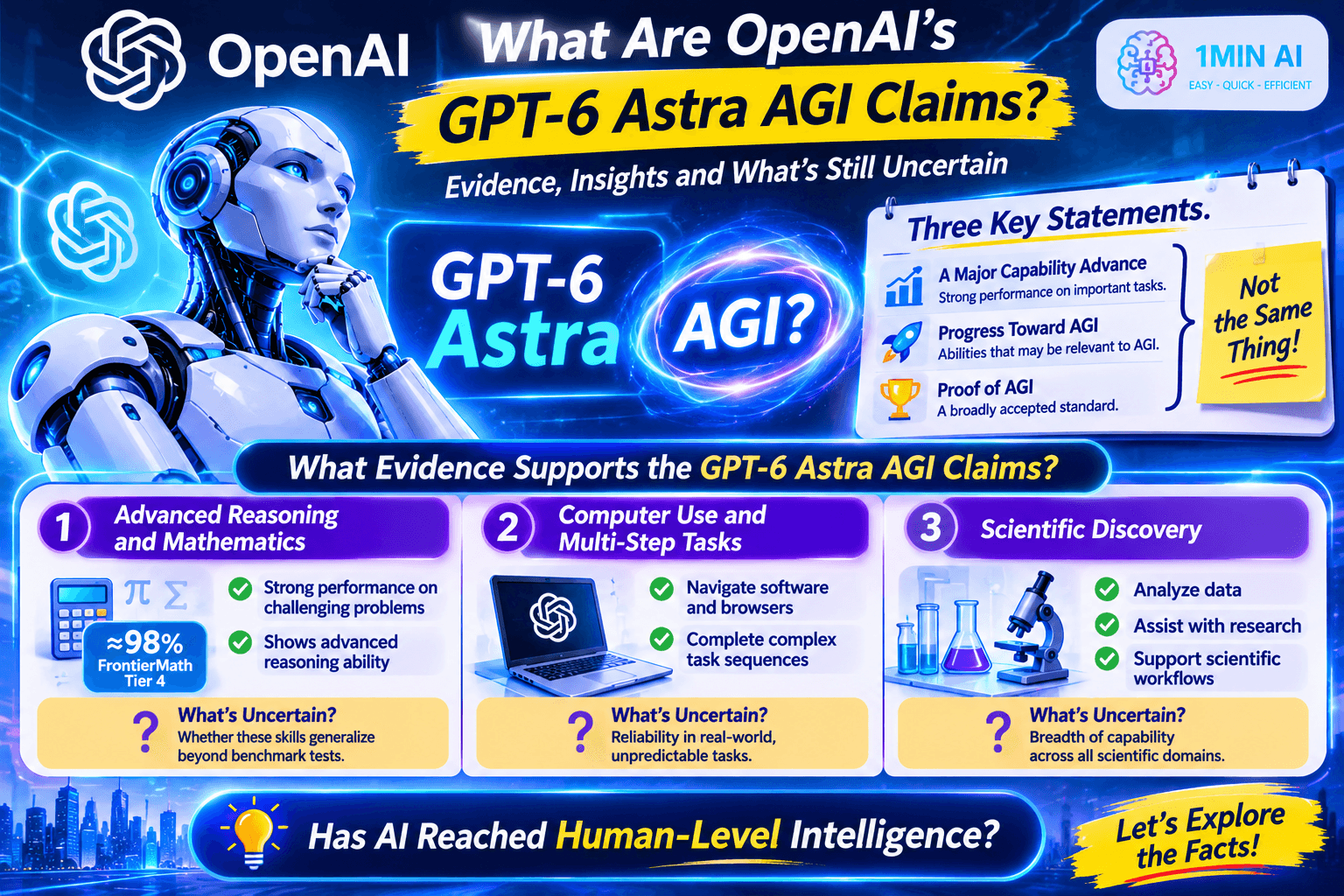
However, three different statements should not be treated as interchangeable:
- A major capability advance: A model performs substantially better than earlier systems on important tasks.
- Progress toward AGI: A model demonstrates abilities that may be relevant to general intelligence.
- Proof of AGI: A system meets a sufficiently broad and clearly defined standard for artificial general intelligence.
Evidence supporting the first statement does not automatically prove the third.
That distinction is central to understanding the GPT-6 Astra AGI debate.
What Evidence Supports the GPT-6 Astra AGI Claims?
OpenAI has reported strong results for Astra across several technical and professional evaluations. These results are relevant because they show how the model performs on increasingly demanding tasks.
But each benchmark measures a particular set of abilities. To assess the broader AGI claim, it helps to understand what the results demonstrate—and what they leave unanswered.
1. Advanced reasoning and mathematics
OpenAI reported that GPT-6 Astra achieved a score of approximately 98% on FrontierMath Tier 4, a demanding mathematical evaluation. The company also highlighted its performance on other reasoning and science benchmarks.
These results suggest that the model can handle challenging problems that require more than simple pattern matching or factual recall.
However, a high score on a mathematical benchmark does not establish that a model possesses the full range of human intellectual abilities. It does not independently demonstrate robust everyday judgment, social understanding, learning from every unfamiliar situation, or reliable performance across all domains.
What the evidence supports: GPT-6 Astra demonstrates advanced performance on selected mathematical and reasoning tasks.
What remains uncertain: How consistently those abilities generalize to unfamiliar problems and real-world situations outside the evaluation setting.
2. Computer use and multi-step tasks
Another major focus of OpenAI's announcement is computer use. Astra is designed to interact with compatible software and browsers, allowing it to carry out sequences of actions rather than merely explaining what a person should do.
For example, a computer-using AI agent may be able to navigate a website, inspect information, manipulate a spreadsheet, or work through a software workflow when the appropriate tools and permissions are available.
This matters because completing a task requires several capabilities at once:
- Understanding the user's objective.
- Planning a sequence of actions.
- Interpreting the current state of the software.
- Recovering from errors or unexpected changes.
- Checking whether the intended result was achieved.
Nevertheless, successful computer use in tested environments is not equivalent to general competence in every real-world setting. Tasks may differ in complexity, ambiguity, consequences, and the level of human oversight required.
What the evidence supports: Computer-use benchmarks can demonstrate meaningful progress toward more capable AI agents.
What remains uncertain: How reliably Astra handles the full variety of unpredictable tasks people encounter outside controlled evaluations.
3. Scientific discovery
OpenAI has also highlighted Astra's potential to assist with scientific research, including analyzing data and working with specialized software.
This is an important area to watch. Scientific work can require a combination of mathematical reasoning, programming, interpretation of evidence, and iterative experimentation.
Yet there is a distinction between helping researchers investigate a problem and independently establishing a scientific breakthrough. A model's contribution must still be evaluated through reproducibility, expert scrutiny, and validation of its methods and conclusions.
A strong benchmark result can indicate scientific problem-solving ability, but it does not replace the process required to establish that a discovery is correct.
GPT-6 Astra AGI Claims: What Should We Conclude?
A balanced assessment separates the demonstrated capabilities from the broader interpretation.
| Question | What the available evidence suggests |
|---|---|
| Is GPT-6 Astra a significant AI capability advance? | OpenAI reports substantial improvements across several demanding evaluations. |
| Can it support complex professional tasks? | It is designed for coding, computer use, research, and other multi-step workflows, subject to tool availability and reliability. |
| Do high benchmark scores prove AGI? | No. Individual benchmarks measure specific abilities and cannot establish every dimension of general intelligence. |
| Has AGI been conclusively demonstrated? | The available benchmark evidence alone does not establish a universally accepted conclusion. |
| Can users evaluate its capabilities directly? | Yes. Users can test practical tasks and assess the outputs, while recognizing that personal testing is not a scientific proof of AGI. |
The most defensible conclusion is that GPT-6 Astra's reported capabilities provide evidence of progress in several areas associated with general intelligence. Whether those advances constitute AGI depends on the definition, the breadth of the evidence, and the standards used to evaluate the system.
How to Test GPT-6 Astra Yourself on 1minAI
News coverage and benchmark scores provide useful context, but you can also explore what an advanced model can do with tasks relevant to your own work.
1minAI provides access to AI chat workflows, including dedicated pages for GPT-6 Astra. This gives users a practical way to experiment with the model without making an AGI judgment based on headlines alone.
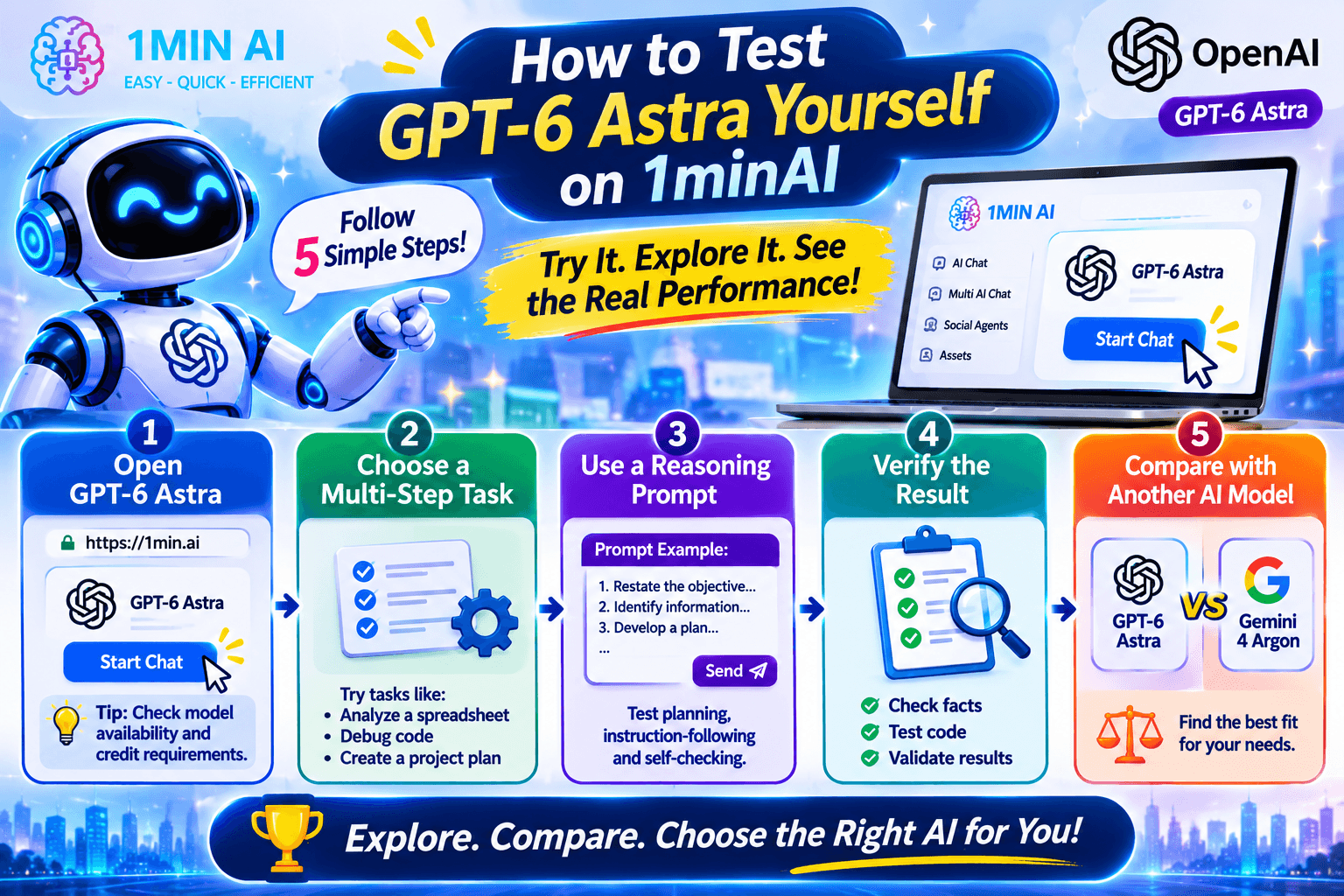
Step 1: Open GPT-6 Astra
Start with Free AI Chat with GPT-6 Astra on 1minAI.
Check the current model availability and credit requirements before beginning. Access through 1minAI is separate from access through an OpenAI ChatGPT subscription or API account.
Step 2: Choose a task that requires multiple steps
Instead of asking a simple factual question, select a task that requires planning, analysis, and a verifiable result.
For example, you could ask the model to analyze a spreadsheet, debug a small program, organize a research brief, or create a structured project plan.
Step 3: Use a prompt that tests reasoning
Try this prompt:
You are an analytical assistant. Complete the task below using a structured process.
- Restate the objective and constraints.
- Identify the information available and any important gaps.
- Develop a step-by-step plan.
- Complete the task and explain the main decisions.
- Check the result against the original requirements.
- Identify uncertainties, assumptions, and anything that needs human verification.
Do not invent facts or claim to have performed actions you did not perform. If you cannot verify a result, state that limitation clearly.
Task: [Insert a real task you want to complete.]
This prompt helps you assess the model's planning, instruction-following, and self-checking behavior.
Step 4: Verify the result independently
A confident answer is not necessarily a correct answer. Check calculations, test generated code, validate factual claims against reliable sources, and confirm any actions that the model says it completed.
You can also repeat the same task with slightly different inputs to see whether the model remains consistent.
Step 5: Compare with another AI model
A second model can provide a useful point of comparison. Try the same prompt with another available model and examine the differences in accuracy, completeness, and the amount of human correction required.
You can start from 1minAI Multi AI Chat to explore multi-model chat workflows in one place.
This comparison can help you identify which model works best for a specific task. It should not be treated as a definitive test of AGI, because performance depends on the prompts, model versions, available tools, and evaluation criteria.
What GPT-6 Astra's Capabilities Mean for Everyday Users
The practical significance of advanced AI may matter more to many users than the debate over whether a particular system qualifies as AGI.
For students and researchers
AI can help explain difficult concepts, organize research notes, analyze documents, and generate questions for further investigation. Users should verify sources and follow their institution's rules on AI assistance.
For developers
Advanced models can help review code, identify potential bugs, suggest tests, and explain unfamiliar systems. Generated code still requires testing, security review, and human judgment before production use.
For business teams
AI agents may help streamline repetitive work, prepare documents, analyze information, and support multi-step workflows. Businesses should assess data privacy, access permissions, auditability, and the consequences of errors before automating sensitive tasks.
For individual professionals
AI can serve as a drafting, research, and problem-solving assistant. The most useful measure is often whether it improves the quality or speed of your work while keeping the results verifiable.
These use cases are valuable regardless of whether researchers ultimately agree that today's models meet a formal AGI threshold.
Frequently Asked Questions
What are the OpenAI GPT-6 Astra AGI claims?
OpenAI has presented GPT-6 Astra as a major advance in general-purpose AI capabilities, and OpenAI President Greg Brockman made comments suggesting that the model could mark the arrival of AGI. The claim remains a matter of debate because there is no universally accepted threshold for AGI.
Has OpenAI officially proved that GPT-6 Astra is AGI?
Strong benchmark performance and statements from company leadership are not the same as conclusive scientific proof. The results provide evidence of advanced capabilities, but they do not independently establish that Astra satisfies every proposed definition of AGI.
What is the difference between AGI and advanced AI?
Advanced AI describes systems that perform demanding tasks, potentially across multiple domains. AGI generally refers to a broader level of intelligence capable of handling a wide range of intellectual tasks. The exact distinction depends on the definition being used.
What benchmarks are relevant to the GPT-6 Astra AGI debate?
Evaluations of mathematical reasoning, computer use, software engineering, scientific work, and adaptation to unfamiliar environments can all contribute evidence. No single benchmark score should be treated as a complete measure of general intelligence.
Can I try GPT-6 Astra free?
You can explore the model through Free AI Chat with GPT-6 Astra on 1minAI, subject to current availability, platform policies, and available credits. Free access does not necessarily mean unlimited usage.
Can I compare GPT-6 Astra with other AI models?
Yes. You can explore 1minAI Multi AI Chat and compare responses to the same prompt. Evaluate accuracy, reasoning quality, completeness, and reliability rather than relying only on writing style or confidence.
Does a model need to be AGI to be useful?
No. An AI system can be useful for research, coding, writing, analysis, and workflow assistance without meeting a formal definition of AGI. Practical value depends on whether it performs the required task accurately, safely, and consistently.
Final: Separate the AGI Claim from the Evidence
The OpenAI GPT-6 Astra AGI claims highlight an important question in AI development: how should we measure progress toward general intelligence?
Astra's reported results across reasoning, computer use, coding, and scientific work suggest meaningful advances. But benchmark performance, even when impressive, cannot alone settle the question of whether AGI has arrived.
The most useful approach is to examine the evidence, understand what each evaluation measures, and test AI systems against real tasks while checking their results independently.
If you want to explore GPT-6 Astra beyond the headlines, start with Free AI Chat with GPT-6 Astra on 1minAI, or use 1minAI Multi AI Chat to compare responses from different available models.
- #Information
- #Navigation
Alternatives
Discover the best alternatives to 1minAI and compare features, pricing, and use cases.

1min.AI vs OpenRouter
1min.AI vs. OpenRouter: Compare the ready-to-use AI creation product against the technical API tool. Find out if you need a zero-code creative studio or a coding infrastructure hub.
 Ngoc Hong
1min.AI vs RedactAI: Which Is Better for LinkedIn?
Compare 1min.AI vs RedactAI for LinkedIn writing brand voice pricing AI models and content workflows to find the right tool for your needs.
 Lien Anh Vu
1min.AI vs Scripe AI for LinkedIn Content
Compare Scripe AI vs 1min.AI on LinkedIn content creation pricing analytics AI models and workflows to find the right tool for your team.
Lien Anh VuAI Tools
Discover the best AI tools to boost productivity, creativity, and everyday work.
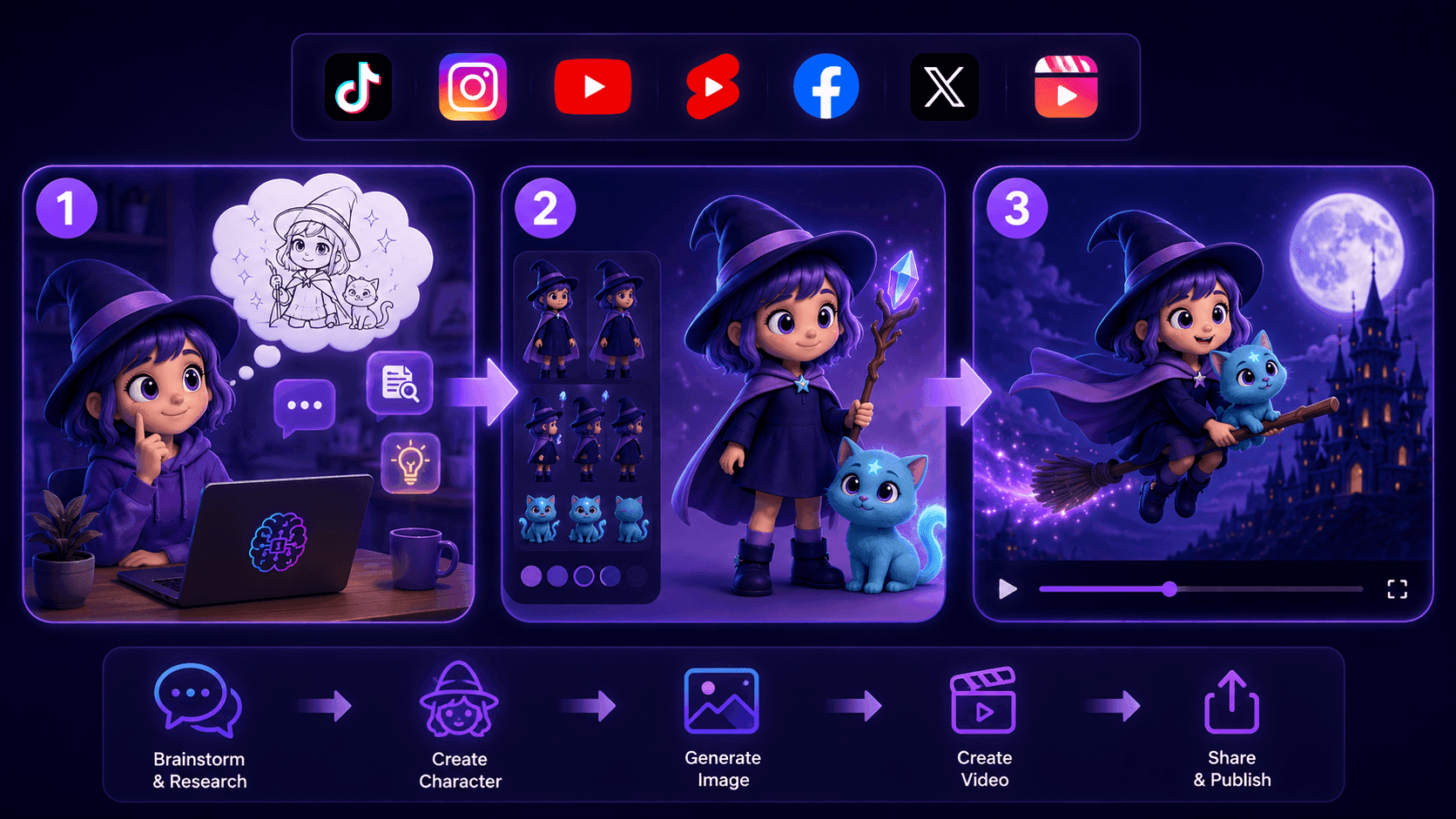
Create Consistent Cartoon Content in Just a Few Steps
Create engaging cartoon videos for TikTok and Reels with 1min.AI. Research ideas, create characters, and turn images into animated videos in 3 simple steps.
Lien Anh Vu
One Product, 10 UGC Creatives: How AI Makes Content Testing Easier
Create more authentic UGC with an AI UGC video generator, test more creative angles and scale affiliate content without filming every version.
Lien Anh Vu
Top 4 Affordable AI Tools for Startup Founders
Discover the top 4 affordable AI tools for startup founders to validate ideas, build products, create content, and launch faster without overspending.
 Tram Ta
AI Features
Comprehensive AI features that streamline workflows, improve efficiency, and empower teams to achieve more.
Create Consistent Cartoon Content in Just a Few Steps
Create engaging cartoon videos for TikTok and Reels with 1min.AI. Research ideas, create characters, and turn images into animated videos in 3 simple steps.
Lien Anh VuOne Product, 10 UGC Creatives: How AI Makes Content Testing Easier
Create more authentic UGC with an AI UGC video generator, test more creative angles and scale affiliate content without filming every version.
Lien Anh Vu
1minAI: Free AI Grammar Checker
Check grammar for free with 1minAI’s AI grammar checker. Find grammar, spelling, and writing mistakes, improve clarity, and polish your content in seconds.
Tram TaAI Use Cases
A curated collection of AI use cases for business, productivity, and industry-specific applications.
Create Consistent Cartoon Content in Just a Few Steps
Create engaging cartoon videos for TikTok and Reels with 1min.AI. Research ideas, create characters, and turn images into animated videos in 3 simple steps.
Lien Anh VuOne Product, 10 UGC Creatives: How AI Makes Content Testing Easier
Create more authentic UGC with an AI UGC video generator, test more creative angles and scale affiliate content without filming every version.
Lien Anh Vu
Best Time to Post on Instagram: A Practical Guide for Better Engagement
Discover the best time to post on Instagram, including the best days and times for different audiences, plus tips to find the ideal posting schedule for your account.
Tram TaAI Tutorials
Learn how to use AI with practical, step-by-step tutorials.
Black Friday AI Tool Deals in 2026
Discover what Black Friday AI tool deals 2026 has to offer. Find out how to secure the 1min.AI lifetime deal via AppSumo, Dealify, Stack Social, and verify on Trustpilot, Slashdot, and Software Advice.
 Hang Nguyen
Create Consistent Cartoon Content in Just a Few Steps
Create engaging cartoon videos for TikTok and Reels with 1min.AI. Research ideas, create characters, and turn images into animated videos in 3 simple steps.
Lien Anh Vu
[Seedance 2.5 New] Better AI Product Videos, Less Rework in 1min.AI
Use Seedance 2.5 image to video on 1min.AI to create more consistent AI product videos, reduce failed generations, save credits, and improve UGC workflows.
Lien Anh VuAI Guides
Learn AI faster with practical guides, real-world examples, and actionable best practices.

Safely Buy AI Tools Online: 2026 Black Friday Guide
Discover how to find and secure the best Black Friday AI deals online. Learn expert strategies to avoid scams, combat subscription fatigue, and verify software.
Hang NguyenCreate Consistent Cartoon Content in Just a Few Steps
Create engaging cartoon videos for TikTok and Reels with 1min.AI. Research ideas, create characters, and turn images into animated videos in 3 simple steps.
Lien Anh Vu[Seedance 2.5 New] Better AI Product Videos, Less Rework in 1min.AI
Use Seedance 2.5 image to video on 1min.AI to create more consistent AI product videos, reduce failed generations, save credits, and improve UGC workflows.
Lien Anh VuAI Solutions
Browse the best AI solutions for automation, coding, research, productivity, customer support, marketing, and business workflows.
Safely Buy AI Tools Online: 2026 Black Friday Guide
Discover how to find and secure the best Black Friday AI deals online. Learn expert strategies to avoid scams, combat subscription fatigue, and verify software.
Hang NguyenCreate Consistent Cartoon Content in Just a Few Steps
Create engaging cartoon videos for TikTok and Reels with 1min.AI. Research ideas, create characters, and turn images into animated videos in 3 simple steps.
Lien Anh VuOne Product, 10 UGC Creatives: How AI Makes Content Testing Easier
Create more authentic UGC with an AI UGC video generator, test more creative angles and scale affiliate content without filming every version.
Lien Anh VuAI Models
Explore the world's leading AI models in one place.
Create Consistent Cartoon Content in Just a Few Steps
Create engaging cartoon videos for TikTok and Reels with 1min.AI. Research ideas, create characters, and turn images into animated videos in 3 simple steps.
Lien Anh VuOne Product, 10 UGC Creatives: How AI Makes Content Testing Easier
Create more authentic UGC with an AI UGC video generator, test more creative angles and scale affiliate content without filming every version.
Lien Anh Vu[Seedance 2.5 New] Better AI Product Videos, Less Rework in 1min.AI
Use Seedance 2.5 image to video on 1min.AI to create more consistent AI product videos, reduce failed generations, save credits, and improve UGC workflows.
Lien Anh VuAI Comparisons
Compare AI tools, models, and platforms to find the best fit for your needs.
Kling AI Vs Veo 3: Which Model Wins?
Kling AI vs Veo 3: compare motion, native audio, pricing & free tiers to see which AI video generator wins for your project - try both on 1min.AI.
 Trang Tran
[Seedance 2.5 New] Better AI Product Videos, Less Rework in 1min.AI
Use Seedance 2.5 image to video on 1min.AI to create more consistent AI product videos, reduce failed generations, save credits, and improve UGC workflows.
Lien Anh Vu
DeepSeek V4 Pro vs Flash Comparison
Compare DeepSeek V4 Pro vs DeepSeek V4 Flash metrics. Optimize your agentic apps and improve AI fact checking on 1min.ai today.
Ngoc HongAI Integrations
Seamlessly integrate AI with the tools you already use to automate work and boost productivity.
POV: You Have 10+ Posts to Make Every Day
Learn how to build an AI content workflow that helps content creators produce 10+ social media posts a day faster with AI brainstorming, image generation, and content creation.
Lien Anh Vu
How to Use an AI Fashion Video Generator for Fashion Week 2026
Turn Fashion Week 2026 ideas into stunning fashion videos with AI. Learn how to brainstorm, create visuals, and transform images into videos with one simple workflow.
Lien Anh Vu
Stop Switching Between AI Apps: How AI Integration Transforms Employer Branding
Discover how AI integration helps HR teams streamline employer branding by combining AI writing, documents, images, video, and multiple AI models into one workspace.
Tram TaAI for Industries
Find the best AI tools and workflows for healthcare, finance, education, legal, manufacturing, retail, real estate, and more
Text To Video AI Free Without Watermark Online
Create text to video AI free without watermark online with 1min.AI. Pick top models, turn prompts into HD clips, and download clean videos fast. Try it free.
Trang Tran
Free AI Product Description Generator
Write product descriptions that sell in minutes. Use this free AI product description generator to turn details or a photo into on-brand copy. Try 1min.AI.
Trang Tran
Best Business Productivity Tools for Startups to Maximize Profits | 1minAI
Discover the best business productivity tools for startups to save time, streamline workflows, reduce repetitive tasks, and support profitable growth with AI.
Tram TaAI Agents
Discover and run AI agents to automate tasks across your work and daily life.
1minAI: Free AI Grammar Checker
Check grammar for free with 1minAI’s AI grammar checker. Find grammar, spelling, and writing mistakes, improve clarity, and polish your content in seconds.
Tram Ta
AI Agents for Facebook
Use an AI Agent for Facebook to create content, generate images, schedule posts, and publish from your documents and conversations.
Ngoc Hong
AI Agent vs AI Assistant: Which One Actually Saves Designers More Time?
Learn the difference between AI Agent vs AI Assistant and discover which solution helps designers automate repetitive work, reduce revisions, and save more time.
Lien Anh VuAI Workflows
Explore ready-to-use AI workflows for productivity, marketing, sales, support, and more.
Create Consistent Cartoon Content in Just a Few Steps
Create engaging cartoon videos for TikTok and Reels with 1min.AI. Research ideas, create characters, and turn images into animated videos in 3 simple steps.
Lien Anh VuOne Product, 10 UGC Creatives: How AI Makes Content Testing Easier
Create more authentic UGC with an AI UGC video generator, test more creative angles and scale affiliate content without filming every version.
Lien Anh VuPOV: You Have 10+ Posts to Make Every Day
Learn how to build an AI content workflow that helps content creators produce 10+ social media posts a day faster with AI brainstorming, image generation, and content creation.
Lien Anh VuNewsletter
Weekly AI Innovations with 1minAI

🔮 Weekly AI Innovations #144: LinkedIn Content Agent: Complete B2B Publishing Pipeline
Scale B2B influence with the LinkedIn Content Agent on 1min.ai. Discover an end-to-end 4-stage pipeline with zero redundant token burn and 1-click publishing.
Hang Nguyen
🔮 Weekly AI Innovations #143: Update GPT-6, GPT-6.1 & Ideogram 4.0
Access GPT-6 Sol, Luna, GPT-6.1 Sol, and Ideogram 4.0 on 1min.ai. Boost typography accuracy to 98.4% and cut reasoning latency by 45% in one platform.
Hang Nguyen
🔮 Weekly AI Innovations #142: Grok 4.7, Opus 5.5 & Sonnet 5.5 on 1min.ai
Access Grok 4.7, Claude Opus 5.5, and Sonnet 5.5 on 1min.ai. Cut subscription costs by up to 70% and process millions tokens in a single unified workspace.
Hang Nguyen