
How to Create Recurring Revenue With White Label AI Services

Tram Ta
August 27, 2026
Learn how to create recurring revenue with white label AI services using subscriptions, AI-as-a-service, usage-based pricing, managed services, training, and support.
White label AI can be more than a way to add AI features to an existing business. For agencies, consultants, SaaS companies, and entrepreneurs, it can become a recurring-revenue business model. By packaging AI into subscriptions, managed services, usage-based plans, training, and support, businesses can turn third-party AI capabilities into ongoing client relationships without building the underlying AI infrastructure from scratch.
Why White Label AI Can Create Recurring Revenue
Selling AI software once creates a transaction. Building an ongoing AI service can create a relationship.
This distinction is important for businesses exploring white label AI services.
Instead of simply giving clients access to an AI tool, businesses can package AI around a continuing need:
- Content creation
- Marketing production
- Customer support
- Business productivity
- AI automation
- Research
- Image and video generation
- Internal AI assistants
- Employee training
For example, a marketing agency could offer a monthly AI content package that includes AI writing, image generation, content repurposing, and ongoing support.
The client isn't paying only for software access. They're paying for an ongoing business outcome.
The Basic Recurring-Revenue Model
A simple white label AI business model can look like:
AI Platform → Your Brand → Service Package → Monthly Subscription → Recurring Revenue
The technology provider handles much of the underlying AI infrastructure, while the reseller or agency focuses on the customer relationship.
This can be attractive because recurring services give businesses a more predictable revenue model than relying entirely on one-time projects.
Don't Sell the Tool—Sell the Outcome
One of the most important principles is positioning.
A business could tell a client: "We offer a white label AI writing tool."
Or it could offer: "We provide your marketing team with an ongoing AI-powered content production service."
The second approach focuses on the customer's problem.
The AI software is simply part of the solution.
This gives agencies and entrepreneurs more flexibility to combine software access with strategy, implementation, support, and human expertise.
6 Ways to Build Recurring Revenue With White Label AI
There isn't one universal pricing model for a white label AI platform. The right approach depends on the target customer, usage, service level, and business model.
Here are six practical ways to package recurring AI services.
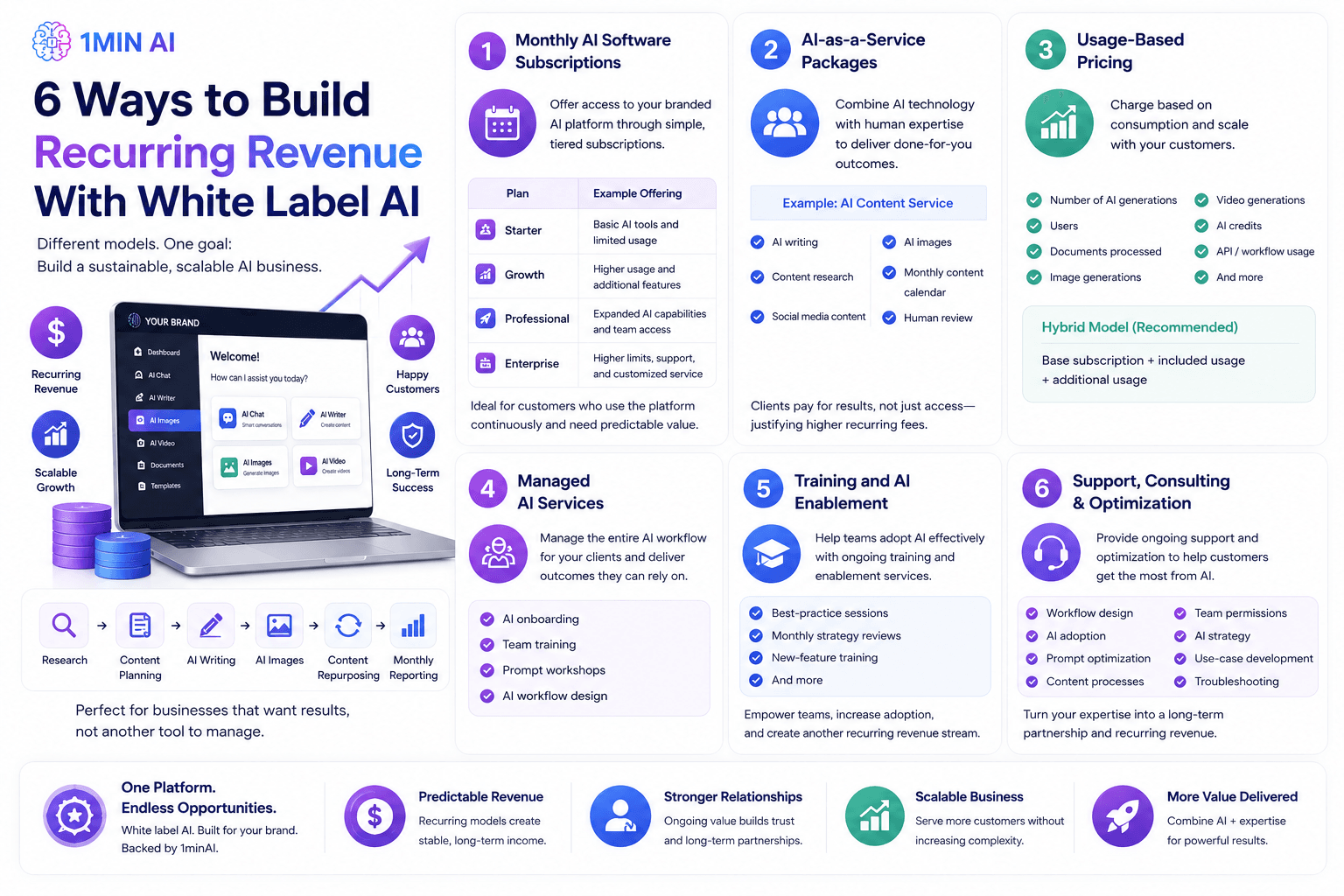
1. Monthly AI Software Subscriptions
The simplest model is a recurring subscription.
Customers pay monthly or annually for access to your branded AI solution.
For example:
| Plan | Example Offering |
|---|---|
| Starter | Basic AI tools and limited usage |
| Growth | Higher usage and additional features |
| Professional | Expanded AI capabilities and team access |
| Enterprise | Higher limits, support, and customized service |
The exact features and pricing should reflect your AI costs and the value delivered to customers.
This model works particularly well when customers use the platform continuously rather than for a one-time project.
2. AI-as-a-Service Packages
A more service-oriented model combines AI software with human expertise.
For example, an agency could sell:
AI Content Service
- AI writing
- Content research
- Social media content
- AI images
- Monthly content calendar
- Human review
Instead of asking customers to learn how to use an AI platform themselves, the agency manages the workflow for them.
This can justify a higher recurring fee because the client is purchasing both technology and execution.
3. Usage-Based Pricing
Some AI businesses may prefer to charge based on consumption.
For example, pricing could be structured around:
- Number of AI generations
- Number of users
- Number of documents processed
- Image generations
- Video generations
- AI credits
- API or workflow usage
This model can align revenue more closely with the underlying cost of delivering AI services.
However, usage-based pricing should be easy for customers to understand. If clients cannot predict what their monthly bill will look like, the pricing model can create friction.
A hybrid model can sometimes work better:
Base subscription + included usage + additional usage
This provides predictable recurring revenue while allowing customers to scale.
4. Managed AI Services
Not every customer wants another software platform to manage.
Some businesses want someone else to handle the AI workflow.
This creates an opportunity for managed AI services.
For example, an agency could provide:
Managed AI Marketing
→ Research
→ Content planning
→ AI writing
→ Image generation
→ Content repurposing
→ Monthly reporting
The customer receives the outcome without needing to manage the AI tools themselves.
This model can be particularly valuable for small and medium-sized businesses that want to use AI but don't have dedicated AI specialists.
5. Training and AI Enablement
AI adoption doesn't end when a company gets access to software.
Employees still need to understand how to use AI effectively.
Businesses can therefore add recurring training or enablement services such as:
- AI onboarding
- Team training
- Prompt workshops
- AI workflow design
- Best-practice sessions
- Monthly AI strategy reviews
- New-feature training
For example, an agency could offer a monthly AI enablement package alongside a white label AI platform.
This creates another recurring service layer while helping customers get more value from the technology.
6. Support, Consulting, and Optimization
Another opportunity is to charge for ongoing support and optimization.
As customers use AI more extensively, their requirements can change.
They may need help with:
- Workflow design
- AI adoption
- Prompt optimization
- Content processes
- Team permissions
- AI strategy
- Use-case development
- Troubleshooting
These services can be packaged as a recurring support plan.
This is especially useful for agencies and consultants because it turns their existing expertise into an ongoing revenue stream.
How to Build a Recurring White Label AI Business With 1minAI
A recurring AI business needs more than a pricing model. It needs technology capable of supporting multiple AI use cases as the customer's needs evolve.
1minAI brings multiple AI capabilities into one workspace, including AI chat, writing, images, documents, video, audio, and AI agents.
For a reseller, agency, or entrepreneur, this broader ecosystem creates opportunities to package AI around different business needs rather than selling a single isolated capability.
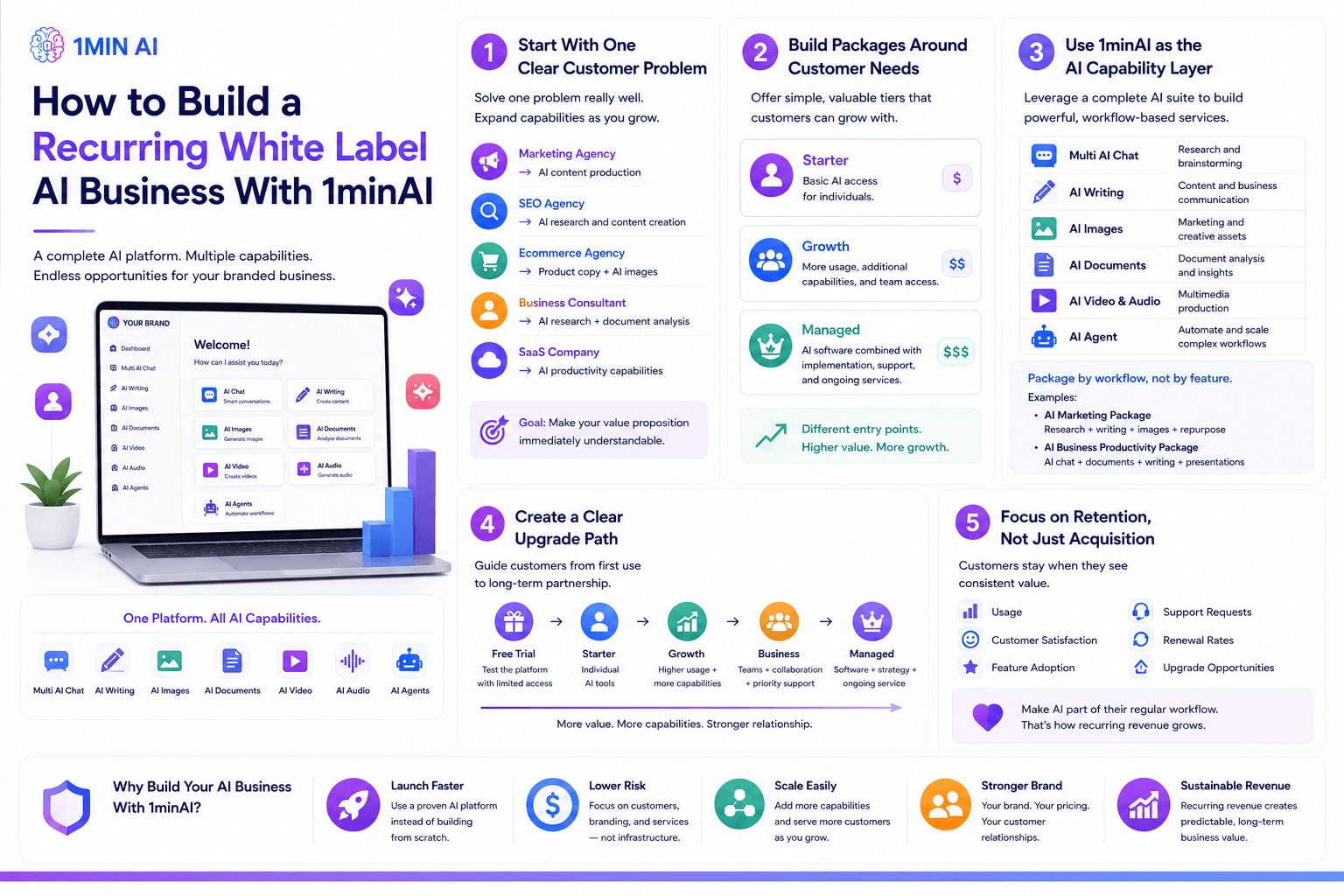
Start With One Clear Customer Problem
Don't launch with a package containing every possible AI feature.
Start with a specific customer problem.
For example:
Marketing Agency
→ AI content production
SEO Agency
→ AI research and content creation
Ecommerce Agency
→ Product copy + AI images
Business Consultant
→ AI research + document analysis
SaaS Company
→ AI productivity capabilities
The goal is to make the value proposition immediately understandable.
Once customers are using the service, additional AI capabilities can become natural upsells.
Build Packages Around Customer Needs
A practical white label AI business could use three tiers.
Starter
Basic AI access for individuals.
Growth
More usage, additional capabilities, and team access.
Managed
AI software combined with implementation, support, and ongoing services.
This gives customers different entry points while creating opportunities to move successful customers into higher-value plans.
Use 1minAI as the AI Capability Layer
Instead of developing every AI capability internally, a business can focus its resources on customer acquisition, branding, service design, and support while using an established AI platform as part of the technology foundation.
With 1minAI, a broader AI service could combine:
Multi AI Chat
→ Research and brainstorming
AI Writing
→ Content and business communication
AI Images
→ Marketing and creative assets
AI Documents
→ Document analysis
AI Video & Audio
→ Multimedia production
AI Agent
→ More complex AI workflows
This makes it possible to design packages around workflows rather than individual AI features.
For example:
AI Marketing Package
Research + writing + images + content repurposing
or:
AI Business Productivity Package
AI chat + document analysis + writing + presentations
The exact package can be adapted to the customer's industry and needs.
Create a Clear Upgrade Path
Recurring revenue becomes more valuable when customers have a reason to expand their relationship with your business.
A possible progression could be:
Free Trial
→ Basic AI experience
Starter
→ Individual AI tools
Growth
→ Higher usage + more capabilities
Business
→ Teams + collaboration + support
Managed
→ Software + strategy + ongoing service
This creates a natural customer journey instead of forcing every customer into the same plan.
Focus on Retention, Not Just Acquisition
Recurring revenue only works when customers continue seeing value.
That means businesses should monitor:
- Usage
- Customer satisfaction
- Feature adoption
- Support requests
- Renewal rates
- Upgrade opportunities
The goal is to make the AI service part of the customer's regular workflow.
If a marketing team relies on the platform every week for content production, replacing it becomes less attractive than if the customer only uses it occasionally.
This is why onboarding, training, support, and workflow integration can be just as important as the AI technology itself.
Conclusion: Turn White Label AI Into Recurring Business Revenue
White label AI services can create recurring revenue when businesses package AI around ongoing customer needs rather than selling access to technology alone.
Subscriptions, usage-based plans, managed services, training, consulting, and support all provide potential ways to build a sustainable AI business model.
With 1minAI, businesses can combine multiple AI capabilities into broader service packages while focusing their own resources on branding, customer relationships, and growth.
Ready to build a recurring white label AI business? Contact 1minAI at collaborate@1min.ai.
Alternatives
Discover the best alternatives to 1minAI and compare features, pricing, and use cases.

1min.AI vs OpenRouter
1min.AI vs. OpenRouter: Compare the ready-to-use AI creation product against the technical API tool. Find out if you need a zero-code creative studio or a coding infrastructure hub.
 Ngoc Hong
1min.AI vs Chatplayground AI
Compare 1min.AI (Voice Cloning, Object Removal, Team Plans) vs. ChatPlayground AI (14+ Models, Teams/O365 Integration). Discover the superior platform for predictable pricing and long-term content production growth.
Ngoc Hong
1min.AI vs Krater AI
Compare 1min.AI vs Krater AI features, pricing, AI models, and workflows to find the best all-in-one AI tool for content, design, and productivity.
Ngoc HongAI Tools
Discover the best AI tools to boost productivity, creativity, and everyday work.
How to Create a Podcast Without Expensive Equipment
Learn how to create a podcast without expensive equipment using AI for scripting, voice, video, editing, and content repurposing with 1min.AI.
 Lien Anh Vu
Free AI Character Generator - No Signup
Generate an AI character free from text or photo prompts. Try 1min.AI's AI character generator with multiple models, no design skills needed.
 Trang Tran
Turn “Make It Better” Into Better Content With AI
Use AI to turn vague client feedback into clear revisions, reduce unnecessary edits, and deliver better content faster.
Lien Anh VuAI Features
Comprehensive AI features that streamline workflows, improve efficiency, and empower teams to achieve more.
Create Better Prompts by Testing Multiple AI Models
Looking for a prompt generator? Learn how to create, test, and refine AI prompts across multiple models with 1minAI’s Multi AI Chat.
 Uyen Hoang
Free AI Tools for Artist
Artist Studio brings image generation, editing, audio creation, and creative tools into one AI workspace, so artists can explore ideas, refine their work, and create finished pieces without switching between different tools.
Uyen Hoang
Free AI Tools for Small Business
Small Business Studio brings AI writing, email replies, pricing, content, and visual tools into one workspace to help small businesses handle everyday work faster.
Uyen HoangAI Use Cases
A curated collection of AI use cases for business, productivity, and industry-specific applications.
How to Create Recurring Revenue With White Label AI Services
Learn how to create recurring revenue with white label AI services using subscriptions, AI-as-a-service, usage-based pricing, managed services, training, and support.
 Tram Ta
1min.AI vs QuillBot for Korean-to-English Translation
Compare 1min.AI vs QuillBot for Korean-to-English translation, including limits, document workflows, AI models, and long-form translation needs.
Ngoc Hong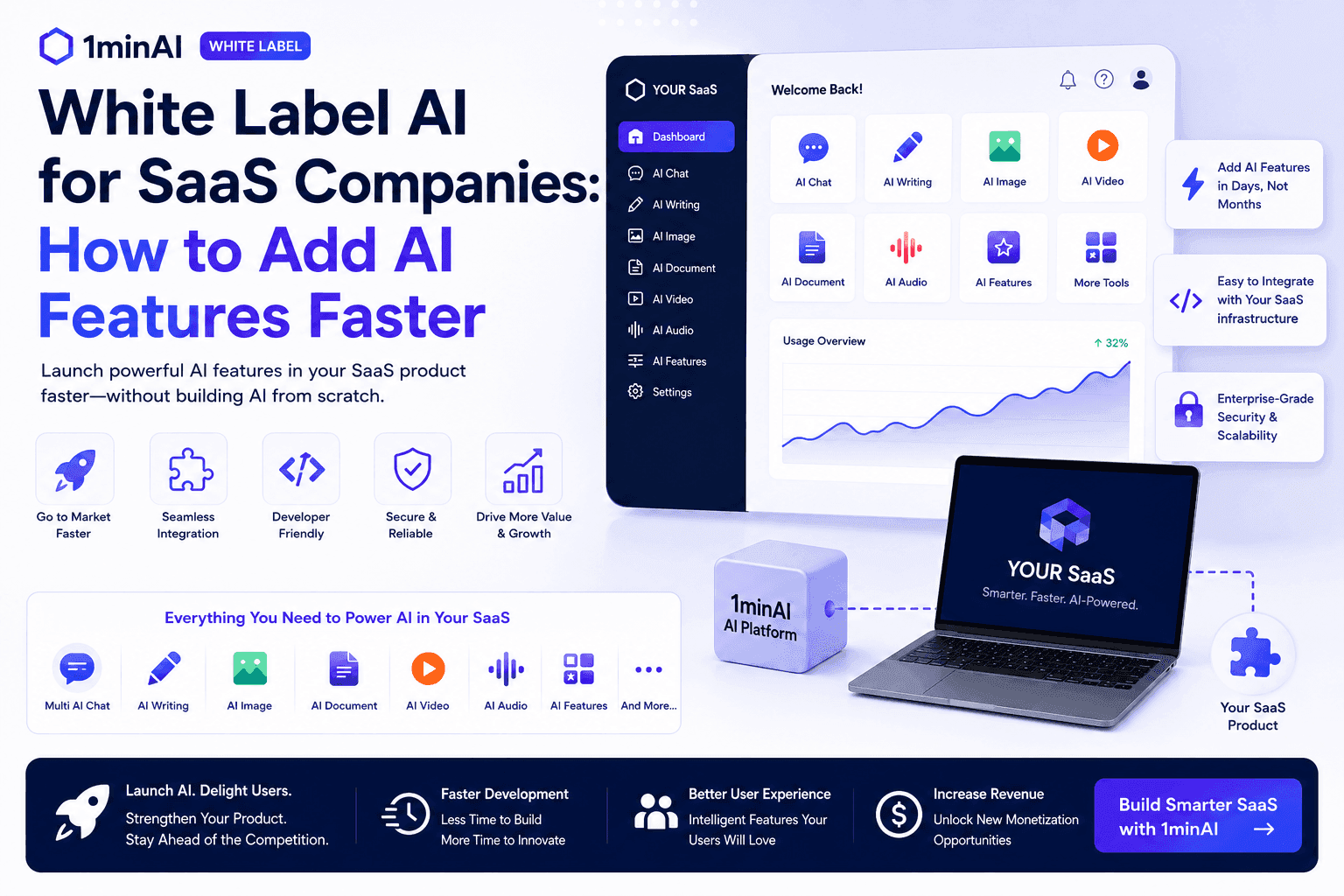
White Label AI for SaaS Companies: How to Add AI Features Faster
Discover how white label AI for SaaS companies can help you add AI features faster without building AI infrastructure from scratch. Learn what to consider and how 1minAI can help.
Tram TaAI Tutorials
Learn how to use AI with practical, step-by-step tutorials.
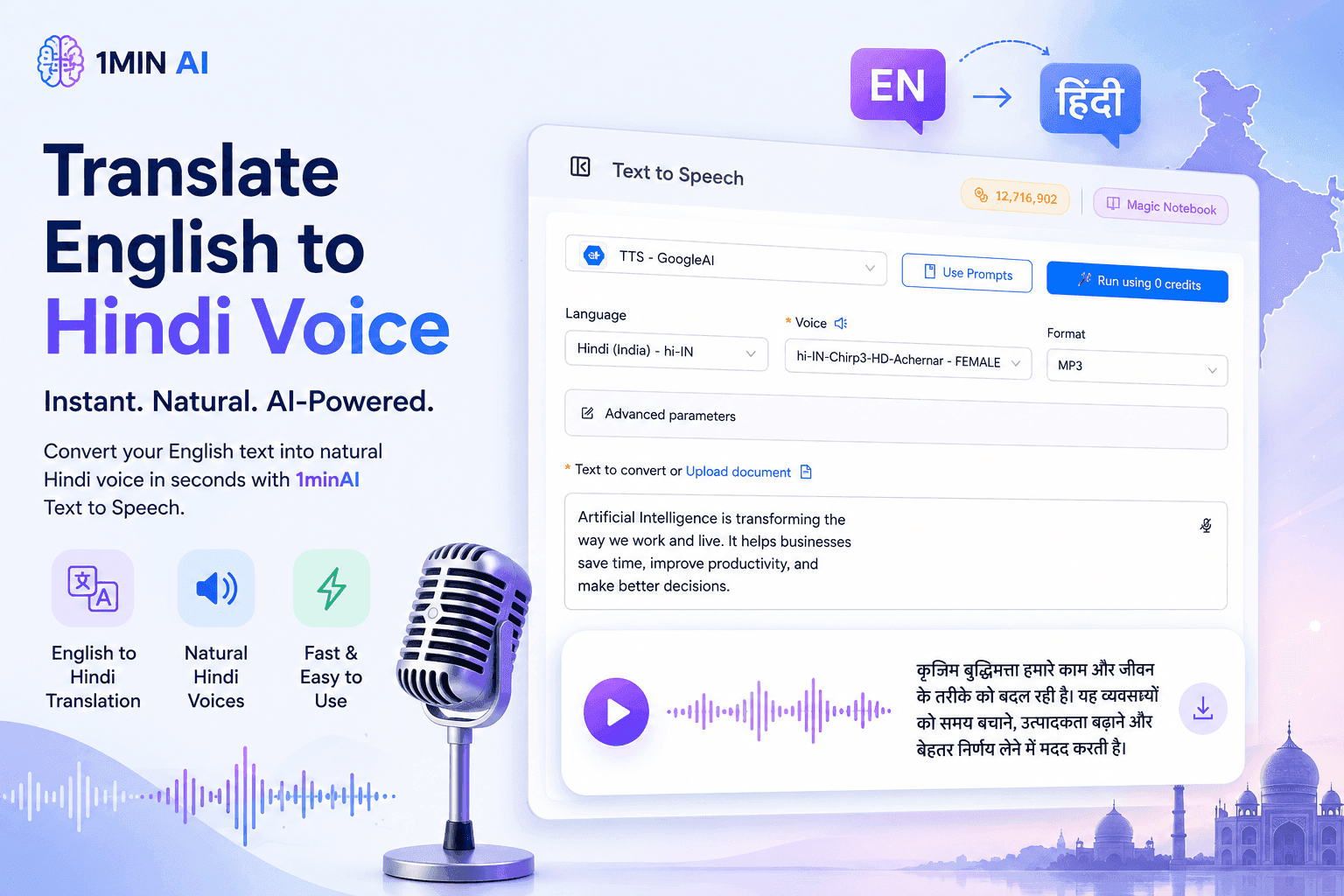
Translate English to Hindi Voice With 1minAI
Translate English to Hindi and convert your text into natural-sounding Hindi voice with 1minAI. Choose a Hindi voice, paste your text, and generate audio in seconds.
Tram Ta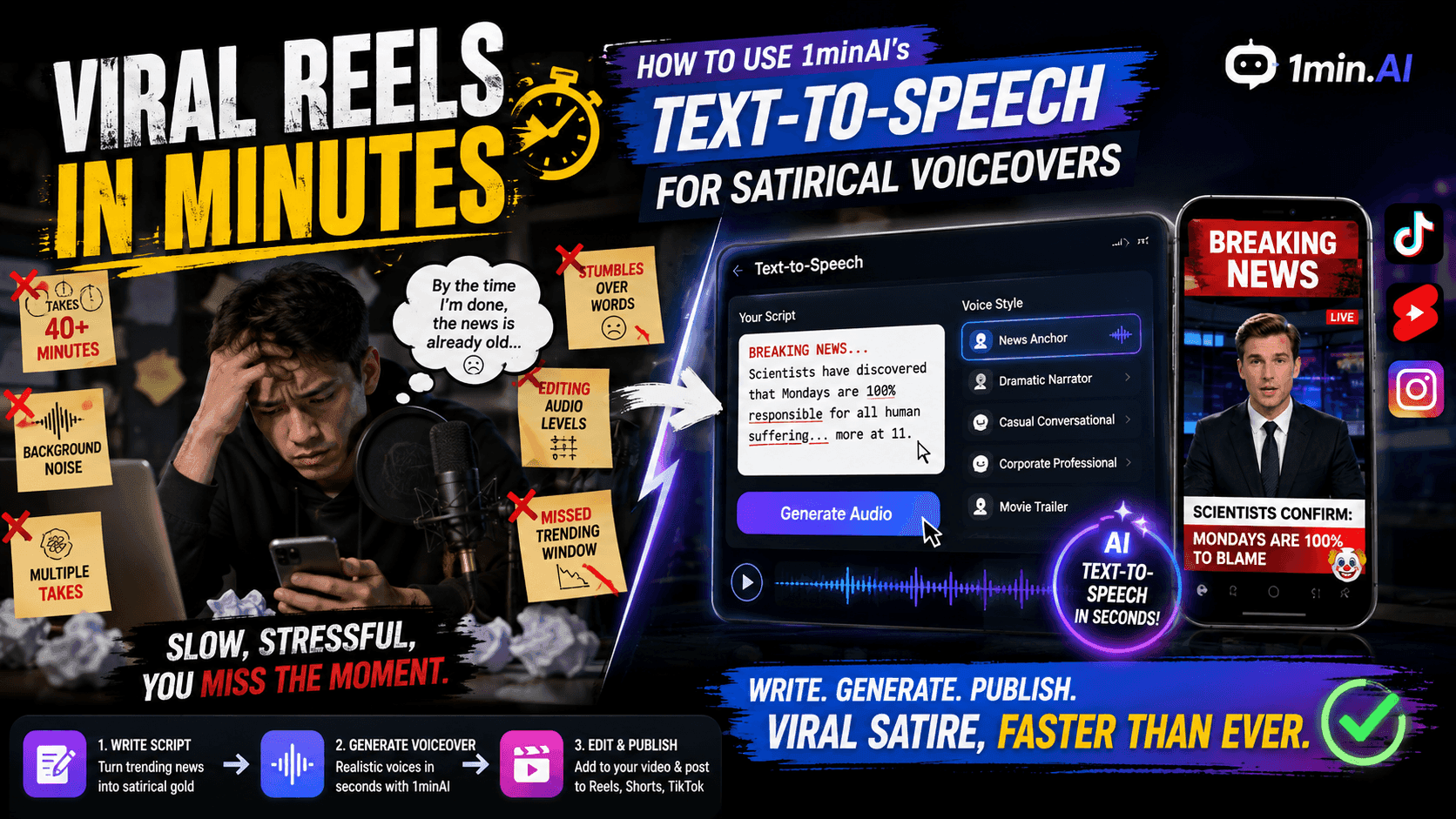
Viral Reels in Minutes: How to Use 1minAI’s Text-to-Speech for Satirical Voiceovers
Learn how satirical page admins use 1minAI’s Text-to-Speech feature to generate instant news anchor and dramatic voiceovers for TikToks, Shorts, and Instagram Reels.
Uyen Hoang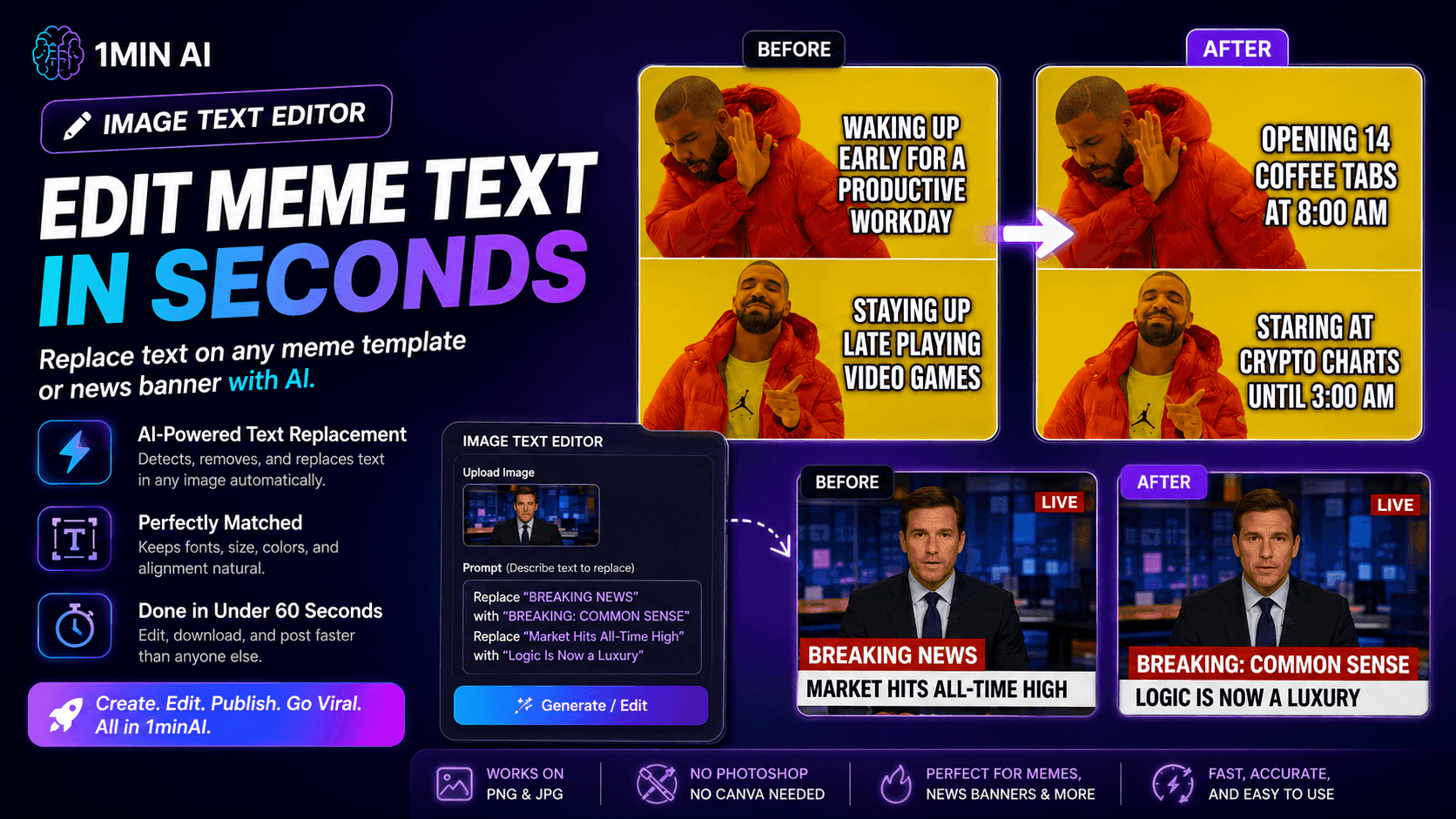
No Photoshop Needed: How to Use 1minAI’s Image Text Editor for Instant Meme Customization
Stop wasting time opening Photoshop or Canva to edit meme captions. Learn how 1minAI’s Image Text Editor replaces text on any meme template or news banner in seconds.
Uyen HoangAI Guides
Learn AI faster with practical guides, real-world examples, and actionable best practices.
How to Create a Podcast Without Expensive Equipment
Learn how to create a podcast without expensive equipment using AI for scripting, voice, video, editing, and content repurposing with 1min.AI.
Lien Anh Vu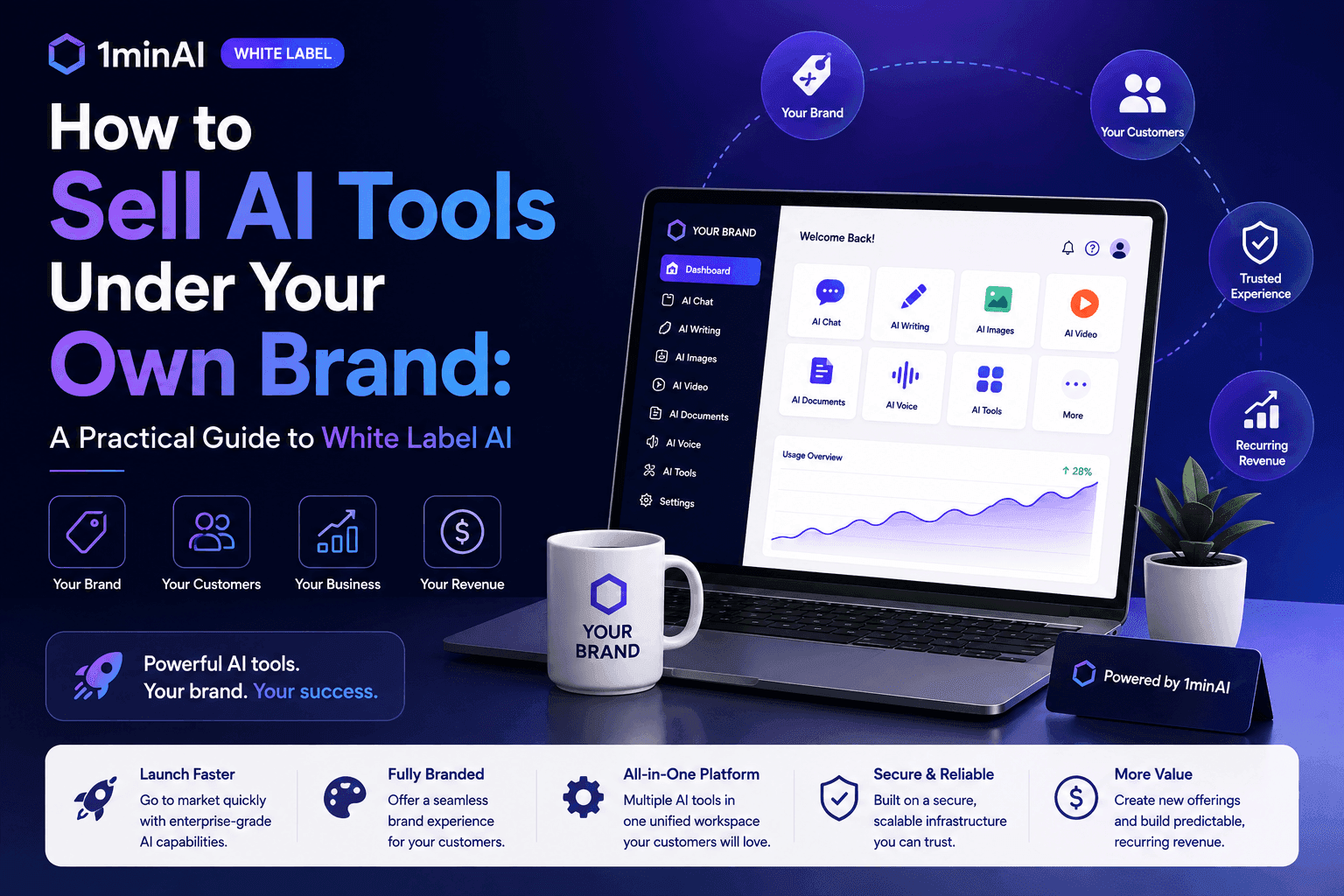
How to Sell AI Tools Under Your Own Brand: A Practical Guide to White Label AI
Learn how to sell AI tools under your own brand with white label AI. Discover how branding, packaging, pricing, onboarding, and recurring revenue work.
Tram Ta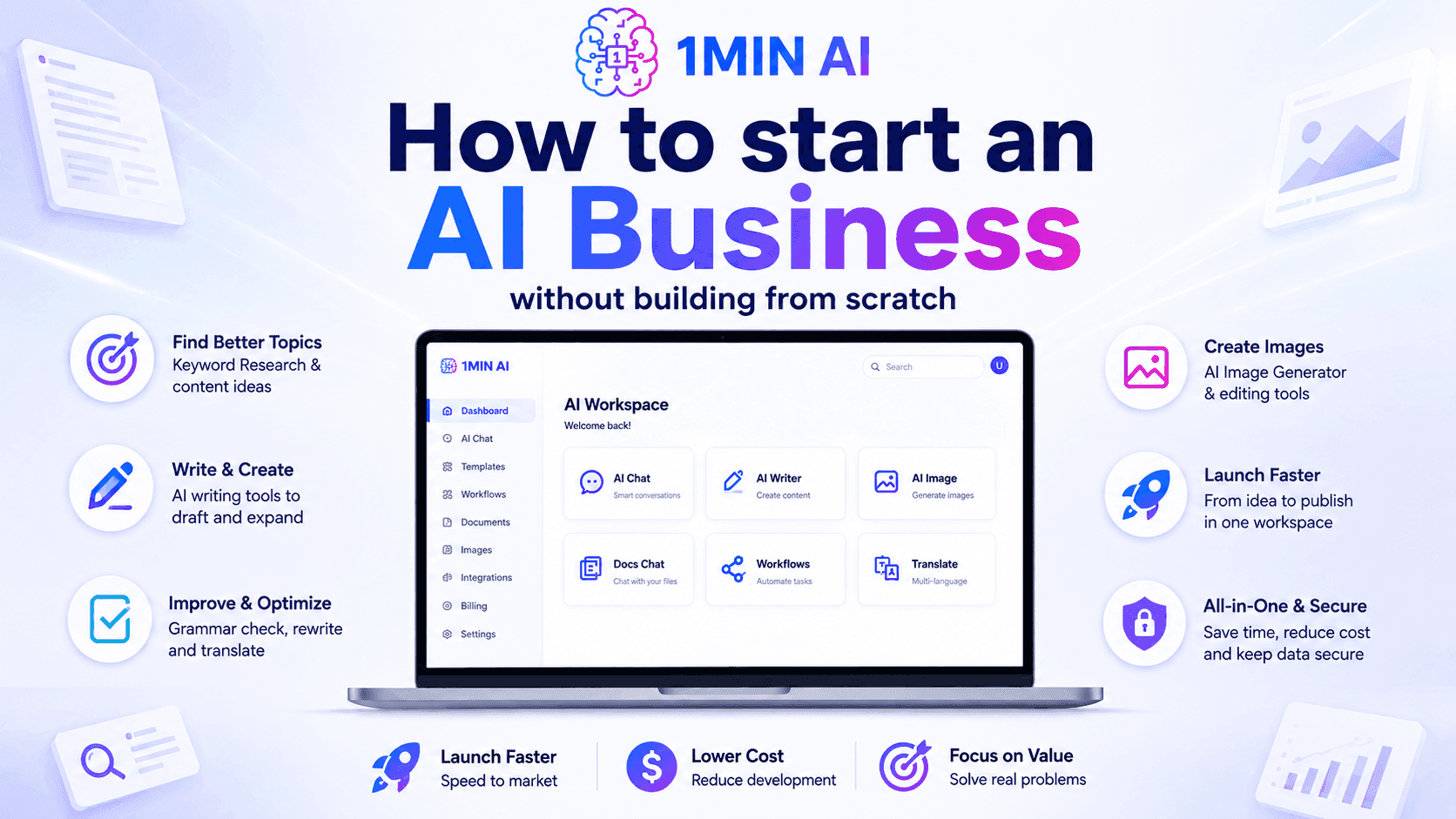
How to start an AI business without building from scratch
Learn how to start an AI business, validate your idea, and launch faster without building costly AI infrastructure from scratch.
Ngoc HongAI Solutions
Browse the best AI solutions for automation, coding, research, productivity, customer support, marketing, and business workflows.
How to Create Recurring Revenue With White Label AI Services
Learn how to create recurring revenue with white label AI services using subscriptions, AI-as-a-service, usage-based pricing, managed services, training, and support.
Tram Ta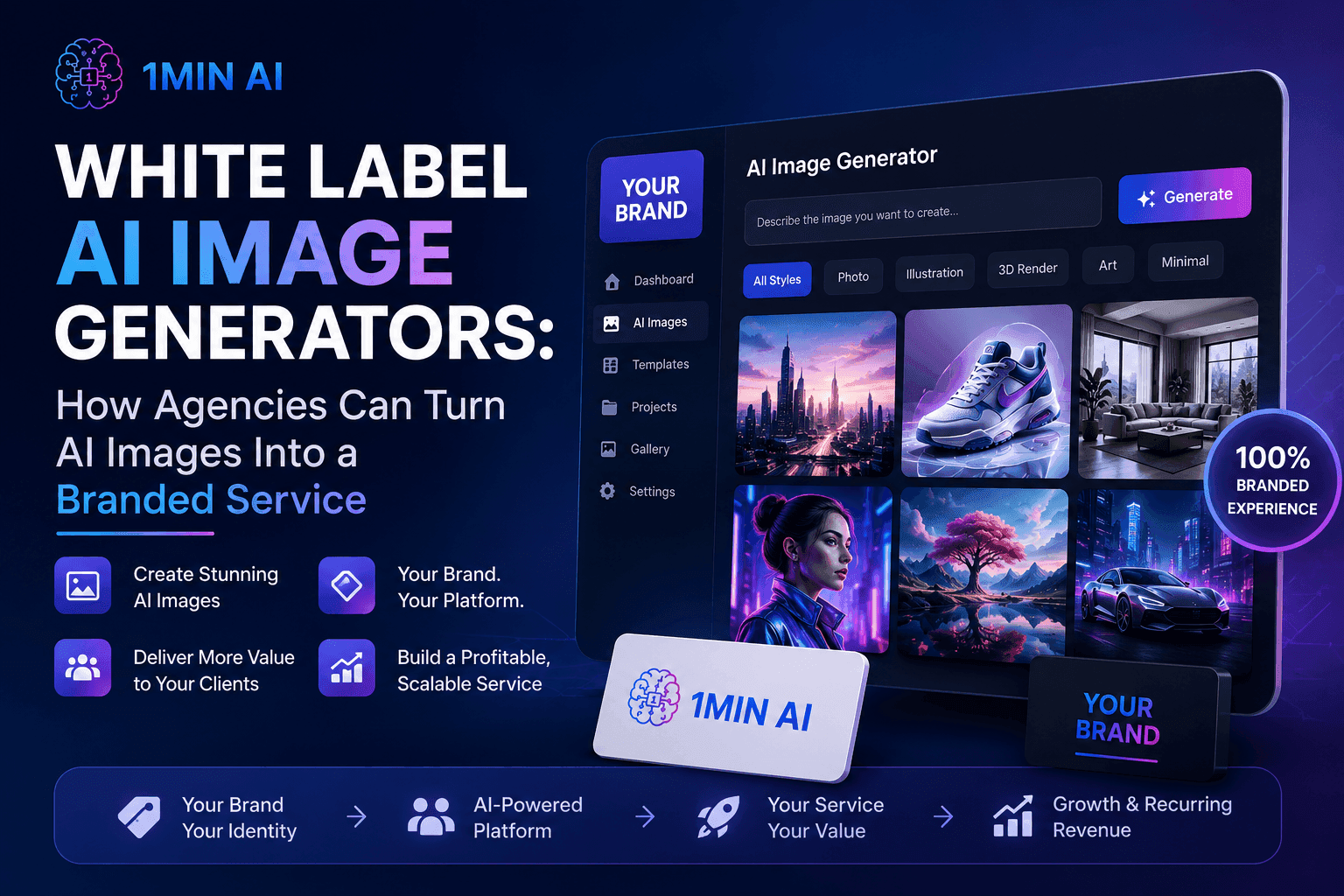
White Label AI Image Generators: How Agencies Can Turn AI Images Into a Branded Service
Learn how agencies can use a white label AI image generator to offer branded creative services for ecommerce, social media, advertising, and branding clients.
Tram TaHow to Create a Podcast Without Expensive Equipment
Learn how to create a podcast without expensive equipment using AI for scripting, voice, video, editing, and content repurposing with 1min.AI.
Lien Anh VuAI Models
Explore the world's leading AI models in one place.
How to Create a Podcast Without Expensive Equipment
Learn how to create a podcast without expensive equipment using AI for scripting, voice, video, editing, and content repurposing with 1min.AI.
Lien Anh Vu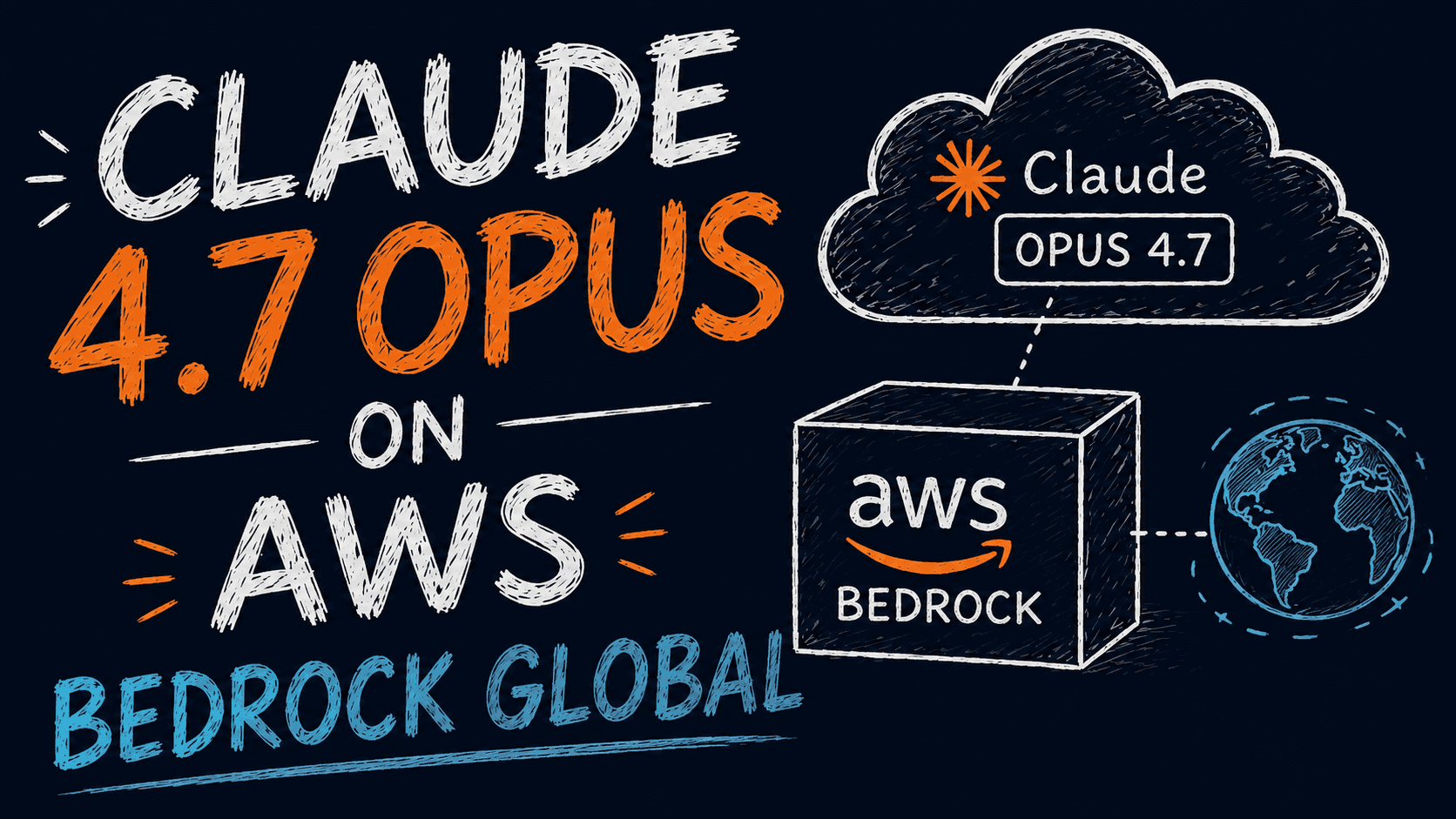
CLAUDE 4.7 OPUS - AWS BEDROCK US
Deploy Claude 4.7 Opus on AWS Bedrock US. Discover enterprise AI infrastructure, advanced coding, adaptive thinking, secure inference, and seamless AWS integration.
Ngoc Hong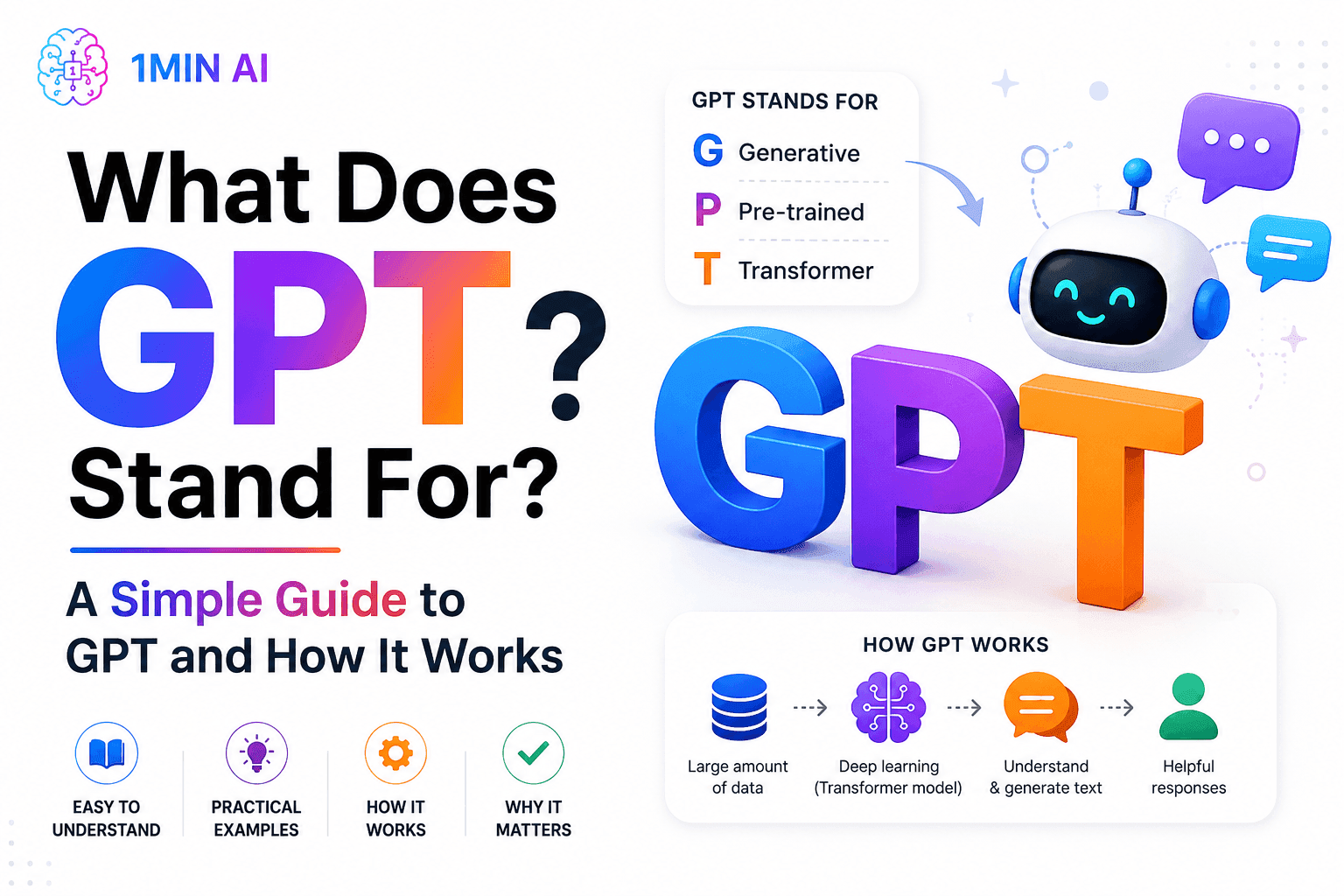
What Does GPT Stand For? A Simple Guide to GPT and How It Works
What does GPT stand for? Learn what GPT means, how Generative Pre-trained Transformer technology works, and why GPT models are important to modern AI.
Tram TaAI Comparisons
Compare AI tools, models, and platforms to find the best fit for your needs.
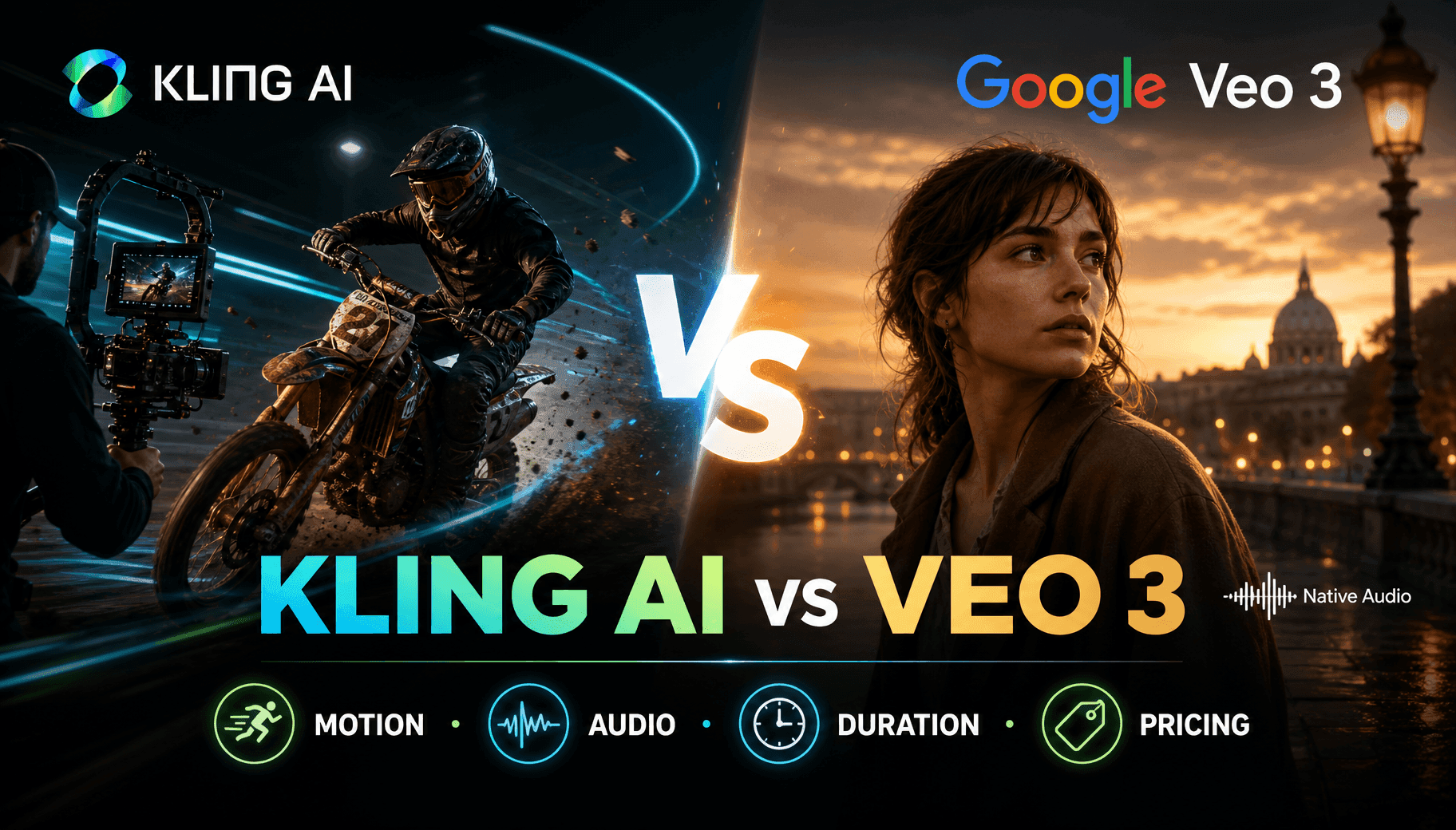
Kling AI Vs Veo 3: Which Model Wins?
Kling AI vs Veo 3: compare motion, native audio, pricing & free tiers to see which AI video generator wins for your project - try both on 1min.AI.
Trang Tran1min.AI vs QuillBot for Korean-to-English Translation
Compare 1min.AI vs QuillBot for Korean-to-English translation, including limits, document workflows, AI models, and long-form translation needs.
Ngoc Hong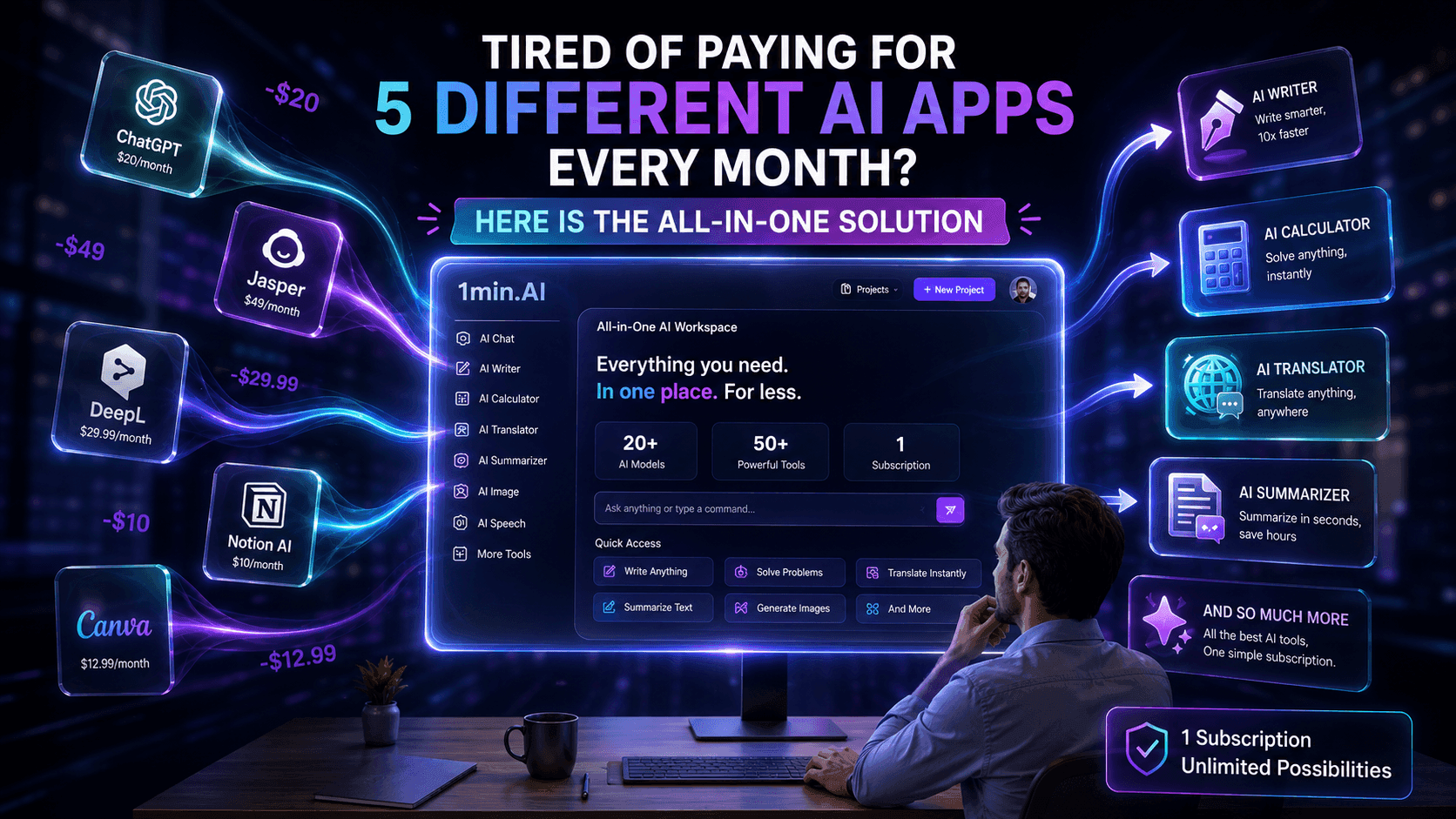
Your Sales Team Only Needs One App Instead of Five
Ditch the multi-app bills. Learn why high-performing sales teams are moving to an all-in-one AI platform to cut tool fatigue and leverage top models.
Uyen HoangAI Integrations
Seamlessly integrate AI with the tools you already use to automate work and boost productivity.
How to Create a Podcast Without Expensive Equipment
Learn how to create a podcast without expensive equipment using AI for scripting, voice, video, editing, and content repurposing with 1min.AI.
Lien Anh Vu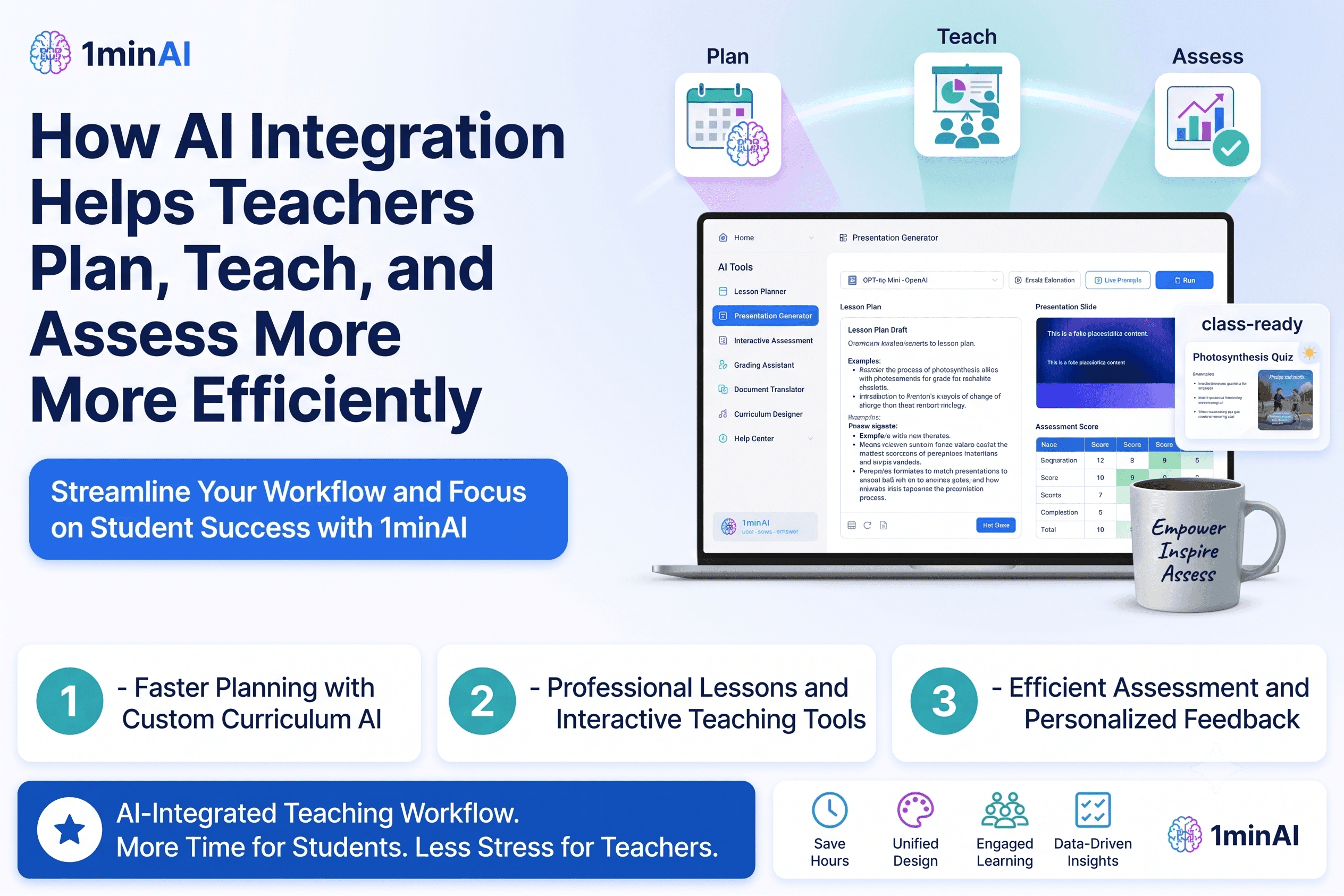
How AI Integrations Help Teachers Plan, Teach, and Assess More Efficiently
Discover how AI integration helps teachers streamline lesson planning, presentations, classroom materials, assessments, and student engagement in one AI workspace.
Tram Ta
AI Content Workflow for Freelancers: From Brief to Post
Discover an AI content workflow for freelancers. Use Claude for brainstorming and ChatGPT for images to turn client briefs into polished social posts faster.
Lien Anh VuAI for Industries
Find the best AI tools and workflows for healthcare, finance, education, legal, manufacturing, retail, real estate, and more
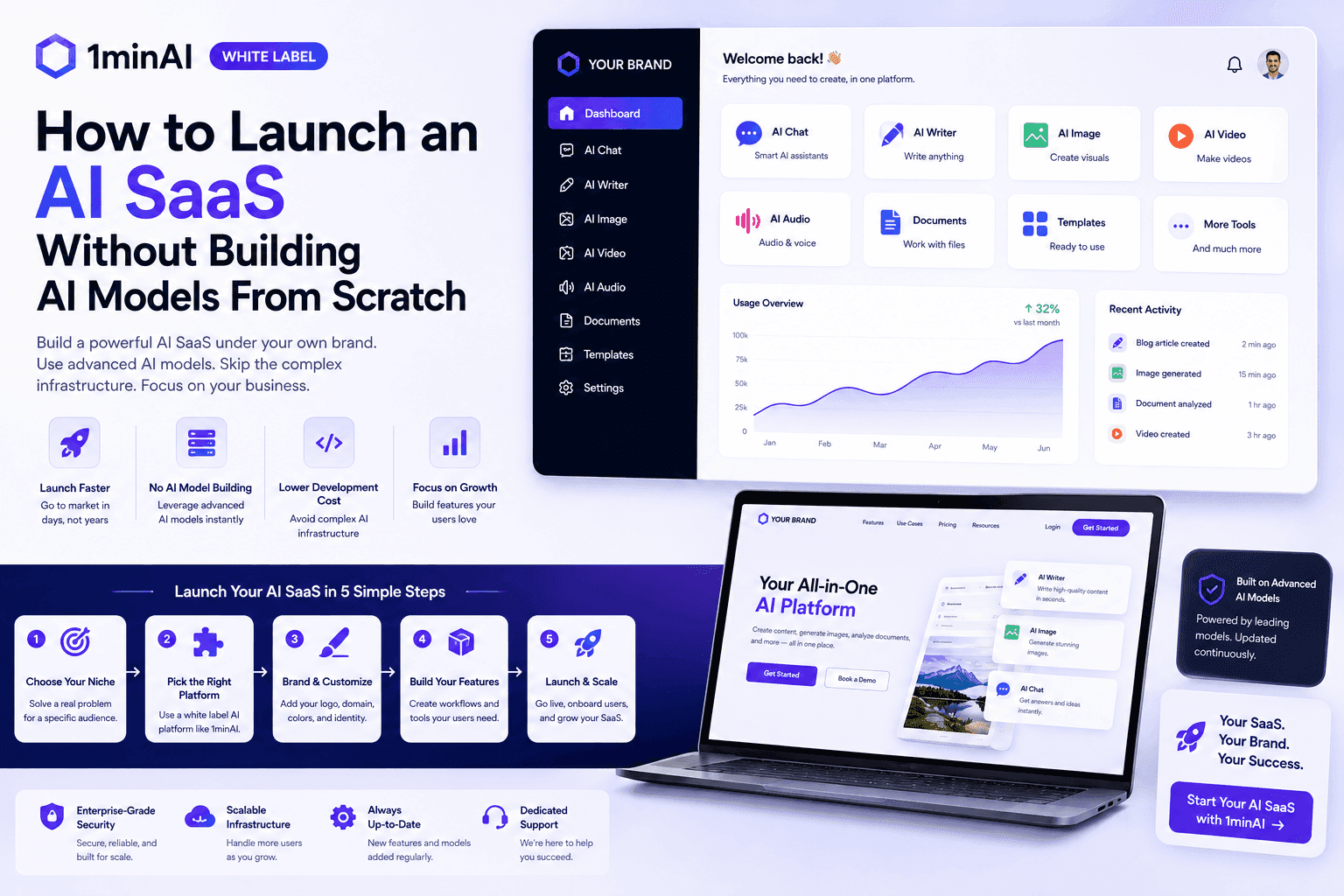
How to Launch an AI SaaS Without Building AI Models From Scratch
Learn how to launch an AI SaaS without building AI models from scratch. Explore white-label AI, product strategy, branding, pricing, and how 1minAI can help.
Tram Ta
Free AI Tools for Photographers to Elevate Creative Work
Discover free AI tools for photographers to edit images, create visuals and videos, develop content, and streamline client workflows with 1min.AI.
Lien Anh Vu
Free AI Tools for Social Media Managers to Create Faster
Discover free AI tools for social media managers to brainstorm content, create visuals and videos, write captions, and streamline social media workflows with 1min.AI.
Lien Anh VuAI Agents
Discover and run AI agents to automate tasks across your work and daily life.
White Label AI Image Generators: How Agencies Can Turn AI Images Into a Branded Service
Learn how agencies can use a white label AI image generator to offer branded creative services for ecommerce, social media, advertising, and branding clients.
Tram Ta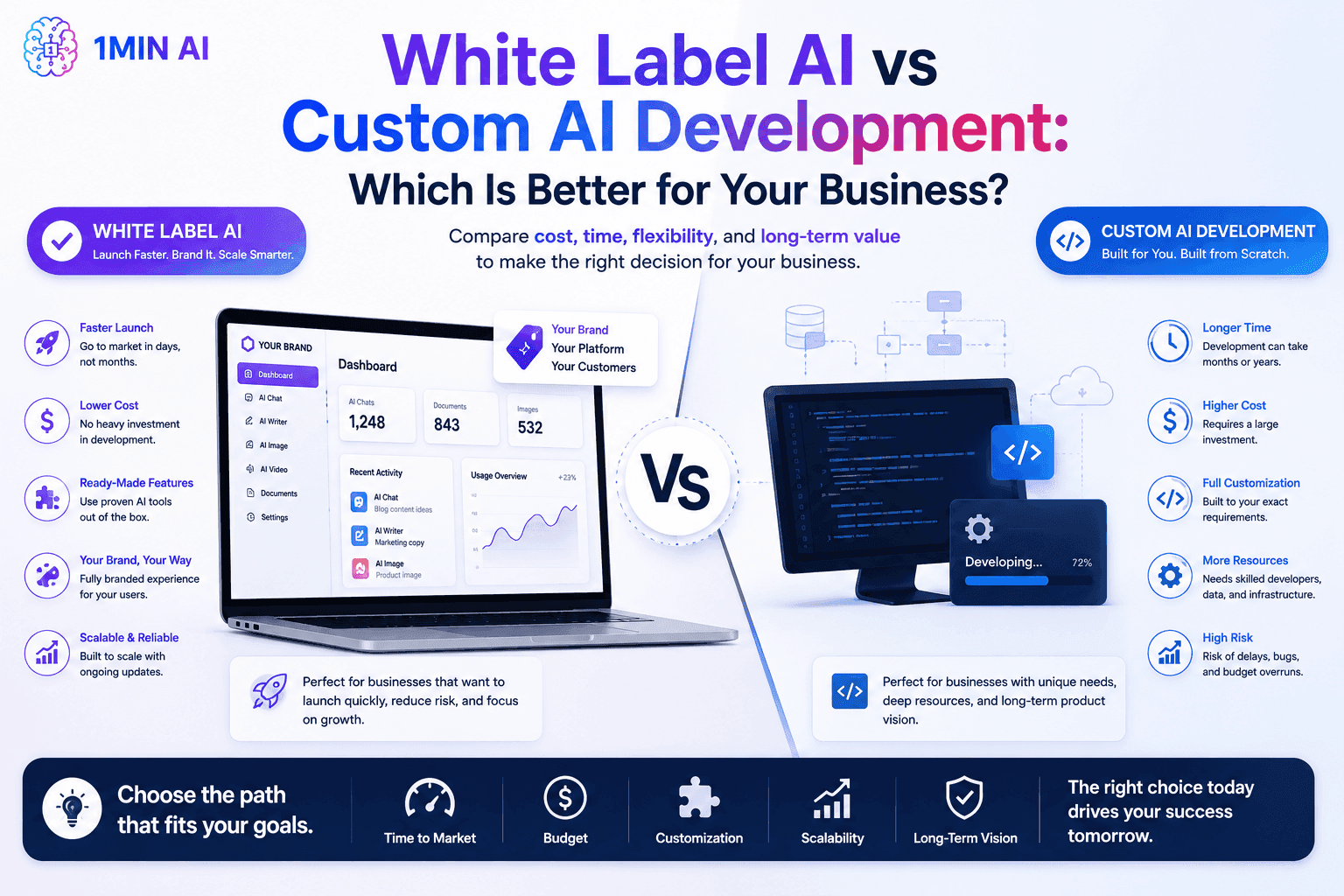
White Label AI vs Custom AI Development: Which Is Better for Your Business?
Compare white label AI vs custom AI development to understand the differences in cost, launch time, customization, maintenance, and scalability.
Tram Ta
White Label AI Chatbots: Build Branded AI Assistants for Your Business
Discover how white label AI chatbots help agencies and businesses offer branded AI assistants for support, lead generation, and productivity with 1minAI.
Tram TaAI Workflows
Explore ready-to-use AI workflows for productivity, marketing, sales, support, and more.
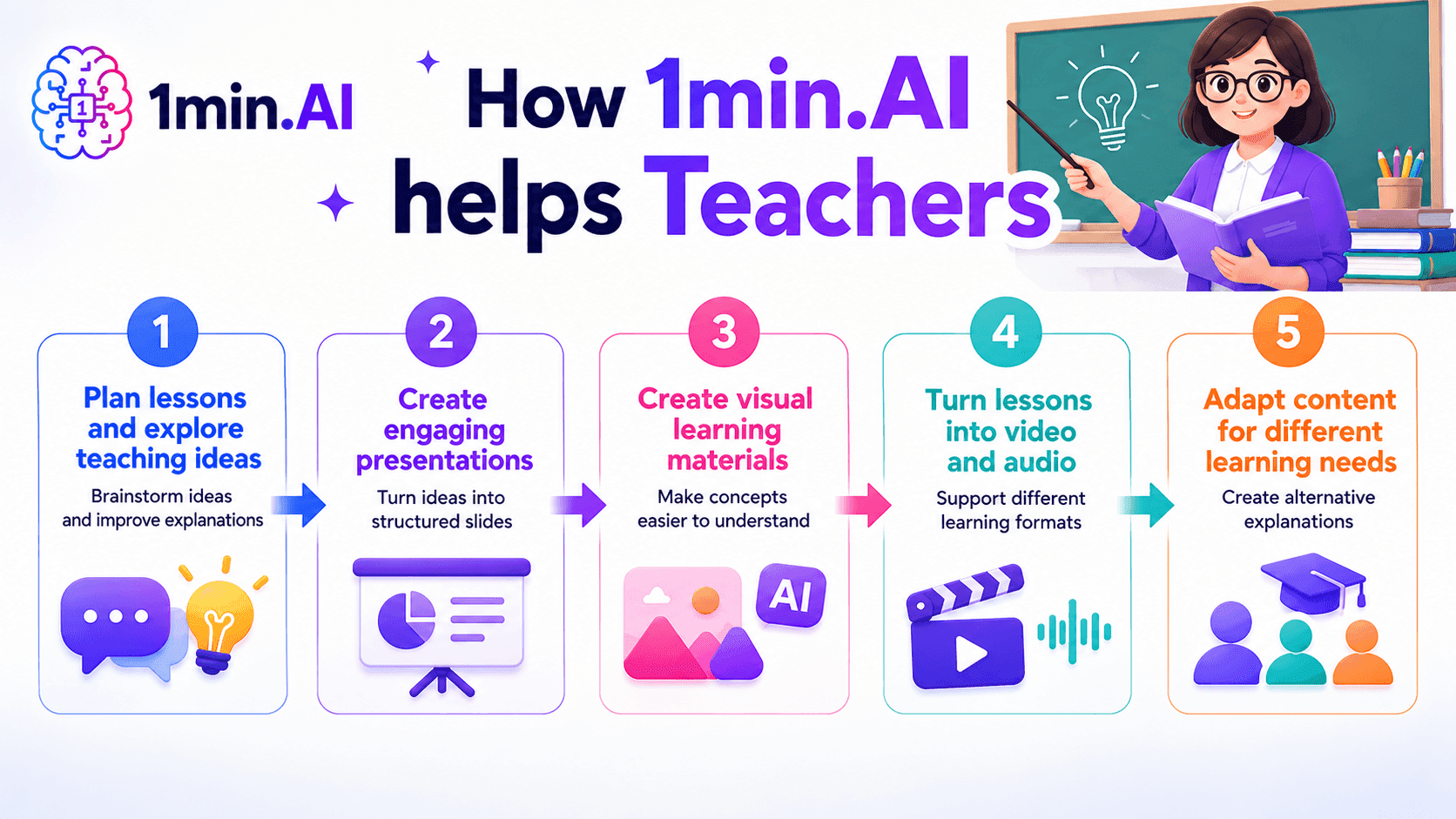
AI tools for Teachers
Discover AI tools for Teachers to create lessons, presentations, visuals, videos, and audio materials from one AI workspace with 1min.AI.
Ngoc Hong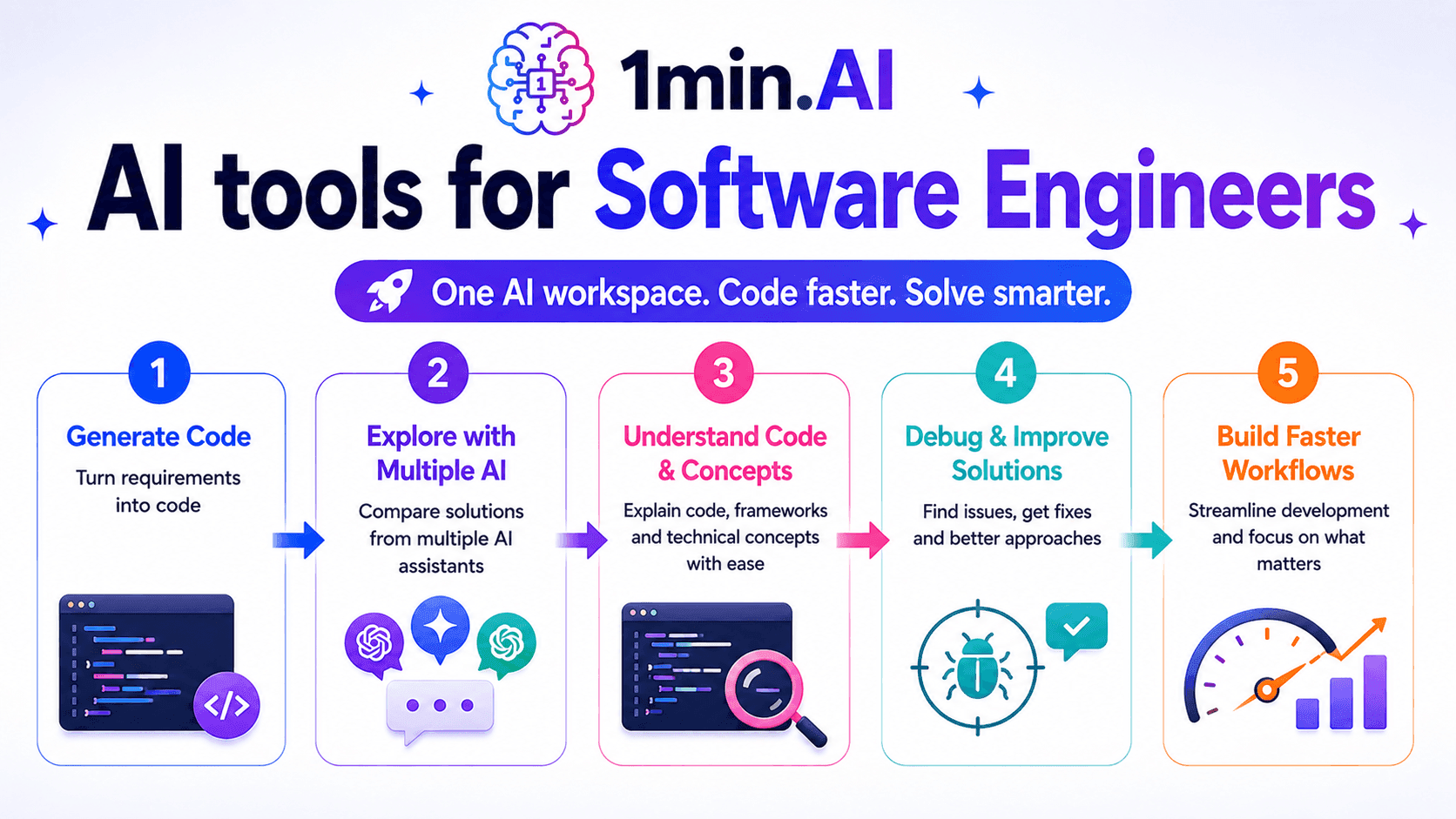
AI Tools for Software Engineers
Discover AI tools for Software Engineers to generate code, debug problems, understand technical concepts, and streamline development with 1min.AI.
Ngoc Hong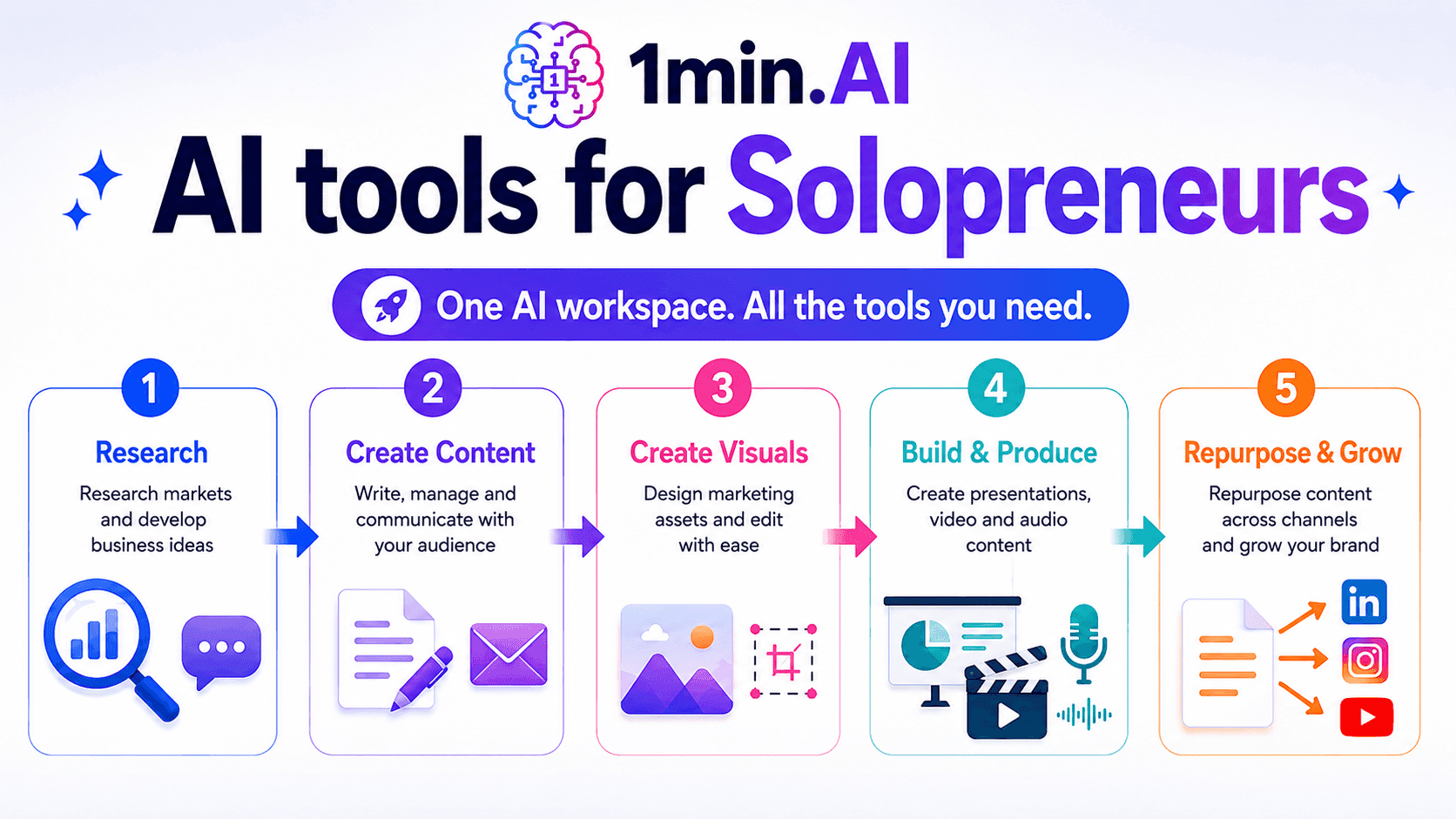
AI tools for Solopreneurs
Discover AI tools for Solopreneurs to research, create content, design, market, and manage business tasks from one AI workspace.
Ngoc HongNewsletter
Weekly AI Innovations with 1minAI

🔮 Weekly AI Innovations #134: Experience Free Qwen on AI Chat; The 3.7 and 3.6 Series Update
Looking for a powerful, free AI assistant? Explore the latest Qwen 3.7 and 3.6 series on 1min.ai. Enjoy high-speed, accurate AI chat at zero cost today!
 Hang Nguyen
🔮 Weekly AI Innovations #133: Earn Credits and more with AI Social
Explore DeepSeek V4's open-source efficiency and xAI's Grok 4.3 & 4.5 for advanced reasoning and ultra-fast coding in 2026.
Hang Nguyen
🔮 Weekly AI Innovations #132: DeepSeek V4 & xAI's Grok 4.3, 4.5
Explore DeepSeek V4's open-source efficiency and xAI's Grok 4.3 & 4.5 for advanced reasoning and ultra-fast coding in 2026.
Hang Nguyen