White Label AI Chatbots: Build Branded AI Assistants for Your Business

Tram Ta
August 26, 2026
Discover how white label AI chatbots help agencies and businesses offer branded AI assistants for support, lead generation, and productivity with 1minAI.
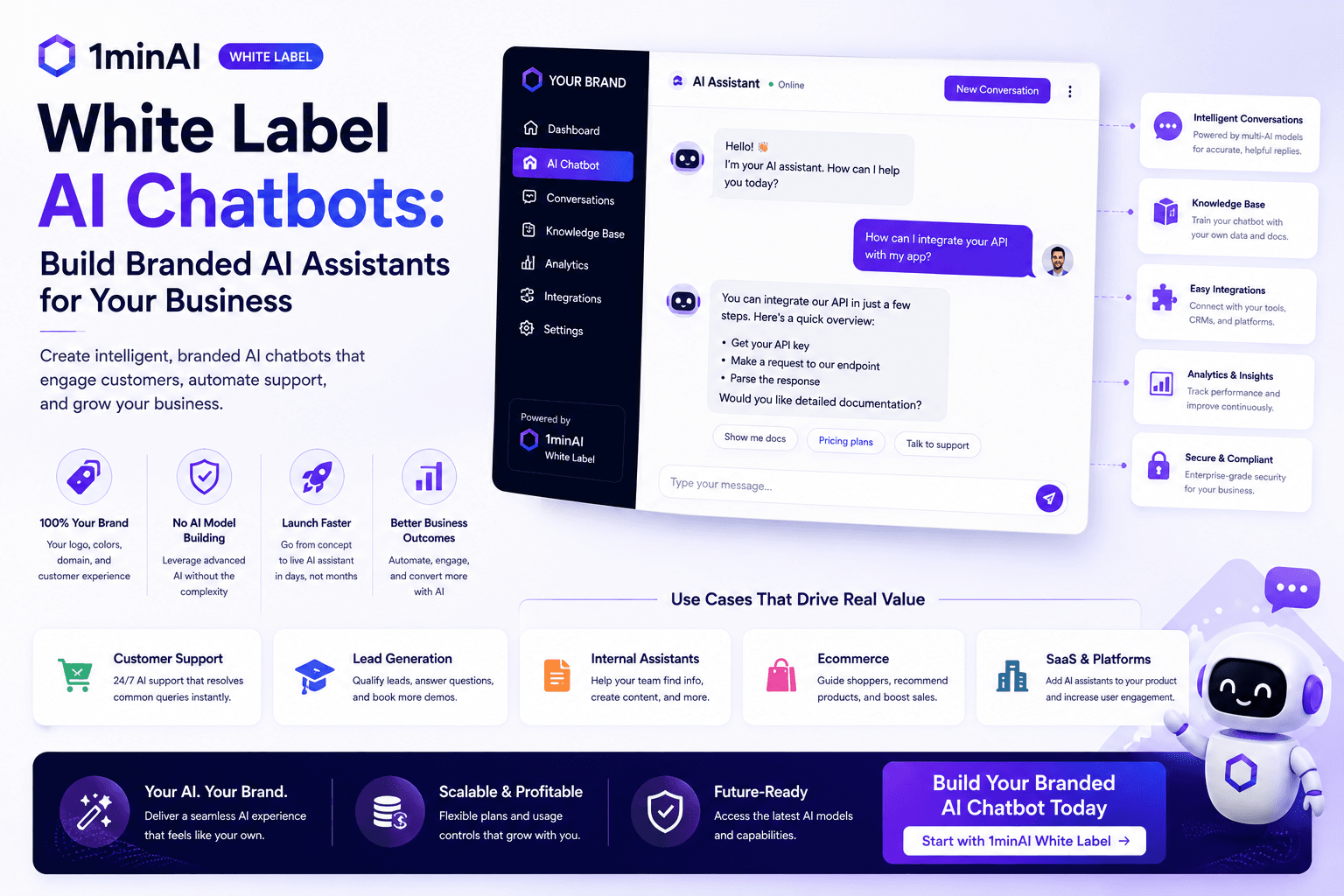
AI chatbots are becoming a practical way for businesses to support customers, qualify leads, answer questions, and improve internal workflows. But for agencies, SaaS companies, and entrepreneurs, simply recommending a third-party chatbot may not be enough. White label AI chatbots offer a way to package AI capabilities under your own brand and turn them into part of a broader product or service offering.
Instead of building AI models from scratch, businesses can use an existing AI infrastructure and focus on what matters most: branding, positioning, customer experience, and recurring revenue.
What Is a White Label AI Chatbot?
A white label AI chatbot is an AI-powered chat solution that can be offered under another company's brand. The underlying AI technology is provided by a platform or technology partner, while the business using the solution can position the experience as part of its own product or service.
This model can be especially attractive for:
- Marketing and digital agencies
- SaaS companies
- AI consultants
- Business service providers
- Entrepreneurs launching AI products
- Companies adding AI services to an existing offering
The concept is similar to white label software in other industries: instead of spending months developing the entire technology stack, a business starts with an existing capability and builds its own commercial offering around it.
Why Businesses Are Looking at White Label AI Chatbots
Building a chatbot from scratch can involve much more than creating a chat interface.
A production-ready AI solution may require:
- AI model access
- Prompt and conversation management
- Model selection
- User interfaces
- Infrastructure
- Usage management
- Testing
- Ongoing model updates
- Customer support
For many businesses, developing all of these components internally isn't the best use of time or resources.
A white label approach can shift the focus from building AI infrastructure to building an AI business.
For example, an agency could package an AI assistant as part of its marketing service. A SaaS company could add AI-powered conversations to its existing product offering. An entrepreneur could develop a branded AI productivity service without having to train its own large language model.
White Label AI Chatbot vs. Building Your Own AI
The difference is mainly about where your resources go.
With custom AI development, you are responsible for a much larger portion of the technology stack.
With white label AI, the technology partner provides the underlying capability while you focus more heavily on:
Brand → Positioning → Customer Experience → Distribution → Pricing → Support
This can significantly shorten the path from an AI idea to a marketable offering.
It also makes white label AI particularly interesting for businesses that want to experiment with AI services without making a large upfront investment in model development.
How Businesses Can Use White Label AI Chatbots
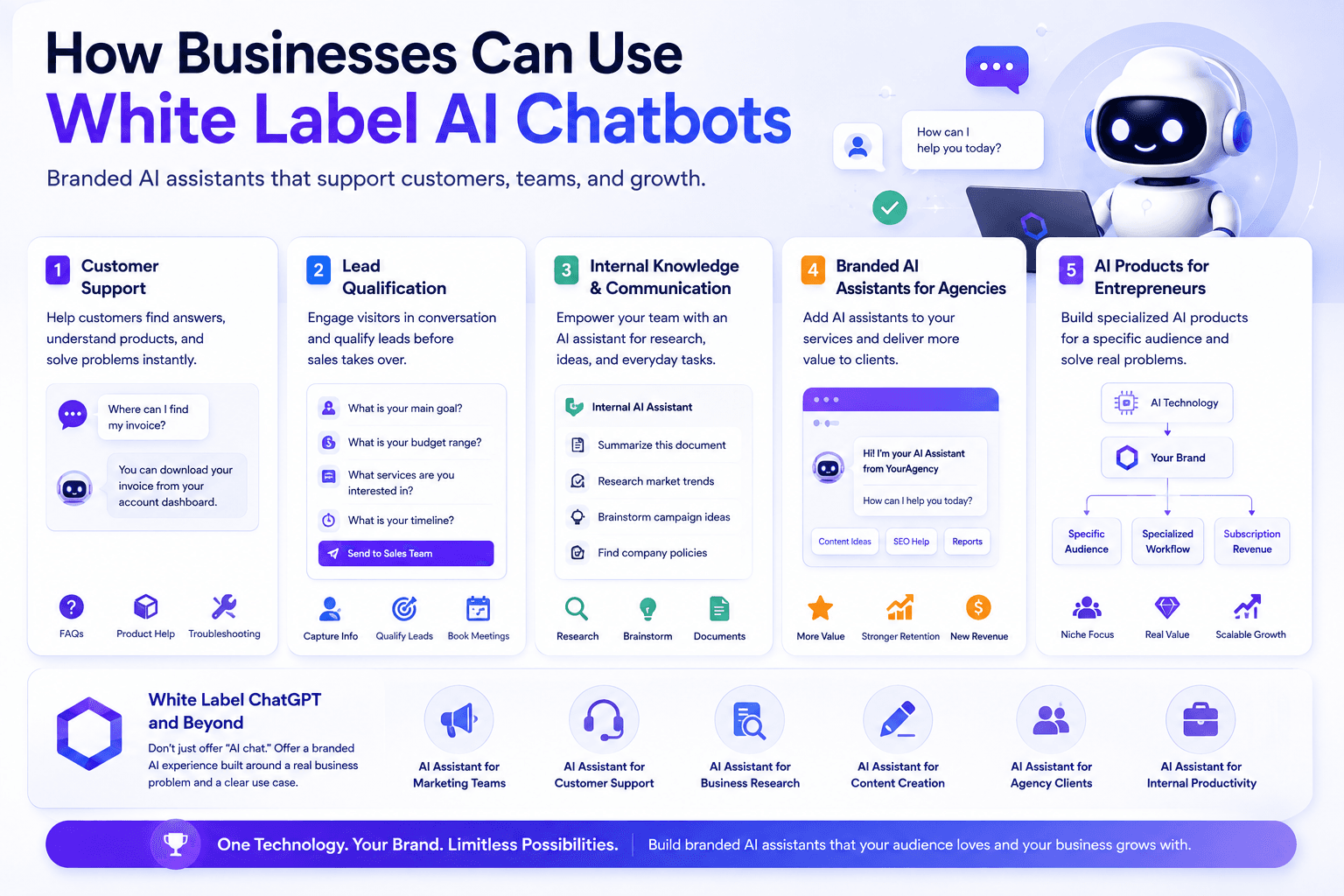
A branded AI assistant can support much more than basic customer questions. The most valuable use cases depend on the business model, audience, and information the assistant is designed to work with.
1. Customer Support
Businesses can use AI chat experiences to help customers find answers to common questions, understand products, and navigate services.
For example, a software company could offer an AI assistant that helps users understand features or troubleshoot common problems.
An agency could also package an AI assistant as part of a client's digital experience.
The important advantage is that AI can provide an additional communication layer without requiring employees to manually answer every repetitive question.
2. Lead Qualification
AI chat can also become part of a sales workflow.
Instead of simply displaying a contact form, a business can use conversational AI to help visitors explain what they need.
The conversation could focus on:
- Business needs
- Budget range
- Project requirements
- Preferred services
- Timeline
- Product interests
This information can help businesses understand potential customers before a sales representative takes over.
For agencies, this creates an opportunity to package AI chat as part of a broader lead-generation service rather than selling a chatbot as an isolated feature.
3. Internal Knowledge and Business Communication
AI chatbots don't have to be customer-facing.
Companies can also use conversational AI internally to help employees interact with information, brainstorm ideas, summarize material, or explore business questions.
For example, a company could provide employees with an internal AI assistant for:
- Research
- Brainstorming
- Content development
- Business questions
- Document-related tasks
- Communication support
This makes conversational AI useful beyond customer service and gives businesses more opportunities to integrate AI into everyday workflows.
4. Branded AI Assistants for Agencies
For agencies, a white label AI chatbot can become an additional service that complements existing offerings.
A marketing agency, for example, could combine:
Website → Content → SEO → Advertising → AI Assistant
Rather than referring clients to a separate AI provider, the agency can position AI as another component of its own service package.
This can create a more cohesive customer experience while opening another potential source of recurring revenue.
5. AI Products for Entrepreneurs
Entrepreneurs can also use white label AI to create specialized AI products.
Instead of trying to build a general-purpose AI model, the entrepreneur can focus on a specific audience and use case.
For example:
AI technology → Your brand → Specific audience → Specialized workflow → Subscription
The differentiation doesn't necessarily come from owning the underlying AI model.
It can come from how the product is packaged, who it serves, how easy it is to use, and what problem it solves.
Where “White Label ChatGPT” Fits
The term white label ChatGPT is often used when people are looking for a way to offer a ChatGPT-like conversational experience under their own brand.
However, businesses should think beyond simply copying a general chatbot.
The real opportunity is to create a branded AI experience designed around a specific business problem.
For example, instead of offering “AI chat,” a company could position its product as:
- AI assistant for marketing teams
- AI assistant for customer support
- AI assistant for business research
- AI assistant for content creation
- AI assistant for agency clients
- AI assistant for internal productivity
The underlying technology may be AI chat, but the commercial value comes from the use case and customer experience.
How 1minAI Supports a White Label AI Chatbot Strategy
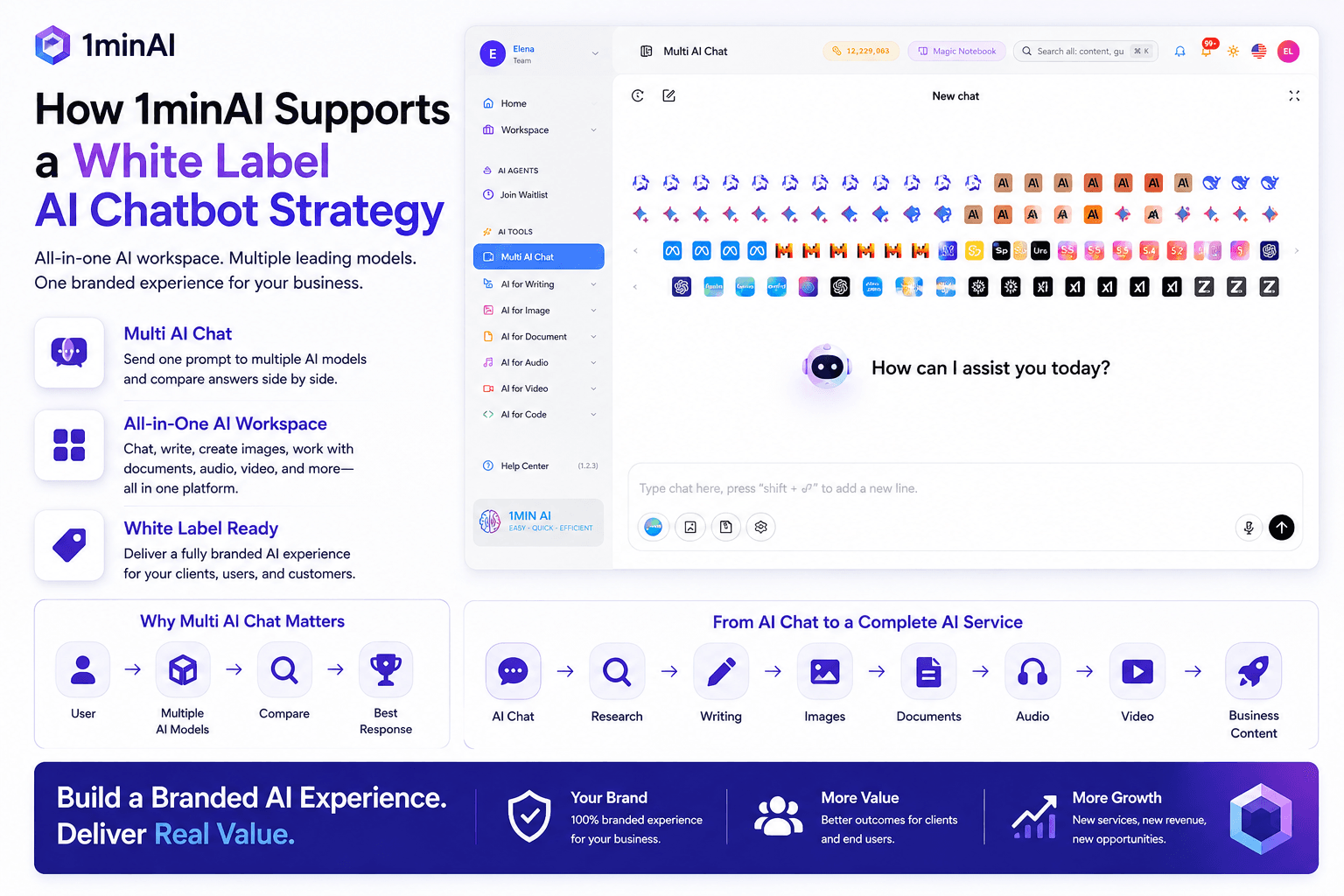
1minAI approaches AI from an all-in-one workspace perspective, bringing multiple AI capabilities together rather than requiring users to manage completely separate tools. Its current Multi AI Chat experience allows users to send one prompt to multiple leading AI models and compare their responses within the same workspace.
That multi-model capability can be particularly useful when developing or delivering branded AI experiences because different models can produce different strengths in reasoning, writing, research, coding, and creative tasks.
Multi AI Chat for More Flexible AI Experiences
With Multi AI Chat, users can send the same prompt to multiple AI models and review their answers side by side. Current 1minAI materials describe support for leading models including ChatGPT, Claude, Gemini, DeepSeek, and others.
This changes the traditional chatbot workflow.
Instead of:
User → One AI model → One answer
the workflow can become:
User → Multiple AI models → Compare → Select the strongest response
For businesses, this can be valuable when the quality of the answer matters and different models may perform differently depending on the task.
For example, an agency could use multiple models when developing content strategies for clients, researching an industry, brainstorming campaigns, or evaluating different approaches.
One AI Workspace Instead of Multiple AI Subscriptions
One of the problems with building an AI stack is fragmentation.
A business might otherwise need one platform for ChatGPT, another for Claude, another for Gemini, and additional applications for writing, images, documents, and other AI tasks.
1minAI's approach is to bring multiple AI capabilities into one workspace. Its current platform includes AI chat alongside writing, image, document, audio, video, and agent capabilities. (1minAI)
For businesses exploring a white label AI strategy, this broader ecosystem can be useful because the chatbot does not have to exist as an isolated capability.
A potential workflow could look like:
AI Chat → Research → Writing → Images → Video → Business Content
That creates opportunities to build a more complete AI service around the customer's needs.
From AI Chat to a Broader AI Service
The strongest white label offering is rarely just a technology feature.
It is a solution.
For example, an agency could position its offering as an AI productivity platform for clients rather than simply selling access to an AI chatbot.
The underlying workflow could include:
Chat → Research → Content → Documents → Visuals → Multimedia
This allows businesses to create a broader value proposition around AI while using specialized capabilities as components of the overall service.
1minAI's current product direction supports this broader all-in-one approach, with multiple AI capabilities available within the same platform.
For agencies and entrepreneurs, that means the opportunity is not simply to resell “a chatbot.”
It is to build a branded AI solution around a specific audience, workflow, and business outcome.
Conclusion: Build a Branded AI Experience Without Starting From Scratch
White label AI chatbots give agencies, SaaS companies, and entrepreneurs a way to turn existing AI capabilities into branded business offerings without taking on the full complexity of building AI infrastructure themselves.
With the right strategy, an AI assistant can support customer service, lead qualification, internal knowledge, business communication, and productivity—and become part of a larger recurring-revenue service.
With 1minAI Multi AI Chat, businesses can also work with multiple AI models in one workspace instead of relying on a single model or managing multiple disconnected AI platforms.
Interested in building your own branded AI solution with 1minAI? Contact us at collaborate@1min.ai.
Alternatives
Discover the best alternatives to 1minAI and compare features, pricing, and use cases.

1min.AI vs OpenRouter
1min.AI vs. OpenRouter: Compare the ready-to-use AI creation product against the technical API tool. Find out if you need a zero-code creative studio or a coding infrastructure hub.
 Ngoc Hong
1min.AI vs Chatplayground AI
Compare 1min.AI (Voice Cloning, Object Removal, Team Plans) vs. ChatPlayground AI (14+ Models, Teams/O365 Integration). Discover the superior platform for predictable pricing and long-term content production growth.
Ngoc Hong
1min.AI vs Krater AI
Compare 1min.AI vs Krater AI features, pricing, AI models, and workflows to find the best all-in-one AI tool for content, design, and productivity.
Ngoc HongAI Tools
Discover the best AI tools to boost productivity, creativity, and everyday work.
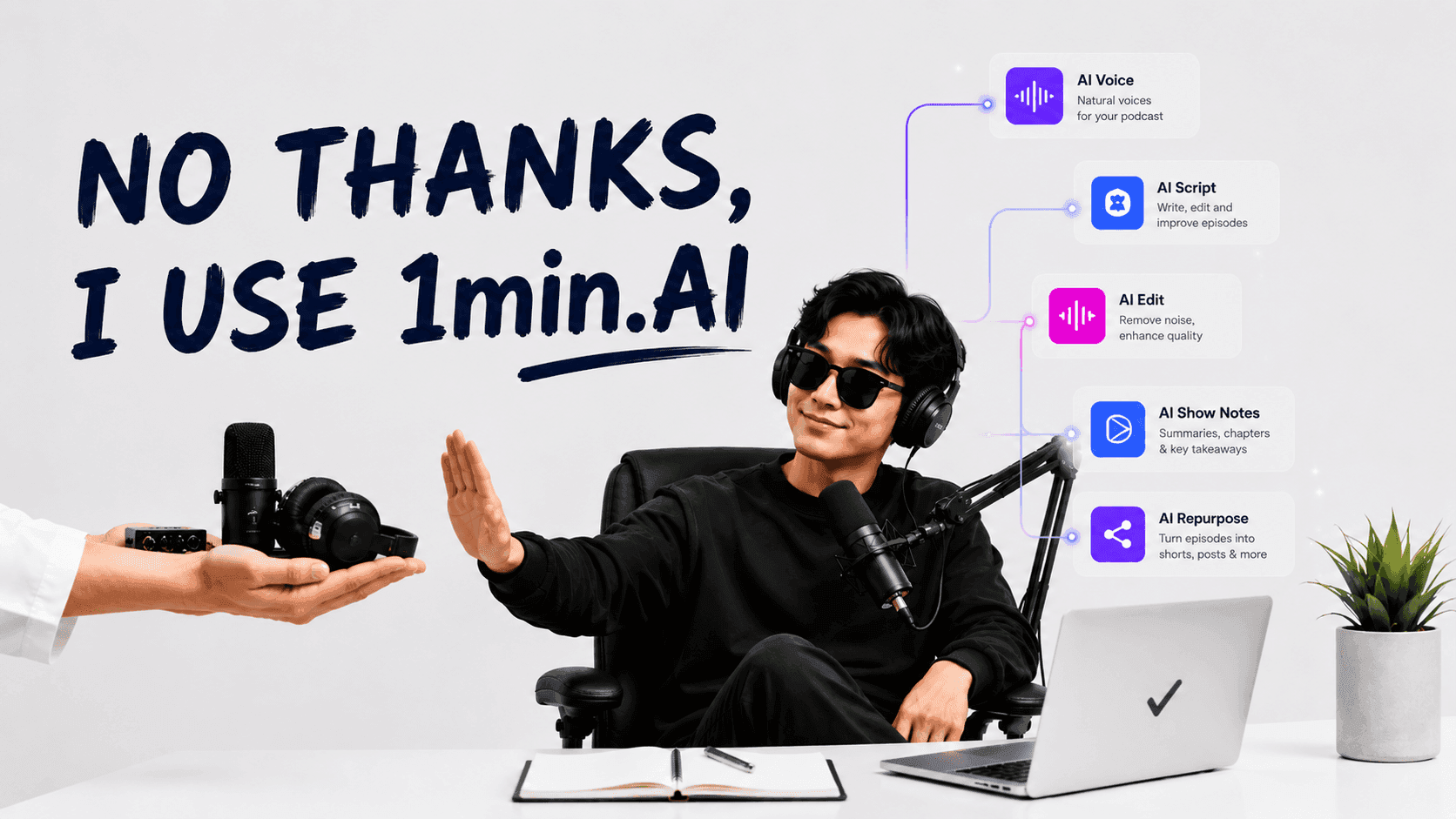
How to Create a Podcast Without Expensive Equipment
Learn how to create a podcast without expensive equipment using AI for scripting, voice, video, editing, and content repurposing with 1min.AI.
 Lien Anh Vu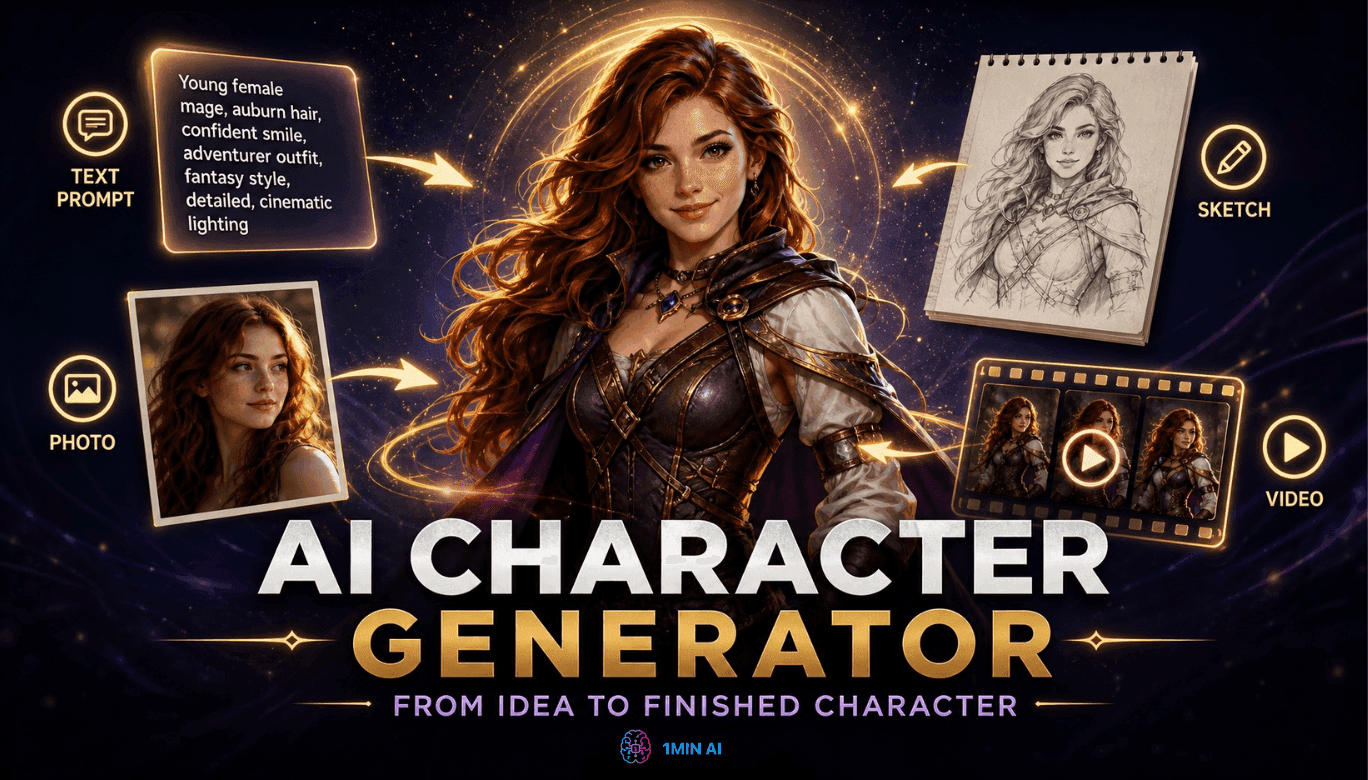
Free AI Character Generator - No Signup
Generate an AI character free from text or photo prompts. Try 1min.AI's AI character generator with multiple models, no design skills needed.
 Trang Tran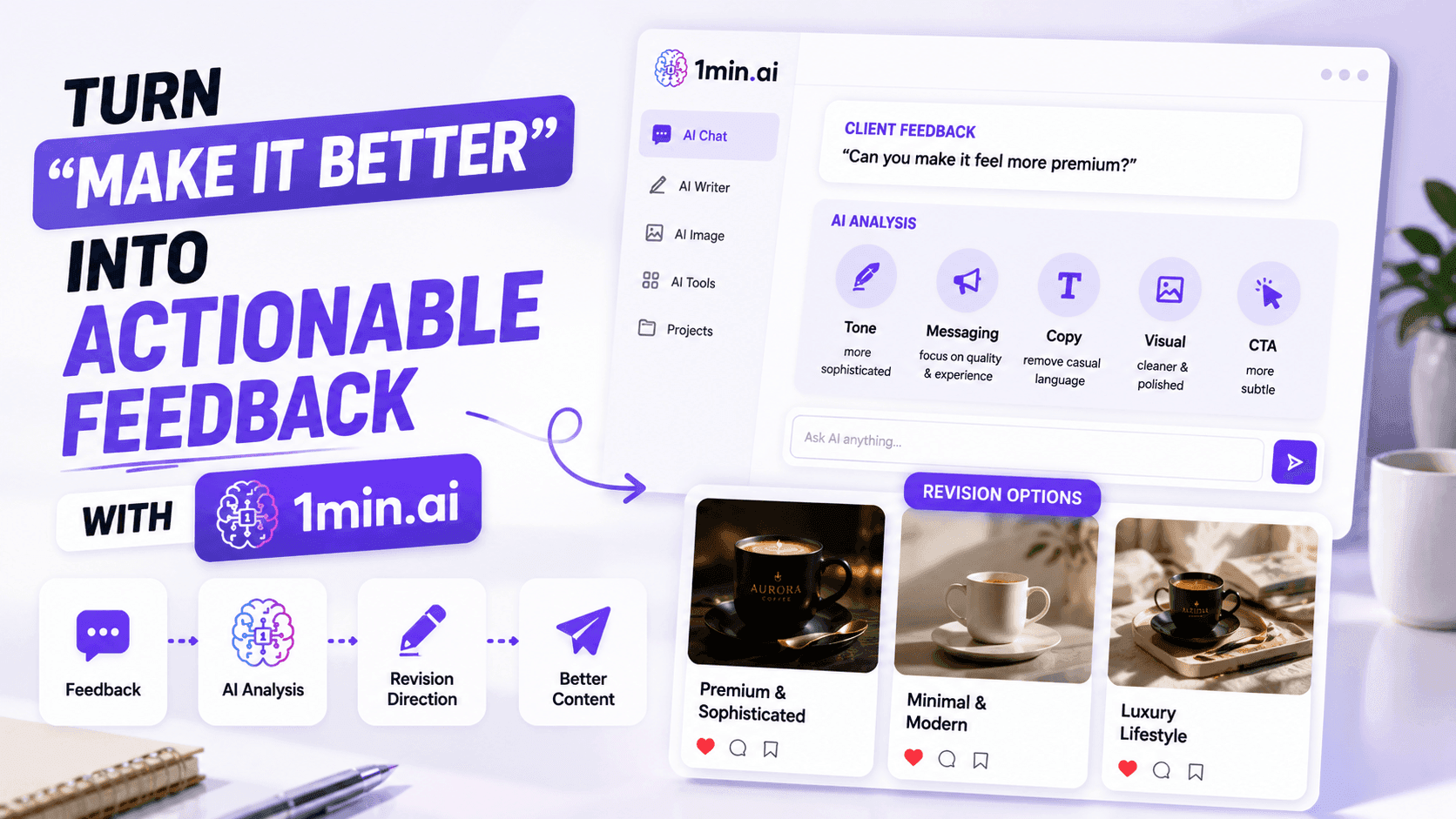
Turn “Make It Better” Into Better Content With AI
Use AI to turn vague client feedback into clear revisions, reduce unnecessary edits, and deliver better content faster.
Lien Anh VuAI Features
Comprehensive AI features that streamline workflows, improve efficiency, and empower teams to achieve more.
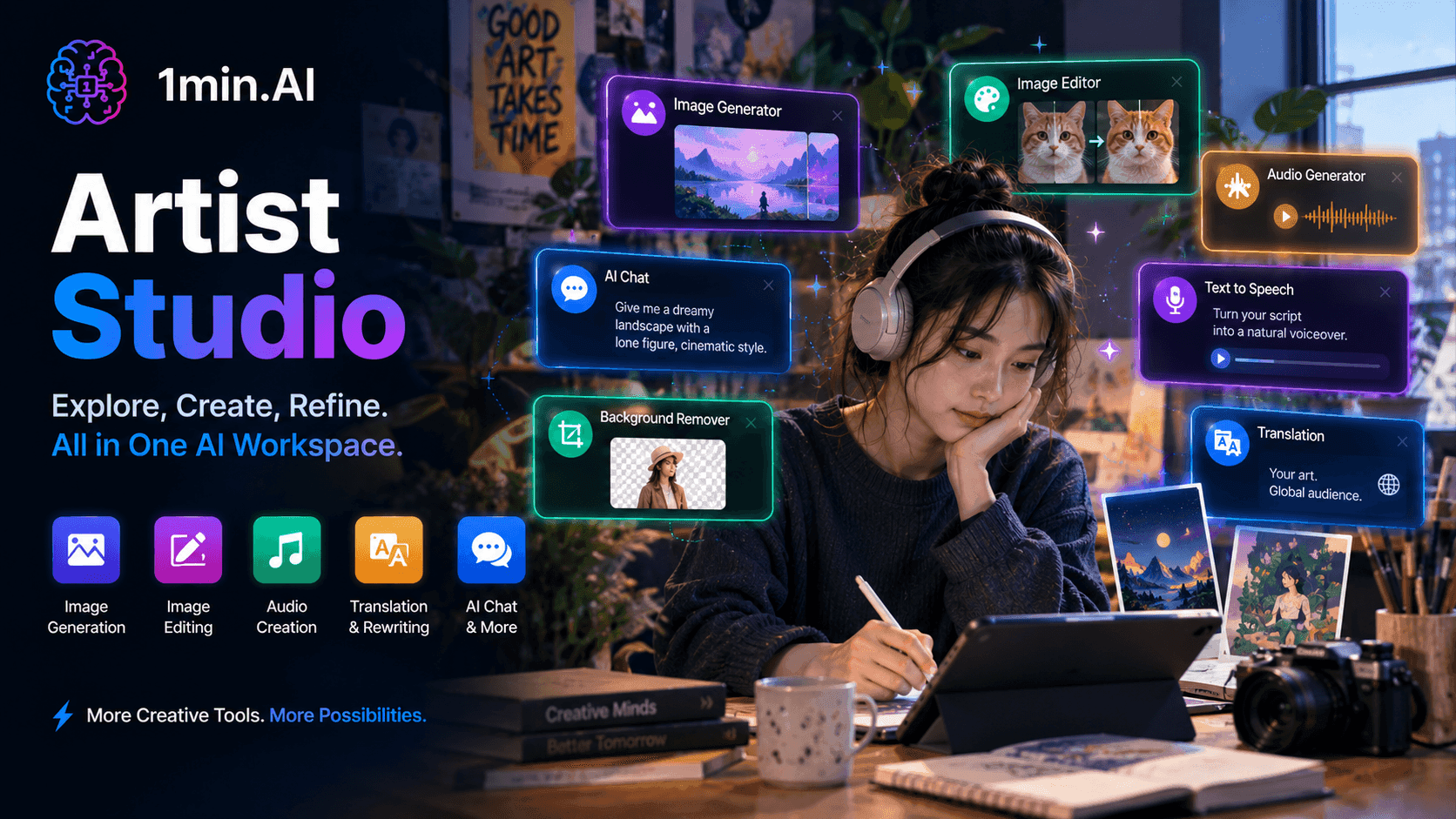
Free AI Tools for Artist
Artist Studio brings image generation, editing, audio creation, and creative tools into one AI workspace, so artists can explore ideas, refine their work, and create finished pieces without switching between different tools.
 Uyen Hoang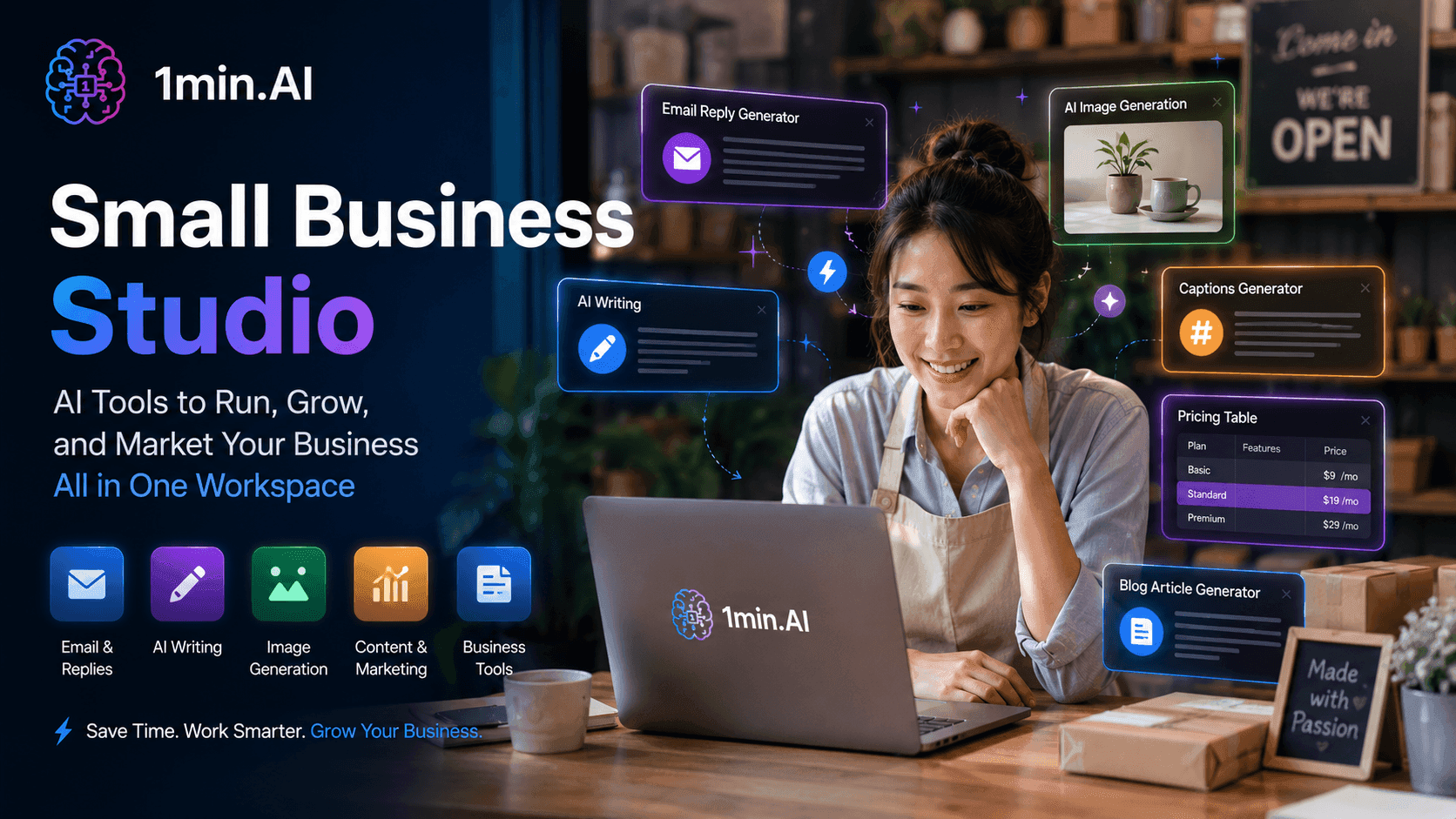
Free AI Tools for Small Business
Small Business Studio brings AI writing, email replies, pricing, content, and visual tools into one workspace to help small businesses handle everyday work faster.
Uyen Hoang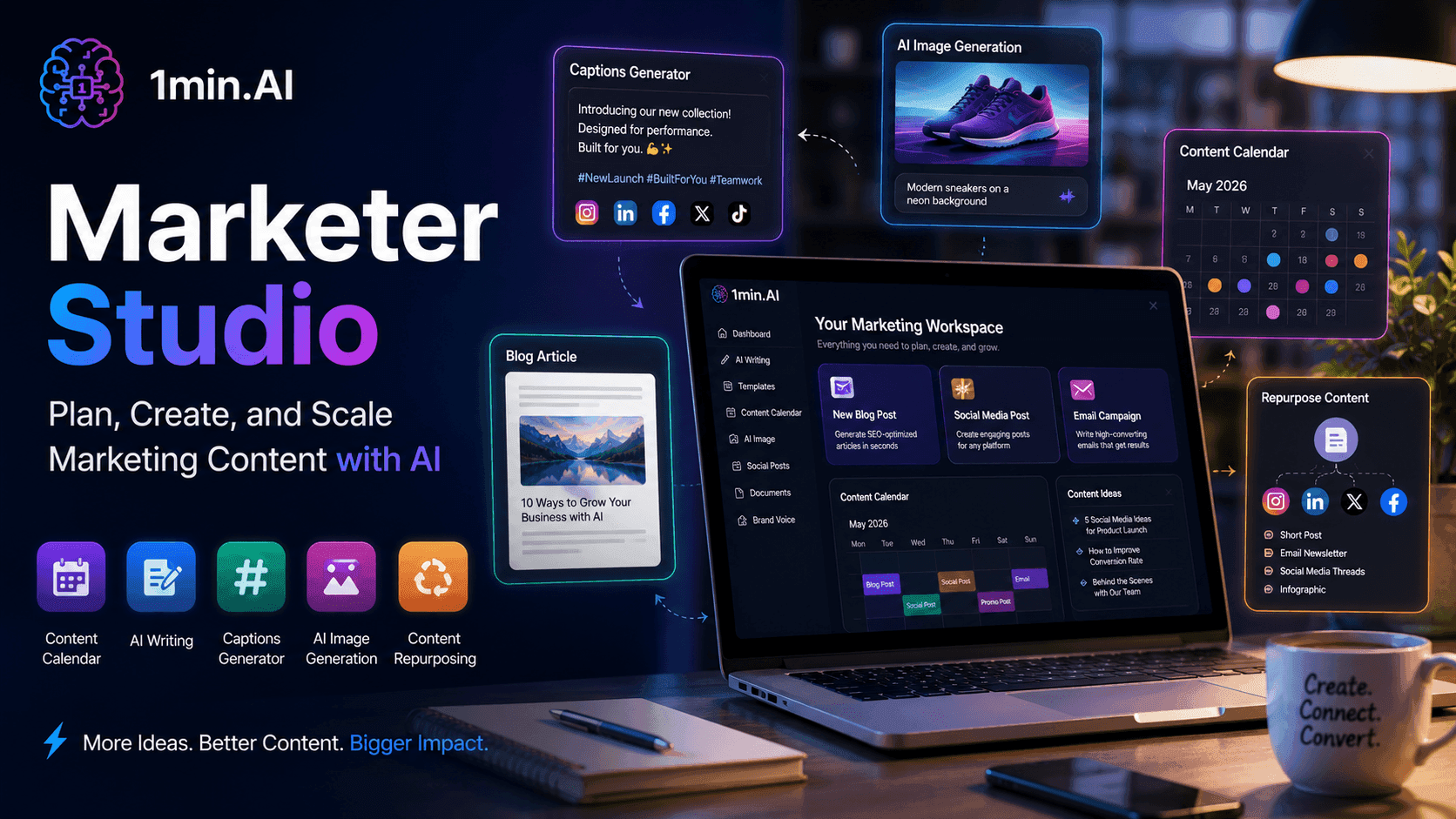
Free AI Tools for Marketer
Marketer Studio brings AI tools for content planning, writing, social posts, images, and repurposing into one workspace to help marketers create campaigns faster.
Uyen HoangAI Use Cases
A curated collection of AI use cases for business, productivity, and industry-specific applications.
White Label AI for SaaS Companies: How to Add AI Features Faster
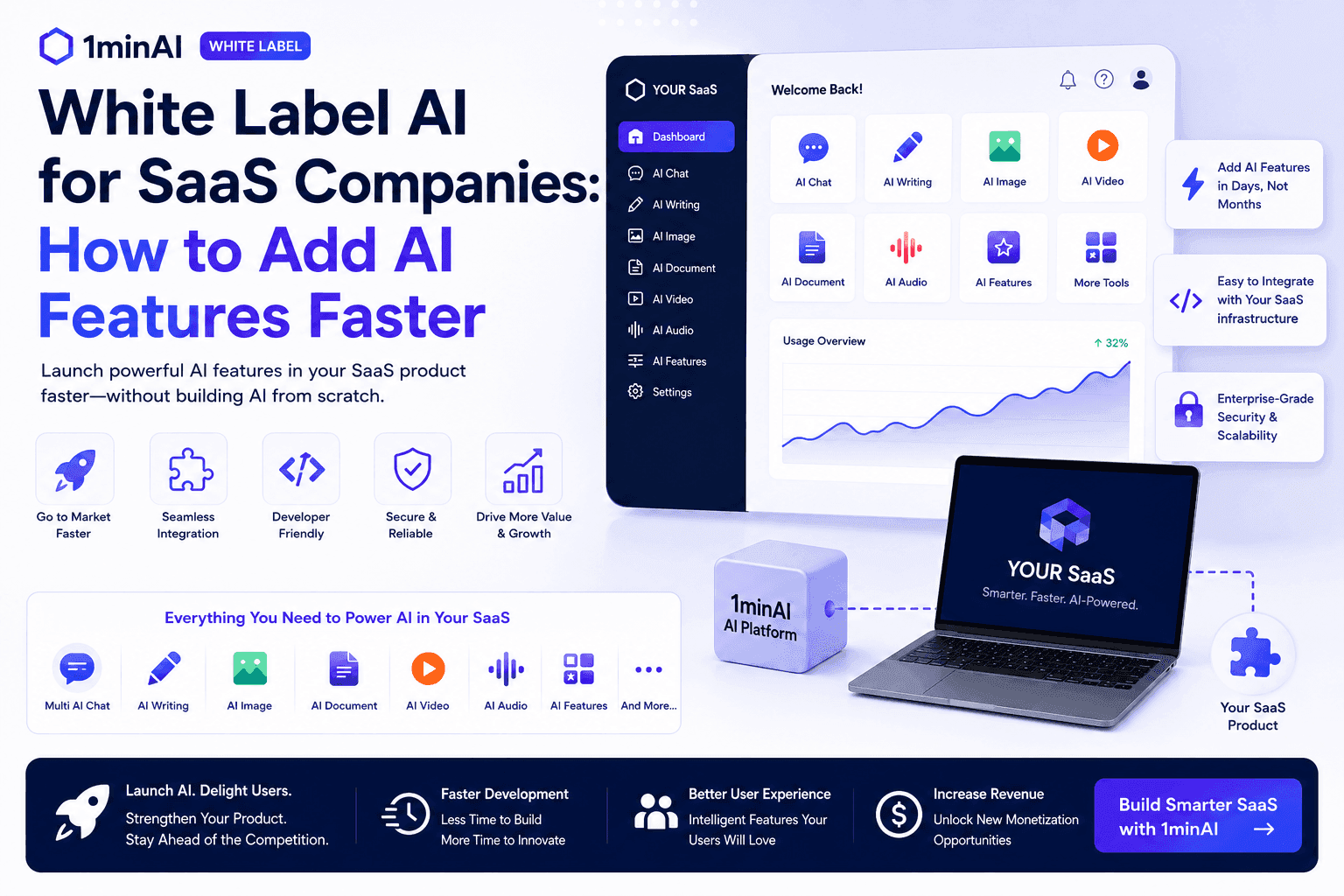
Discover how white label AI for SaaS companies can help you add AI features faster without building AI infrastructure from scratch. Learn what to consider and how 1minAI can help.
 Tram Ta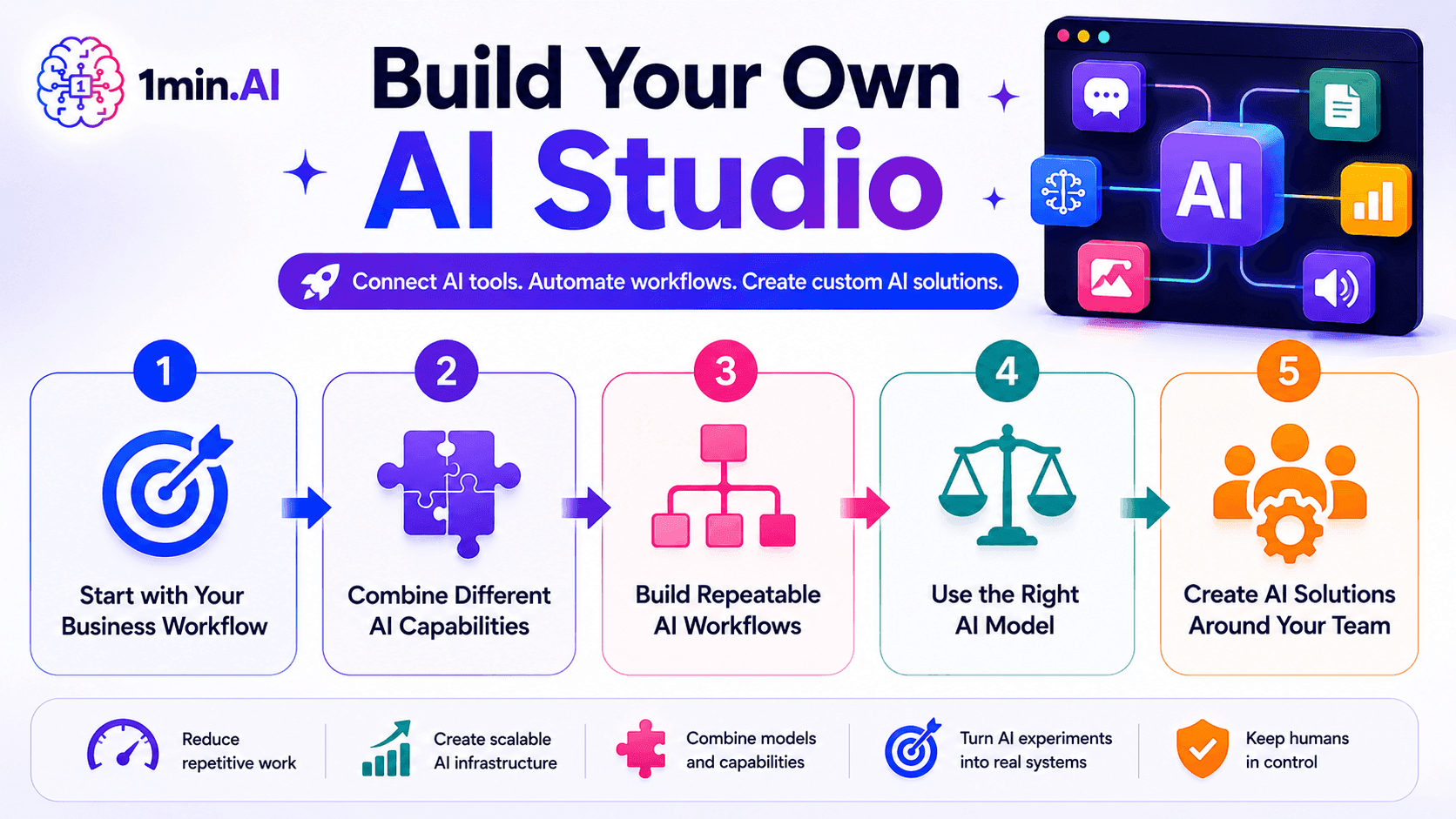
Build Your Own AI Studio
Build your own AI Studio with 1min.AI to connect AI tools, streamline workflows, and create custom AI solutions for your team and business.
Ngoc Hong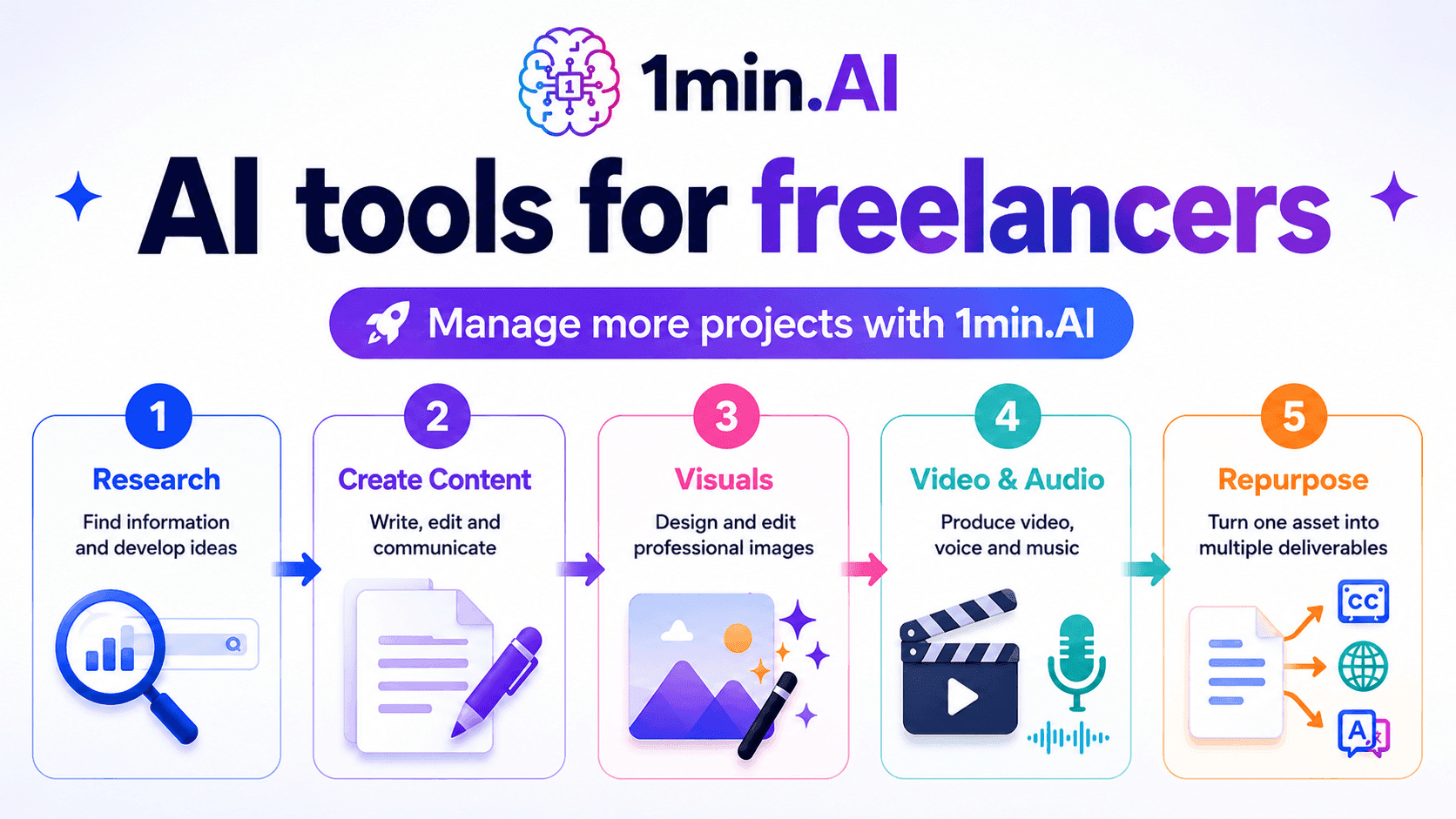
AI tools for Freelancers
Discover AI tools for Freelancers to manage writing, research, design, video, audio, and client work from one AI workspace with 1min.AI.
Ngoc HongAI Tutorials
Learn how to use AI with practical, step-by-step tutorials.
Translate English to Hindi Voice With 1minAI
Translate English to Hindi and convert your text into natural-sounding Hindi voice with 1minAI. Choose a Hindi voice, paste your text, and generate audio in seconds.
Tram Ta
Viral Reels in Minutes: How to Use 1minAI’s Text-to-Speech for Satirical Voiceovers
Learn how satirical page admins use 1minAI’s Text-to-Speech feature to generate instant news anchor and dramatic voiceovers for TikToks, Shorts, and Instagram Reels.
Uyen Hoang
No Photoshop Needed: How to Use 1minAI’s Image Text Editor for Instant Meme Customization
Stop wasting time opening Photoshop or Canva to edit meme captions. Learn how 1minAI’s Image Text Editor replaces text on any meme template or news banner in seconds.
Uyen HoangAI Guides
Learn AI faster with practical guides, real-world examples, and actionable best practices.
How to Create a Podcast Without Expensive Equipment
Learn how to create a podcast without expensive equipment using AI for scripting, voice, video, editing, and content repurposing with 1min.AI.
Lien Anh Vu
How to Sell AI Tools Under Your Own Brand: A Practical Guide to White Label AI
Learn how to sell AI tools under your own brand with white label AI. Discover how branding, packaging, pricing, onboarding, and recurring revenue work.
Tram Ta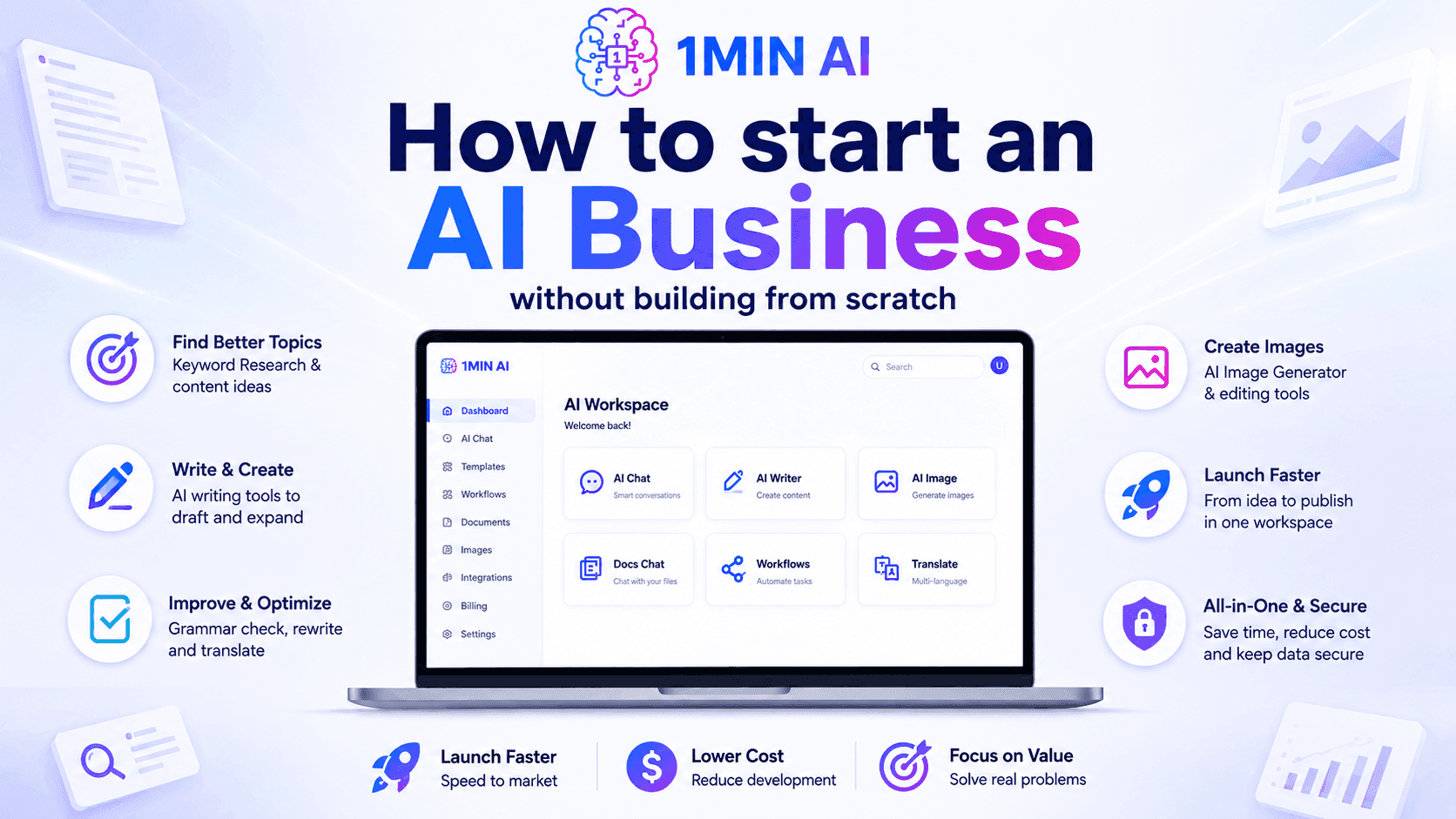
How to start an AI business without building from scratch
Learn how to start an AI business, validate your idea, and launch faster without building costly AI infrastructure from scratch.
Ngoc HongAI Solutions
Browse the best AI solutions for automation, coding, research, productivity, customer support, marketing, and business workflows.
White Label AI for SaaS Companies: How to Add AI Features Faster
Discover how white label AI for SaaS companies can help you add AI features faster without building AI infrastructure from scratch. Learn what to consider and how 1minAI can help.
Tram Ta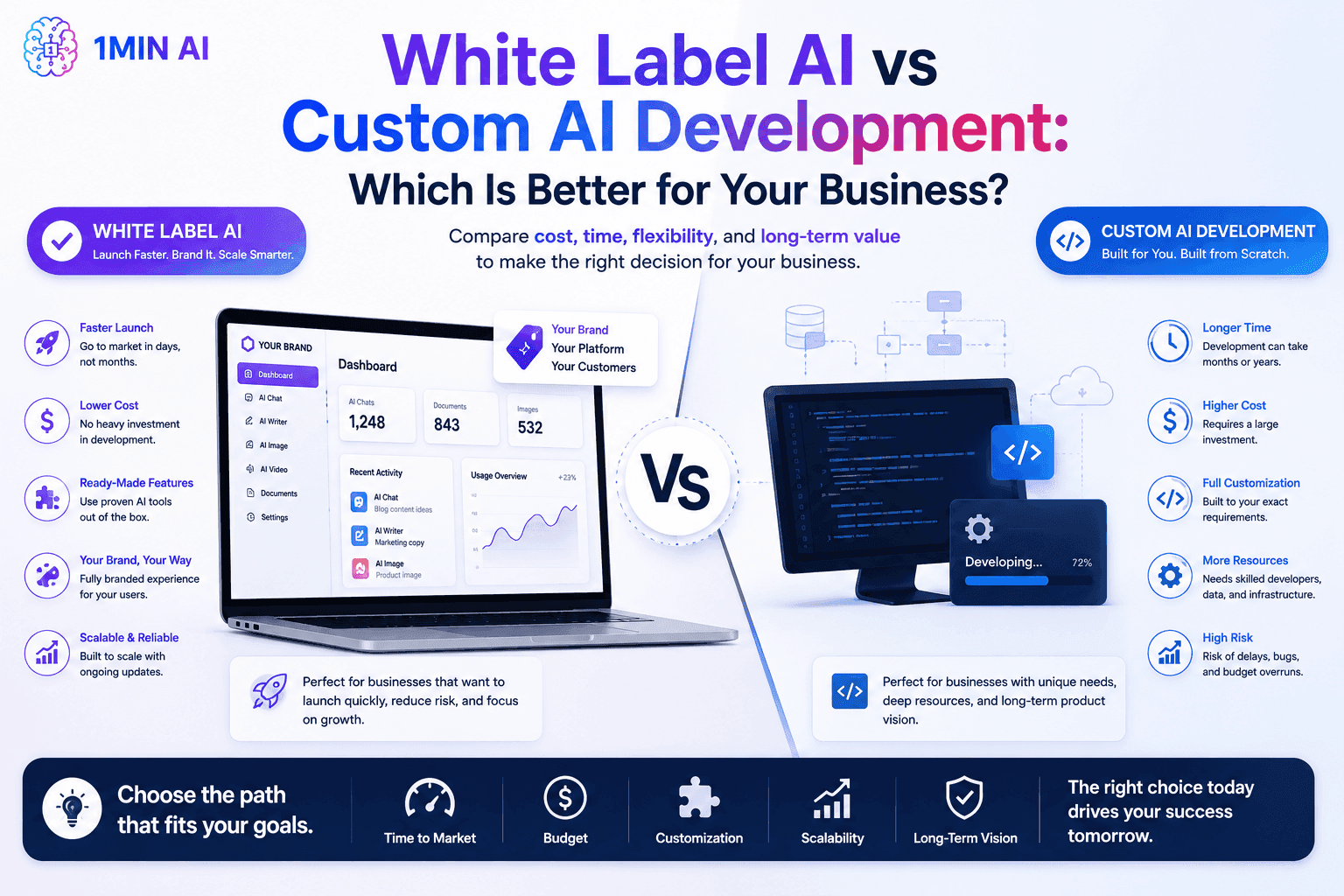
White Label AI vs Custom AI Development: Which Is Better for Your Business?
Compare white label AI vs custom AI development to understand the differences in cost, launch time, customization, maintenance, and scalability.
Tram TaWhite Label AI Chatbots: Build Branded AI Assistants for Your Business
Discover how white label AI chatbots help agencies and businesses offer branded AI assistants for support, lead generation, and productivity with 1minAI.
Tram TaAI Models
Explore the world's leading AI models in one place.
How to Create a Podcast Without Expensive Equipment
Learn how to create a podcast without expensive equipment using AI for scripting, voice, video, editing, and content repurposing with 1min.AI.
Lien Anh Vu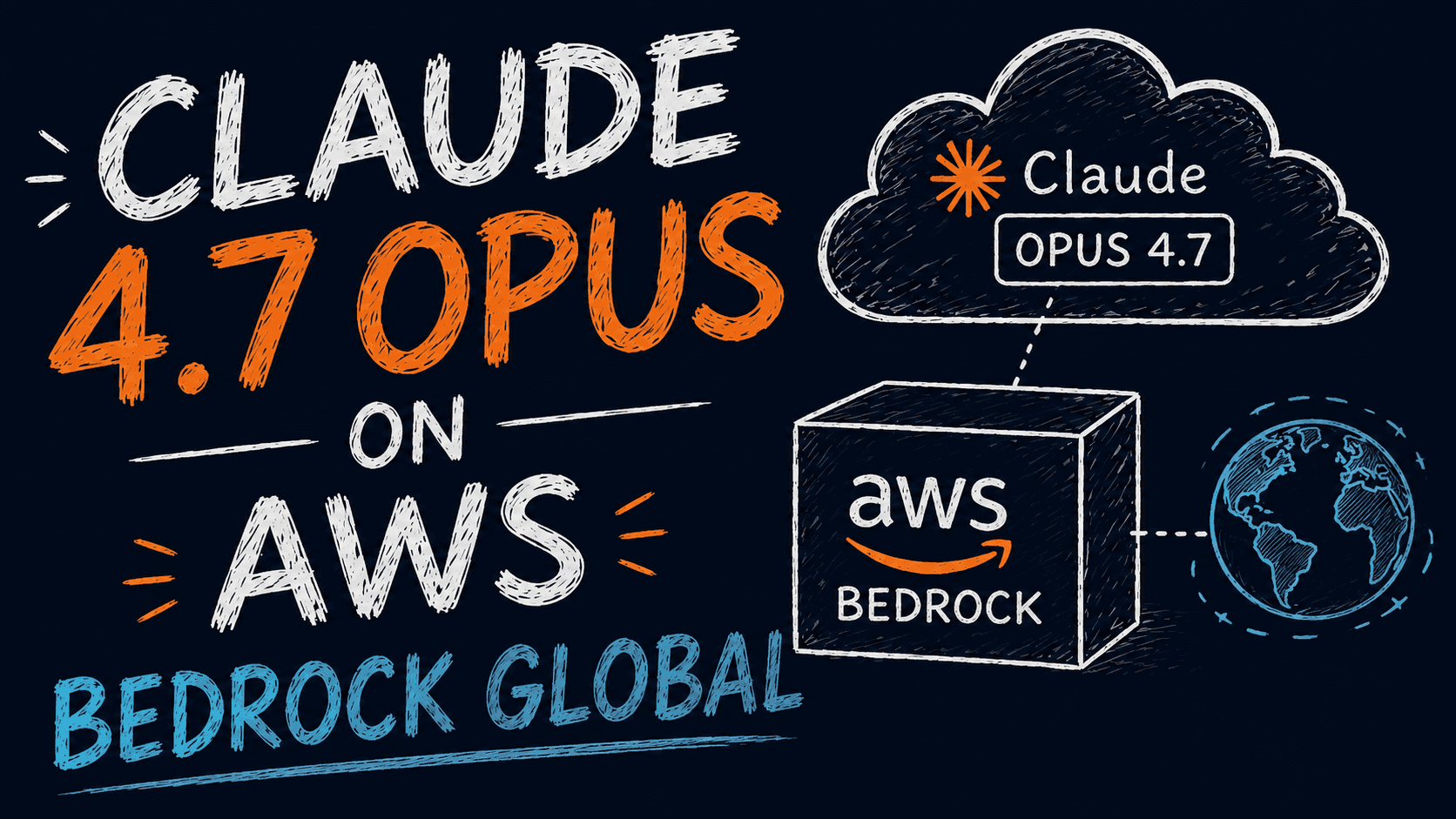
CLAUDE 4.7 OPUS - AWS BEDROCK US
Deploy Claude 4.7 Opus on AWS Bedrock US. Discover enterprise AI infrastructure, advanced coding, adaptive thinking, secure inference, and seamless AWS integration.
Ngoc Hong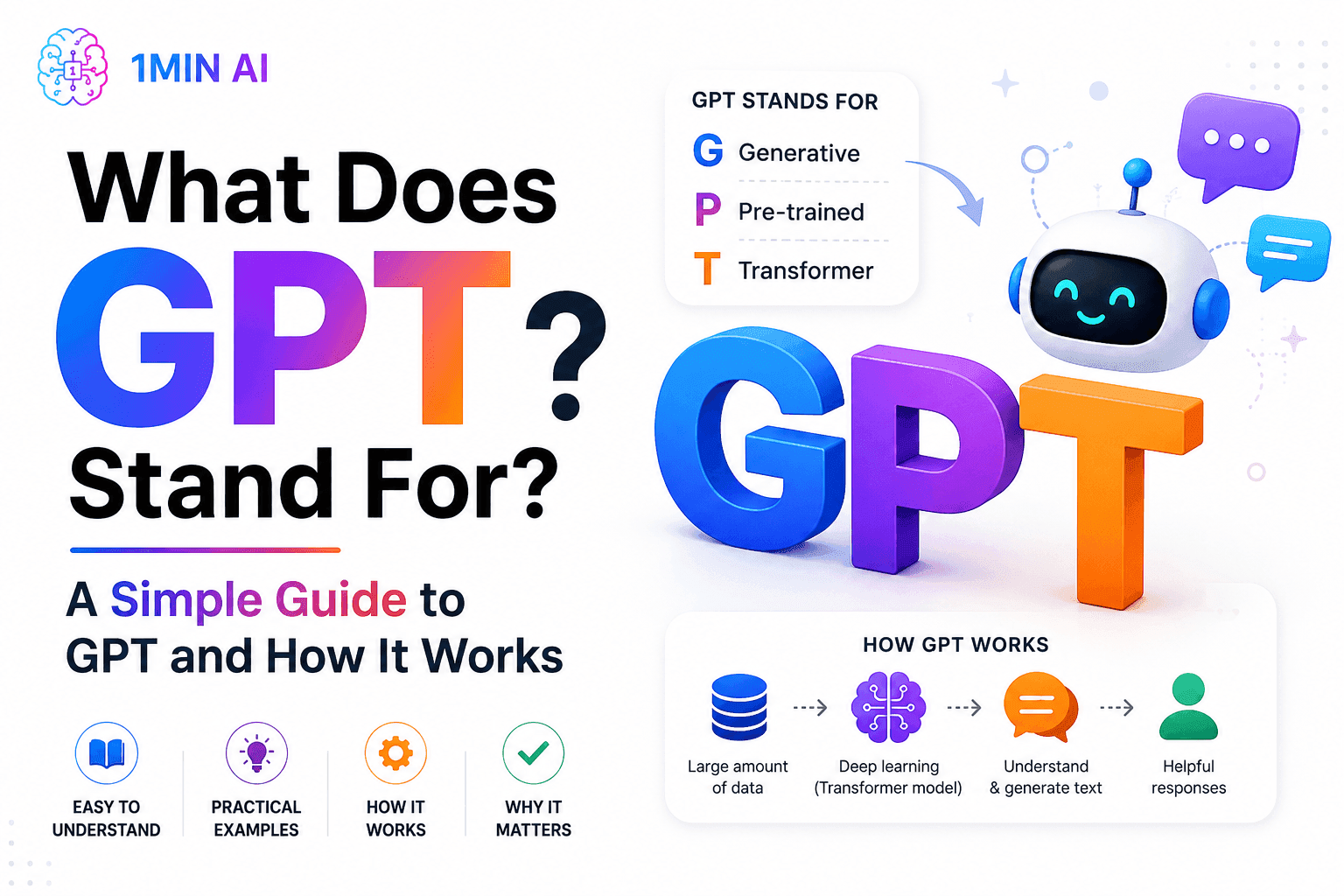
What Does GPT Stand For? A Simple Guide to GPT and How It Works
What does GPT stand for? Learn what GPT means, how Generative Pre-trained Transformer technology works, and why GPT models are important to modern AI.
Tram TaAI Comparisons
Compare AI tools, models, and platforms to find the best fit for your needs.
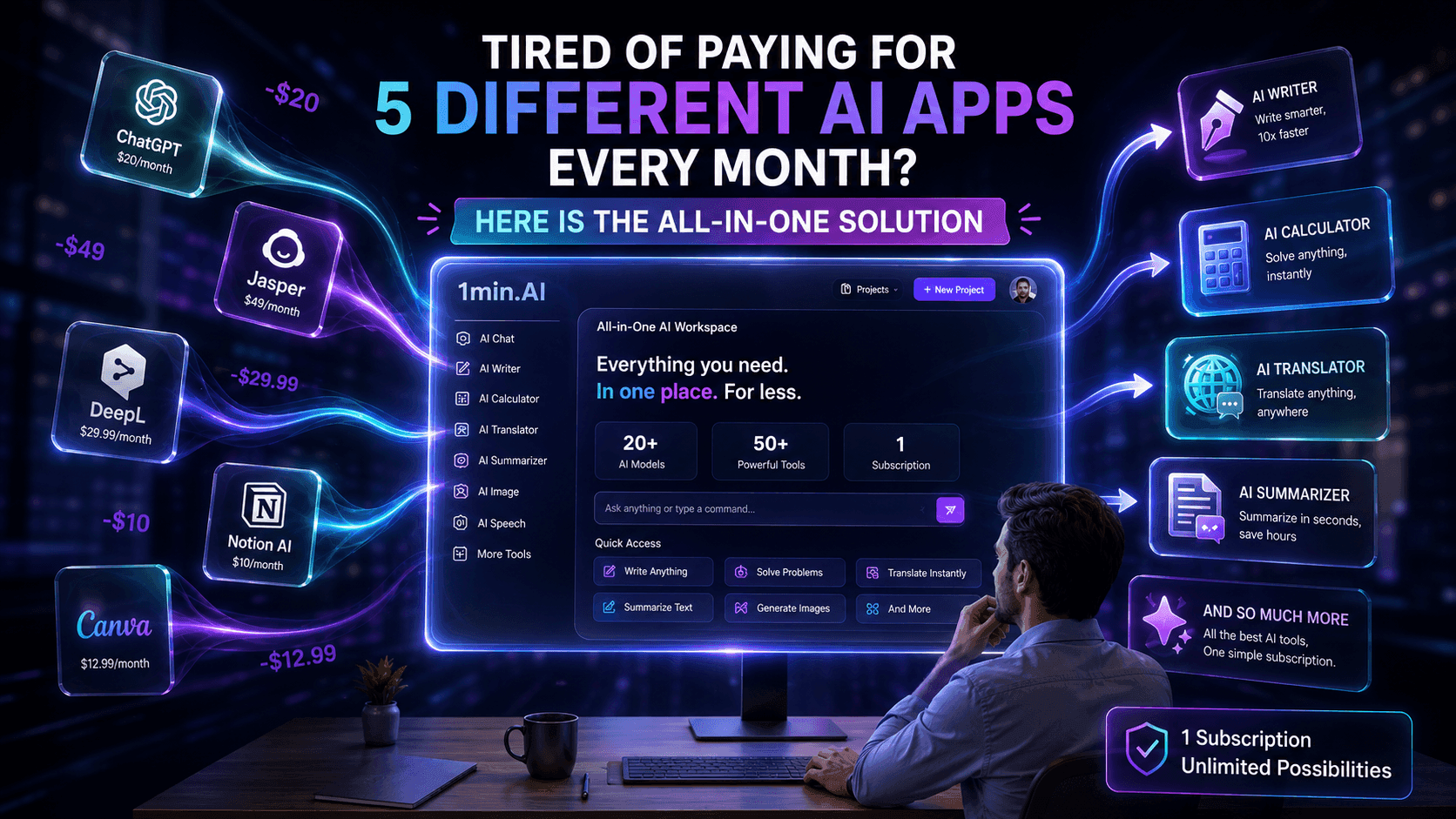
Your Sales Team Only Needs One App Instead of Five
Ditch the multi-app bills. Learn why high-performing sales teams are moving to an all-in-one AI platform to cut tool fatigue and leverage top models.
Uyen Hoang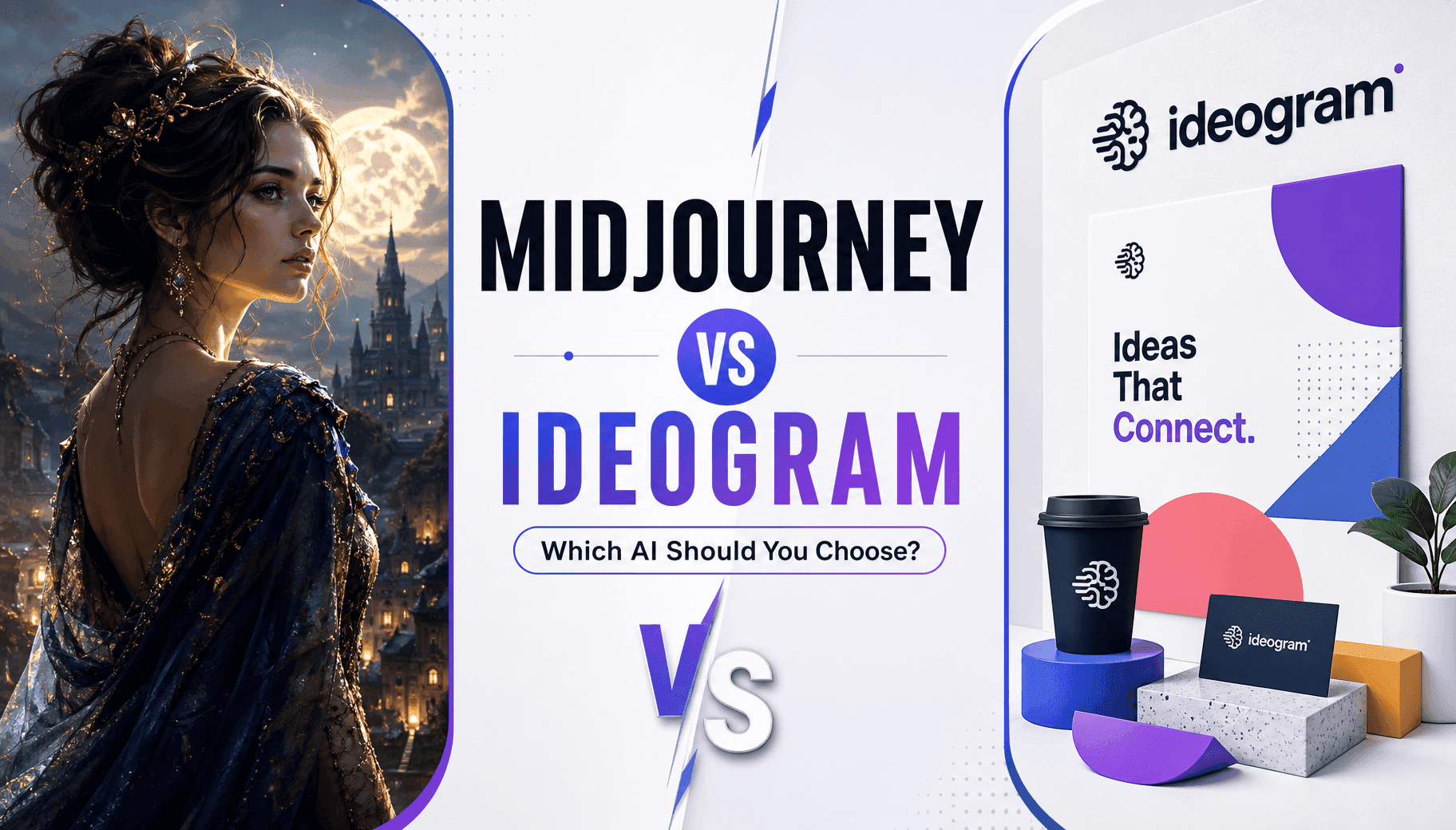
Midjourney vs Ideogram: Which AI Should You Choose?
Compare Midjourney vs Ideogram to find the best AI image generator for your needs. Explore image quality, typography, features, and real-world use cases.
Trang Tran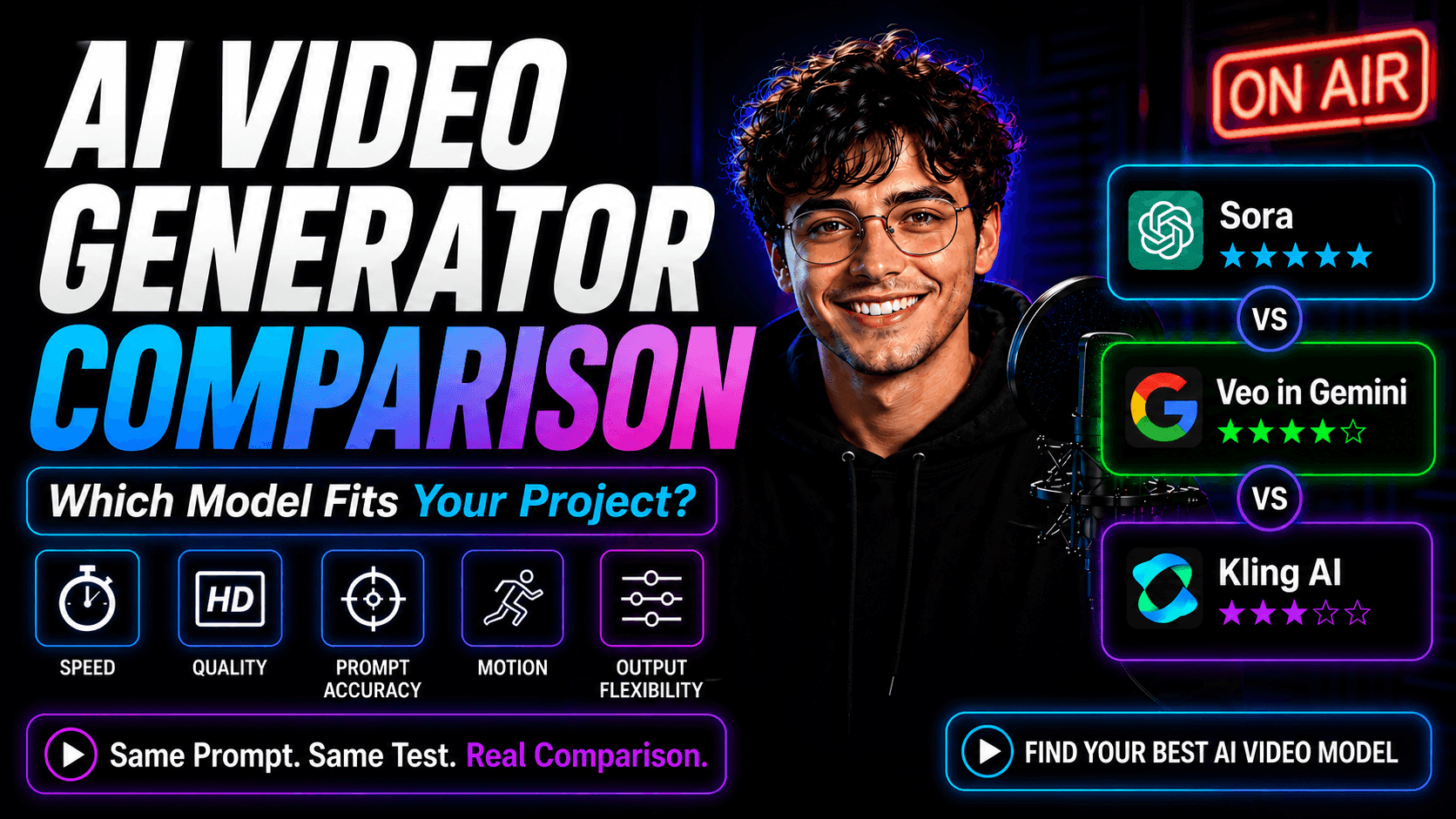
AI Video Generator Comparison on 1min.AI: Which Model Fits Your Project?
Compare Sora, Google Veo in Gemini, and Kling AI on 1min.AI using the same prompt. See speed, quality, prompt accuracy, motion, and output flexibility.
Lien Anh VuAI Integrations
Seamlessly integrate AI with the tools you already use to automate work and boost productivity.
How to Create a Podcast Without Expensive Equipment
Learn how to create a podcast without expensive equipment using AI for scripting, voice, video, editing, and content repurposing with 1min.AI.
Lien Anh Vu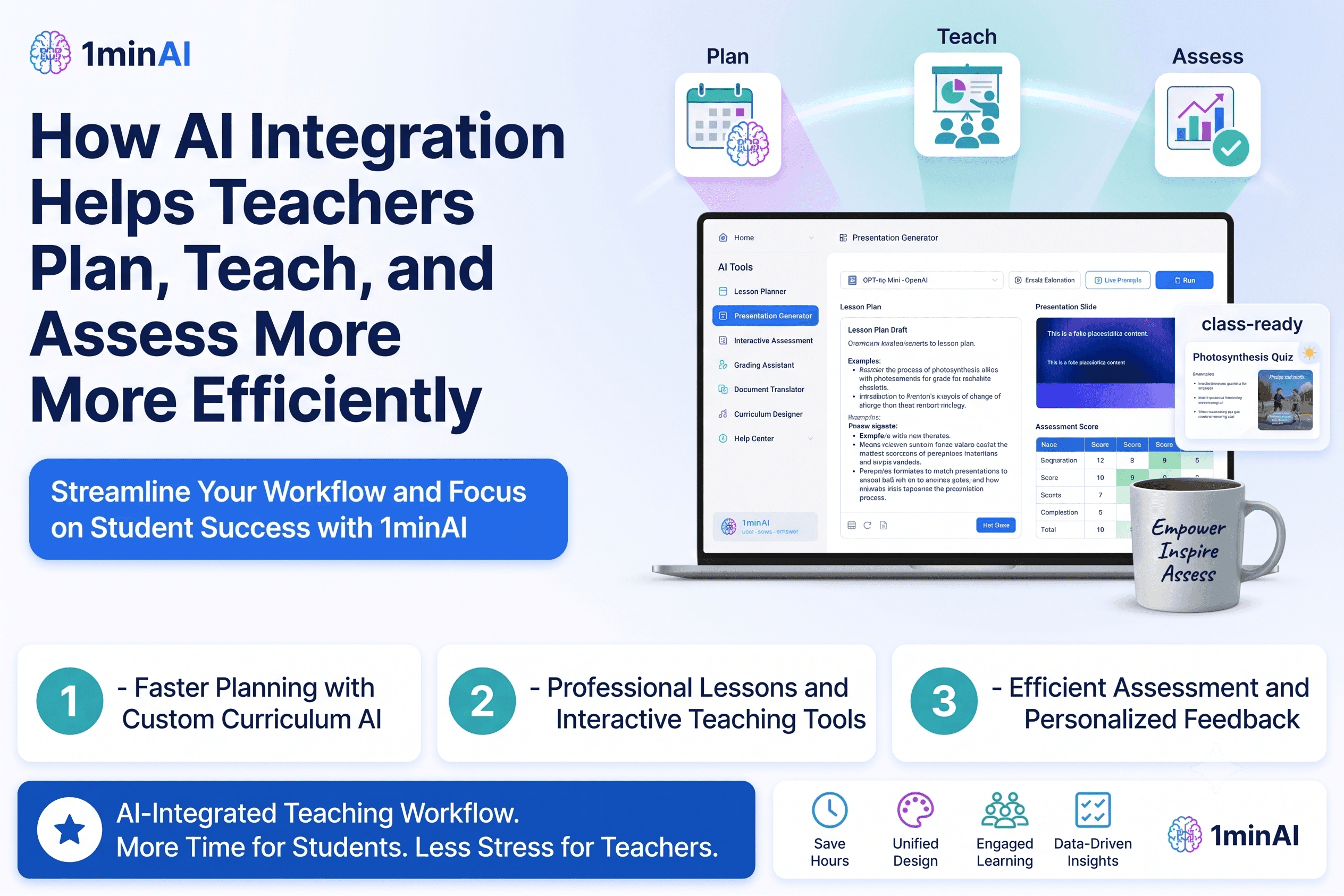
How AI Integrations Help Teachers Plan, Teach, and Assess More Efficiently
Discover how AI integration helps teachers streamline lesson planning, presentations, classroom materials, assessments, and student engagement in one AI workspace.
Tram Ta
AI Content Workflow for Freelancers: From Brief to Post
Discover an AI content workflow for freelancers. Use Claude for brainstorming and ChatGPT for images to turn client briefs into polished social posts faster.
Lien Anh VuAI for Industries
Find the best AI tools and workflows for healthcare, finance, education, legal, manufacturing, retail, real estate, and more
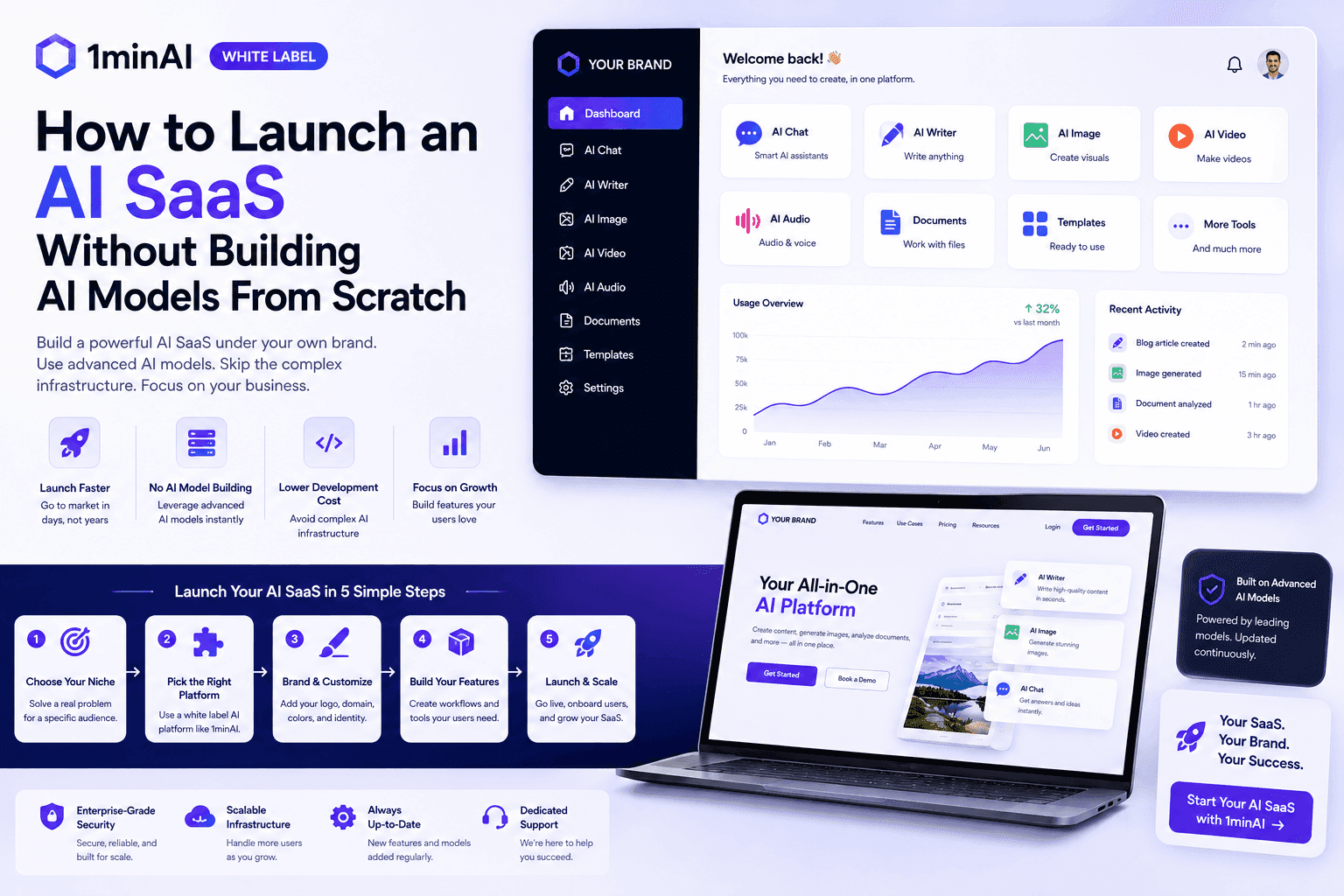
How to Launch an AI SaaS Without Building AI Models From Scratch
Learn how to launch an AI SaaS without building AI models from scratch. Explore white-label AI, product strategy, branding, pricing, and how 1minAI can help.
Tram Ta
Free AI Tools for Photographers to Elevate Creative Work
Discover free AI tools for photographers to edit images, create visuals and videos, develop content, and streamline client workflows with 1min.AI.
Lien Anh Vu
Free AI Tools for Social Media Managers to Create Faster
Discover free AI tools for social media managers to brainstorm content, create visuals and videos, write captions, and streamline social media workflows with 1min.AI.
Lien Anh VuAI Agents
Discover and run AI agents to automate tasks across your work and daily life.
White Label AI vs Custom AI Development: Which Is Better for Your Business?
Compare white label AI vs custom AI development to understand the differences in cost, launch time, customization, maintenance, and scalability.
Tram TaWhite Label AI Chatbots: Build Branded AI Assistants for Your Business
Discover how white label AI chatbots help agencies and businesses offer branded AI assistants for support, lead generation, and productivity with 1minAI.
Tram Ta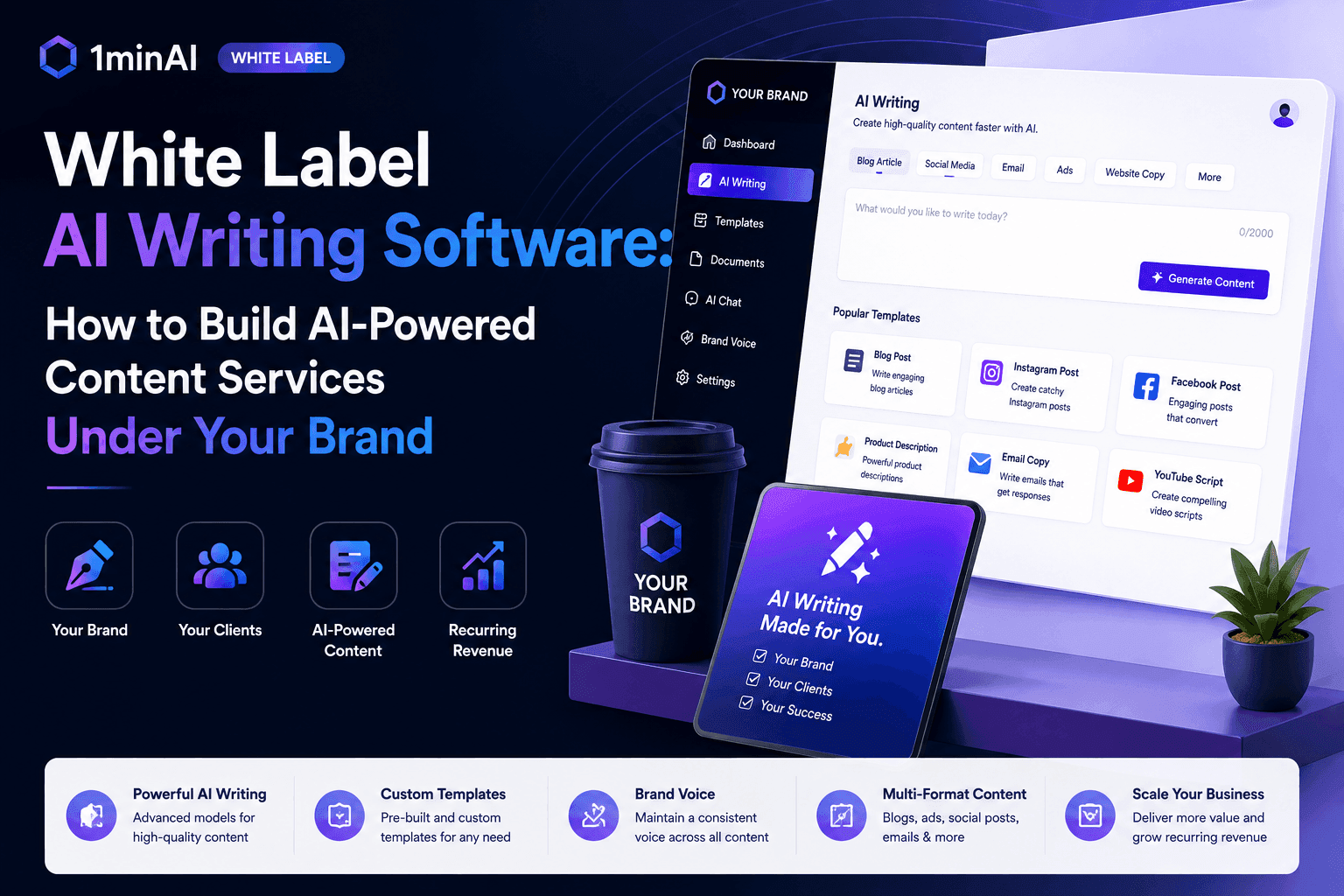
White Label AI Writing Software: How to Build AI-Powered Content Services Under Your Brand
Discover how white label AI writing software helps agencies, publishers, SEO companies, marketing teams, and consultants offer AI-powered content services under their own brand.
Tram TaAI Workflows
Explore ready-to-use AI workflows for productivity, marketing, sales, support, and more.
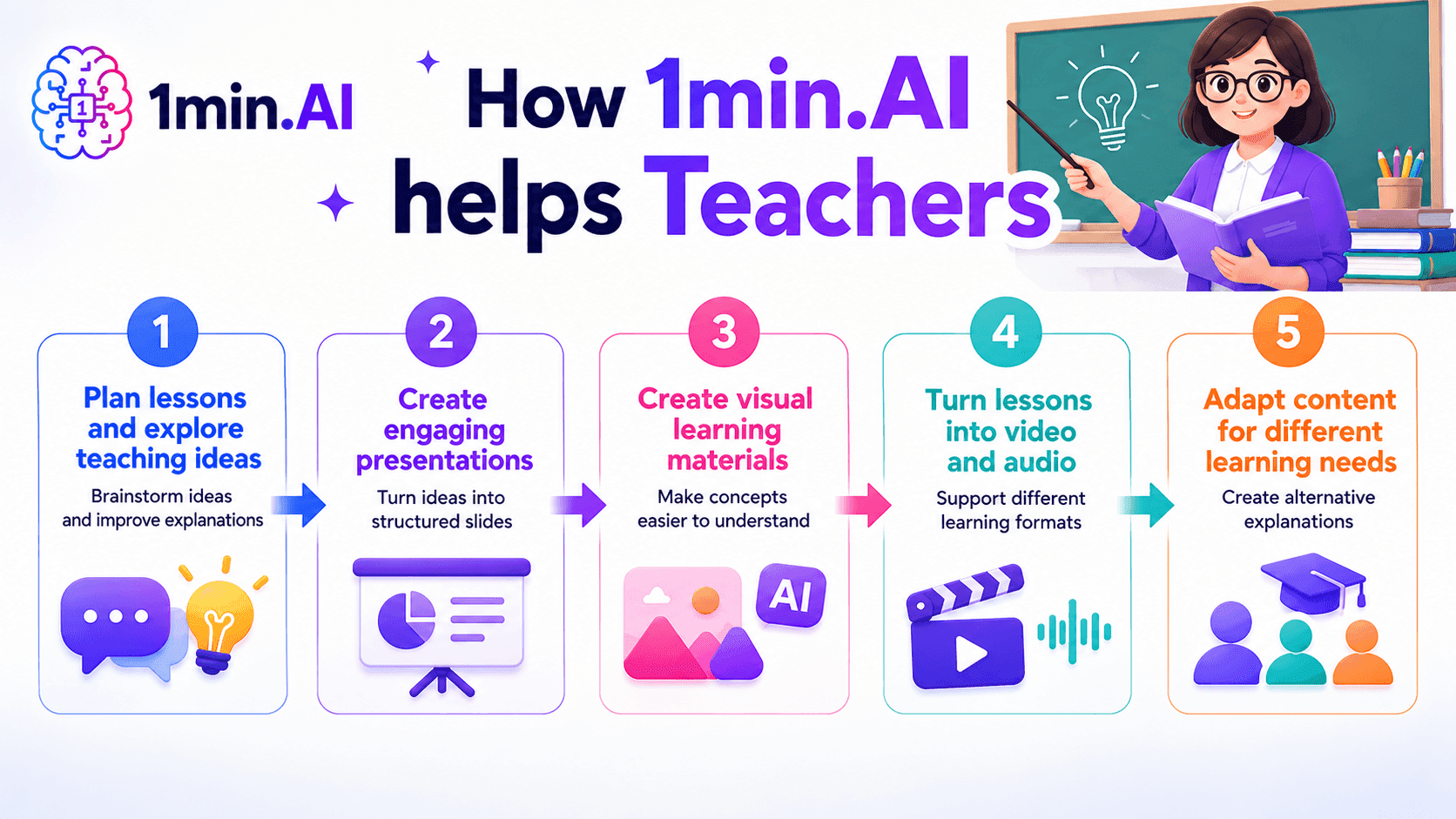
AI tools for Teachers
Discover AI tools for Teachers to create lessons, presentations, visuals, videos, and audio materials from one AI workspace with 1min.AI.
Ngoc Hong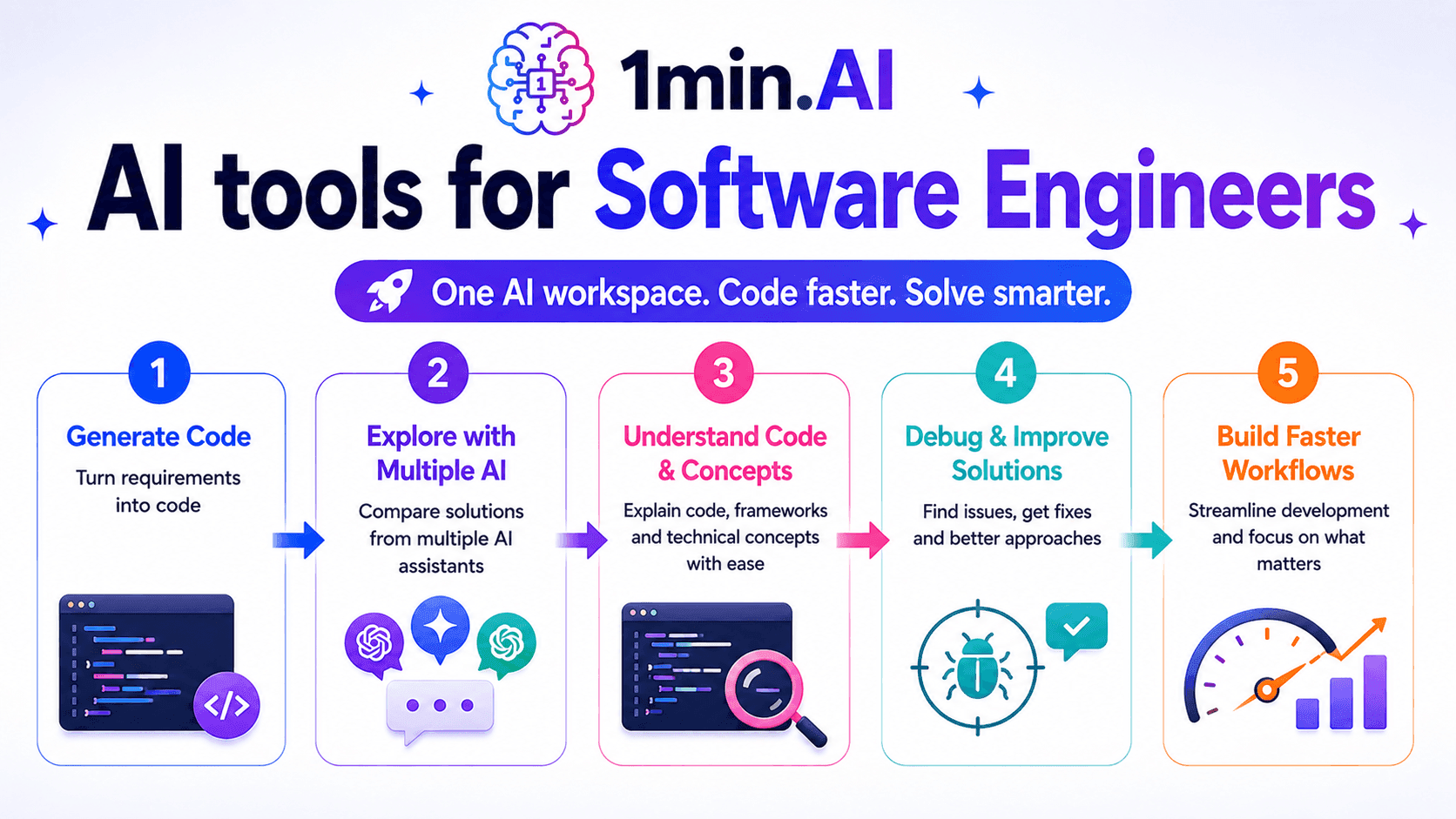
AI Tools for Software Engineers
Discover AI tools for Software Engineers to generate code, debug problems, understand technical concepts, and streamline development with 1min.AI.
Ngoc Hong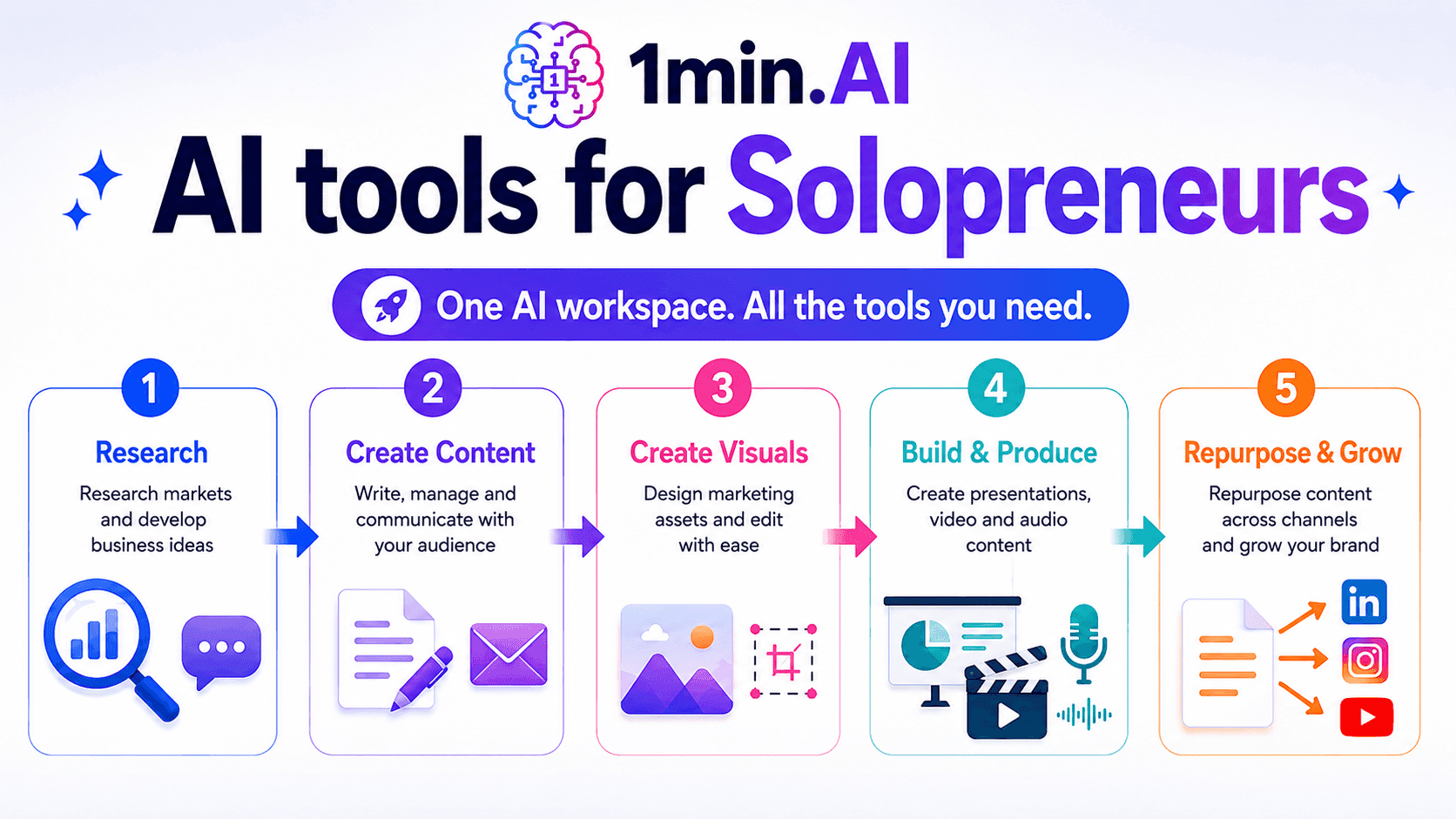
AI tools for Solopreneurs
Discover AI tools for Solopreneurs to research, create content, design, market, and manage business tasks from one AI workspace.
Ngoc HongNewsletter
Weekly AI Innovations with 1minAI
🔮 Weekly AI Innovations #134: Experience Free Qwen on AI Chat; The 3.7 and 3.6 Series Update
Looking for a powerful, free AI assistant? Explore the latest Qwen 3.7 and 3.6 series on 1min.ai. Enjoy high-speed, accurate AI chat at zero cost today!
 Hang Nguyen
🔮 Weekly AI Innovations #133: Earn Credits and more with AI Social
Explore DeepSeek V4's open-source efficiency and xAI's Grok 4.3 & 4.5 for advanced reasoning and ultra-fast coding in 2026.
Hang Nguyen
🔮 Weekly AI Innovations #132: DeepSeek V4 & xAI's Grok 4.3, 4.5
Explore DeepSeek V4's open-source efficiency and xAI's Grok 4.3 & 4.5 for advanced reasoning and ultra-fast coding in 2026.
Hang Nguyen