
GPT-6.1 Sol vs Opus 5.5: Benchmarks & Cost

Trang Tran
23 October 2026
GPT-6.1 Sol vs Opus 5.5 compared on benchmarks, cost, speed and coding. See which fits your work, then test both on one prompt in 1min.AI.
Claude Opus 5.5 leads GPT-6.1 Sol on intelligence, coding and output speed. GPT-6.1 Sol delivers each task for a fraction of the cost and starts answering sooner. This guide compares the two on benchmarks, cost per task, coding and real user feedback, then shows how to run the same prompt on both in 1min.AI so you can judge the difference on your own work.
Key takeaways
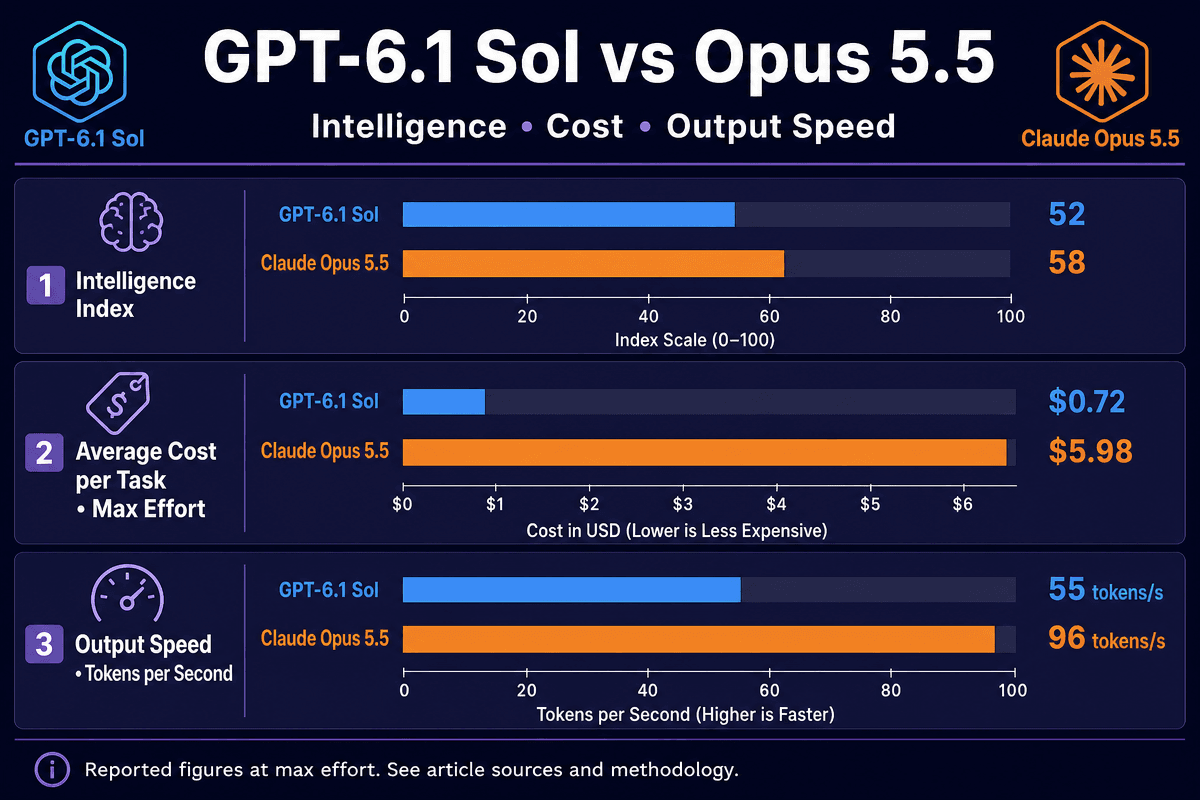
- Opus 5.5 scores 58 and Sol scores 52 on the Artificial Analysis Intelligence Index at max effort.
- Sol averages $0.72 per task at max effort. Opus 5.5 averages $5.98.
- Opus 5.5 streams at 96 tokens per second. Sol streams at 55 but returns its first token sooner.
- Developers split by task: Sol for debugging and review, Opus for UI and architecture.
6.1 Sol vs Opus 5.5 at a Glance
OpenAI released GPT-6.1 Sol on September 29, one week after Anthropic released Claude Opus 5.5. Both aim to deliver near-flagship results at a lower price. This table shows how they compare at max effort.
| Feature | GPT-6.1 Sol | Claude Opus 5.5 |
|---|---|---|
| Maker | OpenAI | Anthropic |
| Intelligence Index | 52 | 58 |
| Output speed | 55 tokens/s | 96 tokens/s |
| Cost per task | $0.72 | $5.98 |
| API rates per 1M tokens (input / output) | $2 / $10 | $4 / $20 |
| Context window | 1.05M tokens | 1M tokens |
| Inputs | Text, image | Text, image |
| Best for | High-volume work, debugging, review | Complex reasoning, architecture, UI |
Sources: Artificial Analysis, BenchLM, official model documentation.
Benchmarks: Which Model Scores Higher?
Intelligence Index and Industry Scores
Opus 5.5 leads every index Artificial Analysis publishes for these two models at max effort.
| Index | GPT-6.1 Sol | Claude Opus 5.5 |
|---|---|---|
| Intelligence Index | 52 | 58 |
| Finance and Accounting | 54 | 61 |
| Strategy and Ops | 57 | 64 |
| Legal | 58 | 63 |
| Healthcare and Medical | 52 | 55 |
| Engineering | 54 | 60 |
| Economics | 59 | 66 |
The gap depends on the effort setting. At low effort both models score 42. At medium effort it is 51 for Opus 5.5 and 48 for Sol, so the lead grows as you ask for more thinking.
What Independent Scoreboards Add
BenchLM reaches the same direction with a useful caveat. Opus 5.5 scores 86.69 overall against 84.19 for Sol, but the 90% score intervals overlap, so BenchLM treats it as a lead, not a settled win. Opus 5.5 is ahead on knowledge (90.3 vs 86.1). Sol is ahead on some reasoning and math rows, including ARC-AGI-2 (94.2% vs 91.7%) and FrontierMath Tier 4 (100% vs 95%).
Speed and Latency
Opus 5.5 generates text faster once it starts: 96 vs 55 tokens per second at max effort, and 81 vs 48 at medium. Sol starts sooner. At medium effort its time to first token is 4.41 seconds against 12.99 for Opus 5.5. Many short prompts feel snappier on Sol. Long outputs finish sooner on Opus 5.5.
Coding: Opus 5.5 vs GPT 6.1 Sol
On BenchLM’s coding score, Opus 5.5 leads 82.7 to 71.0. Its Engineering Index lead (60 vs 54) points the same way. Benchmarks measure set tasks, though, so here is how each model tends to behave in daily work.
Debugging and Code Review
Developers on r/codex describe Sol as slow but steady and strong at taking code apart, debugging and reviewing. One user said it did not burn through usage quickly. If most of your day goes to finding faults in existing code, Sol earns a test.
UI Design and Long Agentic Tasks
Several users report that Opus 5.5 produces better interface designs and feels faster and more pleasant to work with. Anthropic positions it for long-running agentic coding, including large code migrations. One user cautioned that it sometimes makes choices you did not request, so check its output on edge cases.
GPT 6.1 Sol vs Opus 5.5 Cost: What a Task Really Takes
API Token Rates
| Rate (per 1M tokens) | GPT-6.1 Sol | Claude Opus 5.5 |
|---|---|---|
| Input | $2.00 | $4.00 |
| Output | $10.00 | $20.00 |
| Cached input | $0.10 | $0.20 |
Sol’s listed rates are exactly half of Opus 5.5’s. BenchLM’s sample workloads confirm it: a repository review costs about $0.13 on Sol and $0.26 on Opus 5.5.
Cost per Task by Effort Level
Token rates miss one thing. Reasoning models spend tokens thinking, so the real cost depends on how much each model thinks. Artificial Analysis measures the average cost per task:
| Effort | GPT-6.1 Sol | Claude Opus 5.5 |
|---|---|---|
| Low | $0.13 | $0.55 |
| Medium | $0.21 | $1.34 |
| High | $0.32 | $1.82 |
| Max | $0.72 | $5.98 |
Where Sol Is the Smarter Choice
Sol at max effort scores 52 for $0.72 per task. Opus 5.5 at medium effort scores 51 for $1.34. That means similar intelligence for about half the cost. For repeatable, high-volume work such as batch summaries, document translation or structured extraction, Sol stretches your credits much further. The same pattern holds in 1min.AI, where Sol uses roughly half the credits of Opus 5.5 per page of text.
What Reddit Users Say
The opus 5.5 vs gpt 6.1 sol reddit threads agree on a pattern, not a winner:
- Opus 5.5: faster, more pleasant to work with, stronger UI results and good for setting up a project’s foundations.
- Sol 6.1: methodical, strong at debugging and review and light on usage, but slower.
- Common workflow: several developers keep both models and assign each to different stages of a project.
These are personal experiences, not measurements. They show why a side-by-side test beats any single score.
Which Should You Choose?
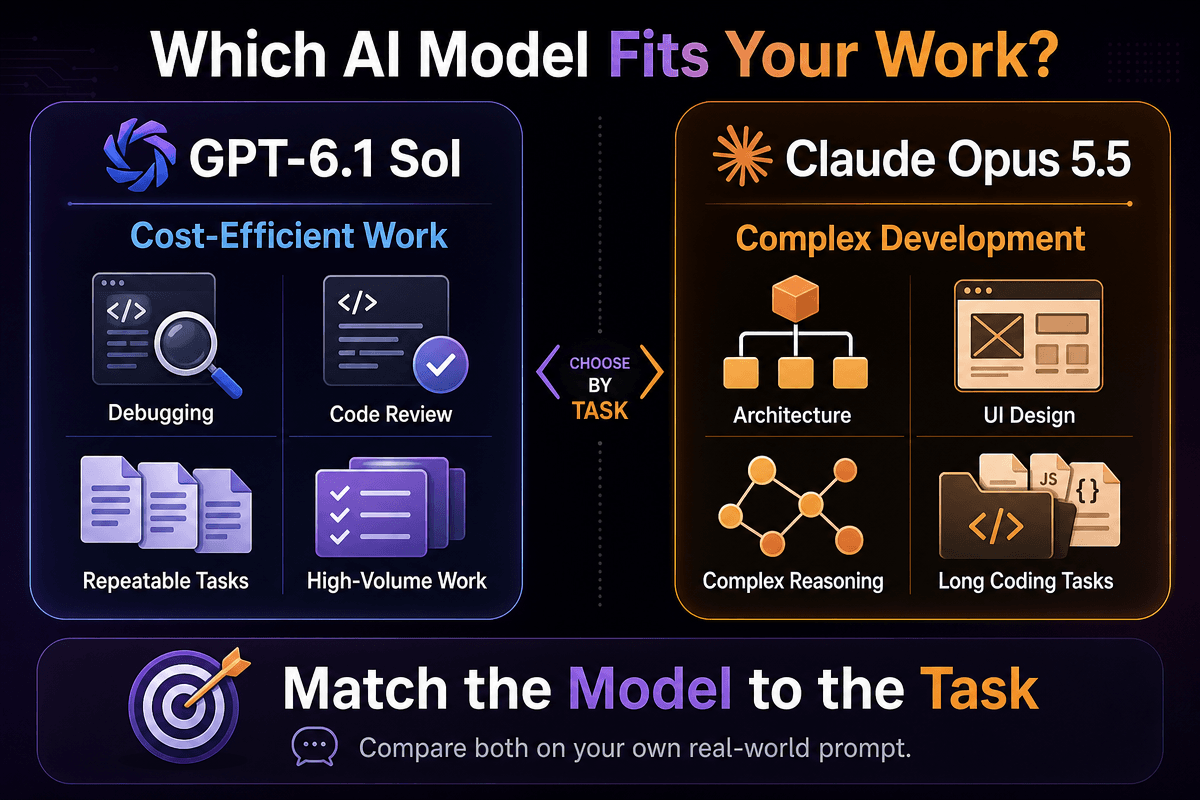
Choose GPT-6.1 Sol if you:
- run repeatable, high-volume tasks where cost per task adds up
- spend most of your time debugging and reviewing code
- want answers to begin quickly on short prompts
- need the larger 1.05M-token context window
Choose Claude Opus 5.5 if you:
- tackle complex reasoning, architecture or multi-file engineering
- work in finance, strategy or legal analysis, where its scores are higher
- care about UI and front-end quality
- need faster streaming on long outputs
Not sure? Use both. Splitting work by task is the most common approach, and it is easy to do in one workspace.
How to Test Both Models in 1min.AI
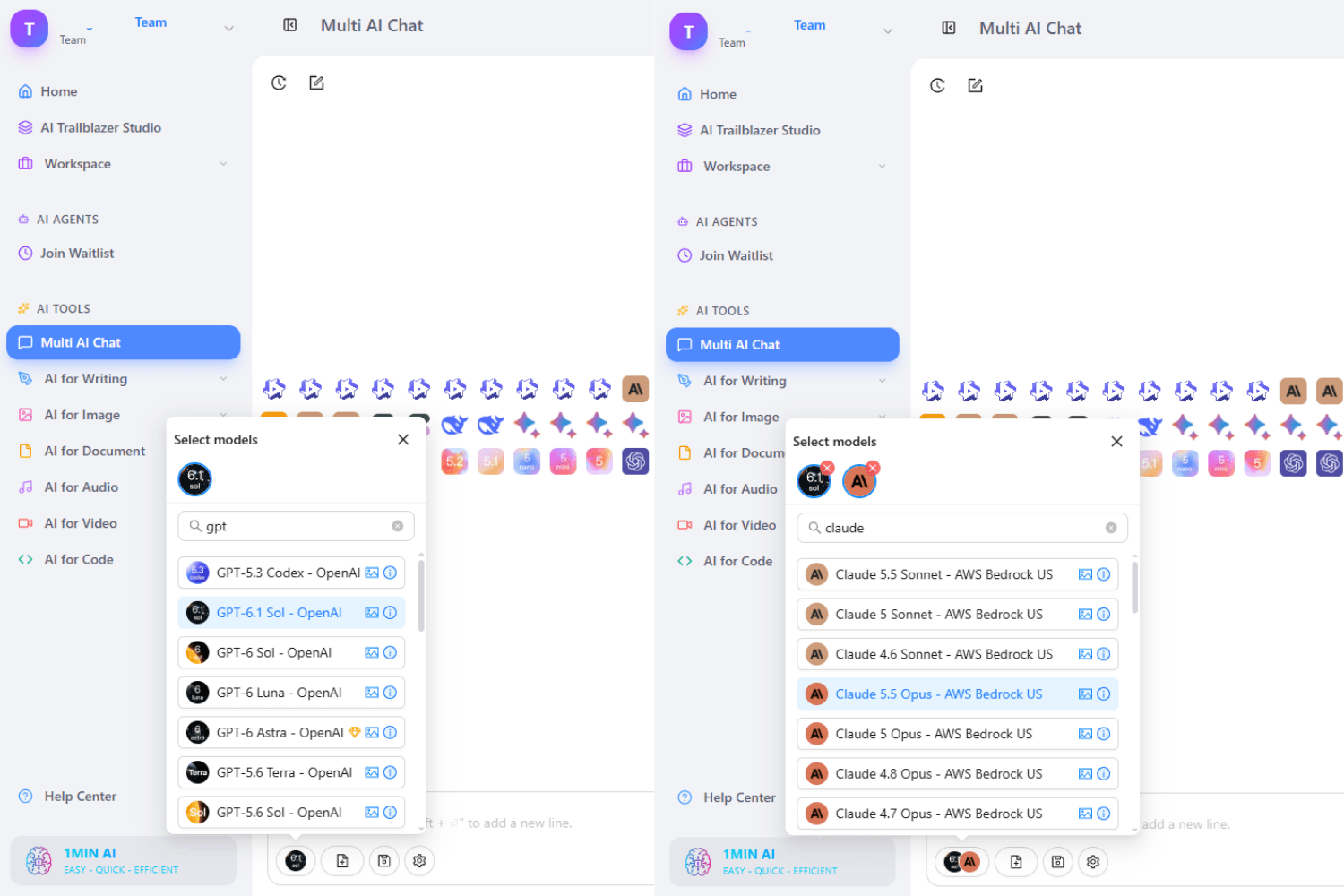
You do not need separate tools to settle the sol 6.1 vs opus 5.5 question. Both models are ready in one place:
- Open Multi AI Chat in 1min.AI.
- Select GPT-6.1 Sol and paste a real prompt from your work, such as a bug report, a contract clause or a feature spec.
- Switch to Claude Opus 5.5 and send the identical prompt.
- Compare accuracy, tone, speed and how much editing each answer needs.
Both models also work in Content Generator, Rewriter, Summarizer, Grammar Checker, Document Translator, Presentation Generator and Code Generator, so you can test them on the exact task you care about.
FAQs
Is GPT Sol better than Opus?
It depends on the job. Opus 5.5 scores higher on intelligence, coding and industry benchmarks. GPT-6.1 Sol completes each task at a much lower cost and is praised for debugging and review.
How much cheaper is GPT-6.1 Sol than Opus 5.5?
Its API rates are half ($2 / $10 vs $4 / $20 per 1M tokens). Per task at max effort, Sol averages $0.72 against $5.98 for Opus 5.5.
Which is better for coding, Opus 5.5 or GPT 6.1 Sol?
Opus 5.5 has the higher coding score (82.7 vs 71.0 on BenchLM) and is favored for architecture and UI. Sol is favored for debugging and code review.
Which model is faster?
Opus 5.5 generates text faster (96 vs 55 tokens per second at max effort). Sol returns its first token sooner at the same effort levels.
Can I use both models in one place?
Yes. In 1min.AI you can run the same prompt on both models in Multi AI Chat and compare the results.
Data sources: Artificial Analysis, BenchLM, official OpenAI and Anthropic model documentation, and community discussion on r/codex.
- #Commerce
Alternatives
Discover the best alternatives to 1minAI and compare features, pricing, and use cases.

1min.AI vs OpenRouter
1min.AI vs. OpenRouter: Compare the ready-to-use AI creation product against the technical API tool. Find out if you need a zero-code creative studio or a coding infrastructure hub.
 Ngoc Hong

1min.AI vs. Hootsuite: Which Social Media Tool Fits Your Workflow?
Compare 1min.AI vs. Hootsuite to explore their AI content creation, social media publishing, analytics, pricing, and collaboration features. Find the right tool for your workflow.
 Uyen Hoang

1min AI vs Buffer
Compare 1min.AI vs Buffer for Facebook content creation, AI writing, image generation, scheduling, pricing, and everyday marketing workflows.
Ngoc HongAI Tools
Discover the best AI tools to boost productivity, creativity, and everyday work.
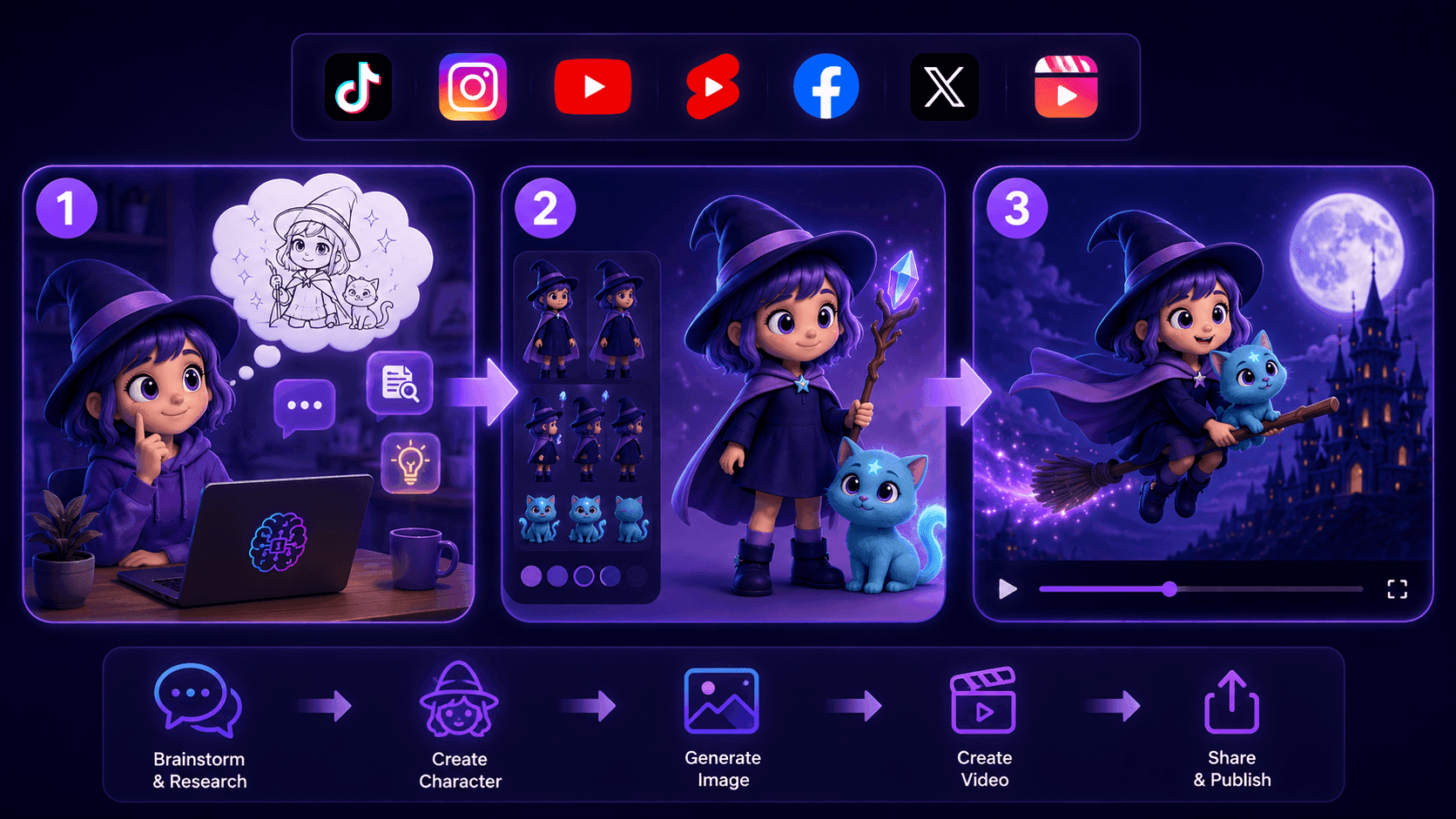
Create Consistent Cartoon Content in Just a Few Steps
Create engaging cartoon videos for TikTok and Reels with 1min.AI. Research ideas, create characters, and turn images into animated videos in 3 simple steps.
 Lien Anh Vu
One Product, 10 UGC Creatives: How AI Makes Content Testing Easier
Create more authentic UGC with an AI UGC video generator, test more creative angles and scale affiliate content without filming every version.
Lien Anh Vu
Top 4 Affordable AI Tools for Startup Founders
Discover the top 4 affordable AI tools for startup founders to validate ideas, build products, create content, and launch faster without overspending.
 Tram Ta
AI Features
Comprehensive AI features that streamline workflows, improve efficiency, and empower teams to achieve more.
Create Consistent Cartoon Content in Just a Few Steps
Create engaging cartoon videos for TikTok and Reels with 1min.AI. Research ideas, create characters, and turn images into animated videos in 3 simple steps.
Lien Anh VuOne Product, 10 UGC Creatives: How AI Makes Content Testing Easier
Create more authentic UGC with an AI UGC video generator, test more creative angles and scale affiliate content without filming every version.
Lien Anh Vu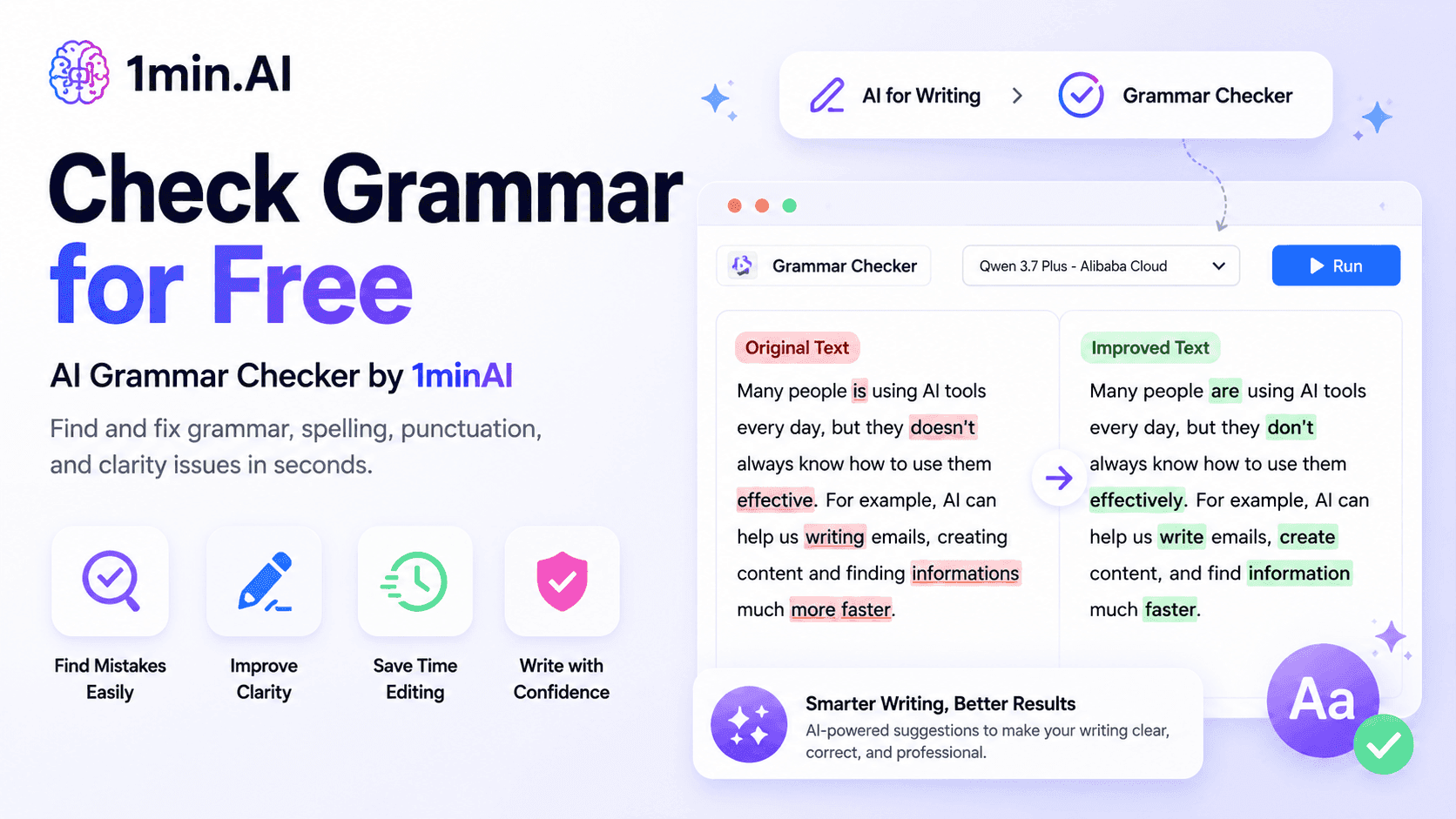
1minAI: Free AI Grammar Checker
Check grammar for free with 1minAI’s AI grammar checker. Find grammar, spelling, and writing mistakes, improve clarity, and polish your content in seconds.
Tram TaAI Use Cases
A curated collection of AI use cases for business, productivity, and industry-specific applications.
Create Consistent Cartoon Content in Just a Few Steps
Create engaging cartoon videos for TikTok and Reels with 1min.AI. Research ideas, create characters, and turn images into animated videos in 3 simple steps.
Lien Anh VuOne Product, 10 UGC Creatives: How AI Makes Content Testing Easier
Create more authentic UGC with an AI UGC video generator, test more creative angles and scale affiliate content without filming every version.
Lien Anh Vu
Best Time to Post on Instagram: A Practical Guide for Better Engagement
Discover the best time to post on Instagram, including the best days and times for different audiences, plus tips to find the ideal posting schedule for your account.
Tram TaAI Tutorials
Learn how to use AI with practical, step-by-step tutorials.

Black Friday AI Tool Deals in 2026
Discover what Black Friday AI tool deals 2026 has to offer. Find out how to secure the 1min.AI lifetime deal via AppSumo, Dealify, Stack Social, and verify on Trustpilot, Slashdot, and Software Advice.
 Hang Nguyen
Create Consistent Cartoon Content in Just a Few Steps
Create engaging cartoon videos for TikTok and Reels with 1min.AI. Research ideas, create characters, and turn images into animated videos in 3 simple steps.
Lien Anh Vu
[Seedance 2.5 New] Better AI Product Videos, Less Rework in 1min.AI
Use Seedance 2.5 image to video on 1min.AI to create more consistent AI product videos, reduce failed generations, save credits, and improve UGC workflows.
Lien Anh VuAI Guides
Learn AI faster with practical guides, real-world examples, and actionable best practices.

Safely Buy AI Tools Online: 2026 Black Friday Guide
Discover how to find and secure the best Black Friday AI deals online. Learn expert strategies to avoid scams, combat subscription fatigue, and verify software.
Hang NguyenCreate Consistent Cartoon Content in Just a Few Steps
Create engaging cartoon videos for TikTok and Reels with 1min.AI. Research ideas, create characters, and turn images into animated videos in 3 simple steps.
Lien Anh Vu[Seedance 2.5 New] Better AI Product Videos, Less Rework in 1min.AI
Use Seedance 2.5 image to video on 1min.AI to create more consistent AI product videos, reduce failed generations, save credits, and improve UGC workflows.
Lien Anh VuAI Solutions
Browse the best AI solutions for automation, coding, research, productivity, customer support, marketing, and business workflows.
Safely Buy AI Tools Online: 2026 Black Friday Guide
Discover how to find and secure the best Black Friday AI deals online. Learn expert strategies to avoid scams, combat subscription fatigue, and verify software.
Hang NguyenCreate Consistent Cartoon Content in Just a Few Steps
Create engaging cartoon videos for TikTok and Reels with 1min.AI. Research ideas, create characters, and turn images into animated videos in 3 simple steps.
Lien Anh VuOne Product, 10 UGC Creatives: How AI Makes Content Testing Easier
Create more authentic UGC with an AI UGC video generator, test more creative angles and scale affiliate content without filming every version.
Lien Anh VuAI Models
Explore the world's leading AI models in one place.
Create Consistent Cartoon Content in Just a Few Steps
Create engaging cartoon videos for TikTok and Reels with 1min.AI. Research ideas, create characters, and turn images into animated videos in 3 simple steps.
Lien Anh VuOne Product, 10 UGC Creatives: How AI Makes Content Testing Easier
Create more authentic UGC with an AI UGC video generator, test more creative angles and scale affiliate content without filming every version.
Lien Anh Vu[Seedance 2.5 New] Better AI Product Videos, Less Rework in 1min.AI
Use Seedance 2.5 image to video on 1min.AI to create more consistent AI product videos, reduce failed generations, save credits, and improve UGC workflows.
Lien Anh VuAI Comparisons
Compare AI tools, models, and platforms to find the best fit for your needs.
Kling AI Vs Veo 3: Which Model Wins?
Kling AI vs Veo 3: compare motion, native audio, pricing & free tiers to see which AI video generator wins for your project - try both on 1min.AI.
 Trang Tran
[Seedance 2.5 New] Better AI Product Videos, Less Rework in 1min.AI
Use Seedance 2.5 image to video on 1min.AI to create more consistent AI product videos, reduce failed generations, save credits, and improve UGC workflows.
Lien Anh Vu
DeepSeek V4 Pro vs Flash Comparison
Compare DeepSeek V4 Pro vs DeepSeek V4 Flash metrics. Optimize your agentic apps and improve AI fact checking on 1min.ai today.
Ngoc HongAI Integrations
Seamlessly integrate AI with the tools you already use to automate work and boost productivity.

POV: You Have 10+ Posts to Make Every Day
Learn how to build an AI content workflow that helps content creators produce 10+ social media posts a day faster with AI brainstorming, image generation, and content creation.
Lien Anh Vu
How to Use an AI Fashion Video Generator for Fashion Week 2026
Turn Fashion Week 2026 ideas into stunning fashion videos with AI. Learn how to brainstorm, create visuals, and transform images into videos with one simple workflow.
Lien Anh Vu
Stop Switching Between AI Apps: How AI Integration Transforms Employer Branding
Discover how AI integration helps HR teams streamline employer branding by combining AI writing, documents, images, video, and multiple AI models into one workspace.
Tram TaAI for Industries
Find the best AI tools and workflows for healthcare, finance, education, legal, manufacturing, retail, real estate, and more

Voice Cloning AI Free: How to Clone Any Voice Online in Minutes
Try voice cloning AI free with 1min.AI. Upload a 5-second clip, pick an ElevenLabs model, choose from 32 languages, and turn text to speech in your own voice.
Trang Tran
Text To Video AI Free Without Watermark Online
Create text to video AI free without watermark online with 1min.AI. Pick top models, turn prompts into HD clips, and download clean videos fast. Try it free.
Trang Tran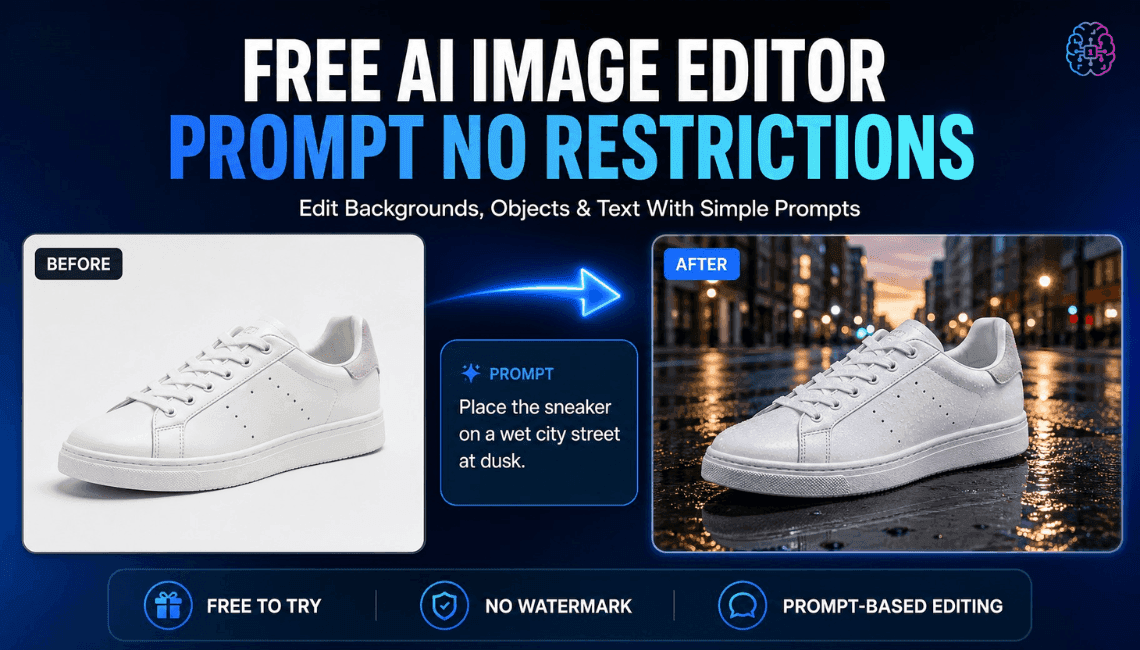
Free AI Image Editor With Prompt No Restrictions
Looking for a free AI image editor with prompt no restrictions? Edit backgrounds, objects and text by typing, no watermark. Try 1min.AI’s flexible editor now.
Trang TranAI Agents
Discover and run AI agents to automate tasks across your work and daily life.
1minAI: Free AI Grammar Checker
Check grammar for free with 1minAI’s AI grammar checker. Find grammar, spelling, and writing mistakes, improve clarity, and polish your content in seconds.
Tram Ta
AI Agents for Facebook
Use an AI Agent for Facebook to create content, generate images, schedule posts, and publish from your documents and conversations.
Ngoc Hong
AI Agent vs AI Assistant: Which One Actually Saves Designers More Time?
Learn the difference between AI Agent vs AI Assistant and discover which solution helps designers automate repetitive work, reduce revisions, and save more time.
Lien Anh VuAI Workflows
Explore ready-to-use AI workflows for productivity, marketing, sales, support, and more.
Create Consistent Cartoon Content in Just a Few Steps
Create engaging cartoon videos for TikTok and Reels with 1min.AI. Research ideas, create characters, and turn images into animated videos in 3 simple steps.
Lien Anh VuOne Product, 10 UGC Creatives: How AI Makes Content Testing Easier
Create more authentic UGC with an AI UGC video generator, test more creative angles and scale affiliate content without filming every version.
Lien Anh VuPOV: You Have 10+ Posts to Make Every Day
Learn how to build an AI content workflow that helps content creators produce 10+ social media posts a day faster with AI brainstorming, image generation, and content creation.
Lien Anh VuNewsletter
Weekly AI Innovations with 1minAI
🔮 Weekly AI Innovations #145: X Content Agent & GPT 6.1 Terra on 1min.ai
Scale viral reach with the X Content Agent on 1min.ai. Discover an end-to-end 4-stage pipeline with zero token burn, plus the launch of GPT 6.1 Terra.
Hang Nguyen
🔮 Weekly AI Innovations #144: LinkedIn Content Agent: Complete B2B Publishing Pipeline
Scale B2B influence with the LinkedIn Content Agent on 1min.ai. Discover an end-to-end 4-stage pipeline with zero redundant token burn and 1-click publishing.
Hang Nguyen
🔮 Weekly AI Innovations #143: Update GPT-6, GPT-6.1 & Ideogram 4.0
Access GPT-6 Sol, Luna, GPT-6.1 Sol, and Ideogram 4.0 on 1min.ai. Boost typography accuracy to 98.4% and cut reasoning latency by 45% in one platform.
Hang Nguyen